
BuddhistCatholicContemplativeEvangelicalGeneral ChristianHinduJewishLatter-day SaintMuslimNew VisionsProgressive Christian
Beliefs
- Buddhist
- Catholic
- Contemplative
- Evangelical
- General Christian
- Hindu
- Jewish
- Latter-day Saint
- More Voices
- Muslim
- New Visions
- Pagan
- Progressive Christian
Topics
- Religion News
- Food and Religion
- Sports and Religion
- Religious Art
- Religious Music and Entertainment
- Religious Events
- History and Religion
- Style and Religion
- Politics and Religion
- Women in Religion
- Recreation Outdoors and Religion
- Business Finance and Religion
- Careers Workplace and Religion
- Education and Religion
- Family Parenting and Religion
- Health Fitness and Religion
- Home and Religion
- Relationships and Religion
- Technology and Religion
- Travel and Religion
Columnists
- Buddhist Columnists
- Business Finance and Religion Columnists
- Careers Workplace and Religion Columnists
- Catholic Columnists
- Contemplative Columnists
- Education and Religion Columnists
- Evangelists Columnists
- Family Parenting and Religion Columnists
- General Christian Columnists
- Health Fitness and Religion Columnists
- Hindu Columnists
- History and Religion Columnists
- Home and Religion Columnists
- Jewish Columnists
- More Voices Columnists
- Latter Day Columnists
- Muslim Columnists
- New Visions Columnists
- Nonreligious Columnists
- Pagan Columnists
- Politics and Religion Columnists
- Progressive Columnists
- Recreation Outdoors and Religion Columnists
- Relationships and Religion Columnists
- Religion News Columnists
- Religious Art Columnists
- Religious Events Columnists
- Religious Music and Entertainment Columnists
- Sports and Religion Columnists
- Style and Religion Columnists
- Technology and Religion Columnists
- Travel and Religion Columnists
- Women in Religion Columnists
Resource Library
- 2026 Calendar
- Library of World Religions
- The 100 Most Holy Places on Earth
- Patheos Answers
- Podcasts
- Videos
- Faith Leaders Database
- Anglican Episcopalian
- Bahai
- Baptist
- Buddhism
- Christianity
- Confucianism
- Eastern Orthodoxy
- Hinduism
- Holiness and Pentecostal
- ISKCON
- Islam
- Judaism
- Lutheran
- Methodist
- The Church of Jesus Christ of Latter-day Saints
- New Age
- Paganism
- Presbytarian and Reformed
- Protestantism
- Religion Behind the Scenes
- Roman Catholic
- Scientology
- Shia Islam
- Sikhism
- Sufism
- Sunni Islam
- Taoism
- Zen
- See all religions
Research Tools
 Ad-Free & Subscriber Log-In Subscription Support
Ad-Free & Subscriber Log-In Subscription Support
Follow Patheos 

- Trending:
- Forgiveness
- |
- Marriage
- |
- Consciousness
- |
- Death Penalty
- |
- Election
- |
- Halloween

- Home
- Latter-day Saint
- In Case You Missed Church
In Case You Missed Church
Last updated on: July 13, 2017 at 9:15 am by Margaret Blair Young
In Case You Missed Church 2017-07-13T09:15:13-07:00 Margaret Blair Young
Patheos Explore the world's faith through different perspectives on religion and spirituality! Patheos has the views of the prevalent religions and spiritualities of the world.

My dad, restored to youth
Well, most of you are in the USA, and it’s early morning there, so you haven’t missed church YET. But just in case you do, or in case you’re sick, this is my gift.
I didn’t get to go to church today, so I chose my own worship service. It was great. My late father gave the sermon and taught the Gospel Doctrine class. Here is what he said. It’s the devotional he presented at Brigham Young University in 1998. In it, he mostly tells stories–after an impressive introduction by a BYU administrator. As I listen to this one hour from 1998 which was preserved via recording, I find a sharp contrast between the introduction and Dad’s actual talk. Don’t you?
The introduction lists my dad’s accomplishments, his many books, the languages he studied, the scholarly contributions he made. And it is pretty much irrelevant. It’s like other introductions I’ve heard and even received, full of citations, lists of accomplishments, names of awards. But when Dad starts talking after that pregnant intro, he speaks simply. He is the man of stories. How bold it was of him to present himself so meekly at an academic citadel! I did not immediately appreciate what he had done. My inner reaction was, “Wow, Dad. You told stories. Wow. Don’t people already know those stories, though?”
Oh, I loved his devotional, but I did not realize how powerful his talk actually was, how and why it would come back to me over and over for the next nearly twenty years. As we sat next to Dad’s hospital while he slept after some surgery, I pulled the talk up on my computer. I started it. There was Dad’s voice, captured in a computer while he slept. I was quite aware that our time with him present was limited. Unbeknownst to me, we would live through many false alarms, and he would endure for three more years. I would learn to care for him at dialysis, and would learn to recognize the signs of him fainting–though the first time was terrifying, and I yelled, “Dad? Dad? Dad?” Eventually, I didn’t yell, but called him gently back to the moment. Finally, on February 19th, 2016, he died in his sleep. I was in his home with my mother, as we had gone into twenty-four-hour care. His death, or my realizing that he had actually died, will always be vivid in my mind–the nurse beckoning me into the room with the words, “Hurry!” Her words: “There is no pulse. What do you want me to do?” My words: “We have a DNR.” There was a bit of foam on his upper lip, and we cleaned that up before going to my mother’s room and telling her. That death is one of my life’s stories.
In the weeks following it, I brought the devotional back to my computer, cherishing that voice.
Listen to him. He speaks simply, employs adjectives only as needed, uses dialogue. He is setting a scene for us, inviting our imagination. (If you don’t know how to access it, look above. Click on the word HERE and the link will be provided. On you can click on this HERE and it’ll come up. I am speaking to people my age now.)
This is what I hear, in Africa, as it becomes my worship service:
King Midas, as Dad tells it:
In a panic, Midas fell to his knees and cried out, “No! No! Oh, what have I done? God, forgive me! In my lust for gold I have destroyed my own daughter.”
Just then the immortal visitor appeared again before him.
“Midas, you are weeping. What has happened?”
“Oh, immortal visitor, I am of all men most miserable.”

“Is it that I did not keep the promise I made you?”
“No, you granted me my wish. Whatever I touch turns to gold.”
“You told me that that power would bring you happiness, but now you tell me you are of all men most miserable. How can this be?”
“Oh, I didn’t realize how evil my selfish wish was. My lust for gold has robbed me forever of happiness.”
“But, Midas, is not gold the most beautiful thing in all the world?”
“I detest the very sight of it.”
“Tell me, is not gold the most valuable thing in all the world?”
“Immortal visitor, tell me wherein gold has its value.”
“Well, surely it is more valuable than a cup of tea, is it not?”
“No. A cup of tea is of more worth than all the gold I possess.”
“Surely gold is more valuable than a piece of fruit, do you not agree?”
“No. A piece of fruit is of more worth than all the gold I possess.”
“Is gold not more valuable than a daughter’s love?”
“Oh, immortal stranger, you don’t understand. I have come to see that the common things of life: our children, our friends, even the ordinary things we see and touch every day, these are our real treasures.”
Seeing that the king’s sorrow was genuine, the immortal visitor took pity on him and said, “Would you have me remove the power I gave you, and let you restore your daughter’s life?”
“Oh, noble stranger, do this and I will give you all my gold.”
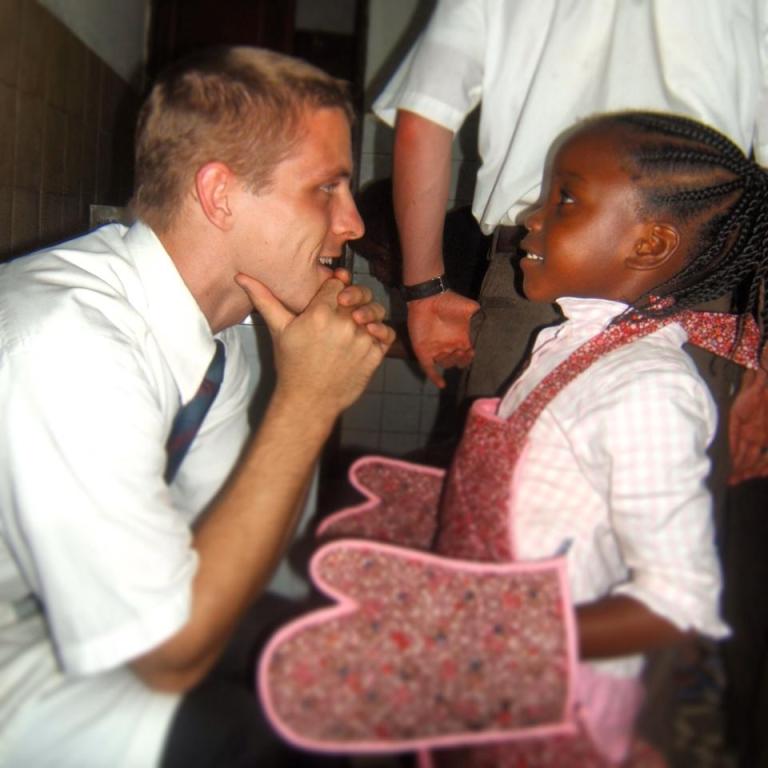
In the Congo and throughout Africa, there are many like King Midas, willing to give up everything of real worth in order to have gold or other symbols of wealth. (Of course, the gold itself is not wealth and becomes wealth only as it is so perceived.) However, they do not offer their own food, but the food of the needy. They do not turn their own children to gold, but with a mere touch of the hand, paralyze or kill the children of others. Nonetheless, the story of King Midas teaches us that such behavior cannot go unanswered. Eventually, these leaders are either defeated by one who recognizes that the children of one are the responsibility of all, or the leader himself repents. (Of course, new leaders are assaulted by the same temptations and deceptions as were those who came before. We do not know how Patrice Lumumba would have governed, since he was assassinated so soon after his rise, but we know what happened to his successor, Mobutu. He started off relatively well, honoring education and providing for university students. Within twenty years, though, some of his counselors had persuaded him that this rising class of intelligentsia would overpower him with their new understanding. Mobutu, already in the habit of killing anyone who might overthrow him, started having them executed. They had been his most favored sons, but the threat to his power and wealth overcame any loyalty to them. He was the tyrant at the top of a kleptocracy and these, his children, were metaphorically turned into gold.
Other leaders arose, but the custom of corruption was set. I once asked a former ambassador to the DR-Congo if there were any in the government who was not corrupt. It was like asking if there were any in Sodom who could be spared because of righteousness. The ambassador pondered it, and I could see him going through the names in his mind. Finally, he shook his head. “No.”
The Prodigal Son
The next story my dad tells is of the Prodigal. Again, the dialogue is simple and evocative.
Suddenly he saw the figure of a young man approaching. His heart jumped. The boy’s clothes weren’t recognizable. They were tattered and dirty. The boy was limping. His hair was long and disheveled. But the father recognized his son, and his heart filled with compassion. Johnny had come home! He ran joyously to meet his son and threw himself on his neck and kissed him. “Johnny, my son, you’ve come back!”
But the son said to his father, “Father, I have sinned against God.”
“Yes, Johnny, I know.”
“I have sinned before you, Father.”
“Yes, my son, I know.”
“Oh, I am ashamed, Father. I am no longer worthy to be called your son.”
“Johnny, my son, my son. How terribly you must have suffered.”
The father called to his servants: “Bring clean clothes and dress my son. Put shoes on his feet. Put this ring back on his finger. Come, let us celebrate. For this my son was lost but now is found. This my son was dead but has returned to life.”
In this story, I see not the African as the one who has sought worldly diversions rather than a life aligned with God and family. I see the privileged, the elite of any culture. Because I am a Latter-day Saint, I see US Mormons as those who have often been distracted by wealth, useless or redundant conversations, gossip, and the careful ignoring of those who need what we can offer. By “what we can offer,” I go beyond the gospel as defined in missionary lessons, and directly to our actual instructions to care for the poor, the widowed, the imprisoned, the lost.
Here, I reverse some of the images, and re-frame the story:
 Suddenly, he saw the figure of a young man approaching. His heart jumped. The boy’s clothes weren’t recognizable. They were silk and satin. But he had no servant with him. He was walking alone, though he looked like one who would always be accompanied by “lesser” men, those who would fetch his water and his meals. The boy was limping. No surprise. Surely he was unaccustomed to walking on his feet rather than being carried in a grand carriage or chariot. His hair was wrapped in a dingy turban, which suggested the length of the journey. But the father recognized his son, and his heart filled with compassion. Johnny had come home! He ran joyously to meet his son and threw himself on his neck and kissed him. “Johnny, my son, you’ve come back!”
But the son said to his father, “Father–you don’t realize.”
“My boy. You are tired. Let’s go inside?”
“Not yet. Let’s just sit.”
And they did, on tree stumps cut for that purpose.
“Go on,” said the father.
“I’ve done a lot of things. Good things, some. I’ve followed good causes. I spoke at some rallies, and I got a little bit famous–which is what I wanted. What I thought I wanted.”
“I know, Johnny. We heard of what you were doing. You cared for many.”
“At first. Then I was only imitating it. It was my own reflection I wanted.”
“Ah.”
“I loved seeing my face on posters.”
“It’s a good face.”
“And people asked me to sign my name. I didn’t realize how magnetic my own name could be.”
“We gave you a good name.”
“But it was your name, and I signed it as if I owned it, as if it stood without its roots.”
“That’s an easy snare.”
“Somehow, I lost track of God.”
“And that, too, is easy.”
“Here–right here, I always felt that God was nearby, watching me, comforting me, magnifying everything I did. I haven’t sensed God since I left. “
“Why do you laugh, Son?”
“It’s so strange. I have headed so many campaigns. I got rich. In the end, my efforts were small, though. When I look back on them, I see how few changes came because of anything I did. My own strength is paltry. Here, God made my every effort magnificent. I have come home to find God again.”
“You must be hungry.”
“I have sinned greatly.”
“Yes, Johnny, I know.”
“I have sinned against you. I abandoned you in my pursuit of–of everything.”
“Yes, my son, I know.”
“I am ashamed. I am no longer worthy to be called your son.”
“Oh my son, how terribly you must have suffered!”
“You think of my suffering? Of course you do. That has always been your way.”
“It only matters that you are here now.”
“What would you have me do?”
“You already know that. You have already done that. You’re here. You must be thirsty.”
From inside his old home, Johnny could hear his mother sing. He had not heard that song in so many years–or had he? Wasn’t it just on the edge of his sleep every night? Wasn’t it somehow in every river and every leaf?
“The Lord bless you and keep you. The Lord make His face to shine upon you, and give you peace.”
And then his mother was there, smiling. In her hands were a dipper of water and a cup.
Painting by J. Kirk Richards, used with his perpetual permission

The final story Dad tells is Joseph and his Brothers. But that one deserves its own post.
Previous Post

July 7, 2017
That is for Rich People! Don't you realize you're poor? (Part 2)
Next Post
July 14, 2017 That's for Rich People. Don't You Realize You're Poor? (Part 3)
Browse Our Archives
Select a Category Ancestors family conflict in the scriptures race and religion Uncategorized
Select a Month August 2026 March 2026 January 2026 December 2025 November 2025 October 2025 September 2025 July 2025 April 2025 March 2025 January 2025 November 2024 May 2024 April 2024 November 2023 October 2023 September 2023 June 2023 September 2022 August 2022 July 2022 May 2022 April 2022 March 2022 January 2022 December 2021 October 2021 September 2021 July 2021 June 2021 October 2020 August 2020 July 2020 June 2020 March 2020 January 2020 December 2019 November 2019 October 2019 June 2019 January 2019 December 2018 November 2018 September 2018 August 2018 May 2018 March 2018 January 2018 November 2017 October 2017 August 2017 July 2017 June 2017 May 2017 March 2017 February 2017 November 2016 October 2016 August 2016 July 2016 June 2016 May 2016 April 2016 March 2016 February 2016 January 2016 November 2015 August 2015 July 2015 May 2015 April 2015 March 2015 February 2015 January 2015 December 2014 November 2014 October 2014 August 2014 July 2014 June 2014 May 2014 April 2014 March 2014 February 2014 January 2014 December 2013 November 2013 October 2013 September 2013 August 2013 July 2013 June 2013 May 2013 April 2013 March 2013 February 2013 January 2013 December 2012
Follow Us!
TAKE THE
Religious Wisdom Quiz
What does the Bible warn about "idle chatter"?
Select your answer to see how you score.
Is entertaining Is educational Leads to poverty Is holy
Related posts from The Welcome Table
Questions for Any LDS Utah Judge (including Bishops)

Giving Machines: Easy as Buying a Candy Bar


TRENDING AT PATHEOS Latter-day Saint

Did Prayer Cure His Cancer? Or Was It...
At 4 AM one morning, Joshua W. Brown’s wife awoke to a...

8 Ways a Near-Death Experience Rewires the Soul
Does Consciousness Survive Physical Death? After 50 Years of Research, Dr. Raymond...

Holy Longing: What Our Restlessness Is Telling Us
“One can find so many pains when the rain is falling.” -John...

What this is NOT about. This blog is definitely not about...

Who said the Israelites were God’s chosen? That’s right, they did. Who...

The Spirit World Is the Real World: God...
A Monk’s Wisdom on Body and Spirit I sit with Brother Martin...
view all Latter-day Saint blogs
Ad-Free & Subscriber Log-In Subscription Support
- About Us
- 2026 Calendar
- Videos
- Podcasts
- Library of World Religions
- Faith In Media Tracker
- Advertise With Us
- Write for Us
- Privacy Policy
- Terms of Service
- Do Not Sell My Data
- Contact Us
- Radiant Digital
- Manage Newsletter Subscriptions
- Unsubscribe From Notifications
- Sitemap
Copyright 2008-2026, Patheos. All rights reserved.
Subscription Support Ad-Free & Subscriber Log-In
Follow Patheos