
BuddhistCatholicContemplativeEvangelicalGeneral ChristianHinduJewishLatter-day SaintMuslimNew VisionsProgressive Christian
Beliefs
- Buddhist
- Catholic
- Contemplative
- Evangelical
- General Christian
- Hindu
- Jewish
- Latter-day Saint
- More Voices
- Muslim
- New Visions
- Pagan
- Progressive Christian
Topics
- Religion News
- Food and Religion
- Sports and Religion
- Religious Art
- Religious Music and Entertainment
- Religious Events
- History and Religion
- Style and Religion
- Politics and Religion
- Women in Religion
- Recreation Outdoors and Religion
- Business Finance and Religion
- Careers Workplace and Religion
- Education and Religion
- Family Parenting and Religion
- Health Fitness and Religion
- Home and Religion
- Relationships and Religion
- Technology and Religion
- Travel and Religion
Columnists
- Buddhist Columnists
- Business Finance and Religion Columnists
- Careers Workplace and Religion Columnists
- Catholic Columnists
- Contemplative Columnists
- Education and Religion Columnists
- Evangelists Columnists
- Family Parenting and Religion Columnists
- General Christian Columnists
- Health Fitness and Religion Columnists
- Hindu Columnists
- History and Religion Columnists
- Home and Religion Columnists
- Jewish Columnists
- More Voices Columnists
- Latter Day Columnists
- Muslim Columnists
- New Visions Columnists
- Nonreligious Columnists
- Pagan Columnists
- Politics and Religion Columnists
- Progressive Columnists
- Recreation Outdoors and Religion Columnists
- Relationships and Religion Columnists
- Religion News Columnists
- Religious Art Columnists
- Religious Events Columnists
- Religious Music and Entertainment Columnists
- Sports and Religion Columnists
- Style and Religion Columnists
- Technology and Religion Columnists
- Travel and Religion Columnists
- Women in Religion Columnists
Resource Library
- 2026 Calendar
- Library of World Religions
- The 100 Most Holy Places on Earth
- Patheos Answers
- Podcasts
- Videos
- Faith Leaders Database
- Anglican Episcopalian
- Bahai
- Baptist
- Buddhism
- Christianity
- Confucianism
- Eastern Orthodoxy
- Hinduism
- Holiness and Pentecostal
- ISKCON
- Islam
- Judaism
- Lutheran
- Methodist
- The Church of Jesus Christ of Latter-day Saints
- New Age
- Paganism
- Presbytarian and Reformed
- Protestantism
- Religion Behind the Scenes
- Roman Catholic
- Scientology
- Shia Islam
- Sikhism
- Sufism
- Sunni Islam
- Taoism
- Zen
- See all religions
Research Tools
 Ad-Free & Subscriber Log-In Subscription Support
Ad-Free & Subscriber Log-In Subscription Support
Follow Patheos 

- Trending:
- Forgiveness
- |
- Marriage
- |
- Consciousness
- |
- Death Penalty
- |
- Election
- |
- Halloween

- Home
- Latter-day Saint
- Salvador: The Truth behind the Fiction, Part 3
Salvador: The Truth behind the Fiction, Part 3
Last updated on: May 12, 2016 at 7:34 am by Margaret Blair Young
Salvador: The Truth behind the Fiction, Part 3 2016-05-12T07:34:13-07:00 Margaret Blair Young
Patheos Explore the world's faith through different perspectives on religion and spirituality! Patheos has the views of the prevalent religions and spiritualities of the world.
 I beseech you, in the bowels of Christ, think it possible you may be mistaken. (Oliver Cromwell)
Daniel Choc was one of Dale Grover’s most ardent supporters, having lived on the plantation for two years, the beneficiary of Dale’s good work and training. He had returned to his home in Patzicia when I met him in 1975. He–the same age as the missionaries Dad was training to speak Cakchiquel–became Dad’s main assistant. Often, Daniel became an angelic voice whispering translations to the missionaries as they expressed themselves in Spanish. “Yo quiero chocolate,” a missionary would say, and Daniel would whisper into his ear, “Yin ninwajo chocolate.” “Dame el pan.” “Ta-ya chwe yin ri wey.”
Earlier, on Dale’s plantation, Daniel had been a diplomat and a peacemaker.
When disagreements had arisen between Dale and the mission president, Harvey Glade, Daniel had said, “If it’s only a misunderstanding, then let’s write letters!” He, with his third grade education, led the others in a letter-writing campaign. Dale also wrote a letter, which was not well-received.
I have no way of knowing what Dale’s letter said. I do know that he was determined to have his foundation be in partnership with the LDS Church, something the leaders resisted. As I have studied peacemaking, I am struck by how much each of us usually contributes to “disagreements.” This quote from The Anatomy of Peace, published by The Arbinger Institute, is instructive:
“The more sure I am that I’m right, the more likely I will actually be mistaken. My need to be right makes it more likely that I will be wrong! Likewise, the more sure I am that I am mistreated, the more likely I am to miss ways that I am mistreating others myself. My need for justification obscures the truth.”
I have focused my life to learning more about building peace, as I certainly was no expert during my Guatemala years. In fact, I had much in common with Dale in how I viewed the LDS Church and its leaders.
I suspect that Daniel’s life and my father’s support of Dale’s work influenced the mission president, who presided during the time we were first in Guatemala. President Robert Arnold made Dale the District President in the Coban area. From all appearances, Dale was an authorized agent of the Church, heroically offering “the good life” to hundreds of Kekchi Mayans.
After a few months of being Dad’s assistant, Daniel was called to be the first Cakchiquel Indian missionary. His family, along with the CujCuj family and others, had gone to the Mesa, Arizona temple to be sealed. 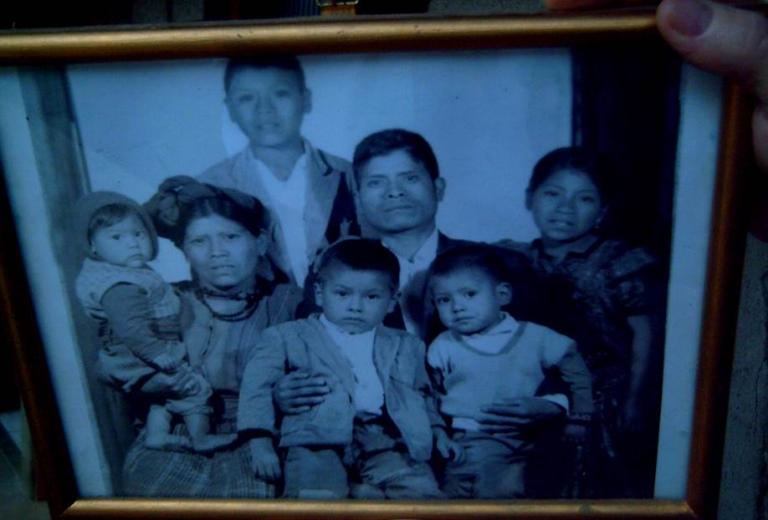
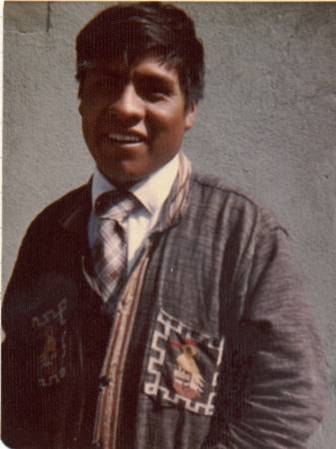
I can picture Daniel perfectly. He was joy personified-short, squat, and perpetually grinning. He laughed at the missionaries’ attempts to speak his language, but never mocked. And halfway through the training, Daniel received a call to serve as full time missionary. He would be the first Cakchiquel Mormon missionary. A new day had arrived, a day when the gospel would come not just from white Americans, but from one who knew the Cakchiquel people because he was one of them.
That was 1975. My family returned to Utah in May, moving from the mists and canyons and adobe huts of Guatemala to the mountains and well-wired condominiums of Provo.
The next February, around midnight, Guatemala was hit by an earthquake, the epicenter only a fifty miles from Patsun. Twenty-two thousand people-mostly Cakchiquel Indians perished as their adobe collapsed around and on top of them. Daniel Choc’s pregnant mother was among the fatalities, as were two of his siblings.
A month after the quake, Daniel and other Mormon missionaries were helping with the reconstruction of Patsun. He was taking down a wall when one of the missionaries yelled in English, “You guys, it’s going to fall! Get out of there!” Daniel stood still and then tried to get out of the door. It was too late. The wall came down on him. He died within fifteen minutes. One of the missionaries whom Dad had trained in Cakchiquel, Elder D. Warnock, took Daniel’s body, covered by a sheet, to his father, Pablo Choc, in Patzicia.
I received the news of Daniel’s death while living in Denver. Later that same year, 1976, I returned to Guatemala. I wanted to see Daniel’s grave and to visit Patsun, the place which had introduced me to Tomas Cujcuj. I flew to Guatema with a team of doctors, Dr. Dodge piloting the small plane through a lightning storm. I saw how intent his face was but didn’t realize at the time that lightning can bring a small plane down with one quick strike. I was oblivious about many things back then.
The doctors were on humanitarian missions (unofficial ones) doing oral surgery on children who had been born with cleft palates. They had a center in a place called Cunen, which was our first stop. I admired their work, but thought it paltry compared to Dale’s much wider vision–and I said so. A doctor’s wife chastised me soundly. I deserved it more than I knew.
My next stop was Patzicia, where Daniel was buried.
Many who had died the previous year in the quake had been buried in mass graves. Generally, the Cakchiqueles bury their dead in colorful crypts like thin mountains. The coffins are placed and cemented, one grave on top of another. It’s a highrise of death. Daniel’s grave, however, was set apart. The Church had donated money for this particular memorial. His grave, the size and shape of a refrigerator, was painted white and bore a headstone engraved with a gold-leafed Angel Moroni and a scriptur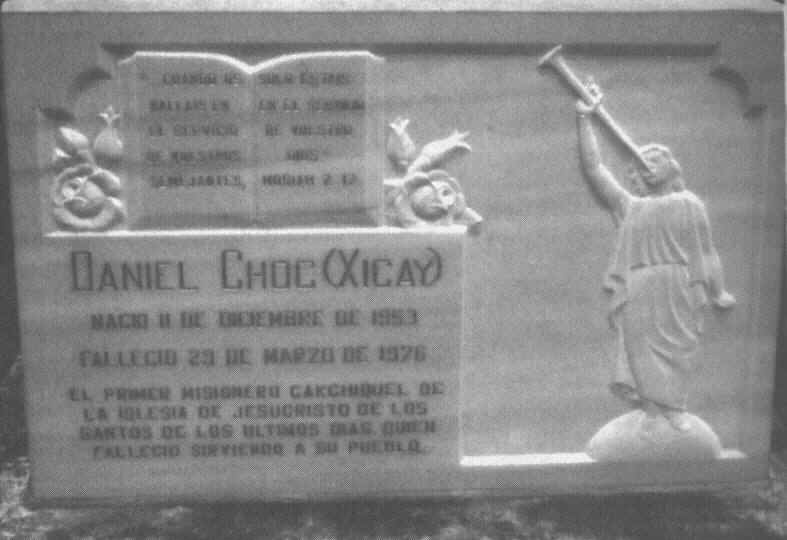 e: “Cuando os halláis en el servicio de vuestros semejantes, sólo estais en el servicio de vuestro Dios.” When ye are in the service of your fellow beings, ye are only in the service of your God. I think President Arnold probably selected that scripture.
When I returned to the devastated area (I could not locate any recognizable landmarks), Daniel’s grave was easy to find. I remember saying only three words when I looked at the grave: “Pues si, Hermano.” I could not imagine that one so full of life could have been stilled.
After visiting the grave, I decided I would live in Patsun, where our family had stayed the year before. There, I lived with a Cakchiquel family. I slept on a mat, ate in a hut, and learned how to clap out tortillas, Patsun style. My father thought it was a wonderful place for me to stay, and visited once, proudly stating, “You speak the worst Spanish I’ve ever heard. You sound just like an Indian.” It was true. I spoke Spanish with Cakchiquel grammar.
I could not stay with the family, however, because the father–the branch president–tried to seduce me. I spoke with two of the RMs whom Dad had taught, and they encouraged me to find different housing. I also thought the mission president should know. President Arnold had now been replaced by President O’Donnal. I had to travel to Quetzaltenango–several hours away–to see him. I already knew he was Dale’s nemesis. When I told him what had happened in Patsun, President O’Donnal said only, “You stay away from him.” It wasn’t the answer I expected to my revelation that the branch president had touched me inappropriately, and it verified my bad opinion of the new mission president.
I subsequently traveled to Dale’s place, where my father, with a man named Dean Black, was preparing for new projects: radio shows focused on literacy and health education. Couldn’t we, like Dale, affect hundreds?
Because I was with my father at the plantation, I was included on a trip to the city of Chulac. There, I witnessed the conversion of hundreds to Mormonism. And back at the plantation, I joined in the enthusiastic bashing of the mission president.
Forty years later, J.B., one of the missionaries who taught the Kekchi in Chulac, said to me, “I had forgotten that you were there [in Chulac] on the most important day of my mission.”
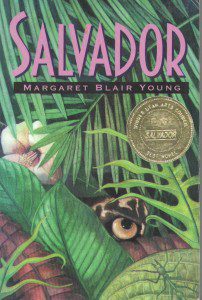
For some reason, I was at the right place and at the right time to live through details of the story I would later fictionalize in Salvador.
I left Guatemala earlier than I had planned, however. The mission president complained about me to the area authority, Elder Asay. He described me as hippie-like and one who took advantage of the members by living with them. I was then in Momostenango, having left the dangerous situation. I received a terse telegram from my father telling me that I needed to get home to the U.S. immediately. At the time, I was enraged, and so was my dad. I was not a missionary! How on earth could President O’Donnal presume to tell me what I could or could not do? Wasn’t he treating me just like he treated Dale?
In 2016, I completely understand President John O’Donnal’s perspective, and I honor him.
To be continued. . .
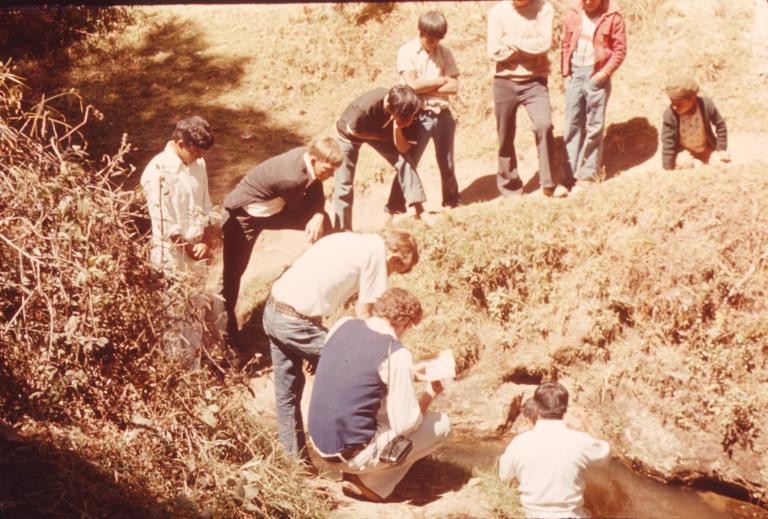 This photo shows Daniel Choc performing his final baptism, after the earthquake.
Previous Post

May 8, 2016
Mothers' Day Tribute--Nancy Young Layton
Next Post
May 16, 2016 Salvador: The Truth Behind the Fiction, Part 4
Browse Our Archives
Select a Category Ancestors family conflict in the scriptures race and religion Uncategorized
Select a Month August 2026 March 2026 January 2026 December 2025 November 2025 October 2025 September 2025 July 2025 April 2025 March 2025 January 2025 November 2024 May 2024 April 2024 November 2023 October 2023 September 2023 June 2023 September 2022 August 2022 July 2022 May 2022 April 2022 March 2022 January 2022 December 2021 October 2021 September 2021 July 2021 June 2021 October 2020 August 2020 July 2020 June 2020 March 2020 January 2020 December 2019 November 2019 October 2019 June 2019 January 2019 December 2018 November 2018 September 2018 August 2018 May 2018 March 2018 January 2018 November 2017 October 2017 August 2017 July 2017 June 2017 May 2017 March 2017 February 2017 November 2016 October 2016 August 2016 July 2016 June 2016 May 2016 April 2016 March 2016 February 2016 January 2016 November 2015 August 2015 July 2015 May 2015 April 2015 March 2015 February 2015 January 2015 December 2014 November 2014 October 2014 August 2014 July 2014 June 2014 May 2014 April 2014 March 2014 February 2014 January 2014 December 2013 November 2013 October 2013 September 2013 August 2013 July 2013 June 2013 May 2013 April 2013 March 2013 February 2013 January 2013 December 2012
Follow Us!
TAKE THE
Religious Wisdom Quiz
What did John see coming down from heaven in Revelation 21?
Select your answer to see how you score.
The New Jerusalem The four horsemen A chariot of fire The Ark of the Covenant
Related posts from The Welcome Table

Giving Machines: Easy as Buying a Candy Bar
TRENDING AT PATHEOS Latter-day Saint

Did Prayer Cure His Cancer? Or Was It...
At 4 AM one morning, Joshua W. Brown’s wife awoke to a...

8 Ways a Near-Death Experience Rewires the Soul
Does Consciousness Survive Physical Death? After 50 Years of Research, Dr. Raymond...

Holy Longing: What Our Restlessness Is Telling Us
“One can find so many pains when the rain is falling.” -John...

What this is NOT about. This blog is definitely not about...

Who said the Israelites were God’s chosen? That’s right, they did. Who...

The Spirit World Is the Real World: God...
A Monk’s Wisdom on Body and Spirit I sit with Brother Martin...
view all Latter-day Saint blogs
Ad-Free & Subscriber Log-In Subscription Support
- About Us
- 2026 Calendar
- Videos
- Podcasts
- Library of World Religions
- Faith In Media Tracker
- Advertise With Us
- Write for Us
- Privacy Policy
- Terms of Service
- Do Not Sell My Data
- Contact Us
- Radiant Digital
- Manage Newsletter Subscriptions
- Unsubscribe From Notifications
- Sitemap
Copyright 2008-2026, Patheos. All rights reserved.
Subscription Support Ad-Free & Subscriber Log-In
Follow Patheos