
BuddhistCatholicContemplativeEvangelicalGeneral ChristianHinduJewishLatter-day SaintMuslimNew VisionsProgressive Christian
Beliefs
- Buddhist
- Catholic
- Contemplative
- Evangelical
- General Christian
- Hindu
- Jewish
- Latter-day Saint
- More Voices
- Muslim
- New Visions
- Pagan
- Progressive Christian
Topics
- Religion News
- Food and Religion
- Sports and Religion
- Religious Art
- Religious Music and Entertainment
- Religious Events
- History and Religion
- Style and Religion
- Politics and Religion
- Women in Religion
- Recreation Outdoors and Religion
- Business Finance and Religion
- Careers Workplace and Religion
- Education and Religion
- Family Parenting and Religion
- Health Fitness and Religion
- Home and Religion
- Relationships and Religion
- Technology and Religion
- Travel and Religion
Columnists
- Buddhist Columnists
- Business Finance and Religion Columnists
- Careers Workplace and Religion Columnists
- Catholic Columnists
- Contemplative Columnists
- Education and Religion Columnists
- Evangelists Columnists
- Family Parenting and Religion Columnists
- General Christian Columnists
- Health Fitness and Religion Columnists
- Hindu Columnists
- History and Religion Columnists
- Home and Religion Columnists
- Jewish Columnists
- More Voices Columnists
- Latter Day Columnists
- Muslim Columnists
- New Visions Columnists
- Nonreligious Columnists
- Pagan Columnists
- Politics and Religion Columnists
- Progressive Columnists
- Recreation Outdoors and Religion Columnists
- Relationships and Religion Columnists
- Religion News Columnists
- Religious Art Columnists
- Religious Events Columnists
- Religious Music and Entertainment Columnists
- Sports and Religion Columnists
- Style and Religion Columnists
- Technology and Religion Columnists
- Travel and Religion Columnists
- Women in Religion Columnists
Resource Library
- 2026 Calendar
- Library of World Religions
- The 100 Most Holy Places on Earth
- Patheos Answers
- Podcasts
- Videos
- Faith Leaders Database
- Anglican Episcopalian
- Bahai
- Baptist
- Buddhism
- Christianity
- Confucianism
- Eastern Orthodoxy
- Hinduism
- Holiness and Pentecostal
- ISKCON
- Islam
- Judaism
- Lutheran
- Methodist
- The Church of Jesus Christ of Latter-day Saints
- New Age
- Paganism
- Presbytarian and Reformed
- Protestantism
- Religion Behind the Scenes
- Roman Catholic
- Scientology
- Shia Islam
- Sikhism
- Sufism
- Sunni Islam
- Taoism
- Zen
- See all religions
Research Tools
 Ad-Free & Subscriber Log-In Subscription Support
Ad-Free & Subscriber Log-In Subscription Support
Follow Patheos 

- Trending:
- Forgiveness
- |
- Marriage
- |
- Consciousness
- |
- Death Penalty
- |
- Election
- |
- Halloween

- Home
- Latter-day Saint
- Robert Blair: Mormon Scholars Testify
Robert Blair: Mormon Scholars Testify
Last updated on: April 18, 2016 at 7:47 pm by Margaret Blair Young
Robert Blair: Mormon Scholars Testify 2016-04-18T19:47:14-07:00 Margaret Blair Young
Patheos Explore the world's faith through different perspectives on religion and spirituality! Patheos has the views of the prevalent religions and spiritualities of the world.

A Linguist’s Perspective on Things Beyond Understanding
 I don’t think that the universe with its billions of galaxies, trillions of stars and planets, and a huge assortment of other objects and phenomena, together with the laws that govern their precise movements, came about by accident. Many scientists conjecture that it all came out of an infinitesimally tiny speck so dense that it contained all that was to become the elements of matter. That out of that submicroscopic particle came all the chemistry and architecture that would make up the earth and the sun and the stars and all the galaxies and all the “dark matter” and “dark energy” of our physical universe. Up to a moment in time—less than fifteen billion years ago—it is assumed by many that there was nothing in the empty infinity of space, nothing in the infinity of time, except for that one incomprehensibly tiny, incredibly dense particle. No sound. No light. No heat. No movement. No change. Only the empty infinity of space, save for that one tiny particle. And of course, as far as can be discovered by empirical means, there was no design or plan or purpose or intelligence behind what was about to happen. How long that single submicroscopic particle existed or how it came to be or what set it in motion is unknown, but according to widely accepted speculation, at one point in time, out of absolute stillness there occurred within that speck a colossal explosion, what is humorously called the “Big Bang,” and out of absolute cold came unimaginable heat, out of darkness came light, out of that dense, inert speck came all that would become the physical universe, all that would became “nature,” including the invisible “dark energy” and “dark matter” that are said to constitute a large percentage of the universe.
Such, as I understand it, is one well-respected speculation of the beginning of the physical universe. But what is even more puzzling and marvelous is the transition from the most primitive inorganic stuff to organic stuff, living matter. Or let me put it this way: the transition over many billions of years from when there was no living matter, no DNA, no heart or womb, down to when the first heart began to pump blood; from when there was no male or female, no egg or sperm, to when there was the first conception; from when there was no brain that could process language and enable infinitely varied speech, no mind to create art or music or poetry—to when these emerged in human kind on this earth not that long ago.
I have negligible training in the physical sciences, but I am fascinated by the discoveries brought about over past centuries thanks to the invention of precision instruments along with meticulous calculations and bold reasoning. I am also aware that some of these discoveries have had to be modified, reinterpreted or retracted multiple times, and I expect that future discoveries and recalculations may well require revision of current explanations of things.
I hold in awe the advance of science and technology while at the same time I believe there is much in the universe that is forever beyond the reach of empirical science. I do not leave divine purpose and divine intelligence out of the equation. I am a believer in Holy Scriptures in which many realities or truths beyond the reach of science have been revealed to Man. I am a believer that, in a way far beyond Man’s ability to comprehend, the universe was organized and is governed by that Supreme Being we call God. How the world was created, whether or not it simply evolved uncontrolled since that “Big Bang,” I cannot speculate, but I ask myself important questions that science cannot address: Was this earth created for a purpose? If so, for what? What is MY life’s purpose? When I die, does my soul, the living spirit within me, continue living in another sphere? Does time stretch into eternity for ME? Did my personal history begin only at my birth? What should I make of my life, and why?
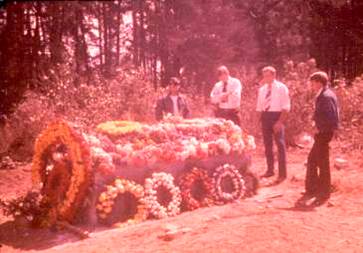
The “Cakchiquel” missionaries. Photo courtesy of Larry Richman
Philosophers may address these questions, but how am I to trust human reasoning about these and other all-important questions? To what or to whom can I turn to find answers to these questions—not just satisfying or comforting answers, but TRUE answers? God’s answers?
I am uplifted by God’s revelation of his purpose in Creation, recorded in sacred scripture: “This is my work and my glory, to bring to pass the immortality and eternal life of Man.” This tells me that although I am but a minuscule speck in the infinite universe, and my lifetime but a minuscule moment in eternity, I somehow fit into God’s purposes. I accept the truth revealed in the Holy Scriptures, that the Creator of this world is the father of my spirit, and that I am here of my own free will and choice to be tried and tested to see what I would do with my life when I have to go on faith. I believe that life is a time of learning and growth. I believe I am accountable for my life, accountable for my decisions and thoughts and intentions and actions, accountable to my Father in Heaven.
A bit of background. My name is Robert Wallace Blair. I was born in California in 1930, the son of parents whose ancestors two generations before chose to join the Church of Jesus Christ of Latter-day Saints. My mother being a high school Spanish teacher, our home was blessed with appreciation for speakers of foreign languages. For most of my eighty years I have probed into the fascinating world of language and languages. Before entering graduate school at Indiana University, I had studied Latin, French, Russian, Finnish, Hebrew, Arabic, German, Gothic, and Old and Middle English. As a doctoral student, I focused on two languages of the Americas, Quechua and Maya, and for my doctoral dissertation I wrote a structural grammar of the latter. Over the following years I engaged in intensive study and description of “exotic” languages, including Chinese, Guaraní, Cakchiquel, and Navajo. After retiring from the BYU Linguistics Department in 1998 I devoted much time to designing language courses for primary and secondary school students. Between 1975 and 2003, my wife and I lived half a year in Guatemala, half a year in Russia, five years in China, and three years in the Baltics (Estonia, Latvia, and Lithuania).
What have I learned from these language-related experiences? For one thing, I stand in awe of the capacity infants have to acquire a language. Living beings from ants to elephants come into the world with an innate bioprogram that equips them with faculties of communication sufficient for their needs. But human babies come into the world with far more. Human babies come into the world with an innate bioprogram than enables them to acquire language, and with it, cognition and communication faculties far beyond those of animals. Just as birds are genetically programmed to fly and fish are genetically programmed to swim, so humans are genetically programmed to learn to communicate and interpret the world with the aid of very complex language.

A newborn’s brain is not, I believe, a tabula rasa. It is more than just grey matter predisposed to learn language by responding to external stimuli together with positive and negative reinforcement. I believe a newborn’s brain is “wired” no more for nursing, crying, and vocalizing than for acquiring language. Many scholars believe, as do I, that its tiny brain contains something like a blueprint of language—not a specific lexicon or grammar, of course, but of language universals, features shared among all languages, features that, given adequate time and environmental conditions, enable language acquisition to happen. Activation of these universals, and creative building upon them, of course, requires, among other things, input from their environment over months and years, but what the nature of that input is, and what the child does with it, is not what one might suppose.
The acquisition of our first language does not come by repetition of word and sentence models, nor is it guided much by corrections from caregivers. Learning to speak proceeds more by creative experimentation than by imitation or repetition. Let me put that in other words: I believe that language acquisition proceeds largely as a creative process, building on the bioprogram, discovering how to make use of the tongue and lips, the lungs and diaphram, the oral and nasal cavities, the glottis, velum, and other parts of the vocal mechanism to modulate sound vibrations, then discovering how to correlate certain of those vibrations with meaning. Also, of course, how to make sense of vocal sound vibrations that enter its ears, roughly correlating those with sounds it discovers it can produce with its own vocal mechanisms. Correlating vocal sounds and rapid-changing articulations with meaning is no easy task. Surely that creative discovery is motivated to a great extent by social interaction, but much of the learning takes place out of view and out of hearing, normally before a child is three years old.
For me, the awesome marvel that appears to have occurred with and following the “Big Bang” is no more awesome than the marvel that occurs regularly in the human species, the marvel of language acquisition, the emergence of language in very young children. I’m struck by the hyperbolic statement of Derek Bickerton in his book The Roots of Language: “The consummate miracle of the universe is a baby acquiring language.”
In a story set in ancient Mesopotamia before writing was invented, a father challenges his son Kish to count the stars, name each one, and map the night sky. The boy soon finds it is an impossible task, but after a frustrating beginning, he combines some of the more prominent stars into constellations and makes up a story for each of those. This enables him to make a rough map of the vast chaos overhead. I compare Kish’s impossible task to the equally impossible task of a baby’s acquiring language. Despite limited cognition, limited memory, limited logic, every normal child succeeds in acquiring speech and the ability to make sense of others’ speech. I shake my head and ask: How is it done?
 I am inspired by the story of the deaf and blind child Helen Keller, who, despite her extreme handicaps, mastered English and even learned to read classical literature in German, French, and Latin. Her breakthrough into language—in my mind reminiscent of the “Big Bang” —came when, at the age of seven, one day she suddenly discovered that things like water and leaf, and concepts like love and good and new, have names. From that wonder-filled day in her eighth year of life, she went about connecting word signs conveyed by hand touch to things and concepts, and suddenly a marvelous world opened up to her, a world mediated through language. In her autobiography The Story of My Life, on page 43, Helen wrote of her teacher Annie Sullivan: “Everything Miss Sullivan taught me she illustrated by a beautiful story.” I try to imagine how her teacher taught her through stories in sign language, but I think that for Helen, as for Kish, stories helped her penetrate the unknown and give order to the world she experienced without hearing or sight.
As I ponder the physical universe, I try in vain to conceptualize its beginnings and its processes in unending space and time. And as I ponder the universe of language and languages that I have experienced, their incredibly varied structure, their acquisition and use, I am equally at a loss to explain what undeniably presents itself before me.
My conclusion is that if I can accept such realities as these even though I cannot comprehend them, then, where there is sufficient evidence, I can accept spiritual realities, unseen realities that are beyond my understanding. So what is “sufficient evidence?” I recognize that throughout much of my life I have personally experienced sufficient evidence so that I accept that there is an almighty Ruler of the universe, the Creator of all things and the Spiritual Father of us all. With that, I accept the universal brotherhood of Man and realize that I have a stewardship in this life that extends beyond myself: it extends to my wife and family and to my ancestors and progeny as well as to all humankind, insofar as I can reach out to them.
In worshiping a Heavenly Father who is concerned with my life as well as with that of all His children past, present, and future, I accept that his counsels and commandments, given through ancient as well as modern, even living, prophets, are part of God’s Plan for his children. I accept that He sent his son Jesus Christ as our Savior to reveal God’s nature and almighty power, to establish a church and divinely guided priesthood, to teach and show us the way to heaven, to open the way for redemption from sin, and to provide resurrection and everlasting life for all. I accept that the church and its leadership, which Jesus Christ set up, over time deviated in teaching and practice, with the result that it lost God’s favor. I accept that Martin Luther and other reformers, relying on their interpretations of the Bible but lacking direct revelation from God, did all they could to reform the church. I accept that Christ’s true church and priesthood authority was at last restored in 1830 by direct revelation from God to a living prophet. I accept the Bible as containing sacred history; I also accept the Book of Mormon as another testament of Jesus Christ, witnessing to his divine mission and complementing the Bible in teaching the way to eternal salvation.
I know that some would say to me: Show me a sign, give me incontrovertible evidence, scientific proof. Only then will I consider accepting what you accept on faith. I can only reply that the witness of the Holy Spirit is a product of faith. As to receiving answers to life’s most pressing questions, I am not dependent on my own or anyone else’s philosophical reasoning or interpretations. What I have myself seen and experienced in the spiritual realm affirms my faith. It invites me to live a consecrated life and gives me hope for the resurrection, hope for life eternal with my wife and loved ones in God’s presence. This is at least as substantive to me as are realities of the physical world that are far beyond my understanding, or the realities of language acquisition that are equally far beyond my comprehension.
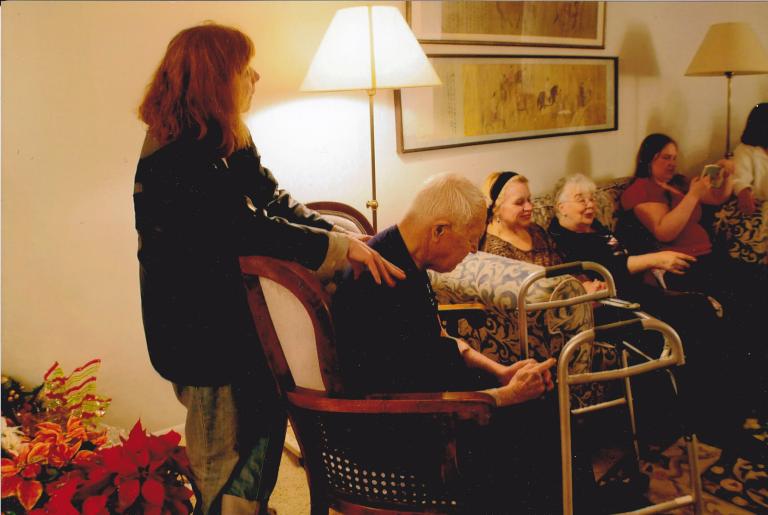
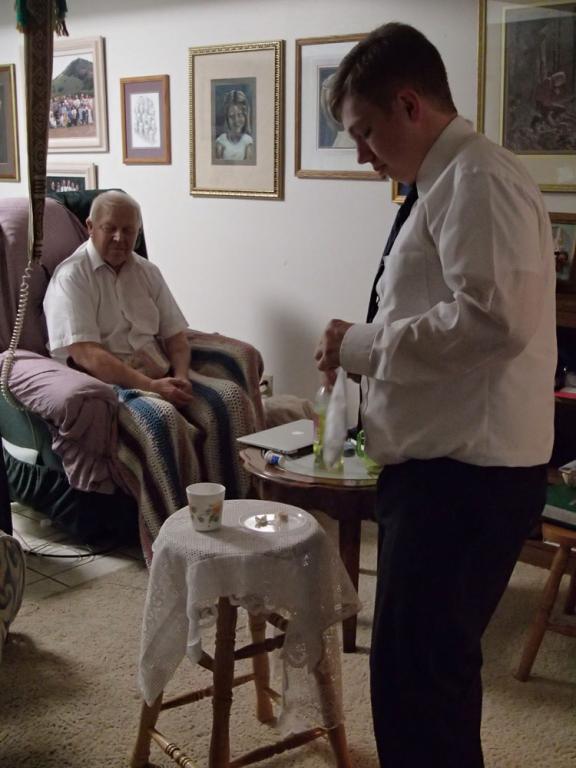
Rubbing Dad’s shoulders–a joyful part of my ministry
—————————————————–
After completing a doctorate at Indiana University with a dissertation on noun and verb morpho-syntax in Yucatec Maya, Robert W. Blair taught linguistics for many years at Brigham Young University. He is the author of Guarani Basic Course (Provo, 1968); with Leon Simmons and Gary Witherspoon, Navajo Basic Course (Provo, 1969); Cakchiquel Basic Course (Provo, 1969); with John S. Robertson, John P. Hawkins, and Andrés Maldonado, Mam Basic Course (Provo, 1979); Diccionario Espanol-Cakchiquel-Inglés (New York, 1981); Innovative Approaches to Language Teaching (Rowley MA, 1982); In Every Tongue: Russian for Latter-day Saints (Salt Lake City, 1994); and various other language-learning books and courses, especially for children and young adults, in Spanish, French, Japanese, Russian, and Latin.
He served as a young missionary for the Church of Jesus Christ of Latter-day Saints in Finland, and then, later in life, presided for three years over missionary work in the Baltic States from headquarters in Riga, Latvia.
Posted August 2010
Previous Post

March 19, 2016
Burning Bush
Next Post
April 28, 2016 On a Day When I Miss My Dad
Browse Our Archives
Select a Category Ancestors family conflict in the scriptures race and religion Uncategorized
Select a Month August 2026 March 2026 January 2026 December 2025 November 2025 October 2025 September 2025 July 2025 April 2025 March 2025 January 2025 November 2024 May 2024 April 2024 November 2023 October 2023 September 2023 June 2023 September 2022 August 2022 July 2022 May 2022 April 2022 March 2022 January 2022 December 2021 October 2021 September 2021 July 2021 June 2021 October 2020 August 2020 July 2020 June 2020 March 2020 January 2020 December 2019 November 2019 October 2019 June 2019 January 2019 December 2018 November 2018 September 2018 August 2018 May 2018 March 2018 January 2018 November 2017 October 2017 August 2017 July 2017 June 2017 May 2017 March 2017 February 2017 November 2016 October 2016 August 2016 July 2016 June 2016 May 2016 April 2016 March 2016 February 2016 January 2016 November 2015 August 2015 July 2015 May 2015 April 2015 March 2015 February 2015 January 2015 December 2014 November 2014 October 2014 August 2014 July 2014 June 2014 May 2014 April 2014 March 2014 February 2014 January 2014 December 2013 November 2013 October 2013 September 2013 August 2013 July 2013 June 2013 May 2013 April 2013 March 2013 February 2013 January 2013 December 2012
Follow Us!
TAKE THE
Religious Wisdom Quiz
Who was King Zedekiah, and what did he do to anger God and ensure Jerusalem's fall?
Select your answer to see how you score.
He rebelled against Babylon He killed Jeremiah He built an idol He burned the scroll
Related posts from The Welcome Table


Church Ball and the Genesis Team
TRENDING AT PATHEOS Latter-day Saint

Did Prayer Cure His Cancer? Or Was It...
At 4 AM one morning, Joshua W. Brown’s wife awoke to a...

8 Ways a Near-Death Experience Rewires the Soul
Does Consciousness Survive Physical Death? After 50 Years of Research, Dr. Raymond...

Holy Longing: What Our Restlessness Is Telling Us
“One can find so many pains when the rain is falling.” -John...

What this is NOT about. This blog is definitely not about...

Who said the Israelites were God’s chosen? That’s right, they did. Who...

The Spirit World Is the Real World: God...
A Monk’s Wisdom on Body and Spirit I sit with Brother Martin...
view all Latter-day Saint blogs
Ad-Free & Subscriber Log-In Subscription Support
- About Us
- 2026 Calendar
- Videos
- Podcasts
- Library of World Religions
- Faith In Media Tracker
- Advertise With Us
- Write for Us
- Privacy Policy
- Terms of Service
- Do Not Sell My Data
- Contact Us
- Radiant Digital
- Manage Newsletter Subscriptions
- Unsubscribe From Notifications
- Sitemap
Copyright 2008-2026, Patheos. All rights reserved.
Subscription Support Ad-Free & Subscriber Log-In
Follow Patheos