
BuddhistCatholicContemplativeEvangelicalGeneral ChristianHinduJewishLatter-day SaintMuslimNew VisionsProgressive Christian
Beliefs
- Buddhist
- Catholic
- Contemplative
- Evangelical
- General Christian
- Hindu
- Jewish
- Latter-day Saint
- More Voices
- Muslim
- New Visions
- Pagan
- Progressive Christian
Topics
- Religion News
- Food and Religion
- Sports and Religion
- Religious Art
- Religious Music and Entertainment
- Religious Events
- History and Religion
- Style and Religion
- Politics and Religion
- Women in Religion
- Recreation Outdoors and Religion
- Business Finance and Religion
- Careers Workplace and Religion
- Education and Religion
- Family Parenting and Religion
- Health Fitness and Religion
- Home and Religion
- Relationships and Religion
- Technology and Religion
- Travel and Religion
Columnists
- Buddhist Columnists
- Business Finance and Religion Columnists
- Careers Workplace and Religion Columnists
- Catholic Columnists
- Contemplative Columnists
- Education and Religion Columnists
- Evangelists Columnists
- Family Parenting and Religion Columnists
- General Christian Columnists
- Health Fitness and Religion Columnists
- Hindu Columnists
- History and Religion Columnists
- Home and Religion Columnists
- Jewish Columnists
- More Voices Columnists
- Latter Day Columnists
- Muslim Columnists
- New Visions Columnists
- Nonreligious Columnists
- Pagan Columnists
- Politics and Religion Columnists
- Progressive Columnists
- Recreation Outdoors and Religion Columnists
- Relationships and Religion Columnists
- Religion News Columnists
- Religious Art Columnists
- Religious Events Columnists
- Religious Music and Entertainment Columnists
- Sports and Religion Columnists
- Style and Religion Columnists
- Technology and Religion Columnists
- Travel and Religion Columnists
- Women in Religion Columnists
Resource Library
- 2026 Calendar
- Library of World Religions
- The 100 Most Holy Places on Earth
- Patheos Answers
- Podcasts
- Videos
- Faith Leaders Database
- Anglican Episcopalian
- Bahai
- Baptist
- Buddhism
- Christianity
- Confucianism
- Eastern Orthodoxy
- Hinduism
- Holiness and Pentecostal
- ISKCON
- Islam
- Judaism
- Lutheran
- Methodist
- The Church of Jesus Christ of Latter-day Saints
- New Age
- Paganism
- Presbytarian and Reformed
- Protestantism
- Religion Behind the Scenes
- Roman Catholic
- Scientology
- Shia Islam
- Sikhism
- Sufism
- Sunni Islam
- Taoism
- Zen
- See all religions
Research Tools
 Ad-Free & Subscriber Log-In Subscription Support
Ad-Free & Subscriber Log-In Subscription Support
Follow Patheos 

- Trending:
- Forgiveness
- |
- Marriage
- |
- Consciousness
- |
- Death Penalty
- |
- Election
- |
- Halloween

- Home
- Latter-day Saint
- Robert Blair Obituary, Part 4: The Story Teller’s Last Stories
Robert Blair Obituary, Part 4: The Story Teller’s Last Stories
Last updated on: March 11, 2016 at 4:42 pm by Margaret Blair Young
Robert Blair Obituary, Part 4: The Story Teller’s Last Stories 2016-03-11T16:42:10-07:00 Margaret Blair Young
Patheos Explore the world's faith through different perspectives on religion and spirituality! Patheos has the views of the prevalent religions and spiritualities of the world.
Note: This post includes a photo of Robert Blair’s lifeless body in the last part. If photos of dead bodies cause you anxiety, please do not continue.
I have written the previous obituary segments in third person. This one will be in first person.
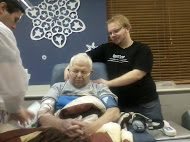 In 2005, Mom and Dad were in China, where they had taught English for five years. Dad had lost most of the function in one kidney. Now, the second kidney failed. All of us Blairs joined in prayer that we’d find a way to get him home for the needed medical help. “Home” ended up being Hong Kong, where he did receive what he needed–as well as an understanding that his time abroad was ending. He would need to return to Provo and begin dialysis. No more international travel. All of his children offered a kidney, but Dad was not eligible for a transplant, given the fact that he had had significant heart trouble and that he was “old.”
He was relatively healthy in those first months and years of dialysis. It was a new language he learned at Davita, and a new community he met. The language included names of medications, procedures, numbers, and the community comprised those in the chairs alongside him–Miguel, Susan, Russell, Richard, Beth, Marilyn. He endured the needles and four-hour sessions of dialysis three times weekly by bringing his computer with him. During dialysis, he often worked on Pashto (“the language of the Taliban”, he called it), and on games and puzzles intended to provide basic conversation skills in several languages.
In 2010, he was approaching his 80th birthday, and seemed also to be approaching death. He was bleeding internally, and when the bleeding was controlled, he had heart attacks. The doctors couldn’t find the source of the bleed, even with sophisticated camera probes. It appeared that we Blairs would be holding a funeral on Dad’s birthday.
I found myself beginning what my sister described as “anticipatory grieving.” This marked the first of my presuming the proximity of my father’s death, and my random, uncontrollable crying. It would continue for years afterwards. Dad did not die, though. Not then. On September 25th, his 80th birthday, Dad came home from the hospital, escorted by two of his namesakes–his son, Robert Groberg Blair, and his grandson, Robert Daren Young.
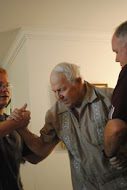 Dad simply was not ready to die. I wonder if his will led the camera to the bleed. It took four tries over a week’s time to locate and cauterize it.
There were projects Dad wanted to finish, he said. Most of us assumed that these referred to language projects. I knew that there was more. Dad had felt guilty that he hadn’t spent more time with his family, and particularly in supporting his wife during the early years of their parenthood. He articulated it several times. “I was gone. I’d go to my office, or to Central America. It all seemed so important. But I got the balance wrong.”
In April, 2014, my brother Dell, Dad’s first son, died. Death did not keep him, however. Dell wrote of his experience here.
When I got to the hospital after Dell flatlined, Dad was in the ICU waiting room with Mom. He had clearly been crying. I approached him. He said, “It was like seeing my dad in the coffin,” he said. “But Dell will live.”
My sister and I went into the room where Dell was emerging from the coma. The doctors had induced it to prevent brain damage as they tried to re-start his heart’s rhythm. We could see the miraculous open/shut pulse of Dell’s heart as a doctor did an ultrasound. Dell was not fully coherent yet, but he was alive.
I contemplated what all of this had meant for Dad. He had been taken back to the worst moment of his young life–the moment when, after caring for his traumatized mother, he had gone to the funeral home and seen his father’s body. Wallace Blair, my grandfather, had a problem with alcohol in the last part of his life, and my dad thought this was part of what killed him. Officially, it was a heart attack, but the man who walked my grandfather to the hospital–the worst thing he could have done–was the same man who had tempted him to drink. Grandpa Blair was fifty-three when he died.
In 2014, it was not his father but his son lying lifeless–or so it appeared. Dell was still in a coma when Mom and Dad saw him. It was an awful deja vu. Dell looks much like our grandfather–both of them tall redheads. How could Dad not remember the sight of his father’s dead body? But this story had a different ending. “Dell will survive.” Dad had lost all of his immediate family by this time. His sister, Carolyn, had died at age 44 in 1972; his mother, Marguerite, had died at age 78 in 1974. He thought he knew death. Now he was brought to the familiar scene again, but with faith and an understanding that this story would have a different ending than it had had in 1949.
“The end of the story hasn’t been written.” This has been my common refrain when my children reported on the misbehavior of one of their friends. It has been a life theme for me as I have watched people change, sometimes for good and sometimes for ill. Never presume that you know how the story ends.
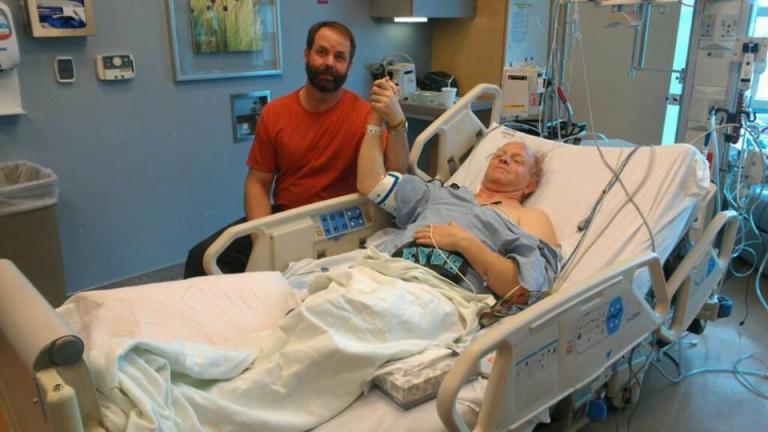
Dell recovered beautifully. Though I begged him to get a pacemaker to celebrate my 59th birthday, he refused, certain that his heart would continue functioning well. Thus far, he has been right.
Dad’s encounters with the unpredictable death of loved ones were not over, though.
On October 11, 2015, our mother, Julia Gay Groberg Blair, began vomiting blood. Dad’s nurse had come early that morning. When Mom made her unsteady way to the kitchen that morning with the words, “I need help,” the nurse called 911. We summoned the family. On October 14, Mom died. For a few minutes. This is what I wrote on that day:
Today, October 14, 2015, is the day we Blair kids ALMOST lost our mother. Her heart arrested multiple times beginning last night. I got a call from her cardiologist right after I taught my classes today. He told me they were going to place a pacemaker into her heart. On the way to the OR, Mom’s heart arrested again in a rather permanent way, and the doctors did CPR. We don’t yet know if they broke ribs, but we understand that CPR is serious business and that she will be sore. The pacemaker was successfully implanted, and Mom’s heart resumed its activity. My siblings and I waited for her to become stable. (Her blood pressure kept dropping.)
After Dad’s dialysis, my sisters took Dad to see Mom. He and my brother gave her a blessing. That will be one of the most tender sights of my life–Dad reaching across the hospital bed with one hand to give his beloved wife a blessing. Mom was unconscious and will be until tomorrow. She has a ventilator for now.
Again, we expect a good recovery. Surely, there will be lasting effects from this traumatic week, but we don’t believe her time is up.
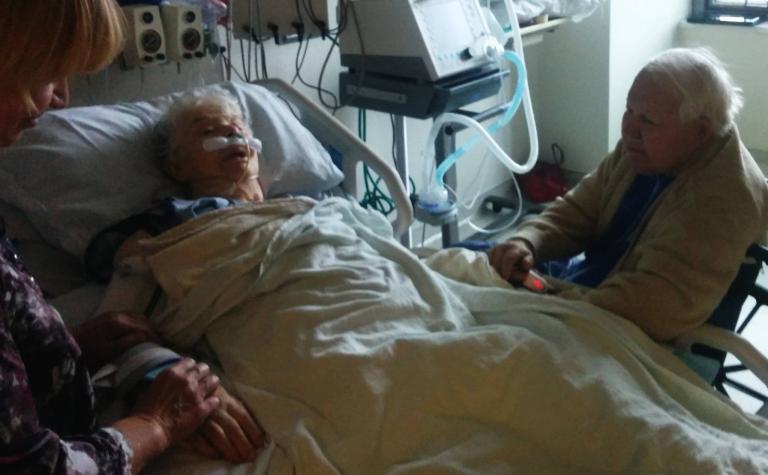
If there ever was a time Dad neglected his wife, he made up for it now. He was her constant guardian and advocate. Even after enduring dialysis, when he was unspeakably weak, he would have us take him to Mom’s side in the hospital.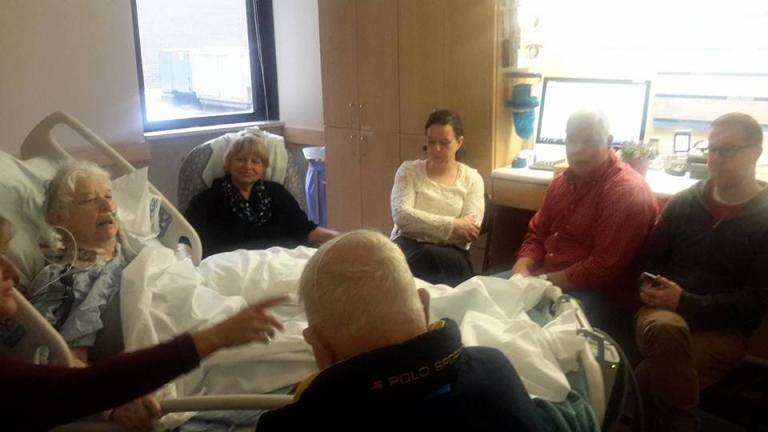 After she had been there for six weeks and was recovering well, the doctors wanted to send her to a care center for several months. Dad refused. He knew that a care center would drive her crazy. We would give Mom 24-hour care at home, he announced. Of course, he didn’t realize that as we put the system into place–with me there during weeknights, my sister, Jen, there for weekends, Dell there daily, and the rest of the Utah Blairs helping as they could–we were also preparing to care for him after Mom’s recovery.
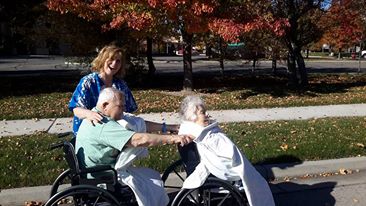
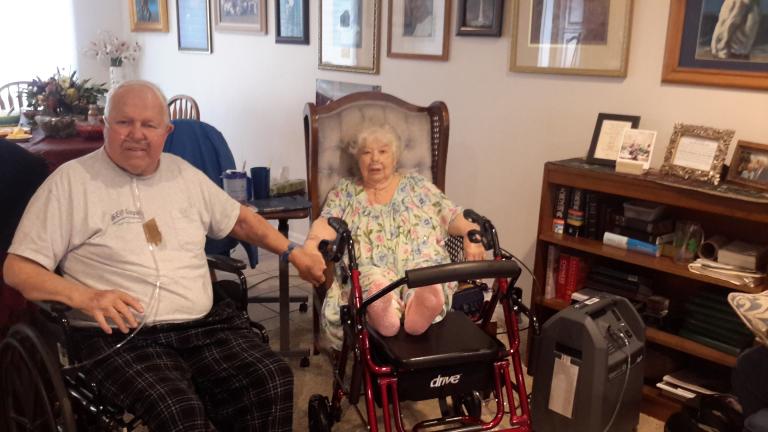
We realized by the new year that Mom didn’t really need twenty-four-hour care any more. She was ambulatory and off her oxygen. Dad, however, did need it. And so we continued.
As soon as Mom recovered, Dad weakened. His last project–taking care of her–was done. He said, “My life was preserved so that I could take care of Julia.”
On February 17th, Dad was unusually weak. He wanted to get out of bed and work on his projects. Dell and I tried lifting him, but Dad had no strength to help. I finally told him that I’d raise his bed and bring him the laptop computer so that he could work on his newest project–a virtual global tour, complete with language learning. Later, Dad asked again to get up. Dell tried lifting him, but Dad fell to the floor on his knees. We don’t know what he damaged, but the next day (Thursday, February 18), he was in terrible pain. I had an obligation to speak at the Church History Museum in Salt Lake City, and got a text as I was preparing to leave that my family was taking Dad to the hospital. I told my husband to keep me updated, though I silenced my phone for the presentation. I had not realized that text messages would still be audible. I heard them coming in throughout my lecture. I knew I was being rude to the audience when, after the lecture was over, I dashed to my phone, curtly greeting those who had come to see me. I apologized, but I needed to see how my dad was doing. All of the messages indicated that he was doing better.
In the hospital, Mom rubbed Dad’s feet. In retrospect, I saw my absence as a blessing. Normally, I would have done the foot rubbing. It was Mom’s turn now, though. This was her last loving act for her husband.
I arrived at my parents’ home just as my husband and my brother, Jim, arrived from the hospital with Dad. He was still in pain. They had given him morphine, which had done nothing to ease him. The followed up with Dilaudid, which took his pain to a tolerable level. He was wearing a leg brace. My husband and brother pushed Dad’s wheelchair, and I lifted his leg to keep it from dragging on the floor. With great difficulty, we got him into bed and he thanked us, then apologized for costing so much money. (He always resisted ambulances, saying, “But that’s a thousand dollars!”)
Around 6:00 a.m., Mom told me that Dad wanted to get up. I said, “I don’t think I can do it. We need to wait until others arrive.” Mom and I checked on Dad, who had apparently gone back to sleep.
His nurse, Amber, arrived at 8:00 a.m., and told me that her grandfather had passed away. We chatted for five minutes or so, and I told her that Dad had had a rough day, but that he was sleeping now. She went into his room, and then ran back out, beckoning me and whispering, “Hurry!”
I knew.
There he was, my dear dad, lying peacefully on his bed. “There is no pulse,” Amber said. “He is still warm. What do you want me to do?”
We had rehearsed this moment. I knew the next line. “We have a DNR,” I said.
There was a bit of foam just under his lip. Amber cleaned it up, and we went together to tell Mom, who was in her office.
“Mom,” I said, and waited until she was looking at me. “Dad has passed.”
She didn’t understand when I first said the words.
“Dad has passed away.”
We went back into the bedroom, and then I began calling my siblings.
In Romeo and Juliet, when Capulet sees his daughter’s body, he says, “Death lies on her like an untimely frost. Upon the sweetest flower of all the field.”
In Dad’s case, death had been almost a companion, lurking, appearing, disappearing for years. He had pushed it away every time–until now. Sometimes, he had pushed it away angrily, such as when it appeared that his body would not accommodate another fistula for dialysis. In the doctor’s office he said sharply, “These doctors need to understand that I have projects I need to finish!” And they did find a spot for a final fistula, giving us a few more months.
The truth is, he did not understand what the unfinished business really was. It had nothing to do with language. It had to do with his wife. Their communication throughout her long recovery was generally without language. He would enter her hospital room and her face would light up. He would hold her hand. He was a sober guardian, assuring that she would have more time.
At last, after raging against the dying of the light, Dad did indeed “go gentle into that good night.”
All of the Utah Blairs met in the bedroom around our father’s body and reminisced for hours. There were occasional jokes, and I would instinctively glance at Dad, surprised that he wasn’t smiling.
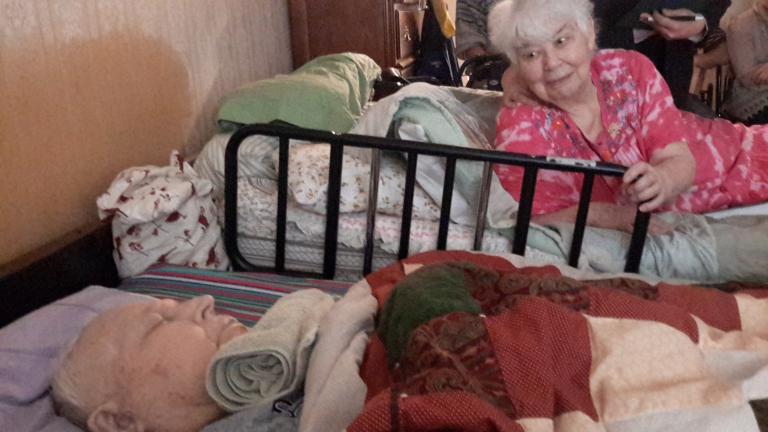
I did not really weep until the funeral workers came for the body. My sister, Jen, a former hospice worker, instructed them to keep Dad’s face uncovered until they were outside.
The day before Dad’s funeral, my brothers dressed him in his temple clothes for burial.
The funeral was a magnificent tribute. Afterwards, we lowered the coffin in to the ground, and Dad’s friends and family tossed in dirt or flowers. My son asked me, “What did you say to him when you threw the flower into the grave?”
“Nothing,” I said. “That’s not my dad. That’s just his body.”
My son said, “I told him I’d keep my word.”
I don’t know what promise my son made to his grandpa, but the act itself was something my dad would have done himself. Inspired by an image or an event, whether good or bad, Dad would commit himself to a high standard and unshakable devotion to God.
We shall not see his like again–not in a fullness. But we who have known and loved him carry his dreams in our lives, and we who comprise his posterity hold him in our very DNA for generations yet to come.
I put a photo an ultrasound in my dad’s coffin–the next generation, due around Dad’s birthday.
Dad often said to his many helpers over the years, “This isn’t me. I’m not an old man!”
At last, his declaration is true.

Previous Post

March 10, 2016
Death of a Latter-day Saint
Next Post
March 19, 2016 Burning Bush
Browse Our Archives
Select a Category Ancestors family conflict in the scriptures race and religion Uncategorized
Select a Month August 2026 March 2026 January 2026 December 2025 November 2025 October 2025 September 2025 July 2025 April 2025 March 2025 January 2025 November 2024 May 2024 April 2024 November 2023 October 2023 September 2023 June 2023 September 2022 August 2022 July 2022 May 2022 April 2022 March 2022 January 2022 December 2021 October 2021 September 2021 July 2021 June 2021 October 2020 August 2020 July 2020 June 2020 March 2020 January 2020 December 2019 November 2019 October 2019 June 2019 January 2019 December 2018 November 2018 September 2018 August 2018 May 2018 March 2018 January 2018 November 2017 October 2017 August 2017 July 2017 June 2017 May 2017 March 2017 February 2017 November 2016 October 2016 August 2016 July 2016 June 2016 May 2016 April 2016 March 2016 February 2016 January 2016 November 2015 August 2015 July 2015 May 2015 April 2015 March 2015 February 2015 January 2015 December 2014 November 2014 October 2014 August 2014 July 2014 June 2014 May 2014 April 2014 March 2014 February 2014 January 2014 December 2013 November 2013 October 2013 September 2013 August 2013 July 2013 June 2013 May 2013 April 2013 March 2013 February 2013 January 2013 December 2012
Follow Us!
TAKE THE
Religious Wisdom Quiz
What is a fruit of the Spirit listed in Galatians 5?
Select your answer to see how you score.
Pride Kindness Greed Envy
Related posts from The Welcome Table


After Death: My Suspicions and Speculations
TRENDING AT PATHEOS Latter-day Saint

Did Prayer Cure His Cancer? Or Was It...
At 4 AM one morning, Joshua W. Brown’s wife awoke to a...

8 Ways a Near-Death Experience Rewires the Soul
Does Consciousness Survive Physical Death? After 50 Years of Research, Dr. Raymond...

Holy Longing: What Our Restlessness Is Telling Us
“One can find so many pains when the rain is falling.” -John...

What this is NOT about. This blog is definitely not about...

Who said the Israelites were God’s chosen? That’s right, they did. Who...

The Spirit World Is the Real World: God...
A Monk’s Wisdom on Body and Spirit I sit with Brother Martin...
view all Latter-day Saint blogs
Ad-Free & Subscriber Log-In Subscription Support
- About Us
- 2026 Calendar
- Videos
- Podcasts
- Library of World Religions
- Faith In Media Tracker
- Advertise With Us
- Write for Us
- Privacy Policy
- Terms of Service
- Do Not Sell My Data
- Contact Us
- Radiant Digital
- Manage Newsletter Subscriptions
- Unsubscribe From Notifications
- Sitemap
Copyright 2008-2026, Patheos. All rights reserved.
Subscription Support Ad-Free & Subscriber Log-In
Follow Patheos