
BuddhistCatholicContemplativeEvangelicalGeneral ChristianHinduJewishLatter-day SaintMuslimNew VisionsProgressive Christian
Beliefs
- Buddhist
- Catholic
- Contemplative
- Evangelical
- General Christian
- Hindu
- Jewish
- Latter-day Saint
- More Voices
- Muslim
- New Visions
- Pagan
- Progressive Christian
Topics
- Religion News
- Food and Religion
- Sports and Religion
- Religious Art
- Religious Music and Entertainment
- Religious Events
- History and Religion
- Style and Religion
- Politics and Religion
- Women in Religion
- Recreation Outdoors and Religion
- Business Finance and Religion
- Careers Workplace and Religion
- Education and Religion
- Family Parenting and Religion
- Health Fitness and Religion
- Home and Religion
- Relationships and Religion
- Technology and Religion
- Travel and Religion
Columnists
- Buddhist Columnists
- Business Finance and Religion Columnists
- Careers Workplace and Religion Columnists
- Catholic Columnists
- Contemplative Columnists
- Education and Religion Columnists
- Evangelists Columnists
- Family Parenting and Religion Columnists
- General Christian Columnists
- Health Fitness and Religion Columnists
- Hindu Columnists
- History and Religion Columnists
- Home and Religion Columnists
- Jewish Columnists
- More Voices Columnists
- Latter Day Columnists
- Muslim Columnists
- New Visions Columnists
- Nonreligious Columnists
- Pagan Columnists
- Politics and Religion Columnists
- Progressive Columnists
- Recreation Outdoors and Religion Columnists
- Relationships and Religion Columnists
- Religion News Columnists
- Religious Art Columnists
- Religious Events Columnists
- Religious Music and Entertainment Columnists
- Sports and Religion Columnists
- Style and Religion Columnists
- Technology and Religion Columnists
- Travel and Religion Columnists
- Women in Religion Columnists
Resource Library
- 2026 Calendar
- Library of World Religions
- The 100 Most Holy Places on Earth
- Patheos Answers
- Podcasts
- Videos
- Faith Leaders Database
- Anglican Episcopalian
- Bahai
- Baptist
- Buddhism
- Christianity
- Confucianism
- Eastern Orthodoxy
- Hinduism
- Holiness and Pentecostal
- ISKCON
- Islam
- Judaism
- Lutheran
- Methodist
- The Church of Jesus Christ of Latter-day Saints
- New Age
- Paganism
- Presbytarian and Reformed
- Protestantism
- Religion Behind the Scenes
- Roman Catholic
- Scientology
- Shia Islam
- Sikhism
- Sufism
- Sunni Islam
- Taoism
- Zen
- See all religions
Research Tools
 Ad-Free & Subscriber Log-In Subscription Support
Ad-Free & Subscriber Log-In Subscription Support
Follow Patheos 

- Trending:
- Forgiveness
- |
- Marriage
- |
- Consciousness
- |
- Death Penalty
- |
- Election
- |
- Halloween

- Home
- Latter-day Saint
- We Tend to Resurrect in my Family
We Tend to Resurrect in my Family
Last updated on: January 31, 2016 at 1:14 pm by Margaret Blair Young
We Tend to Resurrect in my Family 2016-01-31T13:14:45-07:00 Margaret Blair Young
Patheos Explore the world's faith through different perspectives on religion and spirituality! Patheos has the views of the prevalent religions and spiritualities of the world.
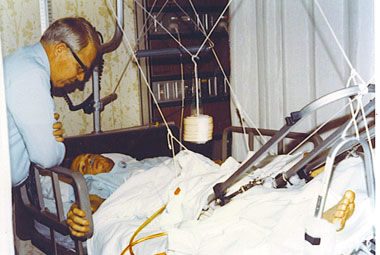 We have frequent resurrections in my family. My brother Bobby suffered a hip-pulverizing injury in 1982 when a stadium gate fell on his pelvis. The doctors did not think he would survive, and my mother called my dad from the ER waiting room: “Bobby is dying.” Dad ran to the hospital and into the room where his semi-conscious son lay. From the ganglia of tubes and wires, Bobby reached his arms out to Dad. “Hug!” he said. That was the moment when all of us Blairs became demonstrative in our affections. Hugs became common.
For Bobby, the pain from his mangled hips was excruciating. There came an hour when he realized that he could die if he wanted to, and the pain would end. He could close his eyes and simply rise beyond the agony. But in that instant, he felt an overwhelming sense of others’ prayers and love. Somehow, the hope from their prayers steeled my brother’s resolve to recover—as far as recovery was possible.
He did not return to being the athlete he had been the day before the accident, when he had run six miles. His recovery was measured in years, not days. He went from the hospital bed to a wheelchair to a cane and finally to merely a limp. He still has his scars, and x-ray technicians tell him that they enjoy x-raying him because they don’t usually see metal hips.
His aspirations changed. He didn’t have a solid focus at the time of his near-death, but as he suffered through his recovery, he became curious about why some people find resiliency during the worst of circumstances, while others collapse. Victor Frankl’s Man’s Search for Meaning was almost scripture to him. Those who survived Auschwitz had to have a purpose. “Those who have a ‘why’ to live,” said Frankl, “can bear with almost any ‘how.’
Bobby decided that his purpose would be resiliency studies. Though he had never been a strong student, his “resurrection” invited him to a new plane of living. He had new passion for learning, and got a PhD in social work. He studied Khmer Rouge survivors in his resilience research, and now teaches at New Mexico University. He once compared his life change to a pianist who has been accustomed to playing only the most often-played keys—and those keys are suddenly non-functional. The pianist must learn to make music on other keys and to learn not only to play these unfamiliar keys well but to make music with them.
Another of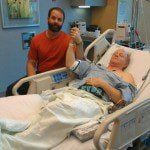 my brothers, Dell, flatlined after a swim workout at age fifty-eight. As it happened, he collapsed next to a man who had re-certified in CPR the day before. That man instantly started CPR, and others brought a nearby defibrilator. Dell flatlined again in the ambulance, and again in the ICU. He died a total of five times, and he did have a near-death experience in which he saw our grandfather and some people he had known when he served a Mormon mission in Ecuador. They asked him to take messages to their families. One being told Dell, “There’s more for you to learn,” and he was returned to his body. He testifies that death and a quick resurrection change one’s perspective. Relationships—with God, with family, with friends—matter, and not much else does. When Dell and I talked after his multiple deaths, he finished the conversation with, “I sure love you.” That was the first time he had said those words to me. We don’t say them much now; some things don’t need repeating.
Our mother, Julia Blair, died on October 14th while being wheeled in to the OR to have a pacemaker placed. She was dead for fifteen minutes while the medical staff performed CPR while simultaneously inserting the pacemaker. She has no memory of what happened during those fifteen minutes, but upon regaining consciousness she understood that she was close to death. Her organs had shut down, and Mom thought, “So this is how it happens.” All of us, her family, were with her. She said to me, “I don’t know how to die. Will someone come for me?” I assured her that when it was time, someone would come. When she asked the same question to my sister, she responded simply, “Who do you think will come?” Mom said, “My parents. I think my parents will come.” A few days later—while we were still deep in the woods of uncertainty—my mother turned to me and another sister and said, “You are wonderful daughters. I hope you will forgive me for–”
I stopped her. “There’s nothing to forgive,” I said.

Dad hangs out with death, and I suspect that they have become friends. At least respectful associates. Death, however, can be a tease. We have been near the actual moment of his “passing” multiple times, and death has granted him a reprieve every time. The most recent was just over a week ago, when he suffered a stroke right after dialysis. We were already in the ER and the neurologist was able to administer a “clot blocking” drug, so Dad’s confused speech normalized. One more reprieve.
For months, I experienced “anticipatory grief” as I dealt with my father. I knew he would die any moment, and the thought of losing him kept me in mourning. But that was five years ago, and he is still with us, still enduring dialysis, still expressing gratitude for life. So I don’t cry much anymore. I joke with my dad, and I serve him. I give him frequent back rubs and foot rubs, which have become sacred acts for me, acts of honoring a man who I have imitated in so many areas of my life.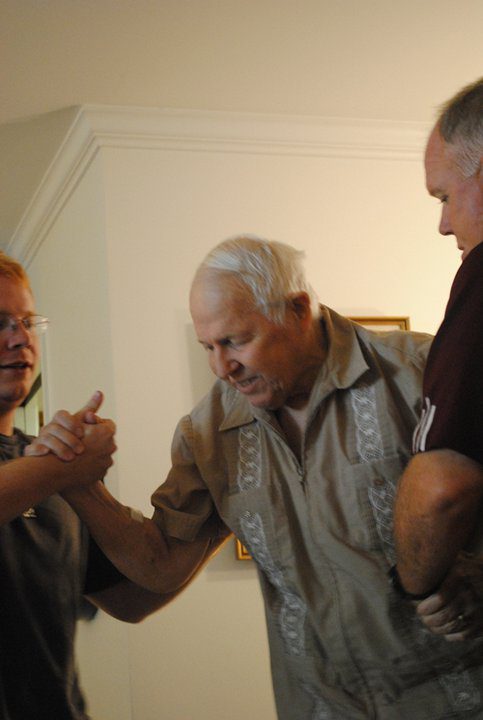
Dad has felt that in the prime of his life, he gave too much time to his career and not enough to family. Now, he spends five hours a day, three times a week in a dialysis chair, and any of his children can drop by to talk. He is stuck. There have been times when I have gone to him in tears over some heartbreak in my life, and he has simply spoken my name in love to calm me. It is remarkable how my name can sound holy when my father speaks it. The knowledge, regardless of the timing, that death is near, illuminates the moments. Are these our last? Is there one more thing we need to say?
The results of these resurrections are as life changing as we allow. They may be only temporary, or they may permanently shift our path.
In Flannery O’Connor’s “A Good Man is Hard to Find” a murderer called “the Misfit” stands with his gun pointed at a stubborn old woman, who cries, “Jesus, Jesus.”
The Misfit answers, “Jesus was the only One that ever raised the dead, and He shouldn’t have done it. He shown everything off balance. If He did what He said, then it’s nothing for you to do but throw away everything and follow Him, and if He didn’t, then it’s nothing for you to do but enjoy the few minutes you got left the best way you can-by killing somebody or burning down his house or doing some other meanness to him. “
As “The Misfit” holds back a sob, the old woman says, “Why you’re one of my babies. You’re one of my own children!”
She reaches for him in this moment with death staring her in the face, and experiences the epiphany that she is somehow the mother to this miserable man and others like him; that he is no different from her own children in his humanity; that he was born of a woman who surely grieves after him. Full of pity and compassion, she touches him, and he instantly shoots her dead.
“She would of been a good woman,” The Misfit says, “if it had been somebody there to shoot her every minute of her life.”
As we feel on the brink of death, our confessions may erupt; our declarations of love will almost certainly try to sweep away the moments when we have betrayed our loved ones; our regrets and fears may rise, and many of us will yearn for just a moment more to make right at least some of our wrongs.
We are easily distracted by so much, and death almost always catches us off guard–even if we have expected it. My family’s frequent encounters with death’s strong flirtations or threats have often kept us in the state of having “somebody there to shoot [us] every minute.” It is sometimes humorous, but mostly tender.
In the film Risen, a Roman soldier becomes a desperate seeker of proof that Jesus has died. The proof will be Jesus’ decomposing body.
The questions the soldier must ask himself point to an eternity of possibilities. If Jesus has been resurrected, what powers did he bring to earth? Was He indeed the Son of God? What will the consequences of his crucifixion be for those Romans and others involved? Will this soldier face divine punishment? What are the implications? The questions await him with every stone he turns, with every dead body he sees–which is somebody else’s body, not Jesus’.
When I said jokingly that my family doesn’t die, a relative asked me if I really believed that.
No, of course I don’t. I know that each of us will die. I also believe that each of us will be resurrected. My belief is a leap of faith which I choose to make. I choose to follow Christ’s path not just because I believe in the resurrection, however, but because I believe in the path itself which Jesus showed through His works. I have long believed that healing hearts and working the miracle of comfort for the comfortless is nearly as great a miracle as the resurrection.
In “A Good Man is Hard to Find”, The Misfit says that he doesn’t know if Jesus raised the dead, and says,”I wisht I had of been there. . .It ain’t right I wasn’t there because if I had of been there I would of known. Listen lady,” he said in a high voice, “if I had of been there I would of known and I wouldn’t be like I am now.”
The Roman soldier in Risen has no way of knowing how much his own life and after-life will depend on Jesus’ glorified body. He is only beginning the search, and he is seeking for understanding far beyond the proof of death–or the possibility of resurrection. The realization that He who was dead now lives will invite the soldier to a new beginning, a new life wherein he himself will be authorized to perform the miracles made possible through a newly wrought faith. He will be invited to “crucify” the old, sword-wielding man in himself, and to be resurrected as a man of peace and peacemaking, trusting that the new life–fraught with risk though it be–will bring him to eternal truths.
I seek that life as well.
Previous Post

January 26, 2016
Risen and Rising
Next Post
February 12, 2016 Jane Manning James: Her Life Story in Her Own Words
Browse Our Archives
Select a Category Ancestors family conflict in the scriptures race and religion Uncategorized
Select a Month August 2026 March 2026 January 2026 December 2025 November 2025 October 2025 September 2025 July 2025 April 2025 March 2025 January 2025 November 2024 May 2024 April 2024 November 2023 October 2023 September 2023 June 2023 September 2022 August 2022 July 2022 May 2022 April 2022 March 2022 January 2022 December 2021 October 2021 September 2021 July 2021 June 2021 October 2020 August 2020 July 2020 June 2020 March 2020 January 2020 December 2019 November 2019 October 2019 June 2019 January 2019 December 2018 November 2018 September 2018 August 2018 May 2018 March 2018 January 2018 November 2017 October 2017 August 2017 July 2017 June 2017 May 2017 March 2017 February 2017 November 2016 October 2016 August 2016 July 2016 June 2016 May 2016 April 2016 March 2016 February 2016 January 2016 November 2015 August 2015 July 2015 May 2015 April 2015 March 2015 February 2015 January 2015 December 2014 November 2014 October 2014 August 2014 July 2014 June 2014 May 2014 April 2014 March 2014 February 2014 January 2014 December 2013 November 2013 October 2013 September 2013 August 2013 July 2013 June 2013 May 2013 April 2013 March 2013 February 2013 January 2013 December 2012
Follow Us!
TAKE THE
Religious Wisdom Quiz
What was Paul's native language?
Select your answer to see how you score.
Latin Hebrew Greek Aramaic
Related posts from The Welcome Table

An Old Woman Remembers The Heavenly Mother

On the Eve of my Father's Death
Reconciliation: My Presidential Address to the Association for...

TRENDING AT PATHEOS Latter-day Saint

Did Prayer Cure His Cancer? Or Was It...
At 4 AM one morning, Joshua W. Brown’s wife awoke to a...

8 Ways a Near-Death Experience Rewires the Soul
Does Consciousness Survive Physical Death? After 50 Years of Research, Dr. Raymond...

Holy Longing: What Our Restlessness Is Telling Us
“One can find so many pains when the rain is falling.” -John...

What this is NOT about. This blog is definitely not about...

Who said the Israelites were God’s chosen? That’s right, they did. Who...

The Spirit World Is the Real World: God...
A Monk’s Wisdom on Body and Spirit I sit with Brother Martin...
view all Latter-day Saint blogs
Ad-Free & Subscriber Log-In Subscription Support
- About Us
- 2026 Calendar
- Videos
- Podcasts
- Library of World Religions
- Faith In Media Tracker
- Advertise With Us
- Write for Us
- Privacy Policy
- Terms of Service
- Do Not Sell My Data
- Contact Us
- Radiant Digital
- Manage Newsletter Subscriptions
- Unsubscribe From Notifications
- Sitemap
Copyright 2008-2026, Patheos. All rights reserved.
Subscription Support Ad-Free & Subscriber Log-In
Follow Patheos