
BuddhistCatholicContemplativeEvangelicalGeneral ChristianHinduJewishLatter-day SaintMuslimNew VisionsProgressive Christian
Beliefs
- Buddhist
- Catholic
- Contemplative
- Evangelical
- General Christian
- Hindu
- Jewish
- Latter-day Saint
- More Voices
- Muslim
- New Visions
- Pagan
- Progressive Christian
Topics
- Religion News
- Food and Religion
- Sports and Religion
- Religious Art
- Religious Music and Entertainment
- Religious Events
- History and Religion
- Style and Religion
- Politics and Religion
- Women in Religion
- Recreation Outdoors and Religion
- Business Finance and Religion
- Careers Workplace and Religion
- Education and Religion
- Family Parenting and Religion
- Health Fitness and Religion
- Home and Religion
- Relationships and Religion
- Technology and Religion
- Travel and Religion
Columnists
- Buddhist Columnists
- Business Finance and Religion Columnists
- Careers Workplace and Religion Columnists
- Catholic Columnists
- Contemplative Columnists
- Education and Religion Columnists
- Evangelists Columnists
- Family Parenting and Religion Columnists
- General Christian Columnists
- Health Fitness and Religion Columnists
- Hindu Columnists
- History and Religion Columnists
- Home and Religion Columnists
- Jewish Columnists
- More Voices Columnists
- Latter Day Columnists
- Muslim Columnists
- New Visions Columnists
- Nonreligious Columnists
- Pagan Columnists
- Politics and Religion Columnists
- Progressive Columnists
- Recreation Outdoors and Religion Columnists
- Relationships and Religion Columnists
- Religion News Columnists
- Religious Art Columnists
- Religious Events Columnists
- Religious Music and Entertainment Columnists
- Sports and Religion Columnists
- Style and Religion Columnists
- Technology and Religion Columnists
- Travel and Religion Columnists
- Women in Religion Columnists
Resource Library
- 2026 Calendar
- Library of World Religions
- The 100 Most Holy Places on Earth
- Patheos Answers
- Podcasts
- Videos
- Faith Leaders Database
- Anglican Episcopalian
- Bahai
- Baptist
- Buddhism
- Christianity
- Confucianism
- Eastern Orthodoxy
- Hinduism
- Holiness and Pentecostal
- ISKCON
- Islam
- Judaism
- Lutheran
- Methodist
- The Church of Jesus Christ of Latter-day Saints
- New Age
- Paganism
- Presbytarian and Reformed
- Protestantism
- Religion Behind the Scenes
- Roman Catholic
- Scientology
- Shia Islam
- Sikhism
- Sufism
- Sunni Islam
- Taoism
- Zen
- See all religions
Research Tools
 Ad-Free & Subscriber Log-In Subscription Support
Ad-Free & Subscriber Log-In Subscription Support
Follow Patheos 

- Trending:
- Forgiveness
- |
- Marriage
- |
- Consciousness
- |
- Death Penalty
- |
- Election
- |
- Halloween

- Home
- Latter-day Saint
- Risen and Rising
Risen and Rising
Last updated on: January 26, 2016 at 10:10 pm by Margaret Blair Young
Risen and Rising 2016-01-26T22:10:00-07:00 Margaret Blair Young
Patheos Explore the world's faith through different perspectives on religion and spirituality! Patheos has the views of the prevalent religions and spiritualities of the world.
 My fundamental belief as a Latter-day Saint is that we are continuously in process of either blossoming or withering, that our potential is infinite and our mortality only one phase of our eternal learning. I have often said that mortality is pre-school, in which we learn (or refuse to learn) the basic principles of the gospel—faith, repentance, forgiveness, charity. I believe that most religions espouse these virtues, and that eventually all will become one, with Christ at the head. In other words, I share many beliefs with world religions–until the final page.
My childhood was full of songs teaching me that I was a child of God. I learned early on that I had a Mother in Heaven as well as a Father, and that “there is beauty all around when there’s love at home.” I was loved by my earthly family.
My first experience with rejection was in fourth grade in Chicago, Illinois, when I overheard some girls gossiping about me. That only foreshadowed what I would experience within two months, when our family moved to Provo, Utah. Within two days of my arrival in Mrs. Stratton’s class, nobody would speak to or play with me. Provo is the navel of Mormonism, so I assumed that my classmates were all Mormons. I asked a classmate why everyone was so mean to me. She couldn’t be caught actually talking to me so she wrote a two page list of the reasons. The first was that I had red hair. I remember hating my name during that year, because it was spoken only mockingly by my classmates. I remember hating being a redhead. I remember learning to love solitude and being at home with my own daydreams and invented dramas.
When I was a chubby twelve-year-old, still desperately insecure, I was supposed to go to a girls’ camp with other members of my LDS stake (like a diocese). I told my mother the night before that I didn’t want to go. Nobody liked me. Mom comforted me by recounting a time in her life when she had felt rejected. She encouraged me to attend the camp with the belief that it might be okay.
I did. I packed my pajamas and my paisley, neon green and pink underwear, which Mom had bought on a super clearance sale. (This was in the sixties.) Of course, there was an underwear raid the second day at camp in which everyone’s bras and panties were confiscated and then hung on a clothesline for all to see. I mostly remember the words, “Whose are THOSE?” I considered not claiming them. I considered it for a long time. My bra and panties were still on the clothesline after everyone else had retrieved theirs. Finally, I walked to the line and pulled my neon paisleys down. Somehow it made sense that I, the unacceptable, would wear absurd underwear.
But something happened two nights later when all of the girls at the camp—around seventy, I’d say—had a “testimony” meeting. At the end of it, I stood alone near another young woman as she spoke to one of her leaders. I heard her say, “I love you so much!” Somehow, those words came to me not as a message from that girl, but from God. “I love you so much!” Others felt something, too, and started speaking nicely to me. Several told me they loved me. LOVED me! One said, “I didn’t like you at first because of your red hair, but now I see that it is beautiful. I love your red hair.” That sentence has stayed with me for forty-eight years as a singular reminder of what happened that night. It was an individual and a communal experience where we were all encircled by love. It was life changing.
I was not instantly cured of my insecurities, of course, but my trajectory improved. Seven years later, I went with my family to Guatemala, where I would learn more about love. Note that I was not learning specifically about Jesus, though I knew many hymns about him, but about love. That was my preparation for the path of faith I would choose.
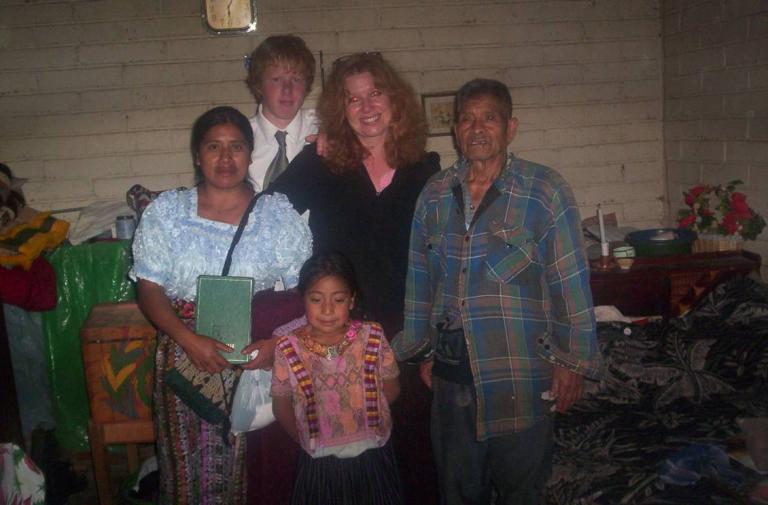
Michael and Margaret Young with Pablo Choc, 2005
We lived in the small town of Patsun, Guatemala in 1975. I thoroughly hated it for several months. I hated not being able to communicate. I knew no Spanish, and Dad wanted me to speak not only Spanish but the indigenous dialect, Cakchiquel. I tried, and children laughed at my attempts—which, I admit, was rather fun. But I was separate from them, almost a different species. Like the girls who had ostrasized me in the fourth grade, I could have written a list for the Cakchiqueles of reasons I could not possibly like them. It would start: “You talk funny.”
It wasn’t until the end of our time in Patsun that everything changed. My brother and I were invited to the death bed of the first Mormon convert in Patsun, Tomas Cujcuj.
By the time we arrived at the Cujcuj hut, it was dark. There was no electricity in that part of town, but the hut was full of Cakchiquel Mormons holding candles. Inside smelled of bamboo mats, wet mud, and melting wax. The women all wore similar clothing—hand-woven, red huipiles. They all had long, braided hair.
Hermano Tomas, wearing a knitted cap, lay on a bed which took up nearly half the space in the hut. His skin looked sallow even by candlelight. Weakly, he requested hymns, and the Cakchiqueles sang. My brother and I used hymn books. Spanish was not native for anyone in that hut, but we all sang the words.
Though the Cakchiqueles sang off-key and mispronounced the words nearly as much as I did, our unity mattered. I realized that we were a community, and each of us belonged. We were all poor and afflicted in some ways, all rich and blessed in others.
Using a battery-powered projector, the missionaries showed a filmstrip of “Man’s Search for Happiness” above Tomas Cujcuj’s deathbed. The pictures were grainy against the adobe. The film depicted the Mormon version of the Plan of Salvation—that we lived as spirit children of Heavenly Parents before our mortal births, that we understood a Savior (Jesus Christ) would deliver us from permanent death and “atone” for our sins, that mortality was a time of learning and progress, and that we would live after death.
Afterwards, the missionaries asked Hermano Tomas if he would like to bear his testimony. He answered in Cakchiquel: “Ha.” Yes.
I did not understand a word he said, but I felt a swell of love and awe. Who was this man who lay dying before me? I became aware that God knew him intimately. I could feel God’s love for him, for it permeated the hut. I knew there were angels in that poor, adobe shelter where Cakchiqueles, missionaries, and two red-headed gringo teenagers sang hymns by candlelight.
Again, my life changed. My community expanded to include a particular people in Patsun, who were revealed to me as magnificent and beautiful. I 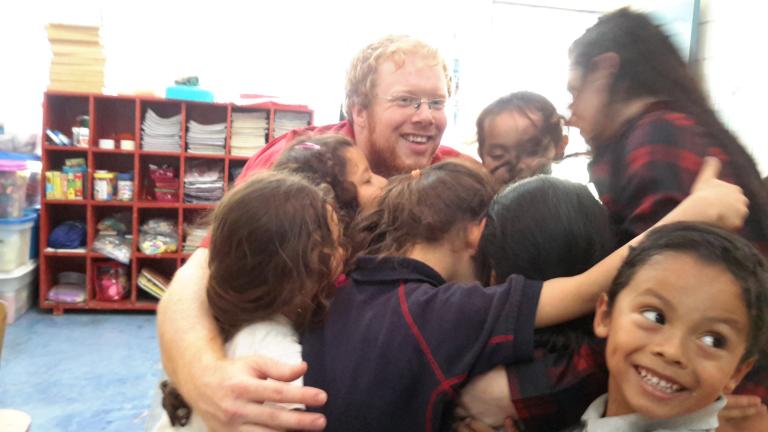 would return to Guatemala many times and would become fluent in Spanish. I would surprise old women at the marketplace by asking them questions in Cakchiquel. More important than my returns, however, were those of the Mormon missionaries I had known. They completed their two-year missionary service, went back to the States to marry and finish their educations, and then, in several cases, returned to Guatemala to set up schools, medical facilities, and businesses. Their hearts had expanded to include Cakchiqueles, to regard them as brothers and sisters. They also understood that loving others carries a responsibility to serve them. My children and I have helped in two of the schools run by a returned missionary who I met in Patsun in 1975.
These two stories, girls’ camp and my experience in Patsun, have set the pattern for my life. As I have matured, I have learned to leap not just intuitively but thoughtfully into new situations with an understanding that God, or the Gods (meaning our Heavenly Parents, Jesus Christ, and the Holy Ghost) love me and everyone around me. I know that as I grow in understanding, I will recognize where doors are opening which I should go through, new thresholds I should cross to the real work of religion: caring for the poor, visiting those in prison, clothing the naked. My borders have been constantly enlarged as I have gone to Venezuela, China, and the DR-Congo. Though I still have a tendency to isolation, I have strong relationships with others from a variety of cultures, and particularly with my husband, who also continues to blossom. My spiritual journey is deeply private and yet also communal. I do not have the same images of Christ as others do—each of us will picture divinity with different templates—but I know that all of us are worthy of love. Many will have endured bullying, tyranny, betrayal, and almost incomprehensible grief—even massacres. The message does not change regardless of circumstance. You are a child of God. You are infinitely loved. You may be infinitely forgiven. You may become a king or a queen in the household of God. If you become a Latter-day Saint, you will be called to the ministry. That’s part of the deal. We are a lay ministry.. A poor farmer in Patsun may serve as a bishop; a tailor in the Congo may become a mission president; a steel worker in Pittsburgh may become an apostle.
This ministry is part of our apprenticeship in learning godliness. In Mere Christianity, C. S. Lewis describes how the Divine will instruct and refine us through our various assignments:
The command Be ye perfect is not idealistic gas. Nor is it a command to do the impossible. He is going to make us into creatures that can obey that command. He said (in the Bible) that we were “gods” and He is going to make good His words. If we let Him—for we can prevent Him, if we choose—He will make the feeblest and filthiest of us into a god or goddess, a dazzling, radiant, immortal creature, pulsating all through with such energy and joy and wisdom and love as we cannot now imagine, a bright stainless mirror which reflects back to God perfectly (though, of course, on a smaller scale) His own boundless power and delight and goodness. The process will be long and in parts very painful, but that is what we are in for. Nothing less. He meant what He said.

When I was in Ghana two summers ago, I was miraculously blessed to meet Huisman Kambango, a man I had heard about for several months. As it turned out, he was at the Ghana LDS temple during the same time I was there with my Congolese godchildren, Aime and Steffy Mbuyi. I stayed in patron housing (next to the temple) so that newlyweds Aime and Steffy could use my hotel room.
Huisman and I had a long conversation just outside patron housing within the light of that temple. He told me that as soon as he saw me, a voice said, “That is Margaret.” This is not to suggest that I am anyone special, only that as I have taken various paths through the open doorways, I have been put into contact with others who have accepted divine assignments (or apprenticeships, if you will). Probably thousands of others, and not all are LDS. Huisman knew who I was, and I understood that he was a part of whatever the Lord is doing in Africa. Indeed, the Spirit of the Lord is troubling the waters throughout that continent. The Lord’s work is to organize chaos into meaning, to make whole what has been divided, to invite all to put away old traditions and old selves fraught with jealousy and pride, and to rise to a place of empathy and good will. The call is not modified for anyone. All are invited to “awake and arise” and to believe that Godly power gives beauty for ashes. But nothing happens without faith or at least a willingness to consider possibilities.
In the film Risen, the Roman soldier seeking Jesus’ body after it has disappeared, is asked what he fears. He replies, “being wrong.”
I have some friends who devote themselves to doubting Christianity. I remember one friend declaring the cessation of his faith with these words: “That whole resurrection thing–the whole Jesus thing–it has to be a myth!” My friend set out to prove the absurdity of his former faith by not following Christian standards. I don’t know what became of him, or who he became, but I am quite sure we prove nothing if we choose nothing. I know others, particularly fellow Mormons, who likewise express the fear of being wrong. Not surprisingly, I have seen some of my Mormon or former-Mormon friends plant themselves in their fear as though it were soil, repeating iterations of it with a succession of issues which, I promise, will never end. “But what if church leaders are completely out of touch?” “But what if Joseph Smith made terrible mistakes?” “But what if Mormonism subjugates women?” I have my own answers to each of those questions, but no question keeps me static. I am listening for the guidance I have come to recognize which leads me on—though I do not always see precisely where I’m going. Like the Roman soldier in Risen, I seek Jesus, though not in a tomb. I seek Jesus in the faces of hungry multitudes, in the hardened glances of the oppressed, in children throughout the world. I see Jesus’ face in any who have committed themselves to charity, whether or not they are in my denomination. I am inspired by women like Mother Teresa, who are willing to go anywhere for the Lord. I often take a first step in the path of faith, knowing that if it is a good step (and it need not be the only possible step), I will find greater light and knowledge—and I will probably endure some kind of opposition, which is part of the package. Just as I had to learn to make sense of the sounds which I now understand as Spanish or Cakchiquel, so I have learned throughout my life to trust in the quiet counsel of the Spirit and to understand even the nuances of divine language which make sense of things I might otherwise presume naively to understand or, worse, which I might discover only as echoes of others’ easy accusations.
I have a foundational belief that Jesus Christ was resurrected, and that as his tombstone was rolled back, he opened the greatest doorway for all of humanity. As a Latter-day Saint, I believe the Roman soldier who ordered that the spear be thrust into Jesus’ side was as worthy of redemption as I am and was likewise invited on a pilgrimage to discovery, though he didn’t know what he actually sought, and needed Mary of Magdalene to tell him, “You’re looking for something you will never find. Open your heart and see.”
As an ordinance worker in an LDS temple, I pronounce blessings upon women who are representing others (often their own ancestors). I speak to these long-dead women through the ages, often spanning centuries with my hands, offering a forgiving balm as though time were merely another room. To those who reject the efficacy of such proxy work, I make no insistence that you believe what I believe, but I will say that temple rituals are meditative for me, long mantras of my particular faith.
I watch as Mormon women enter the temple carrying their temple robes in small suitcases. These robes are sacred to me, signifying the gift and responsibility of fecundity, the steps towards enlightenment (and it is no coincidence that Buddhists use the same word, for there are surely similarities), the robes which connect us to godly power and commit us to kindness, the veil (for women) which, for me, signifies the veil between us and God (Exodus 34: 29-35). I contemplate the way we men and women pray together in the temple—how we carry many names. We represent the person whose temple work we are doing, but we also represent our ancestors, our posterity, and ourselves. Those of us who attend the temple often have borne the names of hundreds of people, in a microcosmic imitation of Jesus bearing the names of every human born or yet to be born. In many ways, we exemplify the observation of Father Zossima in The Brothers Karamazov that (paraphrasing) “all are responsible before all and for everything.” An addiction of an ancestor may affect a newborn baby; the good will of a grandparent will likely influence the nurturing of a grandchild. We ourselves may have set some terrible whirlwind loose with our unbridled anger. Does not our very DNA cry out for redemption, infinite atonement, second chances? Hence, in God’s measurements, time itself expands and dissolves to honor the tears of humanity, and all are called to that salvific work–if, that is, they choose to hear the call.
In the temple, I have often borne the name of a deceased person in my head, and the name of one of my children in my heart. I have received revelation to help me raise my babies. For one son: “There are many paths to Jesus Christ. Let go.” For a daughter: “Show gratitude to her, not criticism.” Such bits of advice might seem obvious, but I needed to leave the distractions of the outside world and focus on a higher perspective before I could hear and understand them clearly. These urgings were pinnacles of my sundry pilgrimages.
I love to see people from other cultures and economic levels enter the temple, knowing that within it, all are equally blessed, that the magnificent edifice belongs as much to the poor as to the rich, that everyone is invited to become a king or a queen; a priest or a priestess. And because of the temple, I still wear weird underwear, though not paisley. For me, part of getting dressed is putting on my temple garments, which remind me of my loyalties, my commitments, and my many invitations to build and edify.
Joseph Smith described our mortal journey in his King Follet discourse:
When you climb a ladder, you must begin at the bottom and go on until you learn the last principle; it will be a great while before you have learned the last. It is not all to be comprehended in this world; it is a great thing to learn salvation beyond the grave.
I believe that I am yet a work in progress, and that my progress is interwoven with my relationships and with the expansion of my borders. My rising is step by step, rung by rung, and will include one spectacular event: when I myself partake of Jesus’ gift and become “risen, as He said”(Matthew 28:6).
Previous Post

January 22, 2016
Love Letters from China
Next Post

January 30, 2016 We Tend to Resurrect in my Family
Browse Our Archives
Select a Category Ancestors family conflict in the scriptures race and religion Uncategorized
Select a Month August 2026 March 2026 January 2026 December 2025 November 2025 October 2025 September 2025 July 2025 April 2025 March 2025 January 2025 November 2024 May 2024 April 2024 November 2023 October 2023 September 2023 June 2023 September 2022 August 2022 July 2022 May 2022 April 2022 March 2022 January 2022 December 2021 October 2021 September 2021 July 2021 June 2021 October 2020 August 2020 July 2020 June 2020 March 2020 January 2020 December 2019 November 2019 October 2019 June 2019 January 2019 December 2018 November 2018 September 2018 August 2018 May 2018 March 2018 January 2018 November 2017 October 2017 August 2017 July 2017 June 2017 May 2017 March 2017 February 2017 November 2016 October 2016 August 2016 July 2016 June 2016 May 2016 April 2016 March 2016 February 2016 January 2016 November 2015 August 2015 July 2015 May 2015 April 2015 March 2015 February 2015 January 2015 December 2014 November 2014 October 2014 August 2014 July 2014 June 2014 May 2014 April 2014 March 2014 February 2014 January 2014 December 2013 November 2013 October 2013 September 2013 August 2013 July 2013 June 2013 May 2013 April 2013 March 2013 February 2013 January 2013 December 2012
Follow Us!
TAKE THE
Religious Wisdom Quiz
The Lord is close to the brokenhearted and saves those who are crushed in ____.
Select your answer to see how you score.
Fear Pain Spirit Grief
Related posts from The Welcome Table



After Death: My Suspicions and Speculations
TRENDING AT PATHEOS Latter-day Saint

Did Prayer Cure His Cancer? Or Was It...
At 4 AM one morning, Joshua W. Brown’s wife awoke to a...

8 Ways a Near-Death Experience Rewires the Soul
Does Consciousness Survive Physical Death? After 50 Years of Research, Dr. Raymond...

Holy Longing: What Our Restlessness Is Telling Us
“One can find so many pains when the rain is falling.” -John...

What this is NOT about. This blog is definitely not about...

Who said the Israelites were God’s chosen? That’s right, they did. Who...

The Spirit World Is the Real World: God...
A Monk’s Wisdom on Body and Spirit I sit with Brother Martin...
view all Latter-day Saint blogs
Ad-Free & Subscriber Log-In Subscription Support
- About Us
- 2026 Calendar
- Videos
- Podcasts
- Library of World Religions
- Faith In Media Tracker
- Advertise With Us
- Write for Us
- Privacy Policy
- Terms of Service
- Do Not Sell My Data
- Contact Us
- Radiant Digital
- Manage Newsletter Subscriptions
- Unsubscribe From Notifications
- Sitemap
Copyright 2008-2026, Patheos. All rights reserved.
Subscription Support Ad-Free & Subscriber Log-In
Follow Patheos