
BuddhistCatholicContemplativeEvangelicalGeneral ChristianHinduJewishLatter-day SaintMuslimNew VisionsProgressive Christian
Beliefs
- Buddhist
- Catholic
- Contemplative
- Evangelical
- General Christian
- Hindu
- Jewish
- Latter-day Saint
- More Voices
- Muslim
- New Visions
- Pagan
- Progressive Christian
Topics
- Religion News
- Food and Religion
- Sports and Religion
- Religious Art
- Religious Music and Entertainment
- Religious Events
- History and Religion
- Style and Religion
- Politics and Religion
- Women in Religion
- Recreation Outdoors and Religion
- Business Finance and Religion
- Careers Workplace and Religion
- Education and Religion
- Family Parenting and Religion
- Health Fitness and Religion
- Home and Religion
- Relationships and Religion
- Technology and Religion
- Travel and Religion
Columnists
- Buddhist Columnists
- Business Finance and Religion Columnists
- Careers Workplace and Religion Columnists
- Catholic Columnists
- Contemplative Columnists
- Education and Religion Columnists
- Evangelists Columnists
- Family Parenting and Religion Columnists
- General Christian Columnists
- Health Fitness and Religion Columnists
- Hindu Columnists
- History and Religion Columnists
- Home and Religion Columnists
- Jewish Columnists
- More Voices Columnists
- Latter Day Columnists
- Muslim Columnists
- New Visions Columnists
- Nonreligious Columnists
- Pagan Columnists
- Politics and Religion Columnists
- Progressive Columnists
- Recreation Outdoors and Religion Columnists
- Relationships and Religion Columnists
- Religion News Columnists
- Religious Art Columnists
- Religious Events Columnists
- Religious Music and Entertainment Columnists
- Sports and Religion Columnists
- Style and Religion Columnists
- Technology and Religion Columnists
- Travel and Religion Columnists
- Women in Religion Columnists
Resource Library
- 2026 Calendar
- Library of World Religions
- The 100 Most Holy Places on Earth
- Patheos Answers
- Podcasts
- Videos
- Faith Leaders Database
- Anglican Episcopalian
- Bahai
- Baptist
- Buddhism
- Christianity
- Confucianism
- Eastern Orthodoxy
- Hinduism
- Holiness and Pentecostal
- ISKCON
- Islam
- Judaism
- Lutheran
- Methodist
- The Church of Jesus Christ of Latter-day Saints
- New Age
- Paganism
- Presbytarian and Reformed
- Protestantism
- Religion Behind the Scenes
- Roman Catholic
- Scientology
- Shia Islam
- Sikhism
- Sufism
- Sunni Islam
- Taoism
- Zen
- See all religions
Research Tools
 Ad-Free & Subscriber Log-In Subscription Support
Ad-Free & Subscriber Log-In Subscription Support
Follow Patheos 

- Trending:
- Forgiveness
- |
- Marriage
- |
- Consciousness
- |
- Death Penalty
- |
- Election
- |
- Halloween

- Home
- Latter-day Saint
- Here am I: Day to Day Miracles
Here am I: Day to Day Miracles
Last updated on: May 8, 2014 at 9:09 am by Margaret Blair Young
Here am I: Day to Day Miracles 2014-05-08T09:09:58-07:00 Margaret Blair Young
Patheos Explore the world's faith through different perspectives on religion and spirituality! Patheos has the views of the prevalent religions and spiritualities of the world.
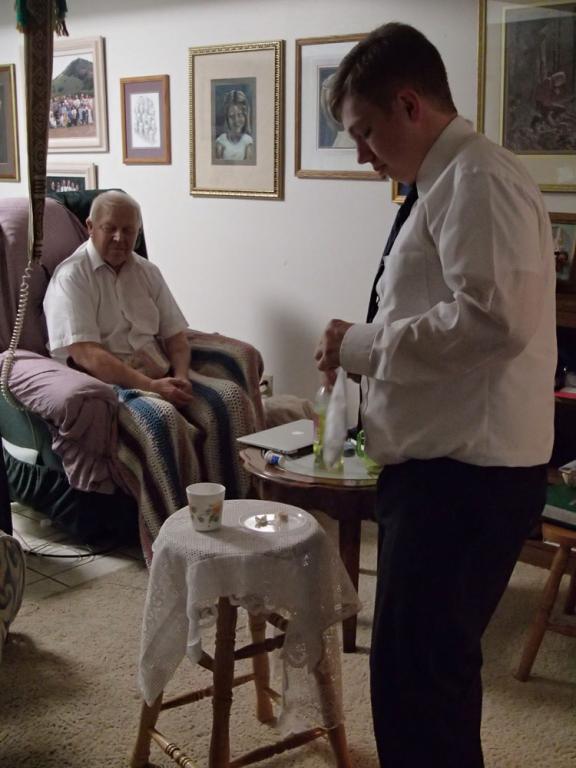
I don’t understand how these little miracles happen. I have had some jaw-dropping right time/right place miracles, but more often the little ones—which I might miss if I weren’t committed to noticing them.
A couple of months ago, I met a lovely redheaded woman—age 27—in the local gym’s hot tub. Her smile was magnificent. I thanked her for being a redhead, something I say to most redheads because there are too few of us and we need to appreciate one another. Somewhere in the conversation, I mentioned that my dad had dialysis three times weekly. “Me too. I’m on dialysis,” she said. “I’m Beth.”
Conversation shifts. Unexpected turn.
In the next five minutes, she told me about her kidneys, which failed when she was eleven. She had a transplant, but it also failed. She had been on dialysis for a total of thirteen years. Half of her life.
I said that I would visit her at dialysis. I did that only once, when I saw her in a chair near my dad’s.
Dialysis chairs sit between oxygen dispensers and a five feet tall machine. Tubes are inserted via thick needles into one arm, and the blood moves through the machine for five hours, doing the kidney’s work. Each patient has a weight goal corresponding to body fluids to be pulled by the mechanical kidney. Some patients wear earphones and watch television. Many sleep. Only a few have visitors. Nurses and aides check blood pressure, blood sugar, potassium, and heart rate. Doctors and social workers make weekly rounds. Sometimes, a patient dies in the chair. Protocol is established. The patient is transported to the hospital, across the street, and not pronounced until there. Sometimes, patients faint. My father does this rather frequently, and I usually hold his legs and meet his eyes. “Dad,” I say, “are you with me? I’m anchoring you. Dad? Can you come back?” A nurse returns some fluid to the patient’s body when such fainting happens.
Yesterday was not a bad one at dialysis. When we were ready to leave, I saw Beth’s unmistakable red hair. “Is that Beth?” I called. She turned. No smile this time. She was expressionless and clearly drained. In one breath, she said, “Could you give me a ride to the Frontrunner station?”
No brainer. Of course I would give her a ride. I told Dad that we would be able to serve one of the patients, and reminded him of Beth, who I had mentioned before.
It was 7:10 p.m. Beth said that her bus, to take her to Payson, would leave at 7:19. In all likelihood, we would miss it. Still, I gave it my best effort. As we approached the station, Beth said, “There it is. Leaving.” I turned in to the lot, opened my window, and waved at the driver. He stopped. Beth got her ride.
A simple event, right?
No. A miracle. Nobody else was leaving dialysis when Beth needed the ride. She was staring forward. This dialysis session was an extra one for her because the process had failed to pull enough fluid the day before. Two sessions in two days are exhausting. I wonder if she had been praying at the moment I saw her. I was in position to take her where she needed to go, and I called her by name, essentially offering myself to serve her. (We should consider that speaking another’s name IS an offer to serve. “I know your name. I am here with you at this moment in time.” In Spanish, introductions are often followed by “a la orden” or “para servirle”–at your order, or at your service.)
We made it to the station within seconds of “too late”, and the driver waited for Beth to board.
How does this happen? I’ve written before about the more obvious miracles—sitting by a woman on a bus in Guatemala City who happened to know where I needed to go, though I did not, and who happened to be Mormon. I stayed the night with her when we arrived at her city, and her son took me to my destination the next day.
Making my way to Green Flake’s grave after a serious misunderstanding with Darius Gray, and finding him there, though he had not told me where he was headed.
Finding myself with Susie Thomas at the temple veil and guiding her through the final part of the endowment, hearing her speak—though her stroke had prevented her from speaking for years.
Or the most recent jaw-dropping miracle: My brother, collapsing in cardiac arrest on April 2, beside a friend who had re-certified in CPR the day before.
There are far too many of these miracles for me to list here, and I know I am not alone in experiencing such things.
Surely giving a ride to Beth doesn’t match rescuing a kidnapping victim. Or does it? Are these miracles on a spectrum of less or more difficult but still of equal value? They unite us as we serve one another.
How does it happen? Is there energy each of us exudes to invite another to answer our need? Are there angelic whisperers guiding us to look and BEHOLD?
These miracles transcend religious and gender lines. I believe they are a part of our human experience. I do not believe that all recognize them equally. Phrases like “nice coincidence” might be reducing a miracle to something comprehensible. No miracle is really comprehensible—either in how it happens or in WHY it happens when so much tragedy exists all around.
Feel free to share your insights, or miracles you have seen. For myself, I have a goal to notice them, to acknowledge them, to give thanks for them, and to be ready for them. Miracles tell us to be ready, to be watchful, and to know we are being prepared for something good.
Previous Post

May 4, 2014
The Innkeeper's Wife
Next Post
May 10, 2014 Alsina Brimhall Holbrook: "With Gratitude for the Privilege"
Browse Our Archives
Select a Category Ancestors family conflict in the scriptures race and religion Uncategorized
Select a Month August 2026 March 2026 January 2026 December 2025 November 2025 October 2025 September 2025 July 2025 April 2025 March 2025 January 2025 November 2024 May 2024 April 2024 November 2023 October 2023 September 2023 June 2023 September 2022 August 2022 July 2022 May 2022 April 2022 March 2022 January 2022 December 2021 October 2021 September 2021 July 2021 June 2021 October 2020 August 2020 July 2020 June 2020 March 2020 January 2020 December 2019 November 2019 October 2019 June 2019 January 2019 December 2018 November 2018 September 2018 August 2018 May 2018 March 2018 January 2018 November 2017 October 2017 August 2017 July 2017 June 2017 May 2017 March 2017 February 2017 November 2016 October 2016 August 2016 July 2016 June 2016 May 2016 April 2016 March 2016 February 2016 January 2016 November 2015 August 2015 July 2015 May 2015 April 2015 March 2015 February 2015 January 2015 December 2014 November 2014 October 2014 August 2014 July 2014 June 2014 May 2014 April 2014 March 2014 February 2014 January 2014 December 2013 November 2013 October 2013 September 2013 August 2013 July 2013 June 2013 May 2013 April 2013 March 2013 February 2013 January 2013 December 2012
Follow Us!
TAKE THE
Religious Wisdom Quiz
Which Christian movement began with John Wesley in the 18th century?
Select your answer to see how you score.
Calvinism Lutheranism Methodism Presbyterianism
Related posts from The Welcome Table


Church Ball and the Genesis Team
TRENDING AT PATHEOS Latter-day Saint

Did Prayer Cure His Cancer? Or Was It...
At 4 AM one morning, Joshua W. Brown’s wife awoke to a...

8 Ways a Near-Death Experience Rewires the Soul
Does Consciousness Survive Physical Death? After 50 Years of Research, Dr. Raymond...

Holy Longing: What Our Restlessness Is Telling Us
“One can find so many pains when the rain is falling.” -John...

What this is NOT about. This blog is definitely not about...

Who said the Israelites were God’s chosen? That’s right, they did. Who...

The Spirit World Is the Real World: God...
A Monk’s Wisdom on Body and Spirit I sit with Brother Martin...
view all Latter-day Saint blogs
Ad-Free & Subscriber Log-In Subscription Support
- About Us
- 2026 Calendar
- Videos
- Podcasts
- Library of World Religions
- Faith In Media Tracker
- Advertise With Us
- Write for Us
- Privacy Policy
- Terms of Service
- Do Not Sell My Data
- Contact Us
- Radiant Digital
- Manage Newsletter Subscriptions
- Unsubscribe From Notifications
- Sitemap
Copyright 2008-2026, Patheos. All rights reserved.
Subscription Support Ad-Free & Subscriber Log-In
Follow Patheos