
BuddhistCatholicContemplativeEvangelicalGeneral ChristianHinduJewishLatter-day SaintMuslimNew VisionsProgressive Christian
Beliefs
- Buddhist
- Catholic
- Contemplative
- Evangelical
- General Christian
- Hindu
- Jewish
- Latter-day Saint
- More Voices
- Muslim
- New Visions
- Pagan
- Progressive Christian
Topics
- Religion News
- Food and Religion
- Sports and Religion
- Religious Art
- Religious Music and Entertainment
- Religious Events
- History and Religion
- Style and Religion
- Politics and Religion
- Women in Religion
- Recreation Outdoors and Religion
- Business Finance and Religion
- Careers Workplace and Religion
- Education and Religion
- Family Parenting and Religion
- Health Fitness and Religion
- Home and Religion
- Relationships and Religion
- Technology and Religion
- Travel and Religion
Columnists
- Buddhist Columnists
- Business Finance and Religion Columnists
- Careers Workplace and Religion Columnists
- Catholic Columnists
- Contemplative Columnists
- Education and Religion Columnists
- Evangelists Columnists
- Family Parenting and Religion Columnists
- General Christian Columnists
- Health Fitness and Religion Columnists
- Hindu Columnists
- History and Religion Columnists
- Home and Religion Columnists
- Jewish Columnists
- More Voices Columnists
- Latter Day Columnists
- Muslim Columnists
- New Visions Columnists
- Nonreligious Columnists
- Pagan Columnists
- Politics and Religion Columnists
- Progressive Columnists
- Recreation Outdoors and Religion Columnists
- Relationships and Religion Columnists
- Religion News Columnists
- Religious Art Columnists
- Religious Events Columnists
- Religious Music and Entertainment Columnists
- Sports and Religion Columnists
- Style and Religion Columnists
- Technology and Religion Columnists
- Travel and Religion Columnists
- Women in Religion Columnists
Resource Library
- 2026 Calendar
- Library of World Religions
- The 100 Most Holy Places on Earth
- Patheos Answers
- Podcasts
- Videos
- Faith Leaders Database
- Anglican Episcopalian
- Bahai
- Baptist
- Buddhism
- Christianity
- Confucianism
- Eastern Orthodoxy
- Hinduism
- Holiness and Pentecostal
- ISKCON
- Islam
- Judaism
- Lutheran
- Methodist
- The Church of Jesus Christ of Latter-day Saints
- New Age
- Paganism
- Presbytarian and Reformed
- Protestantism
- Religion Behind the Scenes
- Roman Catholic
- Scientology
- Shia Islam
- Sikhism
- Sufism
- Sunni Islam
- Taoism
- Zen
- See all religions
Research Tools
 Ad-Free & Subscriber Log-In Subscription Support
Follow Patheos 

- Trending:
- Advent
- |
- Forgiveness
- |
- Thanksgiving
- |
- Election
- |
- Seasonal Holidays
- |
- Marriage

- Home
- Latter-day Saint
- The Play: More Important Now than Ever Before?
The Play: More Important Now than Ever Before?
Last updated on: February 23, 2014 at 4:07 pm by Margaret Blair Young
The Play: More Important Now than Ever Before? 2014-02-23T16:07:03-07:00 Margaret Blair Young
Patheos Explore the world's faith through different perspectives on religion and spirituality! Patheos has the views of the prevalent religions and spiritualities of the world.
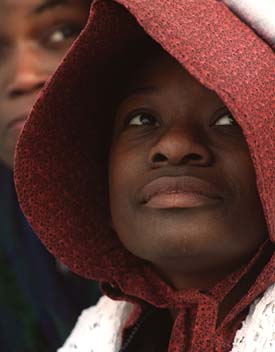
The First Production of _I Am Jane_ in 2001, Denise Cutliff playing Jane.
I think I slept for a month after the first production of I Am Jane. I was completely exhausted. I was the playwright, costume designer, set designer, and director of this play about black Mormon pioneer Jane Manning James. I have since learned to delegate.
We filled the chapel and more for that production, and in some ways it marked the time when the Genesis Group got big and started getting attention. In the audience was one of Jane’s descendants, who had already labeled the play “scurrilous.” She had said she would never forgive the church for what it had done to her father, Monroe Fleming. (I don’t know fully what she meant by that.) I’m sure she hated the production, but I never saw her afterwards, and she died a year later.
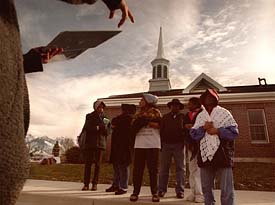
Cast members prepare to present the story of Jane Manning James in the Genesis chapel, 2001.
Soon, we found another descendant, Louis Duffy, who was thrilled to join us in paying tribute to his ancestor. By this time, Tamu Smith was playing Jane and Denise was finishing her degree and getting married.

Tamu did the role for a decade, ceding it to Fiona Smith (who later portrayed Jane in the film about Joseph Smith shown in the Joseph Smith Building theater) during a pregnancy. With Fiona as Jane, we did the show in the Bountiful Regional Center, a church-owned site. We had to send the script through correlation, and met with someone from the committee who wanted a few changes–such as not referring to Elijah Abel as “Elder Abel.”

Fiona Smith and Alex Boye in _I Am Jane_
We performed the play several times at BYU, but it met controversy. One professor was concerned that his students might not be able to handle the discussion of the priesthood restriction, that they might start doubting the prophets.
Today is a new day, though. Once again, we are set to present the play at BYU, starting on Tuesday, February 25th. This might be our most important performance ever, and perhaps our last. Tickets ($3.00/person; $5.00/couple) are available at the WSC information desk, or by calling (801) 422-4313.

The Jane James monument in the SLC Cemetery, depicting Jane giving “two pounds of flour, it being about half she had” to Eliza Partridge Lyman
What follows is my playwright’s statement, which will be on all programs.

Rehearsal 2/22/2014
It is not easy to mount I Am Jane—especially at BYU. We have 265 students of African lineage at BYU, out of a 30,000 student body. Only a fraction of these 265 students have an inclination to be in a play, and of this fraction only a few can find the time for it. We have gone into the community to fully cast it, and each actor has given their time generously and without any compensation. Some have traveled from Salt Lake City to attend rehearsals.
With such difficulties, why would we attempt this play? Simply because it matters, and this year it matters even more than it has previously. On December 6th, 2013, the LDS Church released a statement about blacks and the LDS priesthood, approved by the Quorum of the Twelve and the First Presidency. It states:
Today, the Church disavows the theories advanced in the past that black skin is a sign of divine disfavor or curse, or that it reflects actions in a premortal life; that mixed-race marriages are a sin; or that blacks or people of any other race or ethnicity are inferior in any way to anyone else. Church leaders today unequivocally condemn all racism, past and present, in any form.
No other justifications were given throughout history than those the church now proclaims as wrong. As the statement points out, the Church was restored in a time when race issues were strong. The Civil War was just around the corner. The Nat Turner rebellion happened one year after the Church was organized. Under Brigham Young, black servitude was accepted in Utah, and the priesthood restriction started. The Church statement contextualizes these actions thus:
At the time, many people of African descent lived in slavery, and racial distinctions and prejudice were not just common but customary among white Americans. Those realities, though unfamiliar and disturbing today, influenced all aspects of people’s lives, including their religion.
Jane Manning James is mentioned specifically, along with Elijah Abel, in the statement:
[A]t least two black Mormons continued to hold the priesthood. When one of these men, Elijah Abel, petitioned to receive his temple endowment in 1879, his request was denied. Jane Manning James, a faithful black member who crossed the plains and lived in Salt Lake City until her death in 1908, similarly asked to enter the temple; she was allowed to perform baptisms for the dead for her ancestors but was not allowed to participate in other ordinances.
Consider that Jane approached every church president from John Taylor to Joseph F. Smith to receive her temple blessings. We have copies of the letters she dictated asking poignantly for these ordinances: “I realize my race and color and cannot expect my endowment as others who are white. Still, inasmuch as this is the fullness of times and through Abraham mankind may be blessed, is there no blessing for me?”
It is beyond dispute that Jane was loved by those who surrounded her, including by those church leaders who denied her requests. President Wilford Woodruff received Jane into his home on several occasions. He blessed her for her faith, but recorded in his journal that he could not give her what she wanted:
Oct. 16, 1894: We had meeting with several individuals among the rest Black Jane wanted to know if I would not let her have her endowments in the temple, this I could not do as it was against the law of God as Cain killed Abel all the seed of Cain would have to wait for redemption until all the seed that Abel would have had that may come through other men may be redeemed.
As the playwright and one who has become devoted to Jane’s story and its implications, and has been blessed with the friendship of one of her descendants, Louis M. Duffy (who donated the material on display in Special Collections of the HBLL), I have thought how different BYU might be today had the idea of Cain’s curse been disavowed before the Saints came west. It is a fleeting fantasy, though, because we are where we are in 2014. Therefore, what is our responsibility towards those who constitute the only group of Latter-day Saints who were specifically designated as “cursed”? Now that we understand that the idea of a curse was a remnant of 19th century thought, how do we move forward and invite all to “the welcome table”?
Everyone in this play hopes that it will inspire the empathetic imagination in all who see it, that all may be edified and also challenged. Jane’s faith, which saw beyond any racial distinctions, should mentor our faith. When Elder David B. Haight dedicated the Jane James monument in 2000, he said that he knew Jane had taken care of his ancestors, who were in her pioneer company. He knew this, he said, “because that’s the kind of person Jane was.”
How can we “take care” of Jane’s progeny and others who need access to education, job opportunities, and a glorious vision of their divine nature and eternal possibilities? This is a personal question, one for each audience member to ponder.
We gratefully acknowledge that we as a church have come far from where we started from. As our closing musical number says, “Nobody told me the road would be easy. I don’t believe He brought me this far just to leave me.”
May we commit ourselves to doing all we can to become fully unified as the body of Christ, and to listen to one another’s stories—including the hard parts—with open hearts.
(The Church statement is found here: http://www.lds.org/topics/race-and-the-priesthood?lang=eng )
Previous Post

February 17, 2014
It Exploded (and other adventures in the saga of Jane Manning James)
Next Post
March 4, 2014 What does the [Silver] Fox Say?
Browse Our Archives
Select a Category Ancestors family conflict in the scriptures race and religion Uncategorized
Select a Month August 2026 March 2026 January 2026 December 2025 November 2025 October 2025 September 2025 July 2025 April 2025 March 2025 January 2025 November 2024 May 2024 April 2024 November 2023 October 2023 September 2023 June 2023 September 2022 August 2022 July 2022 May 2022 April 2022 March 2022 January 2022 December 2021 October 2021 September 2021 July 2021 June 2021 October 2020 August 2020 July 2020 June 2020 March 2020 January 2020 December 2019 November 2019 October 2019 June 2019 January 2019 December 2018 November 2018 September 2018 August 2018 May 2018 March 2018 January 2018 November 2017 October 2017 August 2017 July 2017 June 2017 May 2017 March 2017 February 2017 November 2016 October 2016 August 2016 July 2016 June 2016 May 2016 April 2016 March 2016 February 2016 January 2016 November 2015 August 2015 July 2015 May 2015 April 2015 March 2015 February 2015 January 2015 December 2014 November 2014 October 2014 August 2014 July 2014 June 2014 May 2014 April 2014 March 2014 February 2014 January 2014 December 2013 November 2013 October 2013 September 2013 August 2013 July 2013 June 2013 May 2013 April 2013 March 2013 February 2013 January 2013 December 2012
Follow Us!
TAKE THE
Religious Wisdom Quiz
How many times does the word "Christian" appear in the Bible?
Select your answer to see how you score.
3 7 10 12
Related posts from The Welcome Table

Not a Curse but a Calling (Poem from...
Women at the Well - A Review of...
Jane Elizabeth Manning James: Life Story in English...
TRENDING AT PATHEOS Latter-day Saint

Did Prayer Cure His Cancer? Or Was It...
At 4 AM one morning, Joshua W. Brown’s wife awoke to a...

8 Ways a Near-Death Experience Rewires the Soul
Does Consciousness Survive Physical Death? After 50 Years of Research, Dr. Raymond...

Holy Longing: What Our Restlessness Is Telling Us
“One can find so many pains when the rain is falling.” -John...

What this is NOT about. This blog is definitely not about...

Who said the Israelites were God’s chosen? That’s right, they did. Who...

The Spirit World Is the Real World: God...
A Monk’s Wisdom on Body and Spirit I sit with Brother Martin...
view all Latter-day Saint blogs
Ad-Free & Subscriber Log-In Subscription Support
- About Us
- 2026 Calendar
- Videos
- Podcasts
- Library of World Religions
- Faith In Media Tracker
- Advertise With Us
- Write for Us
- Privacy Policy
- Terms of Service
- Do Not Sell My Data
- Contact Us
- Radiant Digital
- Manage Newsletter Subscriptions
- Unsubscribe From Notifications
- Sitemap
Copyright 2008-2026, Patheos, part of the Radiant Digital network of media brands. All rights reserved.
Subscription Support Ad-Free & Subscriber Log-In
Follow Patheos