
BuddhistCatholicContemplativeEvangelicalGeneral ChristianHinduJewishLatter-day SaintMuslimNew VisionsProgressive Christian
Beliefs
- Buddhist
- Catholic
- Contemplative
- Evangelical
- General Christian
- Hindu
- Jewish
- Latter-day Saint
- More Voices
- Muslim
- New Visions
- Pagan
- Progressive Christian
Topics
- Religion News
- Food and Religion
- Sports and Religion
- Religious Art
- Religious Music and Entertainment
- Religious Events
- History and Religion
- Style and Religion
- Politics and Religion
- Women in Religion
- Recreation Outdoors and Religion
- Business Finance and Religion
- Careers Workplace and Religion
- Education and Religion
- Family Parenting and Religion
- Health Fitness and Religion
- Home and Religion
- Relationships and Religion
- Technology and Religion
- Travel and Religion
Columnists
- Buddhist Columnists
- Business Finance and Religion Columnists
- Careers Workplace and Religion Columnists
- Catholic Columnists
- Contemplative Columnists
- Education and Religion Columnists
- Evangelists Columnists
- Family Parenting and Religion Columnists
- General Christian Columnists
- Health Fitness and Religion Columnists
- Hindu Columnists
- History and Religion Columnists
- Home and Religion Columnists
- Jewish Columnists
- More Voices Columnists
- Latter Day Columnists
- Muslim Columnists
- New Visions Columnists
- Nonreligious Columnists
- Pagan Columnists
- Politics and Religion Columnists
- Progressive Columnists
- Recreation Outdoors and Religion Columnists
- Relationships and Religion Columnists
- Religion News Columnists
- Religious Art Columnists
- Religious Events Columnists
- Religious Music and Entertainment Columnists
- Sports and Religion Columnists
- Style and Religion Columnists
- Technology and Religion Columnists
- Travel and Religion Columnists
- Women in Religion Columnists
Resource Library
- 2026 Calendar
- Library of World Religions
- The 100 Most Holy Places on Earth
- Patheos Answers
- Podcasts
- Videos
- Faith Leaders Database
- Anglican Episcopalian
- Bahai
- Baptist
- Buddhism
- Christianity
- Confucianism
- Eastern Orthodoxy
- Hinduism
- Holiness and Pentecostal
- ISKCON
- Islam
- Judaism
- Lutheran
- Methodist
- The Church of Jesus Christ of Latter-day Saints
- New Age
- Paganism
- Presbytarian and Reformed
- Protestantism
- Religion Behind the Scenes
- Roman Catholic
- Scientology
- Shia Islam
- Sikhism
- Sufism
- Sunni Islam
- Taoism
- Zen
- See all religions
Research Tools
 Ad-Free & Subscriber Log-In Subscription Support
Ad-Free & Subscriber Log-In Subscription Support
Follow Patheos 

- Trending:
- Forgiveness
- |
- Marriage
- |
- Consciousness
- |
- Death Penalty
- |
- Election
- |
- Halloween

- Home
- Latter-day Saint
- Darmok and Jalad at Tanagra
Darmok and Jalad at Tanagra
Last updated on: September 26, 2013 at 4:43 pm by Margaret Blair Young
Darmok and Jalad at Tanagra 2013-09-26T16:43:15-07:00 Margaret Blair Young
Patheos Explore the world's faith through different perspectives on religion and spirituality! Patheos has the views of the prevalent religions and spiritualities of the world.
This was one of the last posts I did when I blogged at By Common Consent. It has renewed significance now.
My husband and I recently saw a Star Trek: The Next Generation episode called “Darmok.” In it, the Enterprise is threatened with destruction if they can’t interpret the language of the “enemy” ship’s creatures. Captain Picard is sent to a planet to attempt communication with one of these “enemy” aliens. As it turns out, the aliens’ language is all based on metaphors from their folklore. The captain must not only interpret the words but the stories behind them. There is no grammar involved, simply the stories.
We know that soldiers who killed those uniformed as “enemies” and then found evidences of their common humanity–a photo of a wife and children, a letter from a parent–were often haunted by the killing. They would use words like “I murdered”, or “I slaughtered.” When suggestions of personal stories are revealed in letters or photos, epithets like “Kraut” or “Gook” or “Jap” fail. If only for a moment, killed and killer are simply human.
When I was eight years old, my brother and I accompanied my dad to Yucatan. Dad worked with a Baptist minister to learn Maya. They used Bible stories as their texts. The Mayan minister re-told the story of the Prodigal Son using images distinctive to his culture. The prodigal son, for example, had grown his hair long, a sign to Mayans of rebellion. Such details made the story both particular and universal.
Of course, stories can also divide us. I think of some I was told as a young person in Provo, Utah–stories that would keep me separate from Blacks. My seminary teacher informed my class that Blacks were inferior, and that was why God had withheld the priesthood from them. My home teacher read us an alleged prophecy by John Taylor predicting that Blacks would come en masse from California, would invade our temple, ravish our women, and that blood would run down the streets. Like today’s endlessly forwarded emails, this “prophecy” was carried house to house, and finally every bishop was asked to read a letter to his congregation denouncing the prophecy as a fake. We breathed a sigh of relief.
That’s my side of the story, anyway. Darius Gray, my co-author, experienced it from the Black side. He, a good friend of the police chief in Salt Lake City, was shown the plans to prevent the impending attack. He saw where snipers would be put and what other defensive measures were being taken. As for Darius, he arranged to get his wife out of town, and he planned on leaving by horseback, crossing mountain paths rather than public roads. He experienced an entirely different type of fear.
As Darius and I got acquainted, we shared parts of our life stories. He told me about his mother’s death. She had summoned her two children and told them that she was dying. They insisted that the moment hadn’t yet arrived. She repeated, “Children, listen to me. I am dying.” She called her daughter to her and said loving things. It was Darius’s turn next. She called him by his middle name, Aidan. “Aidan,” she said, “come here.” He did. “Aidan, I adore you. I adore you.”
For Darius and me, there was no black and white. We were brother and sister. My children refer to him as “Grandpa D.”
Sometimes the stories we tell involve our view of Christianity. We tend to repeat the notion that we Mormons don’t use crosses on our chapels/temples because we don’t want to remember the crucifixion of Christ but his resurrection. (The empty cross does actually imply his resurrection, but that’s for another post.)
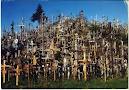
Though I was taught in subtle ways to resist the cross as a symbol of the Savior’s sacrifice, I have been moved to tears by that symbol on another religion’s turf. My family and I visited Lithuania and saw the Hill of Crosses, boldly built in defiance of Soviet rule, which insisted that no crosses be displayed. The Lithuanians sent crosses down the river to be placed on that hill. My father asked me as we approached, “How many crosses do you guess you’ll see?” I said perhaps one thousand. Actually, they weren’t countable. Every cross had several rosaries (with crosses) dangling from the nexus. I could hardly imagine the courage of these people, who had said to the Communist regime: “We are not yours. We are Christ’s.” The story brought me to them and erased our religious distinctions while I surveyed their inspired monument.
Currently, we see the spin on political stories, calculated to make us fear or even hate the “other” side. Some fear feminism or homosexuality or former Mormons. Fear makes us deaf and blind. We will not hear their stories, nor will we see their divinely created faces.
The gospel asks us to open our eyes, ears, minds, hearts. In one story after another, the Savior tells of many prodigals and “unclean” people who open his wells of mercy.
Imagine saying to someone from another planet: “Jesus, when the grave opened.” It would be your call for grace, hope, and it would be your testimony. Their answer? Perhaps some name you’ve never heard, followed by “when the walls fell.”
“For he is our peace, who has made both one, and has broken down the middle wall of partition between us.”
Make it so.
Previous Post

September 20, 2013
Learning to Talk Past Our Differences: Hello Fellow Feminists!
Next Post
September 27, 2013 A Few of my Sisters
Browse Our Archives
Select a Category Ancestors family conflict in the scriptures race and religion Uncategorized
Select a Month August 2026 March 2026 January 2026 December 2025 November 2025 October 2025 September 2025 July 2025 April 2025 March 2025 January 2025 November 2024 May 2024 April 2024 November 2023 October 2023 September 2023 June 2023 September 2022 August 2022 July 2022 May 2022 April 2022 March 2022 January 2022 December 2021 October 2021 September 2021 July 2021 June 2021 October 2020 August 2020 July 2020 June 2020 March 2020 January 2020 December 2019 November 2019 October 2019 June 2019 January 2019 December 2018 November 2018 September 2018 August 2018 May 2018 March 2018 January 2018 November 2017 October 2017 August 2017 July 2017 June 2017 May 2017 March 2017 February 2017 November 2016 October 2016 August 2016 July 2016 June 2016 May 2016 April 2016 March 2016 February 2016 January 2016 November 2015 August 2015 July 2015 May 2015 April 2015 March 2015 February 2015 January 2015 December 2014 November 2014 October 2014 August 2014 July 2014 June 2014 May 2014 April 2014 March 2014 February 2014 January 2014 December 2013 November 2013 October 2013 September 2013 August 2013 July 2013 June 2013 May 2013 April 2013 March 2013 February 2013 January 2013 December 2012
Follow Us!
TAKE THE
Religious Wisdom Quiz
What does "Hoshea" mean in Hebrew?
Select your answer to see how you score.
The Lord is Holy Salvation Chosen One God's Messenger
Related posts from The Welcome Table



After Death: My Suspicions and Speculations
TRENDING AT PATHEOS Latter-day Saint

Did Prayer Cure His Cancer? Or Was It...
At 4 AM one morning, Joshua W. Brown’s wife awoke to a...

8 Ways a Near-Death Experience Rewires the Soul
Does Consciousness Survive Physical Death? After 50 Years of Research, Dr. Raymond...

Holy Longing: What Our Restlessness Is Telling Us
“One can find so many pains when the rain is falling.” -John...

What this is NOT about. This blog is definitely not about...

Who said the Israelites were God’s chosen? That’s right, they did. Who...

The Spirit World Is the Real World: God...
A Monk’s Wisdom on Body and Spirit I sit with Brother Martin...
view all Latter-day Saint blogs
Ad-Free & Subscriber Log-In Subscription Support
- About Us
- 2026 Calendar
- Videos
- Podcasts
- Library of World Religions
- Faith In Media Tracker
- Advertise With Us
- Write for Us
- Privacy Policy
- Terms of Service
- Do Not Sell My Data
- Contact Us
- Radiant Digital
- Manage Newsletter Subscriptions
- Unsubscribe From Notifications
- Sitemap
Copyright 2008-2026, Patheos. All rights reserved.
Subscription Support Ad-Free & Subscriber Log-In
Follow Patheos