
BuddhistCatholicContemplativeEvangelicalGeneral ChristianHinduJewishLatter-day SaintMuslimNew VisionsProgressive Christian
Beliefs
- Buddhist
- Catholic
- Contemplative
- Evangelical
- General Christian
- Hindu
- Jewish
- Latter-day Saint
- More Voices
- Muslim
- New Visions
- Pagan
- Progressive Christian
Topics
- Religion News
- Food and Religion
- Sports and Religion
- Religious Art
- Religious Music and Entertainment
- Religious Events
- History and Religion
- Style and Religion
- Politics and Religion
- Women in Religion
- Recreation Outdoors and Religion
- Business Finance and Religion
- Careers Workplace and Religion
- Education and Religion
- Family Parenting and Religion
- Health Fitness and Religion
- Home and Religion
- Relationships and Religion
- Technology and Religion
- Travel and Religion
Columnists
- Buddhist Columnists
- Business Finance and Religion Columnists
- Careers Workplace and Religion Columnists
- Catholic Columnists
- Contemplative Columnists
- Education and Religion Columnists
- Evangelists Columnists
- Family Parenting and Religion Columnists
- General Christian Columnists
- Health Fitness and Religion Columnists
- Hindu Columnists
- History and Religion Columnists
- Home and Religion Columnists
- Jewish Columnists
- More Voices Columnists
- Latter Day Columnists
- Muslim Columnists
- New Visions Columnists
- Nonreligious Columnists
- Pagan Columnists
- Politics and Religion Columnists
- Progressive Columnists
- Recreation Outdoors and Religion Columnists
- Relationships and Religion Columnists
- Religion News Columnists
- Religious Art Columnists
- Religious Events Columnists
- Religious Music and Entertainment Columnists
- Sports and Religion Columnists
- Style and Religion Columnists
- Technology and Religion Columnists
- Travel and Religion Columnists
- Women in Religion Columnists
Resource Library
- 2026 Calendar
- Library of World Religions
- The 100 Most Holy Places on Earth
- Patheos Answers
- Podcasts
- Videos
- Faith Leaders Database
- Anglican Episcopalian
- Bahai
- Baptist
- Buddhism
- Christianity
- Confucianism
- Eastern Orthodoxy
- Hinduism
- Holiness and Pentecostal
- ISKCON
- Islam
- Judaism
- Lutheran
- Methodist
- The Church of Jesus Christ of Latter-day Saints
- New Age
- Paganism
- Presbytarian and Reformed
- Protestantism
- Religion Behind the Scenes
- Roman Catholic
- Scientology
- Shia Islam
- Sikhism
- Sufism
- Sunni Islam
- Taoism
- Zen
- See all religions
Research Tools
 Ad-Free & Subscriber Log-In Subscription Support
Ad-Free & Subscriber Log-In Subscription Support
Follow Patheos 

- Trending:
- Forgiveness
- |
- Marriage
- |
- Consciousness
- |
- Death Penalty
- |
- Election
- |
- Halloween

- Home
- Latter-day Saint
- Yucatec Maya Noun and Verb Morpho-Syntax
Yucatec Maya Noun and Verb Morpho-Syntax
Last updated on: January 9, 2013 at 9:40 pm by Margaret Blair Young
Yucatec Maya Noun and Verb Morpho-Syntax 2013-01-09T21:40:14-07:00 Margaret Blair Young
Patheos Explore the world's faith through different perspectives on religion and spirituality! Patheos has the views of the prevalent religions and spiritualities of the world.
My father’s doctoral dissertation is titled Yucatec Maya Noun and Verb Morpho-Syntax. I find that an impressive, even intimidating title, though I’m not sure what it means. I amazed my elementary school teachers when I told what my dad “did.” Nothing common like doctor, lawyer, banker or accountant. My dad was “an anthropological linguist.” Picture me at age eight saying that. The typical response was, “Oh.”
When I think of Dad working on his dissertation, I see myself romping around a sandy field in Xocampeche,Yucatan, and asking Dad to translate every Spanish sentence I heard. He finally told me that he had to get his work done, and couldn’t be my every-minute translator.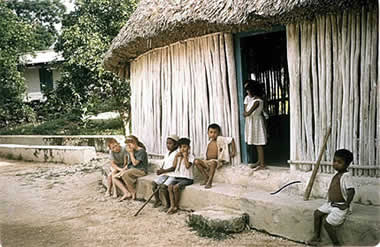
I remember him sitting across a small desk from a Mayan man. I didn’t understand what was happening, but I now know that Dad was learning Mayan by sharing Bible stories with this Indian. That was in 1963. In 1998, Dad gave a devotional at Brigham Young University. He introduced a familiar story in these words: “My beloved teacher, Manuel Tun, told the parable of the prodigal son in his own words in the Maya language of Yucatán.”
Yes, that was the man. Manuel Tun. It was Manuel who tutored Dad, not the other way around. There were details Manuel had added to the story in Luke 15. The prodigal, for one thing, had long hair after his years away from home. In Yucatec Mayan culture, long hair on a man is a sign of extreme poverty or depravity. And there was more. The scriptures say that when the son was “still a great way off, his father saw him and had compassion, and ran and fell on his neck and kissed him.” Dad and Manuel embellished that portion:
Now Johnny came within sight of his father’s house. His father was standing on a hill from where he could look down on the road. Every day he had stood there, hoping to see if by chance his lost son might be coming up the road. And that day, as always, he was there hoping and praying. Suddenly he saw the figure of a young man approaching. His heart jumped. The boy’s clothes weren’t recognizable. They were tattered and dirty. The boy was limping. His hair was long and disheveled. But the father recognized his son, and his heart filled with compassion. Johnny had come home! He ran joyously to meet his son and threw himself on his neck and kissed him. “Johnny, my son, you’ve come back!”
The sentences are short and simple. This is not just a story but an avenue to a new world. This is the foundation of language learning. If you could see the entire story, you would see particular phrases repeated over and over. “The boy”; “the father”; “his son”; “my son”; “I have sinned”; “I know”; “house”; “road”; “lost”; “his heart”. The learner will recognize a word and begin to understand the context, just as a baby does—especially if gestures accompany it. “Is this your hair? Pretty hair. Long hair. Is this my hair? Can you comb my hair? Like this.” Within less than two years, the child is forming basic sentences. As the vocabulary expands, so does the capacity for abstract thought and the synthesis of ideas.
At its most basic, scholarship is relational. Scholars relate to ideas, to fellow students, to teachers, eventually to their own students. Yes, there are some who find the solipsism of the ivory tower inviting and protective; who find very big Latinate words as effective as crocodile-filled motes; who find philosophy a way to divide rather than reconcile humanity. But I think they’re rather rare.
The world has changed since Dad finished his dissertation. Yucatec Mayan is dying, and Dad is eighty-two years old. He has dialysis three times a week, a torment he has endured for nearly six years. There was a time when his blood sugar was out of control and affected his mind. I came into the dialysis center and found him and my mother in tears. He tried to form my name, but couldn’t. “Mar,” he said, his lips quivering. And again: “Mar.” I was suddenly a child and the only word I knew was “Daddy.” He tried to speak several times, and finally managed, “Syntax wrong.” Certainly. He couldn’t get his words in the right order.
He recovered a few days later, and I asked him, “Dad, do you remember the title of your dissertation?”
He shook his head.
“Yucatec Maya Noun and Verb Morpho-Syntax,” I said.
He frowned. “What on earth does that mean?” 
For Christmas I gave him a newspaper article from 1968, talking about Dr. Robert Blair and two Mayan Indians who helped him with translation: Daniel Mich and Manuel Tay. Both are dead now, and the article reminded him not of his own accomplishments but of how much he loved his illiterate “teachers.”
As we approach the end of his time on Earth, we, his family, have some sense of what he has done with his scholarship. He has used it to serve. He always called his Indiana University doctoral robes a “monkey suit,” and was like the LDS scholar Hugh Nibley in his regard for his academic credentials. Nibley was asked to pray at a Brigham Young University commencement and started it thus: “We have met here today clothed in the black robes of the false priesthood to heap upon ourselves the honors of men.”
In the Mormon church, we describe ourselves as seeking “greater light and knowledge.” In the most splendid light, we will surely see others as our own teachers, all of us engaged in personal pilgrimages and often bearing burdens others can’t imagine. We teach best when we abandon the encumbrance of jargon and go to the heart. As I tell my students, “We write to communicate, not to impress.”
I think of Edward Blum, co-author with Paul Harvey of the wonderful Color of Christ. But it’s his essay about his first son which shows Edward in the most resplendent light. I think of my husband, who does wear his crimson robes for every commencement, but who is also a Mormon bishop. He keeps his academic credentials hidden from our congregation. No one should feel intimidated by him when they come for help or seeking his wisdom. He is a shepherd (pastor), not someone defined by a bloated biography. I think of our department chairman, a humorous and brilliant man, who stood by his wife’s coffin in a mortuary as a political rival said, “I wondered if I should come. We don’t always get along.” Our chair put his arm around the “rival” and said, “Oh, that’s in another world. Thank you for being here.”
C.S. Lewis’s master devil (Screwtape) instructs his apprentice: “You see, we need only tweak man’s pride in his intellectual accomplishment, and he will readily throw out a simple and reasonable approach for a far more complicated one, so long as it makes him appear learned and scholarly.”
Yes, it’s not hard to appear scholarly. But the ivory tower eventually collapses, and the apparent scholars are likely to be revealed as the poor naked wretches they are—facing the elements with only words, and with longings they hardly know how to express.
Picture King Lear with the woman he cannot imagine is his own daughter. He addresses her as an unfamiliar spirit after she asks if he knows her, and he finally says, “Pray, do not mock me. I am a very foolish, fond old man…for, as I am a man, I think this child to be my daughter, Cordelia.” But this is not the Cordelia he has imagined as an ungrateful and stubborn girl. She is a heroic and courageous savior. He sees her with new eyes, now capable of discerning the fullness of her light.
How sweet to recognize that the most important words are the names of those we love, and that speaking those names (including the names of deity), recognizing what each of us has meant to the other, is the highest honor we get.
Previous Post

December 27, 2012
Mike Crapo: The First Boy I Kissed
Next Post
January 20, 2013 Dr. King, President Lincoln, and Joseph Smith
Browse Our Archives
Select a Category Ancestors family conflict in the scriptures race and religion Uncategorized
Select a Month August 2026 March 2026 January 2026 December 2025 November 2025 October 2025 September 2025 July 2025 April 2025 March 2025 January 2025 November 2024 May 2024 April 2024 November 2023 October 2023 September 2023 June 2023 September 2022 August 2022 July 2022 May 2022 April 2022 March 2022 January 2022 December 2021 October 2021 September 2021 July 2021 June 2021 October 2020 August 2020 July 2020 June 2020 March 2020 January 2020 December 2019 November 2019 October 2019 June 2019 January 2019 December 2018 November 2018 September 2018 August 2018 May 2018 March 2018 January 2018 November 2017 October 2017 August 2017 July 2017 June 2017 May 2017 March 2017 February 2017 November 2016 October 2016 August 2016 July 2016 June 2016 May 2016 April 2016 March 2016 February 2016 January 2016 November 2015 August 2015 July 2015 May 2015 April 2015 March 2015 February 2015 January 2015 December 2014 November 2014 October 2014 August 2014 July 2014 June 2014 May 2014 April 2014 March 2014 February 2014 January 2014 December 2013 November 2013 October 2013 September 2013 August 2013 July 2013 June 2013 May 2013 April 2013 March 2013 February 2013 January 2013 December 2012
Follow Us!
TAKE THE
Religious Wisdom Quiz
Which Psalm opens with "Blessed is the man"?
Select your answer to see how you score.
Psalm 51 Psalm 23 Psalm 1 Psalm 119
Related posts from The Welcome Table
Truth and Treason, part 3 INCLUDING SPOILERS

TRENDING AT PATHEOS Latter-day Saint

Did Prayer Cure His Cancer? Or Was It...
At 4 AM one morning, Joshua W. Brown’s wife awoke to a...

8 Ways a Near-Death Experience Rewires the Soul
Does Consciousness Survive Physical Death? After 50 Years of Research, Dr. Raymond...

Holy Longing: What Our Restlessness Is Telling Us
“One can find so many pains when the rain is falling.” -John...

What this is NOT about. This blog is definitely not about...

Who said the Israelites were God’s chosen? That’s right, they did. Who...

The Spirit World Is the Real World: God...
A Monk’s Wisdom on Body and Spirit I sit with Brother Martin...
view all Latter-day Saint blogs
Ad-Free & Subscriber Log-In Subscription Support
- About Us
- 2026 Calendar
- Videos
- Podcasts
- Library of World Religions
- Faith In Media Tracker
- Advertise With Us
- Write for Us
- Privacy Policy
- Terms of Service
- Do Not Sell My Data
- Contact Us
- Radiant Digital
- Manage Newsletter Subscriptions
- Unsubscribe From Notifications
- Sitemap
Copyright 2008-2026, Patheos. All rights reserved.
Subscription Support Ad-Free & Subscriber Log-In
Follow Patheos