
BuddhistCatholicContemplativeEvangelicalGeneral ChristianHinduJewishLatter-day SaintMuslimNew VisionsProgressive Christian
Beliefs
- Buddhist
- Catholic
- Contemplative
- Evangelical
- General Christian
- Hindu
- Jewish
- Latter-day Saint
- More Voices
- Muslim
- New Visions
- Pagan
- Progressive Christian
Topics
- Religion News
- Food and Religion
- Sports and Religion
- Religious Art
- Religious Music and Entertainment
- Religious Events
- History and Religion
- Style and Religion
- Politics and Religion
- Women in Religion
- Recreation Outdoors and Religion
- Business Finance and Religion
- Careers Workplace and Religion
- Education and Religion
- Family Parenting and Religion
- Health Fitness and Religion
- Home and Religion
- Relationships and Religion
- Technology and Religion
- Travel and Religion
Columnists
- Buddhist Columnists
- Business Finance and Religion Columnists
- Careers Workplace and Religion Columnists
- Catholic Columnists
- Contemplative Columnists
- Education and Religion Columnists
- Evangelists Columnists
- Family Parenting and Religion Columnists
- General Christian Columnists
- Health Fitness and Religion Columnists
- Hindu Columnists
- History and Religion Columnists
- Home and Religion Columnists
- Jewish Columnists
- More Voices Columnists
- Latter Day Columnists
- Muslim Columnists
- New Visions Columnists
- Nonreligious Columnists
- Pagan Columnists
- Politics and Religion Columnists
- Progressive Columnists
- Recreation Outdoors and Religion Columnists
- Relationships and Religion Columnists
- Religion News Columnists
- Religious Art Columnists
- Religious Events Columnists
- Religious Music and Entertainment Columnists
- Sports and Religion Columnists
- Style and Religion Columnists
- Technology and Religion Columnists
- Travel and Religion Columnists
- Women in Religion Columnists
Resource Library
- 2026 Calendar
- Library of World Religions
- The 100 Most Holy Places on Earth
- Patheos Answers
- Podcasts
- Videos
- Faith Leaders Database
- Anglican Episcopalian
- Bahai
- Baptist
- Buddhism
- Christianity
- Confucianism
- Eastern Orthodoxy
- Hinduism
- Holiness and Pentecostal
- ISKCON
- Islam
- Judaism
- Lutheran
- Methodist
- The Church of Jesus Christ of Latter-day Saints
- New Age
- Paganism
- Presbytarian and Reformed
- Protestantism
- Religion Behind the Scenes
- Roman Catholic
- Scientology
- Shia Islam
- Sikhism
- Sufism
- Sunni Islam
- Taoism
- Zen
- See all religions
Research Tools
 Ad-Free & Subscriber Log-In Subscription Support
Ad-Free & Subscriber Log-In Subscription Support
Follow Patheos 

- Trending:
- Forgiveness
- |
- Marriage
- |
- Consciousness
- |
- Death Penalty
- |
- Election
- |
- Halloween
 Way Station in the Wilderness
- Home
- Catholic
- Giving Thoughtfully: Not All Charity is Charity
Giving Thoughtfully: Not All Charity is Charity
Last updated on: December 5, 2019 at 2:04 pm by Kristy Burmeister
Giving Thoughtfully: Not All Charity is Charity 2019-12-05T14:04:03-05:00 Kristy Burmeister
Patheos Explore the world's faith through different perspectives on religion and spirituality! Patheos has the views of the prevalent religions and spiritualities of the world.

Credit: Pixabay
Charity is good, but we need to be careful about it.
Most of us feel extra charitable around Christmas. As we buy and wrap gifts for our loved ones, we think about all the people who are struggling, and we might look for ways to help them.
It’s easy for us to assume we know what someone else needs, but when you have plenty and have always had plenty, it’s hard to understand what it’s like to live differently. Giving charitably can be wonderful and provide real help, or it can create an additional burden on someone already burdened by poverty.
A friend of mine recently shared an experience she had as a young woman. I asked permission to share her post since it provides some insight most well-meaning people wouldn’t have.
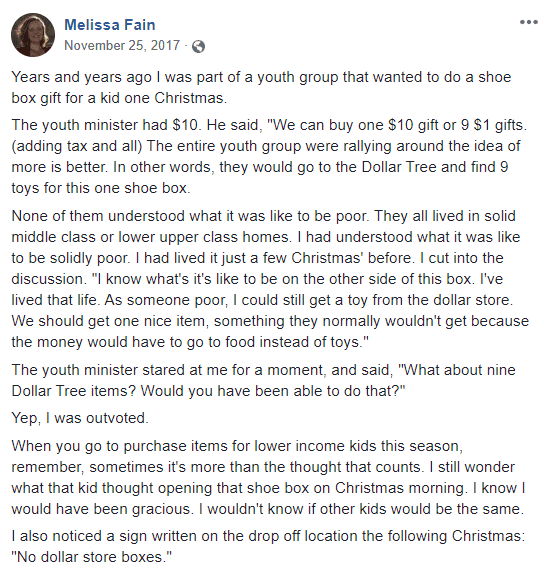
Years and years ago I was part of a youth group that wanted to do a shoe box gift for a kid one Christmas.
The youth minister had $10. He said, “We can buy one $10 gift or 9 $1 gifts. (adding tax and all) The entire youth group were rallying around the idea of more is better. In other words, they would go to the Dollar Tree and find 9 toys for this one shoe box.
None of them understood what it was like to be poor. They all lived in solid middle class or lower upper class homes. I had understood what it was like to be solidly poor. I had lived it just a few Christmas’ before. I cut into the discussion. “I know what’s it’s like to be on the other side of this box. I’ve lived that life. As someone poor, I could still get a toy from the dollar store. We should get one nice item, something they normally wouldn’t get because the money would have to go to food instead of toys.”
The youth minister stared at me for a moment, and said, “What about nine Dollar Tree items? Would you have been able to do that?”
Yep, I was outvoted.
When you go to purchase items for lower income kids this season, remember, sometimes it’s more than the thought that counts. I still wonder what that kid thought opening that shoe box on Christmas morning. I know I would have been gracious. I wouldn’t know if other kids would be the same.
I also noticed a sign written on the drop off location the following Christmas: “No dollar store boxes.”
–Melissa Fain
Melissa had some necessary perspective on giving, but she was ignored. While reading her post, all I could think of was the child who received a box of cheap items on Christmas and was expected to be grateful for it. How demeaning.
I wouldn’t give my own child a box of nine cheap toys. Why would I give that to some other child? Aren’t other children equally as important as my own?
I know what it’s like to be living on the edge and receive “help” that isn’t actually helpful. You have to pretend it’s great because if you don’t, then you’re ungrateful. Poor people are expected to sit under the table like dogs and be thankful for any scraps dropped down to us. It’s dehumanizing.
There were Christmases when what I really wanted was a giant package of toilet paper because the SNAP benefits I had at the time didn’t cover toilet paper. I’m lucky, though. Though I’ve done absolutely nothing to earn it, I happen to have people in my life who are in a position to help if I need someone to step in with armfuls of toilet paper. A lot of people don’t have that.
Still, even when you have the option, asking for help is humbling, if not humiliating, in a society that shames people for living in poverty. Poor people are made in the image of God too, and so many of us have done all the “right” things, and still wound up here. Even the people who’ve made mistakes don’t deserve to be treated like props we drag out every December and toss a few cheap things at to make ourselves feel less guilty about having more than we need. We all make mistakes. Some of us just don’t have a safety net under us when we fall. That’s the only difference between us all.
If you know someone needs help, don’t make them come to you and ask for it. Just do whatever is in your power to do for them, and don’t make a big deal about it. Don’t expect a parade of gratitude just because you’re giving them something extra you had and didn’t absolutely need.
When we give, are we giving the bare minimum because we have the attitude that those poor people should appreciate any old thing we feel like tossing their way? Are we giving what we ourselves would like to receive in those same circumstances? Are we giving thoughtfully and considering what the other person needs or wants to receive? Are we giving without putting any additional emotional burden on someone who is already struggling?
If you received nine cheap items, obviously chosen at random from a dollar store, that you’d just wind up donating because you don’t want or need them, how would you feel? Would you feel differently if you received one, thoughtfully chosen gift? Which gift would best honor your dignity as a person?
Sign up with your email or follow me on Instagram, Twitter, or Facebook to chat with me and keep up with new posts.
Previous Post

October 23, 2019
Converting to Catholicism as a Feminist
Next Post

December 9, 2019 Sitting with Mary
Browse Our Archives
Select a Category Bible Book Review Catholicism Christianity Church Trauma Current Events Feminism Politics Poverty Racism Sacred Forms Saints Sexualized Violence Suffering Writing
Select a Month February 2020 January 2020 December 2019 October 2019 June 2019 May 2019 April 2019 March 2019 February 2019 January 2019 December 2018 November 2018 October 2018 September 2018 August 2018 July 2018
Follow Us!
TAKE THE
Religious Wisdom Quiz
I wept and prayed at the temple, vowing to dedicate my son to the Lord's service. Who am I?
Select your answer to see how you score.
Hannah Sarah Rebekah Rachel
Related posts from Way Station in the Wilderness


Online Christian Communities: An Interview with 4 Leaders

Review: The #MeToo Reckoning by Ruth Everhart
Sacred Forms: The Postpartum Body
TRENDING AT PATHEOS Catholic

Rejecting Doom: Christian Hope And Human Action
Christianity is a religion of hope. We are to have hope and...

It’s What Comes From Within Which Matters
One of the most difficult things for us to understand is why...

Why I Choose the Eucharist Over the Sermon
Choose the Eucharist, Not the Sermon What are we supposed to get...

5 Design Elements Found in Spiritually Rooted Homes
Putting Spirituality Into Home Decor Our homes are more than our living...

Credo: A Story of God Told with the...
About 10 years ago, I began to imagine a personal "Credo" that...

The Anatomy of Divine Revelation in Catholic Thought
The claim that God has made Himself known to human beings is...
view all Catholic blogs
Ad-Free & Subscriber Log-In Subscription Support
- About Us
- 2026 Calendar
- Videos
- Podcasts
- Library of World Religions
- Faith In Media Tracker
- Advertise With Us
- Write for Us
- Privacy Policy
- Terms of Service
- Do Not Sell My Data
- Contact Us
- Radiant Digital
- Manage Newsletter Subscriptions
- Unsubscribe From Notifications
- Sitemap
Copyright 2008-2026, Patheos. All rights reserved.
Subscription Support Ad-Free & Subscriber Log-In
Follow Patheos