
BuddhistCatholicContemplativeEvangelicalGeneral ChristianHinduJewishLatter-day SaintMuslimNew VisionsProgressive Christian
Beliefs
- Buddhist
- Catholic
- Contemplative
- Evangelical
- General Christian
- Hindu
- Jewish
- Latter-day Saint
- More Voices
- Muslim
- New Visions
- Pagan
- Progressive Christian
Topics
- Religion News
- Food and Religion
- Sports and Religion
- Religious Art
- Religious Music and Entertainment
- Religious Events
- History and Religion
- Style and Religion
- Politics and Religion
- Women in Religion
- Recreation Outdoors and Religion
- Business Finance and Religion
- Careers Workplace and Religion
- Education and Religion
- Family Parenting and Religion
- Health Fitness and Religion
- Home and Religion
- Relationships and Religion
- Technology and Religion
- Travel and Religion
Columnists
- Buddhist Columnists
- Business Finance and Religion Columnists
- Careers Workplace and Religion Columnists
- Catholic Columnists
- Contemplative Columnists
- Education and Religion Columnists
- Evangelists Columnists
- Family Parenting and Religion Columnists
- General Christian Columnists
- Health Fitness and Religion Columnists
- Hindu Columnists
- History and Religion Columnists
- Home and Religion Columnists
- Jewish Columnists
- More Voices Columnists
- Latter Day Columnists
- Muslim Columnists
- New Visions Columnists
- Nonreligious Columnists
- Pagan Columnists
- Politics and Religion Columnists
- Progressive Columnists
- Recreation Outdoors and Religion Columnists
- Relationships and Religion Columnists
- Religion News Columnists
- Religious Art Columnists
- Religious Events Columnists
- Religious Music and Entertainment Columnists
- Sports and Religion Columnists
- Style and Religion Columnists
- Technology and Religion Columnists
- Travel and Religion Columnists
- Women in Religion Columnists
Resource Library
- 2026 Calendar
- Library of World Religions
- The 100 Most Holy Places on Earth
- Patheos Answers
- Podcasts
- Videos
- Faith Leaders Database
- Anglican Episcopalian
- Bahai
- Baptist
- Buddhism
- Christianity
- Confucianism
- Eastern Orthodoxy
- Hinduism
- Holiness and Pentecostal
- ISKCON
- Islam
- Judaism
- Lutheran
- Methodist
- The Church of Jesus Christ of Latter-day Saints
- New Age
- Paganism
- Presbytarian and Reformed
- Protestantism
- Religion Behind the Scenes
- Roman Catholic
- Scientology
- Shia Islam
- Sikhism
- Sufism
- Sunni Islam
- Taoism
- Zen
- See all religions
Research Tools
 Ad-Free & Subscriber Log-In Subscription Support
Ad-Free & Subscriber Log-In Subscription Support
Follow Patheos 

- Trending:
- Forgiveness
- |
- Marriage
- |
- Consciousness
- |
- Death Penalty
- |
- Election
- |
- Halloween
 Way Station in the Wilderness
- Home
- Catholic
- Sacred Forms: Basic Female Anatomy
Sacred Forms: Basic Female Anatomy
Last updated on: December 5, 2018 at 11:16 am by Kristy Burmeister
Sacred Forms: Basic Female Anatomy 2018-12-05T11:16:53-05:00 Kristy Burmeister
Patheos Explore the world's faith through different perspectives on religion and spirituality! Patheos has the views of the prevalent religions and spiritualities of the world.
Before getting into how a woman’s body functions, it’s helpful to understand the equipment we’re dealing with. I frequently run into men—and plenty of women—who were never taught basic female anatomy. This information is important for women and men. Even if you don’t have a vagina, someone you care about probably does, and the more you understand about women’s bodies, the better you’ll be able to advocate for women you care about.
This post will focus on primary genitalia. Basically, what’s in our pants (or skirts—I’m not judging your fashion choices.)
The Outside
When we sit through 5th grade health class (or when our mother sits us down to tell us how babies are made), we focus on the internal sex organs and the mechanics of conception and menstruation. Little to no attention is given to women’s external reproductive structures, but they’re important too.
Vulva: This is the outer part of a woman’s genitals.
Labia majora: The vagina is enclosed by two sets of skin folds. The labia majora is the outer set, where hair grows after puberty.
Labia minora: This is the second set of skin folds, just inside the labia majora. It’s important to understand that this set of skin folds can be any size and asymmetrical. Sometimes they aren’t even visible because they’re covered by the labia majora and sometimes they’re longer than the labia majora. Every size and shape is totally normal and has nothing to do with a woman’s health or sexual history.
Urethra: This is a tube that runs from your bladder to the outside of your body. It’s inside the labia minora, just above the vaginal opening. Urine and menstrual blood do not come out of the same opening. Since urine and semen both come out of the penis, sometimes men are confused about that. There is a separate, much smaller opening for urine. This is very important for men to understand if they will be having sex with a woman. Women get urinary tract infections more easily than men. A husband might accidentally increase his wife’s chances of getting a UTI if he introduces bacteria to her urethra. This is incredibly easy to do since the urethra, vagina, and anus are so close to one another. It’s very common for newly married women to have UTIs because they and their husbands don’t know about this. Women should urinate soon after sexual contact to flush out that bacteria before it has time to cause any damage.
Bartholin’s glands: These are two small glands that are below the vaginal opening (inside the labia minora), on either side. These glands provide lubrication for the vagina during sexual arousal. These glands can become blocked, which would most likely result in swelling and pain, especially pain during sex. It’s important to remember a woman should never experience pain during sex. If she does, there’s a problem that needs to be addressed.
Clitoris: This is located above the urethra, right about where the labia minora meet. During about the 11th week of pregnancy, babies begin to develop their external genitalia from a structure called the genital tubercle, which is identical in male and female babies until this time. Male babies develop a penis from it while girl babies develop a clitoris. Both are similar in some ways. The clitoris is covered by a small skin fold and is extremely sensitive, with somewhere around 8,000 nerve endings. Some women have larger clitorises than others, and again, that’s normal. Although the penis and the clitoris develop at the same time and have some similarities, women urinate from their urethras, which is a separate structure.
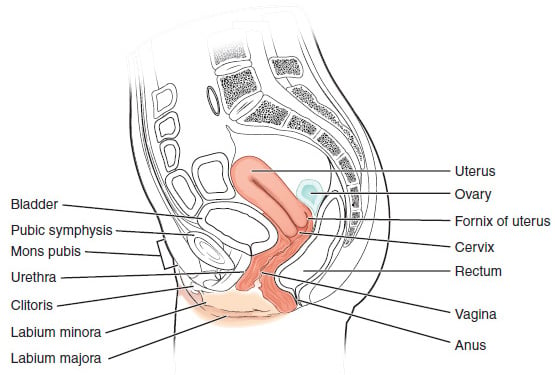
Credit: OpenStax College – Anatomy & Physiology, Connexions (Wikimedia): CC
The Inside
Vagina: The vagina is just below the urethra and above the anus. It’s a stretchy (seriously, entire humans fit through there and it just snaps back) canal that leads to the cervix. When a woman is sexually aroused, the vaginal canal increases lubrication, lengthens, and widens to make intercourse more comfortable. Intercourse is possible when a woman isn’t aroused, but it will be uncomfortable and likely painful for her.
Hymen: This is a small membrane found at the vaginal opening. We could (and probably will) do an entire post on hymens since there is so much misinformation out there. We’ll hit on a few here. The hymen doesn’t usually cover the entire vaginal opening. If it did, how would menstrual blood leave a woman’s body? The hymen stretches and often doesn’t break or tear during sexual contact. Sometimes a woman (yes, even a virgin woman) doesn’t even have a hymen. The presence or lack of a hymen says absolutely nothing about a woman’s virginity. Some hymens can rip during sex, but if a woman feels pain or bleeds the first time she has sex, it’s more likely due to a lack of arousal and lubrication. Women should not expect pain the first time they have sex. A partner who understands women’s bodies can make all the difference there.
Cervix: This is the opening to the uterus. It’s about an inch long and has a small opening that menstrual blood can flow out of and sperm can enter through.
Uterus: This is also known as the womb. It’s where a fertilized egg might implant and develop into a baby. If everything is working correctly, about once a month, the uterus sheds part of its lining. This is where menstrual blood comes from.
Ovaries: These are small glands that are located on either side of the uterus. They produce hormones and release mature eggs about once a month during ovulation (which does not happen at the same time as menstruation.)
Fallopian tubes: These are small tubes that allow eggs to travel from the ovaries into the uterus. They aren’t actually attached to the ovaries, so the egg has to float over to the tube’s opening. Fertilization usually happens in the fallopian tube, then the fertilized egg continues to travel down the tube until it implants in the uterus. Because fertilization usually happens outside the uterus, it’s possible for the fertilized egg to implant outside the uterus. This is called an ectopic pregnancy, a dangerous complication.
Sex and women’s reproductive organs are more interesting than this overview might make it seem, so we’ll be exploring several of these body parts in more detail in future posts.
Sign up with your email to receive updates or follow me on Facebook or Twitter.
Previous Post

December 3, 2018
Desperately Seeking Bethlehem: Advent and Seasonal Depression
Next Post
December 12, 2018 Sacred Forms: The Menstrual Cycle
Browse Our Archives
Select a Category Bible Book Review Catholicism Christianity Church Trauma Current Events Feminism Politics Poverty Racism Sacred Forms Saints Sexualized Violence Suffering Writing
Select a Month February 2020 January 2020 December 2019 October 2019 June 2019 May 2019 April 2019 March 2019 February 2019 January 2019 December 2018 November 2018 October 2018 September 2018 August 2018 July 2018
Follow Us!
TAKE THE
Religious Wisdom Quiz
What book of the Bible tells about Jesus’ birth?
Select your answer to see how you score.
Luke Acts Hebrews Revelation
Related posts from Way Station in the Wilderness

Online Christian Communities: An Interview with 4 Leaders
Review: The #MeToo Reckoning by Ruth Everhart

Sacred Forms: The Postpartum Body
TRENDING AT PATHEOS Catholic

Rejecting Doom: Christian Hope And Human Action
Christianity is a religion of hope. We are to have hope and...

It’s What Comes From Within Which Matters
One of the most difficult things for us to understand is why...

Why I Choose the Eucharist Over the Sermon
Choose the Eucharist, Not the Sermon What are we supposed to get...

5 Design Elements Found in Spiritually Rooted Homes
Putting Spirituality Into Home Decor Our homes are more than our living...

Credo: A Story of God Told with the...
About 10 years ago, I began to imagine a personal "Credo" that...

The Anatomy of Divine Revelation in Catholic Thought
The claim that God has made Himself known to human beings is...
view all Catholic blogs
Ad-Free & Subscriber Log-In Subscription Support
- About Us
- 2026 Calendar
- Videos
- Podcasts
- Library of World Religions
- Faith In Media Tracker
- Advertise With Us
- Write for Us
- Privacy Policy
- Terms of Service
- Do Not Sell My Data
- Contact Us
- Radiant Digital
- Manage Newsletter Subscriptions
- Unsubscribe From Notifications
- Sitemap
Copyright 2008-2026, Patheos. All rights reserved.
Subscription Support Ad-Free & Subscriber Log-In
Follow Patheos