
BuddhistCatholicContemplativeEvangelicalGeneral ChristianHinduJewishLatter-day SaintMuslimNew VisionsProgressive Christian
Beliefs
- Buddhist
- Catholic
- Contemplative
- Evangelical
- General Christian
- Hindu
- Jewish
- Latter-day Saint
- More Voices
- Muslim
- New Visions
- Pagan
- Progressive Christian
Topics
- Religion News
- Food and Religion
- Sports and Religion
- Religious Art
- Religious Music and Entertainment
- Religious Events
- History and Religion
- Style and Religion
- Politics and Religion
- Women in Religion
- Recreation Outdoors and Religion
- Business Finance and Religion
- Careers Workplace and Religion
- Education and Religion
- Family Parenting and Religion
- Health Fitness and Religion
- Home and Religion
- Relationships and Religion
- Technology and Religion
- Travel and Religion
Columnists
- Buddhist Columnists
- Business Finance and Religion Columnists
- Careers Workplace and Religion Columnists
- Catholic Columnists
- Contemplative Columnists
- Education and Religion Columnists
- Evangelists Columnists
- Family Parenting and Religion Columnists
- General Christian Columnists
- Health Fitness and Religion Columnists
- Hindu Columnists
- History and Religion Columnists
- Home and Religion Columnists
- Jewish Columnists
- More Voices Columnists
- Latter Day Columnists
- Muslim Columnists
- New Visions Columnists
- Nonreligious Columnists
- Pagan Columnists
- Politics and Religion Columnists
- Progressive Columnists
- Recreation Outdoors and Religion Columnists
- Relationships and Religion Columnists
- Religion News Columnists
- Religious Art Columnists
- Religious Events Columnists
- Religious Music and Entertainment Columnists
- Sports and Religion Columnists
- Style and Religion Columnists
- Technology and Religion Columnists
- Travel and Religion Columnists
- Women in Religion Columnists
Resource Library
- 2026 Calendar
- Library of World Religions
- The 100 Most Holy Places on Earth
- Patheos Answers
- Podcasts
- Videos
- Faith Leaders Database
- Anglican Episcopalian
- Bahai
- Baptist
- Buddhism
- Christianity
- Confucianism
- Eastern Orthodoxy
- Hinduism
- Holiness and Pentecostal
- ISKCON
- Islam
- Judaism
- Lutheran
- Methodist
- The Church of Jesus Christ of Latter-day Saints
- New Age
- Paganism
- Presbytarian and Reformed
- Protestantism
- Religion Behind the Scenes
- Roman Catholic
- Scientology
- Shia Islam
- Sikhism
- Sufism
- Sunni Islam
- Taoism
- Zen
- See all religions
Research Tools
 Ad-Free & Subscriber Log-In Subscription Support
Ad-Free & Subscriber Log-In Subscription Support
Follow Patheos 

- Trending:
- Forgiveness
- |
- Marriage
- |
- Consciousness
- |
- Death Penalty
- |
- Election
- |
- Halloween
 Way Station in the Wilderness
- Home
- Catholic
- Suffering in the Multiverse
Suffering in the Multiverse
Last updated on: August 13, 2018 at 6:23 pm by Kristy Burmeister
Suffering in the Multiverse 2018-08-13T18:23:10-04:00 Kristy Burmeister
Patheos Explore the world's faith through different perspectives on religion and spirituality! Patheos has the views of the prevalent religions and spiritualities of the world.
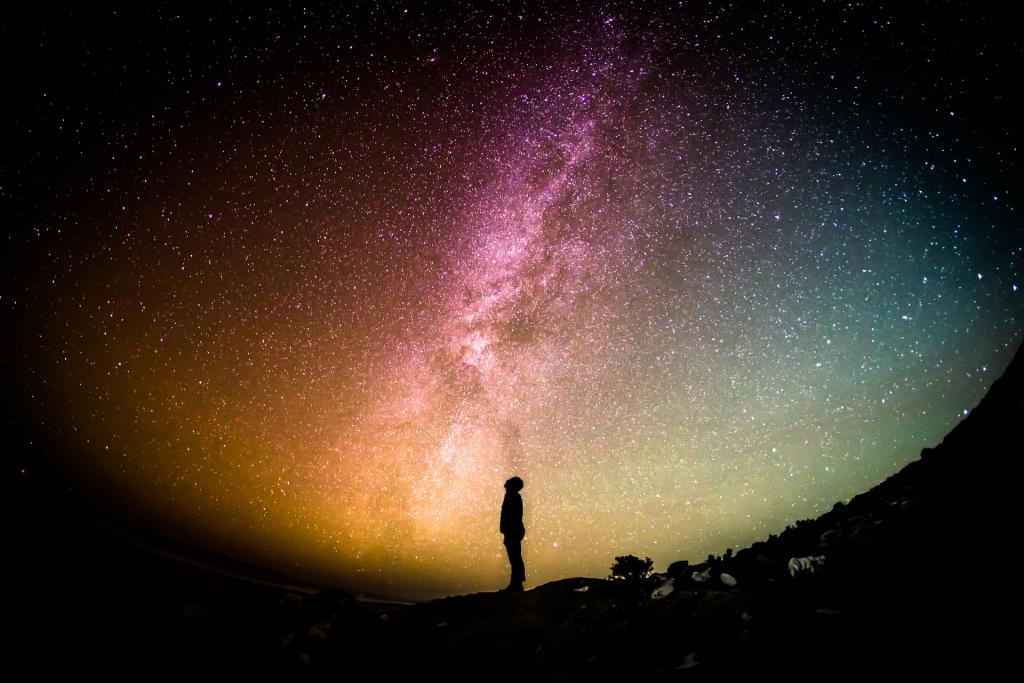
Image credit: Pixabay
When I was nineteen, I worked as a drugstore cashier for a while. I usually took my breaks alone, so I always kept some reading material in the back room.
Two of my favorite magazines to read in the break room were Cosmo and Scientific American—sex and science. Since I was only about a year out of my fundamentalist church, I had some information gaps in both areas. (Don’t worry. I did know enough not to believe Cosmo sex advice.)
I don’t remember if it was Scientific American or some other science magazine, but one night I read an article about multiple universes.
After that, I was in love with the idea of multiple universes and read everything I could reasonably understand about them. I was especially attracted to the idea that if anything could have happened, it did happen in some universe. If that was true, there was another universe out there where I had never suffered at all.
Where I’d never been the new kid who got bullied.
Where an older man had never gotten obsessed with me.
Where I’d never been abandoned by my church.
Where I hadn’t had to give up in my full scholarship just to stay alive.
In some other universe, I was happy. I was safe.
Of course, that meant in some other universe I was also dead. Or I had never existed because my parents never met. But I clung to this alternate me who had it good.
I keep coming back to these other Kristys. What was down all those roads I never took? The older I get, the less I wonder how life could have been different for me, and the more I wonder how life could have been different around me.
We don’t live our lives in total isolation, no matter how much we intentionally might isolate ourselves. We’re all connected, in big ways and small. Sometimes those small ways ripple out into waves.
What ripples have I created in this universe?
Yes, I know, it’s all sounding very It’s a Wonderful Life right now.
But it’s more than “what would happen if I didn’t exist?” It’s about what would happen if we didn’t live the lives we’re living now.
I have a complicated relationship with my own suffering.
I want to be clear here: I do not believe God causes any suffering I experience.
Suffering itself is evil. We may be able to turn it around and use it for good, but it exists as evil. Nothing evil can come from God.
Having said that, the older I get and the more life piles up on me, the less angry I am with God for not intervening in my life. I mean, if God is God, then he could intervene. He could heal my DNA and remove all this physical pain from me. He could have struck down the man who wanted to murder me.
He could have done those things, but he didn’t.
Because God did nothing, as a teenager, I lost my home, my educational opportunities, my church, and my entire community. As an adult dealing with chronic health problems, I lost every bit of ground I’d gained in rebuilding my life when I had to give up my career.
I have my family (which counts for a lot) and I’m not homeless (currently) but everything I’ve ever worked for is gone.
There was a moment, about three years ago, when I realized I didn’t have anything left to lose. And that meant I was free.
I’ve been writing for a long time, but always kept my head down about it. I didn’t want to say anything that might be too controversial and come across as unprofessional in a way that would interfere with my career goals. But you can’t lose a job you don’t have. I never could have written my book if I hadn’t been forced to give up my career.
Three years ago, when I started writing my memoir, I never would have guessed #metoo and #churchtoo would blow up. I didn’t know we would experience this push toward accountability. I didn’t know there were so many other people out there who had also been deeply wounded by their religious communities.
But God knew.
Am I a vital part of this movement? I doubt it. But I do have some small role to play, if I’m willing. If all I ever do is help a dozen people, aren’t those people worth helping?
I wonder what opportunities to help others that alternate version of me has had. Does she worry so much about losing everything that she refuses to help? Has her lack of suffering robbed her of empathy?
Imagine if we could stand with God above all possible universes and see each potential path our lives could have taken laid out in front of us.
One of those little universes contains the choices we’d make and the circumstances we’d live in that would ultimately lead to our best ability to help build God’s kingdom.
Would we willingly choose that option, even if that option meant we’d suffer? Would we choose to suffer if that suffering took us twisting down trails where we could have the most impact?
I hope I would. I pray I have.
I’m not glad I had a stalker who wanted to kill me, but leaving that church opened up so many more possibilities for me to work for God. I never would have left that church if something huge hadn’t chased me out.
I’m not glad I have a genetic condition that causes me pain, but leaving my job opened up possibilities I couldn’t have explored while worrying about my career. I’d worked extremely hard to move up, and I never would have abandoned my career if I hadn’t had to.
I don’t rejoice in my suffering so much as I understand how it drives me. I still get angry, and I think that’s OK. That’s human. I want to have control over my own life and I’ve so often had that control ripped from me. Even though, overall, I can see how some of the suffering in my life has put me into a position to do some real good, sometimes my emotional and physical pain makes it harder for me to help the people I want to help. None of this is simple.
When I’m standing here, in our universe where my life is small and my reach is short, I mourn for what I could have been.
When I’m standing above and view all the possible routes before zooming in on my life, not an isolated life, but one interconnected with so many others in so many ways, I start to get it.
Coming to some sort of peace with our own suffering should never be weaponized against other people. We should become more empathetic, not less. Not all suffering leads to opportunities. Sometimes suffering is just pain. Uniting our suffering with Christ’s is a different conversation (and something we can choose to do, but can’t force on someone else.)
We should always work to stop suffering when we see it. That’s the whole point of getting some perspective on our own pain.
Previous Post
August 9, 2018
The Power of the Laity to Support Victims
Next Post
August 15, 2018 Ears to Hear: Pennsylvania Grand Jury Report
Browse Our Archives
Select a Category Bible Book Review Catholicism Christianity Church Trauma Current Events Feminism Politics Poverty Racism Sacred Forms Saints Sexualized Violence Suffering Writing
Select a Month February 2020 January 2020 December 2019 October 2019 June 2019 May 2019 April 2019 March 2019 February 2019 January 2019 December 2018 November 2018 October 2018 September 2018 August 2018 July 2018
Follow Us!
TAKE THE
Religious Wisdom Quiz
What did Jesus use to feed the 5,000?
Select your answer to see how you score.
Grapes and figs A basket of quail Manna from heaven Five loaves and two fish
Related posts from Way Station in the Wilderness
Online Christian Communities: An Interview with 4 Leaders
Review: The #MeToo Reckoning by Ruth Everhart
Sacred Forms: The Postpartum Body
TRENDING AT PATHEOS Catholic

The Parable Of The Sower And The Word...
One of Christ’s most famous parables is that of the sower who...

Rejecting Doom: Christian Hope And Human Action
Christianity is a religion of hope. We are to have hope and...

Why I Choose the Eucharist Over the Sermon
Choose the Eucharist, Not the Sermon What are we supposed to get...

5 Design Elements Found in Spiritually Rooted Homes
Putting Spirituality Into Home Decor Our homes are more than our living...

Credo: A Story of God Told with the...
About 10 years ago, I began to imagine a personal "Credo" that...

The Anatomy of Divine Revelation in Catholic Thought
The claim that God has made Himself known to human beings is...
view all Catholic blogs
Ad-Free & Subscriber Log-In Subscription Support
- About Us
- 2026 Calendar
- Videos
- Podcasts
- Library of World Religions
- Faith In Media Tracker
- Advertise With Us
- Write for Us
- Privacy Policy
- Terms of Service
- Do Not Sell My Data
- Contact Us
- Radiant Digital
- Manage Newsletter Subscriptions
- Unsubscribe From Notifications
- Sitemap
Copyright 2008-2026, Patheos. All rights reserved.
Subscription Support Ad-Free & Subscriber Log-In
Follow Patheos