
BuddhistCatholicContemplativeEvangelicalGeneral ChristianHinduJewishLatter-day SaintMuslimNew VisionsProgressive Christian
Beliefs
- Buddhist
- Catholic
- Contemplative
- Evangelical
- General Christian
- Hindu
- Jewish
- Latter-day Saint
- More Voices
- Muslim
- New Visions
- Pagan
- Progressive Christian
Topics
- Religion News
- Food and Religion
- Sports and Religion
- Religious Art
- Religious Music and Entertainment
- Religious Events
- History and Religion
- Style and Religion
- Politics and Religion
- Women in Religion
- Recreation Outdoors and Religion
- Business Finance and Religion
- Careers Workplace and Religion
- Education and Religion
- Family Parenting and Religion
- Health Fitness and Religion
- Home and Religion
- Relationships and Religion
- Technology and Religion
- Travel and Religion
Columnists
- Buddhist Columnists
- Business Finance and Religion Columnists
- Careers Workplace and Religion Columnists
- Catholic Columnists
- Contemplative Columnists
- Education and Religion Columnists
- Evangelists Columnists
- Family Parenting and Religion Columnists
- General Christian Columnists
- Health Fitness and Religion Columnists
- Hindu Columnists
- History and Religion Columnists
- Home and Religion Columnists
- Jewish Columnists
- More Voices Columnists
- Latter Day Columnists
- Muslim Columnists
- New Visions Columnists
- Nonreligious Columnists
- Pagan Columnists
- Politics and Religion Columnists
- Progressive Columnists
- Recreation Outdoors and Religion Columnists
- Relationships and Religion Columnists
- Religion News Columnists
- Religious Art Columnists
- Religious Events Columnists
- Religious Music and Entertainment Columnists
- Sports and Religion Columnists
- Style and Religion Columnists
- Technology and Religion Columnists
- Travel and Religion Columnists
- Women in Religion Columnists
Resource Library
- 2026 Calendar
- Library of World Religions
- The 100 Most Holy Places on Earth
- Patheos Answers
- Podcasts
- Videos
- Faith Leaders Database
- Anglican Episcopalian
- Bahai
- Baptist
- Buddhism
- Christianity
- Confucianism
- Eastern Orthodoxy
- Hinduism
- Holiness and Pentecostal
- ISKCON
- Islam
- Judaism
- Lutheran
- Methodist
- The Church of Jesus Christ of Latter-day Saints
- New Age
- Paganism
- Presbytarian and Reformed
- Protestantism
- Religion Behind the Scenes
- Roman Catholic
- Scientology
- Shia Islam
- Sikhism
- Sufism
- Sunni Islam
- Taoism
- Zen
- See all religions
Research Tools
 Ad-Free & Subscriber Log-In Subscription Support
Ad-Free & Subscriber Log-In Subscription Support
Follow Patheos 

- Trending:
- Forgiveness
- |
- Marriage
- |
- Consciousness
- |
- Death Penalty
- |
- Election
- |
- Halloween

- Home
- Pagan
- Clootie and the Sacred Well
Clootie and the Sacred Well
Last updated on: April 26, 2018 at 1:51 pm by Annwyn Avalon
Clootie and the Sacred Well 2018-04-26T13:51:35-08:00 Annwyn Avalon
Patheos Explore the world's faith through different perspectives on religion and spirituality! Patheos has the views of the prevalent religions and spiritualities of the world.
Water is sacred and a wonderful and an endangered resource. We are made of 70% water and we rely on it for our very existence. The ancients knew this, and thus many wells and springs have been considered sacred, magical and holy throughout space and time. Sacred Wells are places of healing, magic, wisdom, liminal space, threshold, and the otherworld. They are said to be associated with nymphs, faery, spirits, saints and witches! Archeology shows us that water and specifically wells and springs were a place where items both simple and extravagant have been deposited as offerings, sacrifices and often to strike a bargain with the local water spirit; some of these included coins, pins, gold and rags called Clootie.
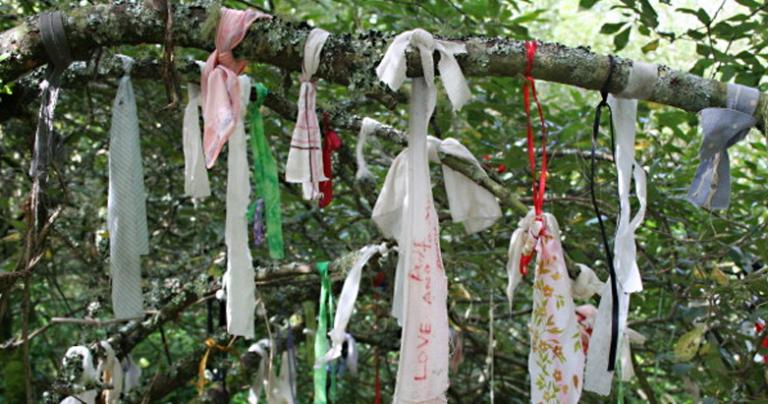
Clootie in a tree- Wikipedia Commons
In Europe, specifically the United Kingdom, sacred wells and founts are holy ground for both Pagans and Christians. Many of the practices there are considered to be dual faith and many wells hold egregore that is both Christian and Pagan. It is widely believed that sacred wells originally were associated with otherworldly beings such as faery, spirits and Water Goddess. Sulis’ temple at Bath and Brigid’s well in Ireland are perfect examples. During Pre-Christian times wells were often dedicated to a spirit or goddess. With the rise of Christianity there was no place in the new religion for these beings and for female deity or spirits. The cult of the Holy Mother or Virgin Mary gave rise to a new goddess in these sacred lands and with it an entire pantheon of saints that began to replace the pagan spirits and gods at many sacred wells. The faery women began to disappear and young Christian women who could perform miracles such as St. Keynes, St. Sidwell and St. Hilda began to replace them. Often time’s sacred wells and founts would have slight changes in their associations some being faery women to young Christian women saints, other times they would be converted to a male saint who would be associated instead.
Long have Sacred wells been associated with miraculous acts, dreaming, prophecy and even cursing, however one of the most well known things that a sacred well is associated with is healing. While there are a vast number of customs and spells associated with sacred wells one of the most famous folk practices is healing with Clootie. Clootie or Cloutie are torn rags, dipped in holy water and hung in a tree. Clootie comes from the Scottish word Cloot which means “Strips of fabric”. Clootie as related to Sacred wells and healing rites are strips of fabric that are torn from the clothing in various manner, then dipped in water from the sacred well or spring and finally tied in a near by sacred tree.
Traditionally someone who was hurt or needed healing would approach a healing well, tear a piece of fabric from the clothing they were wearing close to or on the area that needed healing. They would then dip the rag into the holy water and then hang it in a hazel, thorn or other sacred tree. A variation of this includes the inflicted person dipping themselves in the sacred waters, then they would tear a clootie from the injured location or body and hang it in a tree. Another variation still would be to dip the clootie in the water and then tie it on the injured area for a while and then place it in the tree. Here the spirit of both the water and tree are being used in healing magic, through transference of the disease or problem to the tree.
One practice at a well included going to the well and performing a clootie rite in secret and then returning home a different way than you left. Some clootie are greased and placed under rocks near or at the entrance of the well, while others are hung. It is said that a rag or Clootie should never be removed from the well once it has been deposited there. Never remove someones Clootie as you risk taking on the problem yourself!
It is important to note that it is believed the energy of the well in addition to the curative properties of the waters which often were saturated with minerals such as iron, bicarbonates, magnesium and calcium would bring about the healing. Many believe that the curative properties of the water along with charms and prayers are essential parts to these rites. Other rites include circling wells, most often in a sun wise direction which is believed to be lucky, though other rites in other regions call for circumambulating around the well counter clock wise for different results.
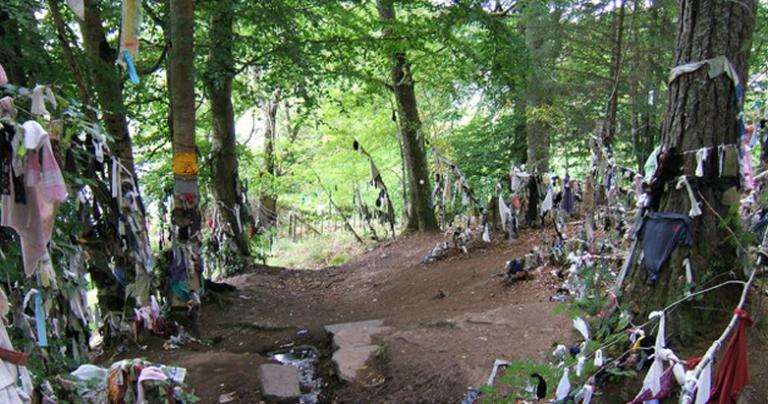
Clootie- Wikipedia Commons
Most sacred wells have some type of tree associated with them. There are many trees that are often associated with sacred water sites or holy wells; they include Hawthorn, Hazel, Blackthorn, Yew, Rowan, Elder, Ash, Holly and Oak. Hawthorn is particularly important because it is a faery tree and the thorns are often used to pierce the clootie on. Hazel is a sacred tree to the Druids and is associated with wisdom, protection and the otherworld and is associated with sacred wells and the Well of Wisdom. Famous wells such as Sancreed well are in a pine and holly grove while others such as Madron’s well is surrounded by blackthorn and hawthorn. The chalice well is guarded by two majestic yew trees and the White Well flows from beneath the Glastonbury Tor which is associated with apple trees and the Holy Thorn. St. Keynes well is associated with Oak, Ash, Elm and willow however by the late 1800s only the ash and elm remain.
From Ireland to Cornwall many wells have been adorned with healing rags. Would you like to perform a clootie rite or spell at a local sacred water source? Is there a tree close to your sacred water source? Can a clootie ritual be performed here? If so give it a try and begin to work with these energies! Perhaps you would like to start working with a sacred tree at a sacred local water source, or one in your own backyard by blessing it and beginning to tie rags as offerings and healing spells.
Play with different sacred and holy waters or visit a water fall or sacred water site near your home. Don’t forget to be creative and follow your intuition! When performing your clootie rite if you don’t wish to tear your clothing, select a piece of natural fabric and tie it over the area that needs healing. After nine days dip the rag in the holy water or well and then tie it in a tree or impale it upon a hawthorn thorn. Perhaps use an old rag or current piece of clothing to create the fabric strip.
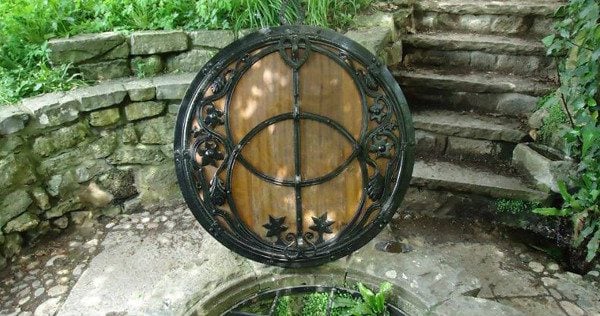
Chalice Well – Image by Annwyn
It is important to note that the old practice would have used a biodegradable cloth or ribbon which over time would decay and it was believed that as it did so would the illness. Much of our modern fabric is synthetic and great care should be taken to perform your clootie rite with fabric that is healthy for the environment and bio degradable. Do be careful not to insult the water spirit or well guardian that dwells there by contaminating their sacred and precious water and it is always good etiquette to give an environmentally friendly offerings when you perform a rite at a sacred site. It is also important to note that it is believed the energy of the well in addition to the curative properties of the waters that bring about the healing, so be sure to connect with the local spirit and ask for their blessing on your clootie rite.
There are thousands of sacred water sites in the UK and Europe; many featuring a rich esoteric history of spells, rituals and customs. From Ireland to Cornwall many wells have been adorned with healing rags which bring each well a rich egregore of esoteric practices. Throughout history, mythology and folklore we know that otherworldly creatures like faery women and saints performed miraculous rites at these sites, however wells are not limited to just these magical women. Many notorious witches such as Mother Shipton were known to live near wells. Today many sacred wells are visited in England, Cornwall and Ireland such as The Chalice Well, The White Well, St. Madrons Well, Sancreed Well, and Brigid’s well just to name a few. Healing rites and working with the local water spirits at sacred wells have become popular once again and we as witches, pagans and magical folk have an opportunity to deepen the egregore and strengthen the magic surrounding Sacred and Holy water sites worldwide.
Learn more about Annwyn and Water Magic by clicking here
Previous Post

March 30, 2018
Creating a Garden Grotto
Next Post

June 20, 2018 Bathing in Luscious Blooms
Browse Our Archives
Select a Category Uncategorized
Select a Month May 2026 February 2026 November 2025 October 2025 July 2025 April 2025 March 2025 February 2025 January 2025 December 2024 November 2024 August 2024 May 2024 March 2024 January 2024 December 2023 September 2023 June 2023 May 2023 December 2022 September 2022 June 2022 March 2022 January 2022 October 2021 September 2021 June 2021 March 2021 February 2021 December 2020 November 2020 October 2020 September 2020 August 2020 July 2020 June 2020 May 2020 April 2020 March 2020 February 2020 January 2020 October 2019 September 2019 August 2019 July 2019 June 2019 May 2019 April 2019 February 2019 January 2019 November 2018 October 2018 August 2018 July 2018 June 2018 April 2018 March 2018 February 2018 January 2018 December 2017 November 2017 October 2017 September 2017 August 2017 July 2017 June 2017 May 2017 April 2017 March 2017 February 2017 January 2017 April 2016 March 2016 January 2016 December 2015 November 2015 October 2015 July 2015 April 2015 March 2015 January 2015 December 2014 September 2014 August 2014 July 2014 June 2014 May 2014 April 2014 March 2014 February 2014 January 2014 December 2013 November 2013 October 2013 September 2013 July 2013 June 2013 April 2013 March 2013 February 2013 January 2013 December 2012 November 2012 October 2012 September 2012 August 2012 July 2012 June 2012 May 2012 March 2012
Follow Us!
TAKE THE
Religious Wisdom Quiz
Which book of the Bible contains the most direct prophecies about the Messiah?
Select your answer to see how you score.
Isaiah Zechariah Micah Psalms
Related posts from Water Priestess
Sacred Waters During Turbulent Times
Bali saved me from returning to the White...
Here is how I healed my Mother Line
TRENDING AT PATHEOS Pagan

I was recently chatting with someone on Instagram. She asked me what...

While there are many people who share their results, the end of...

On July 23, I saw Christopher Nolan's The Odyssey which is Homer’s...

As I write this two big events have just finished up. One...

Restoring the Watershed of Divine Love
Perhaps cooperation is not something we manufacture through legislation, ideology, or moral...

Many UUs don’t pray because of bad experiences in a previous religion,...
view all Pagan blogs
Ad-Free & Subscriber Log-In Subscription Support
- About Us
- 2026 Calendar
- Videos
- Podcasts
- Library of World Religions
- Faith In Media Tracker
- Advertise With Us
- Write for Us
- Privacy Policy
- Terms of Service
- Do Not Sell My Data
- Contact Us
- Radiant Digital
- Manage Newsletter Subscriptions
- Unsubscribe From Notifications
- Sitemap
Copyright 2008-2026, Patheos. All rights reserved.
Subscription Support Ad-Free & Subscriber Log-In
Follow Patheos