
BuddhistCatholicContemplativeEvangelicalGeneral ChristianHinduJewishLatter-day SaintMuslimNew VisionsProgressive Christian
Beliefs
- Buddhist
- Catholic
- Contemplative
- Evangelical
- General Christian
- Hindu
- Jewish
- Latter-day Saint
- More Voices
- Muslim
- New Visions
- Pagan
- Progressive Christian
Topics
- Religion News
- Food and Religion
- Sports and Religion
- Religious Art
- Religious Music and Entertainment
- Religious Events
- History and Religion
- Style and Religion
- Politics and Religion
- Women in Religion
- Recreation Outdoors and Religion
- Business Finance and Religion
- Careers Workplace and Religion
- Education and Religion
- Family Parenting and Religion
- Health Fitness and Religion
- Home and Religion
- Relationships and Religion
- Technology and Religion
- Travel and Religion
Columnists
- Buddhist Columnists
- Business Finance and Religion Columnists
- Careers Workplace and Religion Columnists
- Catholic Columnists
- Contemplative Columnists
- Education and Religion Columnists
- Evangelists Columnists
- Family Parenting and Religion Columnists
- General Christian Columnists
- Health Fitness and Religion Columnists
- Hindu Columnists
- History and Religion Columnists
- Home and Religion Columnists
- Jewish Columnists
- More Voices Columnists
- Latter Day Columnists
- Muslim Columnists
- New Visions Columnists
- Nonreligious Columnists
- Pagan Columnists
- Politics and Religion Columnists
- Progressive Columnists
- Recreation Outdoors and Religion Columnists
- Relationships and Religion Columnists
- Religion News Columnists
- Religious Art Columnists
- Religious Events Columnists
- Religious Music and Entertainment Columnists
- Sports and Religion Columnists
- Style and Religion Columnists
- Technology and Religion Columnists
- Travel and Religion Columnists
- Women in Religion Columnists
Resource Library
- 2026 Calendar
- Library of World Religions
- The 100 Most Holy Places on Earth
- Patheos Answers
- Podcasts
- Videos
- Faith Leaders Database
- Anglican Episcopalian
- Bahai
- Baptist
- Buddhism
- Christianity
- Confucianism
- Eastern Orthodoxy
- Hinduism
- Holiness and Pentecostal
- ISKCON
- Islam
- Judaism
- Lutheran
- Methodist
- The Church of Jesus Christ of Latter-day Saints
- New Age
- Paganism
- Presbytarian and Reformed
- Protestantism
- Religion Behind the Scenes
- Roman Catholic
- Scientology
- Shia Islam
- Sikhism
- Sufism
- Sunni Islam
- Taoism
- Zen
- See all religions
Research Tools
 Ad-Free & Subscriber Log-In Subscription Support
Ad-Free & Subscriber Log-In Subscription Support
Follow Patheos 

- Trending:
- Forgiveness
- |
- Marriage
- |
- Consciousness
- |
- Death Penalty
- |
- Election
- |
- Halloween
 Water into Wine by Lisa Mladinich
- Home
- Catholic
- Broken Gods: Review
Broken Gods: Review
Last updated on: June 6, 2015 at 6:35 pm by Lisa Mladinich
Broken Gods: Review 2015-06-06T18:35:39-04:00 Lisa Mladinich
Patheos Explore the world's faith through different perspectives on religion and spirituality! Patheos has the views of the prevalent religions and spiritualities of the world.
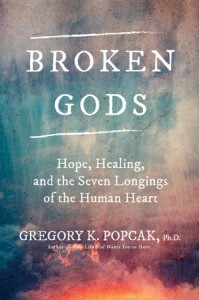 REVIEW: Broken Gods: Hope, Healing, and the 7 Longings of the Human Heart, by Gregory K. Popcak, Ph.D. (Image Books)
[This post originally appeared at AmazingCatechists.com on June 2, 2015.]
Did you know that God is slowly transforming you into a god and that a holy code exists that unlocks the secrets of this process?
From the earliest days of the Church, this process, called “divinization,” has been recognized and believed by all of Christianity. Since God shares his nature with us through adoption, and since his grace transforms and heals us as we journey toward heaven, we gradually become more authentic reflections of his divine image: glorious, perfect, and completely fulfilled.
But of what use is this insight to us as we struggle to comprehend our everyday joys and sorrows?
Dr. Gregory K. Popcak, an eminent and faithful Catholic psychologist and radio host has authored many superb books, some of which I own and love. His newest title, which I received from his publisher for review, Broken Gods: Hope, Healing, and the 7 Longings of the Human Heart, continues to raise the bar on his greatest strength: synthesizing faith, science, and psychology in ways that empower relationships and nourish souls.
Since the fall of human kind, human beings created in the image and likeness of God, willed into existence in order to share in the divine nature, have been broken and confused about our own worth and destiny. Our deepest longings, Popcak explains, can lead us deeper into confusion or, when properly understood, can mark a powerful and beautiful path of sanctity, joy, and ultimate fulfillment.
Popcak’s thrilling work explores the seven principle desires of the human heart for abundance, dignity, justice, peace, trust, well-being, and communion, and reveals the holy code hidden within our sufferings. By weaving psychology, science, spirituality, engaging case studies, and a simple, but powerful, step-by-step system for increasing understanding and self-awareness, he unpacks those buried longings so that we can pursue them more authentically through the prism of God’s call to our hearts.
I underlined so much and turned down so many pages that struck and inspired me that I’d have to quote most of the book in order to provide a complete understanding of why I so highly recommend this unique work; so I’ll have to pick just a few excerpts and ideas and let you discover the rest on your own!
Popcak really got my attention early in the book with this:
Though we are often tempted to feel that our lives and hopes and dreams are burning down around us, deification is the blueprint that allows us to rebuild our lives from the ashes and become everything God intended us to be from the beginning… Understanding deification enables us to finally stop running from our sins and instead begin running toward divinity. (p. 7)
On page 11, Popcak references an image taken from the prodigal son’s return, saying that God meets us as we humbly approach him in fear and trembling:
And yet, even that understandable fear is cast out by the perfect love (see 1 Jn 4:18) that flows from the heart of God, who calls to us, runs to meet us on the road, and wraps his finest cloak–his divinity–around us (see Lk 15:22).
I’ll give you a sense of how much just the foundational chapters effected me. In a section called, “The Inner Ache” (p. 14), I had an epiphany and wrote this in the margin:
Do I believe that God, in his desire to share his nature with me, has truly AMAZING plans for my life? If I do, then my dreams are SACRED and should have my TOTAL COMMITMENT.
In Chapter Two, the author asks,
What if there was a way to stop being afraid of your desires?
and goes on to explain that
…even your most neurotic and destructive desires can be transformed into an engine of divine actualization that can propel you down the path toward both a more joyful life in the present and the fulfillment of your ultimate destiny… (p. 17)
Later he says,
These seven divine longings have such tremendous potential to propel us toward divinization that Satan works hard to keep them hidden where we are least likely to look, behind the parts of ourselves we hate the most. (p. 25)
Did you catch that? The greatest treasures of our souls are often hidden in our self-hatred.
Lest you suspect that the book merely proposes these life-altering, hope-filled ideas, the rest of his work is specific, practical, and sites fascinating examples of actual individuals and couples whose lives and relationships were profoundly healed through the methods Popcak employs, based on these concepts.
Both our bodies and our brains are hardwired for holiness. Using neuroscience, genetic studies, and the theology of the body, Dr. Popcak reveals the innate wisdom of our bodies: when we live according to God’s plan, we are healthier and happier, and it is easier to think and learn! Within the path of sanctity lie all the secrets to our ultimate destiny: union with God and the most perfect expression of our holy individuality.
Presenting a basic recipe for happiness–through meaningfulness, intimacy, and virtue–and by defining and illuminating each concept spiritually, practically, and–sometimes–poetically, the author helps us to appreciate the fundamentals of a life lived to the very full–that answers all the deepest desires of the human heart.
The book includes one of the most fascinating bibliographies I have ever seen (my “buy” list is substantial), and closes with a strong chapter called, “Approaching Divinity.” One of my favorite comments utilizes the image of the wedding feast, with Christ as the groom:
Through these longings, God gets down on one knee and holds out–not a ring–but his Sacred Heart. He is proposing to make you whole, and to show you how you can live in his love for all eternity. He is asking you if you would do him the honor of letting him fulfill your deepest desires so that you will never want for anything again, and so that you can discover how to love yourself the way he loves you. (p. 182)
This extraordinary resource is newly released as of June 2nd!
I highly recommend Broken Gods: Hope, Healing, and the Seven Longings of the Human Heart, by Gregory K. Popcak, Ph.D. (Image Books)
For more help, support and information, contact Dr. Popcak’s organization, Pastoral Solutions Institute. To make an appointment to speak with a counselor, call 740-266-6461, or check out his website, www.CatholicCounselors.com.
Here is Dr. Popcak’s book trailer. Enjoy!
Broken Gods: Hope Healing and the Seven Longings of the Human Heart
Previous Post

June 4, 2015
"Horus Manure"? The Horus-Jesus Straw Man is an Atheist Fiction
Next Post

June 7, 2015 Why Do I Stay in the Catholic Church?
Browse Our Archives
Select a Category #freestuff #GetUp&Dance_Wednesday #giveaway A Preparatory Catechesis for the World Meeting of Families Advent aging atheism beauty Blessed Virgin Mary Book Review catechetical resources Catholic books Catholic conference Catholic events Catholic podcast Catholic prayers Catholic products Catholic radio Catholic television children conversion Divine Mercy Eucharist evangelization free goodies gay marriage GET UP AND DANCE! grieving Health Holy Souls human sexuality Interview joy in the Lord Liturgical year marriage martyrs media memes missionaries mothers movies music occult parents persecution photography pornography prayer prayers for peace pro-life propaganda psychology Purgatory quotations quotatons relationships religious education religious freedom resources resources for women sacraments sacred music saints scripture self-help social media special needs spiritual warfare spirituality The Catechism of the Catholic Church the rosary traditional marriage travel Uncategorized video vocations
Select a Month June 2016 May 2016 November 2015 October 2015 September 2015 August 2015 July 2015 June 2015 May 2015 April 2015 March 2015 February 2015 January 2015 December 2014 November 2014 October 2014 September 2014 August 2014
Follow Us!
TAKE THE
Religious Wisdom Quiz
Which king of Judah destroyed Nehushtan, the bronze serpent?
Select your answer to see how you score.
Manasseh Josiah Uzziah Hezekiah
Related posts from Water into Wine by Lisa Mladinich

Among Women: Talking With a Dear Friend About...
Water into Wine by Lisa Mladinich
#GetUp&Dance Wednesday: Also: Book Talk & Blog Tour!
Water into Wine by Lisa Mladinich

Get Up and Dance Wednesday: Slow Dancing for...
Water into Wine by Lisa Mladinich
My Own Battle Against Darkness with the Help...
Water into Wine by Lisa Mladinich
TRENDING AT PATHEOS Catholic

Rejecting Doom: Christian Hope And Human Action
Christianity is a religion of hope. We are to have hope and...

It’s What Comes From Within Which Matters
One of the most difficult things for us to understand is why...

Why I Choose the Eucharist Over the Sermon
Choose the Eucharist, Not the Sermon What are we supposed to get...

5 Design Elements Found in Spiritually Rooted Homes
Putting Spirituality Into Home Decor Our homes are more than our living...

Credo: A Story of God Told with the...
About 10 years ago, I began to imagine a personal "Credo" that...

The Anatomy of Divine Revelation in Catholic Thought
The claim that God has made Himself known to human beings is...
view all Catholic blogs
Ad-Free & Subscriber Log-In Subscription Support
- About Us
- 2026 Calendar
- Videos
- Podcasts
- Library of World Religions
- Faith In Media Tracker
- Advertise With Us
- Write for Us
- Privacy Policy
- Terms of Service
- Do Not Sell My Data
- Contact Us
- Radiant Digital
- Manage Newsletter Subscriptions
- Unsubscribe From Notifications
- Sitemap
Copyright 2008-2026, Patheos. All rights reserved.
Subscription Support Ad-Free & Subscriber Log-In
Follow Patheos