
BuddhistCatholicContemplativeEvangelicalGeneral ChristianHinduJewishLatter-day SaintMuslimNew VisionsProgressive Christian
Beliefs
- Buddhist
- Catholic
- Contemplative
- Evangelical
- General Christian
- Hindu
- Jewish
- Latter-day Saint
- More Voices
- Muslim
- New Visions
- Pagan
- Progressive Christian
Topics
- Religion News
- Food and Religion
- Sports and Religion
- Religious Art
- Religious Music and Entertainment
- Religious Events
- History and Religion
- Style and Religion
- Politics and Religion
- Women in Religion
- Recreation Outdoors and Religion
- Business Finance and Religion
- Careers Workplace and Religion
- Education and Religion
- Family Parenting and Religion
- Health Fitness and Religion
- Home and Religion
- Relationships and Religion
- Technology and Religion
- Travel and Religion
Columnists
- Buddhist Columnists
- Business Finance and Religion Columnists
- Careers Workplace and Religion Columnists
- Catholic Columnists
- Contemplative Columnists
- Education and Religion Columnists
- Evangelists Columnists
- Family Parenting and Religion Columnists
- General Christian Columnists
- Health Fitness and Religion Columnists
- Hindu Columnists
- History and Religion Columnists
- Home and Religion Columnists
- Jewish Columnists
- More Voices Columnists
- Latter Day Columnists
- Muslim Columnists
- New Visions Columnists
- Nonreligious Columnists
- Pagan Columnists
- Politics and Religion Columnists
- Progressive Columnists
- Recreation Outdoors and Religion Columnists
- Relationships and Religion Columnists
- Religion News Columnists
- Religious Art Columnists
- Religious Events Columnists
- Religious Music and Entertainment Columnists
- Sports and Religion Columnists
- Style and Religion Columnists
- Technology and Religion Columnists
- Travel and Religion Columnists
- Women in Religion Columnists
Resource Library
- 2026 Calendar
- Library of World Religions
- The 100 Most Holy Places on Earth
- Patheos Answers
- Podcasts
- Videos
- Faith Leaders Database
- Anglican Episcopalian
- Bahai
- Baptist
- Buddhism
- Christianity
- Confucianism
- Eastern Orthodoxy
- Hinduism
- Holiness and Pentecostal
- ISKCON
- Islam
- Judaism
- Lutheran
- Methodist
- The Church of Jesus Christ of Latter-day Saints
- New Age
- Paganism
- Presbytarian and Reformed
- Protestantism
- Religion Behind the Scenes
- Roman Catholic
- Scientology
- Shia Islam
- Sikhism
- Sufism
- Sunni Islam
- Taoism
- Zen
- See all religions
Research Tools
 Ad-Free & Subscriber Log-In Subscription Support
Ad-Free & Subscriber Log-In Subscription Support
Follow Patheos 

- Trending:
- Forgiveness
- |
- Marriage
- |
- Consciousness
- |
- Death Penalty
- |
- Election
- |
- Halloween

- Home
- Evangelical
- Religious Music & Entertainment
- ‘We Grown Now’ Explores, Beautifully, a Childlike Faith
‘We Grown Now’ Explores, Beautifully, a Childlike Faith
Last updated on: May 13, 2024 at 1:12 pm by Paul Asay
‘We Grown Now’ Explores, Beautifully, a Childlike Faith 2024-05-13T13:12:47-06:00 Paul Asay
Patheos Explore the world's faith through different perspectives on religion and spirituality! Patheos has the views of the prevalent religions and spiritualities of the world.

Blake Cameron James and Gian Knight Ramirez in We Grown Now, screenshot courtesy Sony Pictures Classic trailer
The summer blockbuster movie season is here, and Hollywood’s “biggest” films are making their way to theaters.
But after you’ve gotten your fill of Fall Guys and power-hungry apes and, this weekend, imaginary friends, you might want to check out something on a smaller scale: The poignant, powerful We Grown Now.
The film, directed by Minhal Baig and distributed by Sony Pictures Classics, focuses on two kids—Malik and Eric—growing up in Chicago’s Cabrini-Green housing project, circa 1992. Seen through their eyes, Cabrini-Green isn’t just the notorious housing complex heard about on the news, awash in drugs and guns and crime. It’s home—but it’s not the home that their parents hoped to give them.
The film has plenty to recommend it. The film is really about the nature of home—what it is and isn’t. It’s about family and society and history. But it’s also about faith, and perhaps how that faith filters into all those other elements.
Malik’s mother, Dolores (played by Jurnee Smollett), raises Malik (Blake Cameron James) and his sister to be Christian. They, along with grandmother Anita (S. Epatha Merkerson), pray together, and you get the sense that those beliefs percolate through their shared lives—so much so that they barely notice it. That faith helps bring a certain warmth to their small home in Cabrini, a warmth visually illustrated by their grandmother’s honey-colored curtains. Sure, that warmth is made of more than just Christianity. But it forms an important cornerstone in this tight-knit family.
Eric’s father (Lil Rel Howery) loves his boy, too. But Eric’s home—which the movie paints in harsher, cooler colors—lacks the familial magic that Malik enjoys. And while we don’t see much of Eric’s home life, religion seems to play a scant role there (if it plays a role at all).
Eric (Gian Knight Ramirez) and Malik have a lot in common. But through faith, we begin to see their differences, too.
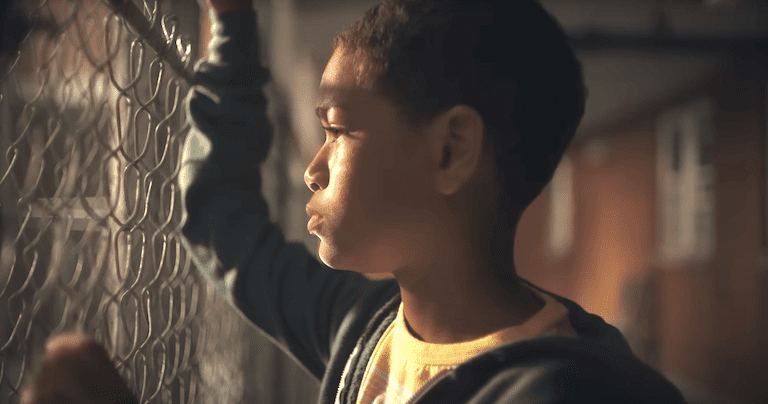
Blake Cameron James in We Grown Now, screenshot courtesy Sony Pictures Classics trailer
‘What Is All This For?’
In October 1992, a stray bullet killed 7-year-old Dantrell Davis in Cabrini-Green. The death shook both the community and the wider city of Chicago: The mayor vowed to clean up Cabrini (using some frightening heavy-handed tactics to do so). Dolores worried ever more about her son’s safety. And Malik and Eric tried to make sense of the young boy’s death.
After Dantrell’s funeral, the two boys sit on some church steps and talk.
“He’s in a better place now,” Malik says.
“I don’t know,” Eric says. “I think he just … go.”
Eric admits that he believes that Jesus lived, but he suspects that the Nazarene was just a man—and He’s not coming back. He suspects that the afterlife isn’t real—that Dantrell just died and that’s that. No heavenly reward. No deeper meaning.
Malik pushes back. “If there ain’t no afterlife, what is all this for?” he asks.
Malik holds out hope that all the suffering that he sees does have a place in a greater story. That what happens today does matter for tomorrow. And we realize that Malik’s hope, and Eric’s doubt, are shaping their own trajectories within Cabrini, too.
The day that Dantrell died, the two boys are approached by an older kid, inviting them both to try on a diamond-studded watch. “I’m good, Malik says, and walks away—knowing the watch comes from drug money. But Eric tries it on. “What does it matter?” He later tells Malik. “Money is money.”
Later, the two boys ditch school and go to Chicago’s famous Art Institute, where they examine Walter Ellison’s 1935 painting “Train Station.” The painting depicts the Great Migration, when African Americans moved from the hostile South to cities like Chicago. Ellison painted a Black porter carting around luggage for some obviously wealthy white travelers—a depiction that Malik bristles at. “They can carry their own bags!” Malik says.
“They get paid to do it,” Eric says.
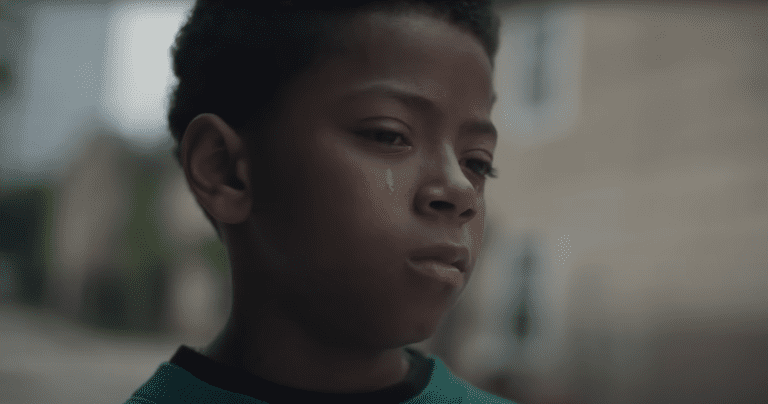
Gian Knight Ramirez in We Grown Now, screenshot courtesy Sony Pictures Classics trailer
Trying to Fly
After the funeral, Malik asked what’s all this for? There’s got to be a reason. A purpose. It matters whether he tries on that watch. It matters that this guy in the painting is stuck carrying luggage. It matters that Dantrell died. These injustices matter because there’s such a thing as justice.
But Eric’s not so sure. Maybe we don’t get an afterlife. Maybe we don’t have purpose. Maybe justice? No such thing. So why not get what we can now? And does it really matter how we get it?
The movie hints at the boys’ different trajectories at its very outset—when the two drag a discarded mattress out to the playground. They throw it on a pile of other mattresses and take turns jumping on them: Malik is the undisputed king of this playground game—and after he marvels at how well he jumped today. “That was the closest I got to God!” he says.
Try as he might, Eric can’t quite soar like Malik. His feet are rooted too deeply in this world to go flying into another.
By the time the movie heads into the final act, we understand that the two best friends are on two different paths. Without giving anything away, we feel that Malik might jump beyond his Cabrini childhood—fly into a wider world beyond. Eric, we worry, may simply get stuck there, trapped in its poverty and vices.
But the film offers some hope for Eric—and again, it comes back to faith. With his friendship with Malik threatened by circumstance and change and schoolboy pride, Eric pays a visit to Malik’s family. And when Dolores says that Malik can’t see him, Eric still hovers in the doorway.
“Can we pray together?” he asks Dolores.
And so Eric, Dolores and grandma Anita gather together and pray. “Heavenly father, watch over us, your children,” Dolores says. “Grand that we mend all that is broken.”
We find a lot of brokenness in We Grown Now. But we find a lot of healing, too—and that healing is powered by faith as much as anything. And that’s one of many reasons why this film is so worth seeing.
Evangelical
General Christian
Religious Music and Entertainment
Previous Post

April 26, 2024
'The Omen' Works. 'The First Omen' Fails. Here’s Why.
Next Post

June 6, 2024 ‘Sight’ Reminds Us That We Can All Be Blind
Recent Comments
Browse Our Archives
Select a Category books celebrities Editor's Choice games movies music news sports superheroes television Uncategorized
Select a Month May 2026 April 2026 March 2026 December 2025 October 2025 July 2025 June 2025 May 2025 February 2025 January 2025 December 2024 July 2024 June 2024 May 2024 April 2024 March 2024 February 2024 January 2024 December 2023 September 2023 March 2023 February 2023 December 2022 November 2022 October 2022 September 2022 August 2022 July 2022 June 2022 May 2022 April 2022 March 2022 February 2022 December 2021 October 2021 August 2021 July 2021 June 2021 May 2021 April 2021 March 2021 October 2020 August 2020 July 2020 June 2020 May 2020 April 2020 March 2020 February 2020 January 2020 December 2019 November 2019 October 2019 September 2019 August 2019 July 2019 June 2019 May 2019 April 2019 March 2019 February 2019 January 2019 December 2018 November 2018 October 2018 September 2018 August 2018 July 2018 June 2018 May 2018 April 2018 March 2018 February 2018 January 2018 December 2017 November 2017 October 2017 September 2017 August 2017 July 2017 June 2017 May 2017 April 2017 March 2017 February 2017 January 2017 December 2016 November 2016 October 2016 September 2016 August 2016 July 2016 June 2016 May 2016 April 2016 March 2016 February 2016 January 2016 December 2015 November 2015 October 2015 September 2015 August 2015 July 2015 June 2015 May 2015 April 2015 March 2015 February 2015 January 2015 December 2014 November 2014 October 2014 September 2014
Follow Us!
TAKE THE
Religious Wisdom Quiz
Who said, "We ought to obey God rather than men"?
Select your answer to see how you score.
James Paul John Peter
Books by This Author Books by Paul Asay
Related posts from Watching God

Finding Forgiveness in the Great Horror Film ‘Hokum’

What makes a hero? These 7 Cinematic Characters...

Finding God's Grace in ‘Project Hail Mary’

Watching God’s Top 10 Movies of 2025
TRENDING AT PATHEOS Religious Music & Entertainment

"Les Diabolique" and Transgression
Alongside something like Arrival, Vertigo, or Charade, Les Diaboliques is a...

"The Plague Dogs" and Mortality
So, flashback to the late 70s, early 80s. Walt Disney Studios is...

With the recent and highly successful release of Christopher Nolan’s epic film,...

"L'avventura" and Human Weakness
Today's piece is going to be a little different for a few...

I first want to apologize for not posting or writing anything. I'm...

I've engaged in the multi-year project of reading through the Church Fathers,...
view all Religious Music & Entertainment blogs
What Are Your Thoughts?leave a comment
Ad-Free & Subscriber Log-In Subscription Support
- About Us
- 2026 Calendar
- Videos
- Podcasts
- Library of World Religions
- Faith In Media Tracker
- Advertise With Us
- Write for Us
- Privacy Policy
- Terms of Service
- Do Not Sell My Data
- Contact Us
- Radiant Digital
- Manage Newsletter Subscriptions
- Unsubscribe From Notifications
- Sitemap
Copyright 2008-2026, Patheos. All rights reserved.
Subscription Support Ad-Free & Subscriber Log-In
Follow Patheos