
BuddhistCatholicContemplativeEvangelicalGeneral ChristianHinduJewishLatter-day SaintMuslimNew VisionsProgressive Christian
Beliefs
- Buddhist
- Catholic
- Contemplative
- Evangelical
- General Christian
- Hindu
- Jewish
- Latter-day Saint
- More Voices
- Muslim
- New Visions
- Pagan
- Progressive Christian
Topics
- Religion News
- Food and Religion
- Sports and Religion
- Religious Art
- Religious Music and Entertainment
- Religious Events
- History and Religion
- Style and Religion
- Politics and Religion
- Women in Religion
- Recreation Outdoors and Religion
- Business Finance and Religion
- Careers Workplace and Religion
- Education and Religion
- Family Parenting and Religion
- Health Fitness and Religion
- Home and Religion
- Relationships and Religion
- Technology and Religion
- Travel and Religion
Columnists
- Buddhist Columnists
- Business Finance and Religion Columnists
- Careers Workplace and Religion Columnists
- Catholic Columnists
- Contemplative Columnists
- Education and Religion Columnists
- Evangelists Columnists
- Family Parenting and Religion Columnists
- General Christian Columnists
- Health Fitness and Religion Columnists
- Hindu Columnists
- History and Religion Columnists
- Home and Religion Columnists
- Jewish Columnists
- More Voices Columnists
- Latter Day Columnists
- Muslim Columnists
- New Visions Columnists
- Nonreligious Columnists
- Pagan Columnists
- Politics and Religion Columnists
- Progressive Columnists
- Recreation Outdoors and Religion Columnists
- Relationships and Religion Columnists
- Religion News Columnists
- Religious Art Columnists
- Religious Events Columnists
- Religious Music and Entertainment Columnists
- Sports and Religion Columnists
- Style and Religion Columnists
- Technology and Religion Columnists
- Travel and Religion Columnists
- Women in Religion Columnists
Resource Library
- 2026 Calendar
- Library of World Religions
- The 100 Most Holy Places on Earth
- Patheos Answers
- Podcasts
- Videos
- Faith Leaders Database
- Anglican Episcopalian
- Bahai
- Baptist
- Buddhism
- Christianity
- Confucianism
- Eastern Orthodoxy
- Hinduism
- Holiness and Pentecostal
- ISKCON
- Islam
- Judaism
- Lutheran
- Methodist
- The Church of Jesus Christ of Latter-day Saints
- New Age
- Paganism
- Presbytarian and Reformed
- Protestantism
- Religion Behind the Scenes
- Roman Catholic
- Scientology
- Shia Islam
- Sikhism
- Sufism
- Sunni Islam
- Taoism
- Zen
- See all religions
Research Tools
 Ad-Free & Subscriber Log-In Subscription Support
Ad-Free & Subscriber Log-In Subscription Support
Follow Patheos 

- Trending:
- Forgiveness
- |
- Marriage
- |
- Consciousness
- |
- Death Penalty
- |
- Election
- |
- Halloween

- Home
- General Christian
- Religious Music & Entertainment
- ‘Dune: Part Two’ Asks Explosive Questions About Religion
‘Dune: Part Two’ Asks Explosive Questions About Religion
Last updated on: March 1, 2024 at 8:53 pm by Paul Asay
‘Dune: Part Two’ Asks Explosive Questions About Religion 2024-03-01T20:53:23-06:00 Paul Asay
Patheos Explore the world's faith through different perspectives on religion and spirituality! Patheos has the views of the prevalent religions and spiritualities of the world.
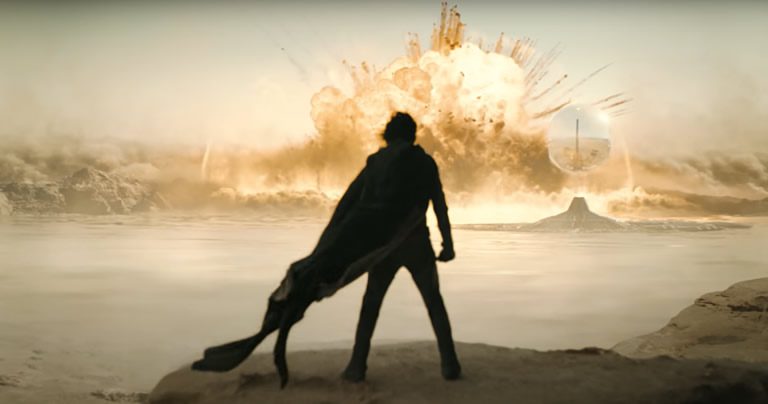
From Dune: Part Two, screen shot courtesy Warner Bros. trailer
Dune: Part Two is out in theaters today, and it’s pretty spectacular. Sure, the film as its content issues (which you can read about in my review), but if you can keep up with Dune’s dense, detailed story, you’ll be rewarded with the sort of grand cinematic saga I’ve not seen since The Lord of the Rings films.
And the film has a lot of interesting spiritual folds to it. Indeed, the saga of Paul “Muad’Dib” Atreides is inescapably tangled with religion. Almost everyone around him seems to ask, “Is This the messiah we’ve been waiting for?”
One of the exceptions? Paul himself.

Timothée Chalamet in Dune: Part Two, screen shot courtesy Warner Bros. trailer
Chosen One?
As we learn in Dune: Part One, Paul Atreides comes to the planet Arrakis with his father (the powerful Duke Leto), his family and the Atreides army. The house of Atreides is one of the most powerful houses in the galaxy, and as such, the galactic emperor asked Duke Leto to take control of Arrakis—home to the spice melange, the galaxy’s most important substance (and a powerful narcotic besides).
But an act of betrayal force he and his mother—Jessica, a part of the mysterious, powerful order of the Bene Gesserit—to flee the palace and head into the Arrakis wilderness. It’s a really uninviting place: Paul calls it a “world beyond cruelty.”
But Paul and Jessica fall in with a group of Fremen—Arrakis’ indigenous people—and begin to learn how to survive in this brutal planet. Paul shows such aptitude that, even as Dune: Part Two opens, some Fremen wonder whether Paul could be the Fremen’s prophesied Lisan al-Gaib, a messiah-like figure who, it is said, will lead them to paradise.
But Paul’s not particularly interested in fulfilling prophecy. He takes his very name, Muad’Dib, from the humble kangaroo rat—perhaps partly in an attempt to diminish himself. And as Jessica does her best to convince the Fremen that he is their messiah, Paul tries to demystify the Bene Gesserit order itself—and undercut her authority. He knows that Bene Gesserit missionaries actually planted those prophecies that point to the Lisan al-Gaib for their own complicated purposes. Paul knows they’re “just stories,” and he practically begs his mother to stop telling them.
Paul knows he’s no messiah: He knows there’s no such thing.
But even in the face of his denials, many believe anyway. Stilgar—the first Fremen leader who helped Paul survive and his most passionate follower—flatly tells him, “I don’t care what you believe! I believe!”

Charlotte Rampling in Dune: Part Two, screen shot courtesy Warner Bros. trailer
True Religion
Small spoiler warning: If you’ve read the books or seen the end of Dune: Part Two, you know that Paul ultimately does take on the role of messiah figure, even if he still didn’t believe he was one. Frank Herbert, who wrote Dune (and four other books in the series) was deeply suspicious of all human constructs, including religion. And in his introduction for his short story collection Eye, he quibbles with the overtly messianic Paul portrayed in the 1984 cinematic version of Dune. “Paul was a man playing god, not a god who could make it rain.”
Herbert’s suspicion of religion is well founded. Every faith system contains its share of very human players. Religion can be a cynical, self-serving construct.
But while Paul insists his no messiah figure, the prophecies—however made up they originally were—are gradually fulfilled. The Dune movies spark a question that I ask myself*: Could the divine still work through that system, in spite of that system?* We’re broken and we inherently build broken things … but might God still find a way to take that brokenness and use it for His own ends?
In the Bible, we often read how God uses unbelieving nations looking out for their own interests to further His plans. Some, such as Assyria or Babylonia, God uses as an instrument of punishment. But God uses others to save His people.
Cyrus the Great essentially took a backwater nation (Persia) and almost singlehandedly turned it into the world’s greatest empire. He could be ruthless when he felt circumstances demanded it, but he was a pretty savvy politician, too. Sure, he conquered and even decimated a few rival empires. But he crows that he also freed a bunch of folks who’d been displaced by those same empires—including the Jews who’d been under the Babylonian thumb—and, according to the Cyrus Cylinder, “returned them to their dwellings.”
Cyrus was not Jewish, of course (even though he acknowledged the Jewish God in Ezra 1:2). In that same document, Cyrus pays homage to Marduk (the patron god of Babylon), and the Persian people subscribed to Zoroastrianism. But biblical writers say that Cyrus was working for God: Isaiah tells us that Cyrus was God’s “anointed” in Isaiah 45:1, which means he was literally a messiah (though, obviously not the Messiah).
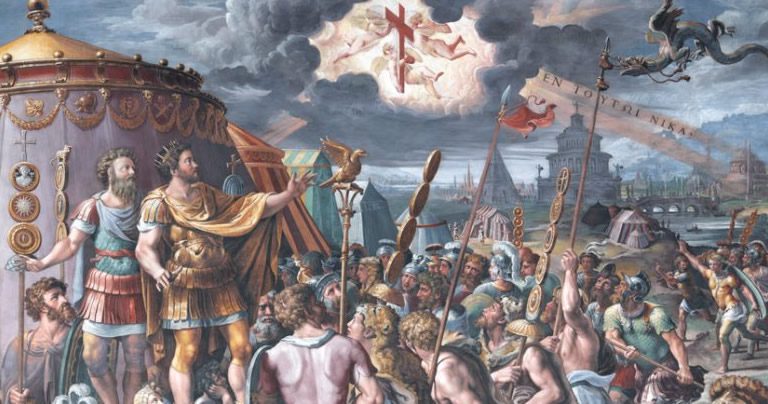
From Vision of the Cross by Gianfrancesco Penni, Giulio Romano and Raffaellino del Colle
A Sign From Above
Fast-forward 850 years or so, and we meet another emperor, Constantine. For centuries, the Roman Empire had been a pretty unfriendly place for Christians. To be a Christian was illegal and could, literally, get you executed.
In October 312, during a critical battle that would secure Constantine’s claim on the whole Roman Empire, the man saw a vision of a cross against the sun, along with the words “in this sign, you will conquer.” The following year, Constantine issued the Edict of Milan, which granted freedom of religion to most everyone in the Empire—including the long-persecuted Christians.
Plenty of historians are skeptical of Constantine’s sudden turn toward the Christian faith. The Christian Church had continued to grow despite its persecutions, they argue, and it just made sense to turn this threat into an asset. It also had a cross-class appeal, which made it potentially a strong unifying force within the Roman Empire. This wasn’t an act of devotion, they argue: It was an act of political savvy.
Perhaps they’re right. But even if Constantine didn’t see that cross on the sun, there’s no question his move to legitimize the faith was a seminal moment for that faith. It was suddenly OK to be Christian in an empire that encompassed much of the known world. And less than 70 years later, it became the empire’s official religion. From then on, Christianity and Western history were joined at the hip.
Dune: Part Two is a sprawling, fascinating story—and how it incorporates religion is among its most fascinating features. Paul may know that he’s no messianic figure. But don’t tell that to the Fremen, who may see their god at work in spite of it all. I believe, they say.
And history suggests that God can work in plenty of our own unlikely vessels, too.
General Christian
Previous Post

February 8, 2024
Suncoast: Coming-of-Age Dramedy With Heart—and Faith
Next Post

April 26, 2024 'The Omen' Works. 'The First Omen' Fails. Here’s Why.
Recent Comments
""The Children of the Night. What Music They Make" - obviously you're not a newcomer ..."
Sinners Is a Great Movie With ..."
"I really enjoyed this article, thanks!"
Seven Movies That Powerfully Confront Racism
"*Messiah"
‘Dune: Part Two’ Asks Explosive Questions ..."
"An interesting play on words is Muad’Dib the desert mouse vs. Mahdi, one name of ..."
‘Dune: Part Two’ Asks Explosive Questions ..."
Browse Our Archives
Select a Category books celebrities Editor's Choice games movies music news sports superheroes television Uncategorized
Select a Month May 2026 April 2026 March 2026 December 2025 October 2025 July 2025 June 2025 May 2025 February 2025 January 2025 December 2024 July 2024 June 2024 May 2024 April 2024 March 2024 February 2024 January 2024 December 2023 September 2023 March 2023 February 2023 December 2022 November 2022 October 2022 September 2022 August 2022 July 2022 June 2022 May 2022 April 2022 March 2022 February 2022 December 2021 October 2021 August 2021 July 2021 June 2021 May 2021 April 2021 March 2021 October 2020 August 2020 July 2020 June 2020 May 2020 April 2020 March 2020 February 2020 January 2020 December 2019 November 2019 October 2019 September 2019 August 2019 July 2019 June 2019 May 2019 April 2019 March 2019 February 2019 January 2019 December 2018 November 2018 October 2018 September 2018 August 2018 July 2018 June 2018 May 2018 April 2018 March 2018 February 2018 January 2018 December 2017 November 2017 October 2017 September 2017 August 2017 July 2017 June 2017 May 2017 April 2017 March 2017 February 2017 January 2017 December 2016 November 2016 October 2016 September 2016 August 2016 July 2016 June 2016 May 2016 April 2016 March 2016 February 2016 January 2016 December 2015 November 2015 October 2015 September 2015 August 2015 July 2015 June 2015 May 2015 April 2015 March 2015 February 2015 January 2015 December 2014 November 2014 October 2014 September 2014
Follow Us!
TAKE THE
Religious Wisdom Quiz
What did Nehemiah do upon reading that Moabites and Ammonites were forbidden in God's assembly?
Select your answer to see how you score.
Expelled them Started a fast Closed the gates Rebuilt the altar
Books by This Author Books by Paul Asay
Related posts from Watching God

Finding Forgiveness in the Great Horror Film ‘Hokum’

What makes a hero? These 7 Cinematic Characters...

Finding God's Grace in ‘Project Hail Mary’

Watching God’s Top 10 Movies of 2025
TRENDING AT PATHEOS Religious Music & Entertainment

"Les Diabolique" and Transgression
Alongside something like Arrival, Vertigo, or Charade, Les Diaboliques is a...

"The Plague Dogs" and Mortality
So, flashback to the late 70s, early 80s. Walt Disney Studios is...

With the recent and highly successful release of Christopher Nolan’s epic film,...

"L'avventura" and Human Weakness
Today's piece is going to be a little different for a few...

I first want to apologize for not posting or writing anything. I'm...

I've engaged in the multi-year project of reading through the Church Fathers,...
view all Religious Music & Entertainment blogs
What Are Your Thoughts?leave a comment
Ad-Free & Subscriber Log-In Subscription Support
- About Us
- 2026 Calendar
- Videos
- Podcasts
- Library of World Religions
- Faith In Media Tracker
- Advertise With Us
- Write for Us
- Privacy Policy
- Terms of Service
- Do Not Sell My Data
- Contact Us
- Radiant Digital
- Manage Newsletter Subscriptions
- Unsubscribe From Notifications
- Sitemap
Copyright 2008-2026, Patheos. All rights reserved.
Subscription Support Ad-Free & Subscriber Log-In
Follow Patheos