
BuddhistCatholicContemplativeEvangelicalGeneral ChristianHinduJewishLatter-day SaintMuslimNew VisionsProgressive Christian
Beliefs
- Buddhist
- Catholic
- Contemplative
- Evangelical
- General Christian
- Hindu
- Jewish
- Latter-day Saint
- More Voices
- Muslim
- New Visions
- Pagan
- Progressive Christian
Topics
- Religion News
- Food and Religion
- Sports and Religion
- Religious Art
- Religious Music and Entertainment
- Religious Events
- History and Religion
- Style and Religion
- Politics and Religion
- Women in Religion
- Recreation Outdoors and Religion
- Business Finance and Religion
- Careers Workplace and Religion
- Education and Religion
- Family Parenting and Religion
- Health Fitness and Religion
- Home and Religion
- Relationships and Religion
- Technology and Religion
- Travel and Religion
Columnists
- Buddhist Columnists
- Business Finance and Religion Columnists
- Careers Workplace and Religion Columnists
- Catholic Columnists
- Contemplative Columnists
- Education and Religion Columnists
- Evangelists Columnists
- Family Parenting and Religion Columnists
- General Christian Columnists
- Health Fitness and Religion Columnists
- Hindu Columnists
- History and Religion Columnists
- Home and Religion Columnists
- Jewish Columnists
- More Voices Columnists
- Latter Day Columnists
- Muslim Columnists
- New Visions Columnists
- Nonreligious Columnists
- Pagan Columnists
- Politics and Religion Columnists
- Progressive Columnists
- Recreation Outdoors and Religion Columnists
- Relationships and Religion Columnists
- Religion News Columnists
- Religious Art Columnists
- Religious Events Columnists
- Religious Music and Entertainment Columnists
- Sports and Religion Columnists
- Style and Religion Columnists
- Technology and Religion Columnists
- Travel and Religion Columnists
- Women in Religion Columnists
Resource Library
- 2026 Calendar
- Library of World Religions
- The 100 Most Holy Places on Earth
- Patheos Answers
- Podcasts
- Videos
- Faith Leaders Database
- Anglican Episcopalian
- Bahai
- Baptist
- Buddhism
- Christianity
- Confucianism
- Eastern Orthodoxy
- Hinduism
- Holiness and Pentecostal
- ISKCON
- Islam
- Judaism
- Lutheran
- Methodist
- The Church of Jesus Christ of Latter-day Saints
- New Age
- Paganism
- Presbytarian and Reformed
- Protestantism
- Religion Behind the Scenes
- Roman Catholic
- Scientology
- Shia Islam
- Sikhism
- Sufism
- Sunni Islam
- Taoism
- Zen
- See all religions
Research Tools
 Ad-Free & Subscriber Log-In Subscription Support
Ad-Free & Subscriber Log-In Subscription Support
Follow Patheos 

- Trending:
- Forgiveness
- |
- Marriage
- |
- Consciousness
- |
- Death Penalty
- |
- Election
- |
- Halloween

- Home
- Religious Music & Entertainment
- Director Alex Garland Has More Than ‘Men’ on His Mind: He’s Thinking About God, Too
Director Alex Garland Has More Than ‘Men’ on His Mind: He’s Thinking About God, Too
Last updated on: May 26, 2022 at 3:09 pm by Paul Asay
Director Alex Garland Has More Than ‘Men’ on His Mind: He’s Thinking About God, Too 2022-05-26T15:09:32-06:00 Paul Asay
Patheos Explore the world's faith through different perspectives on religion and spirituality! Patheos has the views of the prevalent religions and spiritualities of the world.
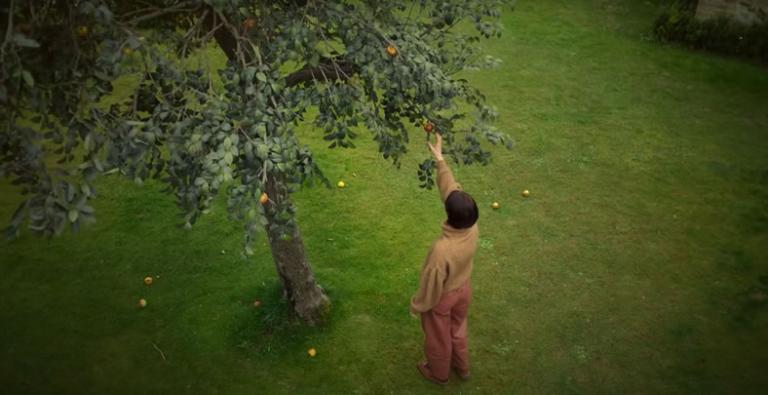
Jessie Buckley in Men, screen shot courtesy from the A24 trailer
Alex Garland might be one of the most provocative directors working right now. His works can feel like enigmatic fever dreams: You might not know exactly what Garland’s saying, but boy, is he saying it with conviction.
Garland began his directorial career with the much-lauded Ex Machina, featuring a very unusual lover’s triangle that mulls consciousness and humanity. He followed that up with Annihilation, which might just be the strangest alien invasion story ever told. Devs, an eight-part miniseries on Hulu, was a stark meditation on free will and determinism.
And now, he’s given the world Men, which might be his most challenging, frustrating and just flat-out gross stories yet. (Yeah, about that. This is an extremely R-rated movie. Read my Plugged In review for more, and please don’t take the following musings as an endorsement or an encouragement to see the film.)
Garland says his ideas are driven by ideas, which can make them a frustrating watch. We moviegoers like to get to know the characters on screen—to see something of ourselves in them–and Garland can make that difficult. But his movies do make you think. Sure, sometimes your first thought might be, “What in the heck was that about?!” But as you chew on Garland’s unforgettable imagery and the sometimes conflicting narrative, you do get a sense on what Garland’s pondering and what he’d like us to ponder, too.
And even though Garland rejected God long ago (according to an interview with Men’s Health), many of those ideas are inherently spiritual.
Ex Machina—which itself is a phrase that means “God in the machine”—ponders how we do, and should, define life. It gives us an AI creation named Ava (suspiciously close to Eve) and introduces us to her creator, who calls himself a “god.” Annihilation is a destruction/creation story as well, with tons of biblical imagery and some deeply provocative themes.
With Men, Garland seems to play with both Christian and pagan imagery as the film explores what would seem a deceptively straightforward theme: The ways in which men tend to blame women for their own problems.
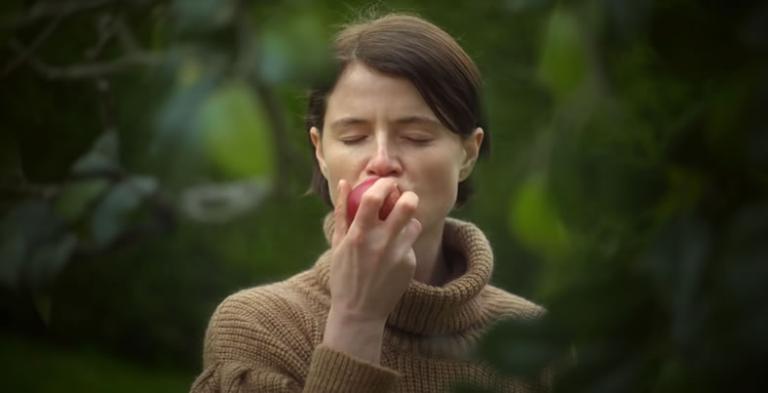
Jessie Buckley in Men, screen shot courtesy A24 trailer
Original Sin
Garland suggests that religion has something to do with it right from the beginning—both of the movie and of creation itself.
Harper, our heroine (played by Jessie Buckley), rents a beautiful house in the English countryside to get over a terrible tragedy. When she steps into the home’s garden, she sees an apple tree. She plucks an apple from one of its branches and takes a bite. Later, the owner of the home tells her that she shouldn’t have done it.
“Forbidden fruit,” he says.
The scene draws our attention to Genesis 3, of course, where Eve is tempted by the serpent to take a bite of the fruit of life—a bite that separates her from God. She encourages Adam to chomp on the fruit, too. Which he does. When God finds out, Adam immediately blames Eve for the whole kerfuffle, and God seems to place more blame at Eve’s feet, too—telling her that childbirth will be incredibly painful from here on out.
That won’t be the last time our attention is drawn to childbirth, incidentally. But the bigger thing to take away, at least at first, is the whole blame thing.
Harper meets a number of guys (most played by Rory Kinnear) who blame Harper for one thing or another. A boy hates Harper for not playing hide-and-seek with him. A man blames Harper for his own sinful desires. And so on.
But the most critical blow is struck by Harper’s former husband, James (Paapa Essiedu) who tells Harper that if she divorces him (as she wants to), he’ll kill himself, and that she’ll have to live with the guilt. He plummets to his death just minutes later, either by accident or design.
But when Harper tells a vicar her sad story, he places blame squarely on her. “You must wonder what you did that drove him to it,” he says. Gardner seems to be telling us that misogyny is rooted in many an institution, including and maybe especially the Christian Church.
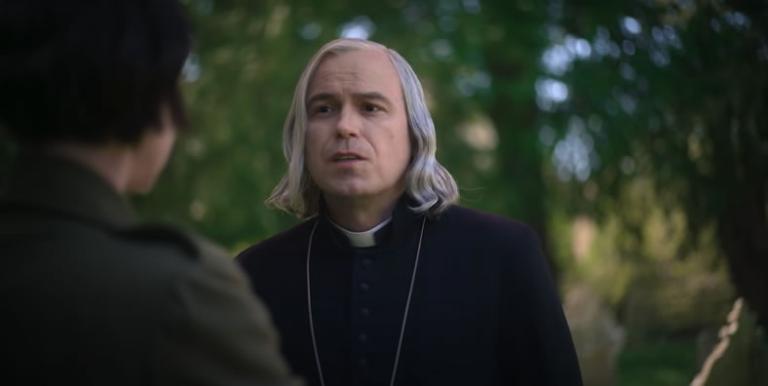
Rory Kinnear in Men, screen shot courtesy A24 trailer
Going to Church
If Gardner is pressing this point, it feels curiously ham-handed for a director of his skill. But he’s hardly one to make things so simple. Another spiritual element filters into Men—one with more pagan undertones.
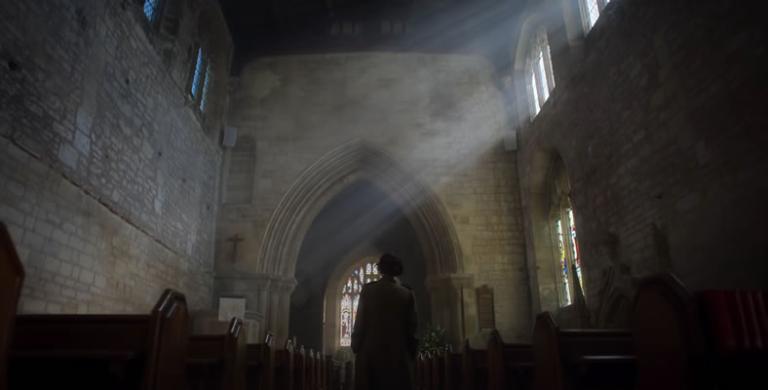
Harper meets her accusing vicar near an ancient church, the interior of which is largely unadorned. A huge stained-glass window, featuring an image of Christ, graces the apse. (Geoffrey, the owner of the house Harper’s staying at, says that looking at the window when the sun’s shining through it can be transcendent.)
The most interesting element, though, is the church pulpit.
On one side—facing the nave, where the congregation would be—we see a leaf-covered face, an image of what is often called the Green Man. Though such images are found in many medieval churches and are seen as symbols of spring and, thus, rebirth, the Green Man is also thought to be a pre-Christian symbol, too—a nod to the nature-worshipping pagans of centuries before.
On the other is what is called a Sheela na Gig—essentially a carving of a woman exposing her privates to the world in a most pornographic manner. Also found in plenty of medieval places of worship, the symbolism is uncertain. Some believed these carvings were a warning against lust; others say they were used almost as gargoyles—images to fend off evil spirits—because a woman’s genitals were apparently thought to have that power.
We’ll talk more about the Sheela na Gig, and the pulpit itself. But first, let’s delve a bit deeper into the Green Man.
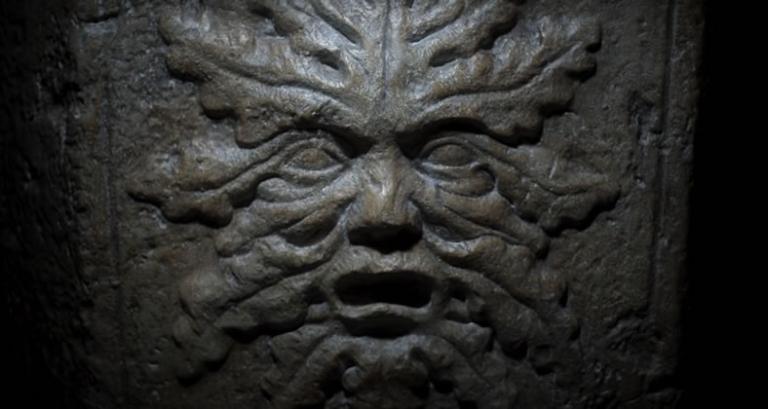
From Men, screen shot courtesy A24 trailer
Mean Green
In Garland’s telling, the Green Man seems to be almost a representation of maleness itself. Harper is haunted and eventually assailed by someone who seems to be a naked, crazy person at first (his genitals are very much out in the open, emphasizing his aggressive male-ness), but who slowly takes on Green Man characteristics as Men goes on. He gouges cuts in his skin and sticks oak leaves in them—leaves that eventually take root.
One could argue that most of the men we see here (again, all played by the same actor) are offshoots of this primeval man, a force of nature that seeks to dominate and possess the film’s central woman. We see him first in a tunnel in which Harper sings (a symbolic setting to be sure), screeching and following. He tries to invade Harper’s red-walled home. It feels both Freudian and freighted with folk symbolism—Harper, a protector of hearth and home being attacked by the forces of aggressive chaos outside.
If the Green Man is indeed representative of toxic masculinity, Garland suggests that it predates the institutions it has infiltrated. The Green Man comes before the vicar. It’s a part of the earth itself, sowing its seeds as it goes. (In fact, the Green Man here is associated with dandelion seeds, some of which he blows into Harper’s face.)
But while the Green Man (and all his underlying men) is Men’s fearsome antagonist, we find a bit of hope for Harper—and, perhaps, hope for Christian faith, even—if we return to that pulpit.
Jessie Buckley in Men, screen shot courtesy A24 trailer
The House of the Rising Sun
In most Medieval churches, the apse (where the priest does his business and where the altar’s located) faces east. Why? Because it’s there where the sun rises. Where hope begins. We can assume that the light from the rising sun shines through the stained-glass window in Harper’s church and reflects off the explicitly female Sheela na Gig.
The Green Man carving, meanwhile, faces the nave and the setting sun, suggesting perhaps that his time is setting, too. Garland makes sure we see both carvings bathed in the church’s changing light, suggesting that he was definitely concerned with how the sun was striking both male and female carvings.
If a thread can be found through Garland’s films, it is perhaps a sense of decay and renewal: The rising and setting sun, how death leads to birth, how destruction leads to new creation. We see both death and birth grotesquely in play as the film heads to its climax, which we’ll not deal with here. And while I believe that many will take Garland’s film as a condemnation of toxic male behavior, I think he was also pointing us toward Harper’s own rebirth after the tragic, terrible death of her husband.
And I also return to the stained glass through which that light cascaded into the Church itself—bathing the stones in light. Yes, the church’s vicar was pretty slimy. And the Church itself can be pretty slimy, too. Recent revelations amongst the Southern Baptists provide another, all-too-familiar, data point for that.
But the light that streams in can steal warm, still comfort and still illuminate even the darkest shadows within the church, and the Church, itself. While the man-created institutions of Men are corrupted and corruptible, the illuminating sun—and for me, the illuminated Son in the window—remains untouched.
Previous Post
May 9, 2022
No Multiverse in No Vacancy, But It Offers a Strange, and Inspiring, Turn
Next Post

June 10, 2022 With Ms. Marvel, Disney+ Gives Us a Muslim Superhero. Great! But …
Browse Our Archives
Select a Category books celebrities Editor's Choice games movies music news sports superheroes television Uncategorized
Select a Month May 2026 April 2026 March 2026 December 2025 October 2025 July 2025 June 2025 May 2025 February 2025 January 2025 December 2024 July 2024 June 2024 May 2024 April 2024 March 2024 February 2024 January 2024 December 2023 September 2023 March 2023 February 2023 December 2022 November 2022 October 2022 September 2022 August 2022 July 2022 June 2022 May 2022 April 2022 March 2022 February 2022 December 2021 October 2021 August 2021 July 2021 June 2021 May 2021 April 2021 March 2021 October 2020 August 2020 July 2020 June 2020 May 2020 April 2020 March 2020 February 2020 January 2020 December 2019 November 2019 October 2019 September 2019 August 2019 July 2019 June 2019 May 2019 April 2019 March 2019 February 2019 January 2019 December 2018 November 2018 October 2018 September 2018 August 2018 July 2018 June 2018 May 2018 April 2018 March 2018 February 2018 January 2018 December 2017 November 2017 October 2017 September 2017 August 2017 July 2017 June 2017 May 2017 April 2017 March 2017 February 2017 January 2017 December 2016 November 2016 October 2016 September 2016 August 2016 July 2016 June 2016 May 2016 April 2016 March 2016 February 2016 January 2016 December 2015 November 2015 October 2015 September 2015 August 2015 July 2015 June 2015 May 2015 April 2015 March 2015 February 2015 January 2015 December 2014 November 2014 October 2014 September 2014
Follow Us!
TAKE THE
Religious Wisdom Quiz
Who saw a vision of a pot boiling toward the north?
Select your answer to see how you score.
Jeremiah Isaiah Habakkuk Zechariah
Books by This Author Books by Paul Asay
Related posts from Watching God

Finding Forgiveness in the Great Horror Film ‘Hokum’

What makes a hero? These 7 Cinematic Characters...

Finding God's Grace in ‘Project Hail Mary’

Watching God’s Top 10 Movies of 2025
TRENDING AT PATHEOS Religious Music & Entertainment

"Les Diabolique" and Transgression
Alongside something like Arrival, Vertigo, or Charade, Les Diaboliques is a...

"The Plague Dogs" and Mortality
So, flashback to the late 70s, early 80s. Walt Disney Studios is...

With the recent and highly successful release of Christopher Nolan’s epic film,...

"L'avventura" and Human Weakness
Today's piece is going to be a little different for a few...

I first want to apologize for not posting or writing anything. I'm...

I've engaged in the multi-year project of reading through the Church Fathers,...
view all Religious Music & Entertainment blogs
Ad-Free & Subscriber Log-In Subscription Support
- About Us
- 2026 Calendar
- Videos
- Podcasts
- Library of World Religions
- Faith In Media Tracker
- Advertise With Us
- Write for Us
- Privacy Policy
- Terms of Service
- Do Not Sell My Data
- Contact Us
- Radiant Digital
- Manage Newsletter Subscriptions
- Unsubscribe From Notifications
- Sitemap
Copyright 2008-2026, Patheos. All rights reserved.
Subscription Support Ad-Free & Subscriber Log-In
Follow Patheos