
BuddhistCatholicContemplativeEvangelicalGeneral ChristianHinduJewishLatter-day SaintMuslimNew VisionsProgressive Christian
Beliefs
- Buddhist
- Catholic
- Contemplative
- Evangelical
- General Christian
- Hindu
- Jewish
- Latter-day Saint
- More Voices
- Muslim
- New Visions
- Pagan
- Progressive Christian
Topics
- Religion News
- Food and Religion
- Sports and Religion
- Religious Art
- Religious Music and Entertainment
- Religious Events
- History and Religion
- Style and Religion
- Politics and Religion
- Women in Religion
- Recreation Outdoors and Religion
- Business Finance and Religion
- Careers Workplace and Religion
- Education and Religion
- Family Parenting and Religion
- Health Fitness and Religion
- Home and Religion
- Relationships and Religion
- Technology and Religion
- Travel and Religion
Columnists
- Buddhist Columnists
- Business Finance and Religion Columnists
- Careers Workplace and Religion Columnists
- Catholic Columnists
- Contemplative Columnists
- Education and Religion Columnists
- Evangelists Columnists
- Family Parenting and Religion Columnists
- General Christian Columnists
- Health Fitness and Religion Columnists
- Hindu Columnists
- History and Religion Columnists
- Home and Religion Columnists
- Jewish Columnists
- More Voices Columnists
- Latter Day Columnists
- Muslim Columnists
- New Visions Columnists
- Nonreligious Columnists
- Pagan Columnists
- Politics and Religion Columnists
- Progressive Columnists
- Recreation Outdoors and Religion Columnists
- Relationships and Religion Columnists
- Religion News Columnists
- Religious Art Columnists
- Religious Events Columnists
- Religious Music and Entertainment Columnists
- Sports and Religion Columnists
- Style and Religion Columnists
- Technology and Religion Columnists
- Travel and Religion Columnists
- Women in Religion Columnists
Resource Library
- 2026 Calendar
- Library of World Religions
- The 100 Most Holy Places on Earth
- Patheos Answers
- Podcasts
- Videos
- Faith Leaders Database
- Anglican Episcopalian
- Bahai
- Baptist
- Buddhism
- Christianity
- Confucianism
- Eastern Orthodoxy
- Hinduism
- Holiness and Pentecostal
- ISKCON
- Islam
- Judaism
- Lutheran
- Methodist
- The Church of Jesus Christ of Latter-day Saints
- New Age
- Paganism
- Presbytarian and Reformed
- Protestantism
- Religion Behind the Scenes
- Roman Catholic
- Scientology
- Shia Islam
- Sikhism
- Sufism
- Sunni Islam
- Taoism
- Zen
- See all religions
Research Tools
 Ad-Free & Subscriber Log-In Subscription Support
Ad-Free & Subscriber Log-In Subscription Support
Follow Patheos 

- Trending:
- Forgiveness
- |
- Marriage
- |
- Consciousness
- |
- Death Penalty
- |
- Election
- |
- Halloween

- Home
- Religious Music & Entertainment
- Four Lessons to Take From Father Stu
Four Lessons to Take From Father Stu
Last updated on: April 14, 2022 at 8:56 am by Paul Asay
Four Lessons to Take From Father Stu 2022-04-14T08:56:40-06:00 Paul Asay
Patheos Explore the world's faith through different perspectives on religion and spirituality! Patheos has the views of the prevalent religions and spiritualities of the world.

Mark Wahlberg in Father Stu, screenshot courtesy Sony Pictures trailer
As an actor, Mark Wahlberg has been a cop and a crook, a boxer and a foul-mouthed bear’s best friend. But I don’t think he’s ever played a priest before. For Wahlberg, Father Stu—a movie which he produced as well as starred in—was a true passion project. He spent “millions” of his own money to make sure the movie was made. He told Insider.com that he prayed “every day about getting this film made,” and—as also reported by Patheos blogger Kate O’Hare—he wants to make more faith-based films.
“I’m hoping lots more will come to me now, not just stories that I can star in but also can help others get their works off the ground,” he told Insider.com. “I want to do more of this in the future, and there’s a huge audience for it.”
He’s right: There is an audience for faith-based and faith-friendly movies. The R-rated Father Stu might be a tough sell to some Christians (you can read all about why in my Plugged In review). But it’s also a well-made and inspiring film that shows God moving in this messy world of ours.
Here’s four lessons I gleaned from Father Stu. (And while this doesn’t reveal any more plot points than the trailers do themselves, be mindful that there could be spoilers.)

Mark Wahlberg in Father Stu, screenshot courtesy Sony Pictures trailer
God Can Take Our Anger
When we first meet Wahlberg’s Stu, he’s a pretty troubled guy. He cashes meager paydays as a boxer, but the window on his athletic career is closing. He apparently drifts from odd jobs here and there without a real plan. His father is all but out of the picture (and, when we see the two talk, we realize that’s probably a good thing). And, as he drinks beside the grave of his little brother, we can see that he’s pretty angry with God.
He starts shouting at a statue of Jesus in the cemetery, furious that he would’ve taken his little bro. He gets no answer, of course, and he finally punches Jesus in the face, leaving the statue unharmed but Stu with bloodied knuckles. He leaves some blood on the marble white, too; an echo of how the real Jesus bled and died for mankind, suffering at our hands.
Tellingly, the statue that Stu punishes—the physical manifestation of Stu’s spiritual rage—depicts Jesus pointing to His chest. To His heart, which in Catholicism is a symbol of His boundless love and grace. The movie suggests that God’s work in Stu’s own heart begins the very next day. And Stu doesn’t suspect a thing.

Mark Wahlberg and Teresa Ruiz in Father Stu, screenshot courtesy Sony Pictures trailer
God Can Work Through Our Selfishness
Stu’s arrested for disorderly conduct after slugging the statue. But he leaves the jailhouse with a new purpose. No, no—he’s not turning his life over to Christ. For him, God is the enemy, if He’s even there at all. But Stu tells his mom (played by Jacki Weaver) that he knows what he wants to do with his life now. (“Seventh time’s the charm,” his mom sighs.) He’s going to go to Hollywood and become an actor.
It’s all a bit ridiculous, of course. But Mom’s supportive, Stu moves to L.A. and takes a job at a supermarket to pay the bills. There he sees a woman named Carmen, and he’s immediately smitten.
“I’d wait 40 years in the desert for you,” Stu says.
“Start with an hour in church,” Carmen tells him.
So begins a strange, stuttering relationship between the two of them—a relationship that revolves, oddly, on Stu’s relationship with Carmen’s devout Catholicism. Faith is deeply important to Carmen, and she won’t date anyone who doesn’t share her faith or her devotion.
So, for Carmen’s sake, Stu starts acting like the Catholic that Carmen wants him to be. He helps her teach Sunday school. He takes confirmation classes and is even baptized into the Catholic Church. Does any of this touch him? Move him toward real belief and devotion? Hard to say, but the movie suggests that whatever faith he has is about as deep as a mud puddle. He’s Catholic now mostly because Carmen wants him to be. But even if Stu doesn’t know it, God’s at work somewhere—tilling the ground, planting the seeds, watering the soil ‘til something sprouts. God used Stu’s own selfish motivations to lead the guy closer to Him.
I’m not Catholic: I was raised in a more evangelical Protestant tradition. And in that tradition, motivation is important: We shouldn’t do things out of duty, we’re told, but because we want to. And I totally understand that.
But in my own life, duty moves me toward want. Push into a good habit of reading the Bible, and I find that you want to read the Bible more. And in the same way, I think sometimes when we pursue God or faith for more selfish reasons—attend a youth group meeting for the pizza or go to church to silence a pestering relative—God often shows up.
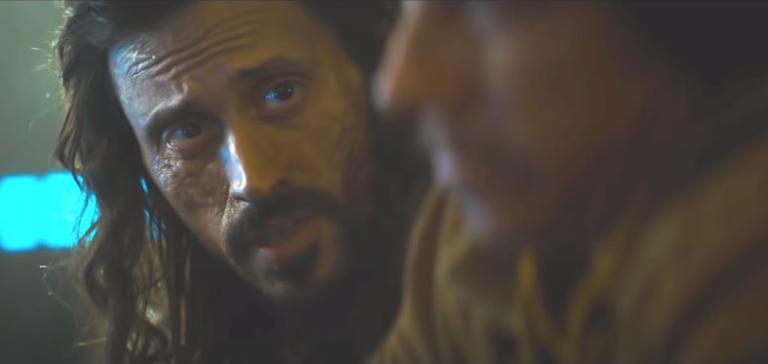
Niko Nicotera in Father Stu, screenshot courtesy Sony Pictures trailer
God Is Everywhere—Even Some Unlikely Places
As Stu spends more time in the church, he begins to ask questions, slowly working on the religious mystery. Late one night, we see him in a bar, still full of questions, as a mysterious barfly engages him on a deeper conversation about life and meaning. Stu’s new friend tells him that life is hard; that it’ll give him (and everyone) plenty of reasons to be angry and bitter. “But you only need one to be grateful,” he adds. And to live in gratitude can change the whole template of your life.
Stu seems to be only half listening. And he certainly doesn’t listen to the barfly when he tells him to be careful driving home. He gets into a horrific accident and finds himself on the asphalt, broken and bleeding. And there he sees (or imagine he sees) Mary—the Mother Mary—leaning over him, comforting him.
That accident becomes a pivot point: Stu’s life turns around, and he spiritually starts walking in an entirely different direction. He begins to wonder whether that barfly might’ve been Jesus, stopping by for a visit.
You wouldn’t expect Jesus to choose a bar to hang out in, or masquerade as kind of a scruffy vagabond. Only, of course, that’s pretty much exactly what Jesus did back in the day. He wandered from town to town, land to land, speaking to people He wasn’t supposed to speak to, hanging out in places that no self-respecting Jew would ever go.
Father Stu leaves it up to the viewer as to whether the guy was really Jesus. But in watching, I actually think that Jesus was around the whole time. He was with Stu when Stu punched that statue of Him; with him when Stu chose to go to California; with him as Stu began to go to church for his own selfish reasons.
I believe that Jesus is around us, too. He doesn’t physically accompany us to local dives, maybe, but I think that He speaks to us more than we often imagine. Like Stu, we sometimes have a hard time listening.
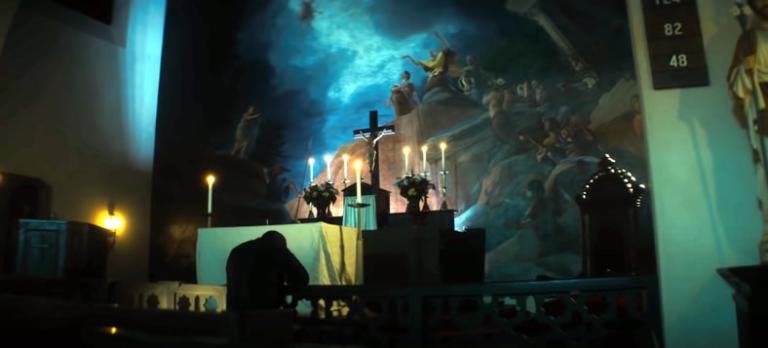
Mark Wahlberg in Father Stu, screenshot courtesy Sony Pictures trailer
God Can Show Up Even In Our Suffering
After his accident, Stu finds that God is far more real, and more important, than he had imagined. He’s alive for a reason, he figures. And as he recovers, Stu begins to wonder whether God is calling him into the priesthood. It’d be a tremendous sacrifice, he knows. Carmen—the woman who led Stu to Christ—won’t like it one little bit. But he grows more and more convicted that that’s what he’s supposed to do.
But as Stu goes through the process of learning how to become a priest, he (and we) discover that God will ask him to make a much greater sacrifice.
Stu learns that he has something called inclusion body myositis, a disease that acts like ALS in that it robs your body’s ability to move and function as it ought to. It’s a horrible diagnosis, and it shakes Stu to his roots. He continues to push through the ordination process, but the disease eats away at him rapidly. In the movie’s most stirring moment, Stu goes to a sanctuary, tosses away his crutches and crawls to the altar. Angry and confused, he begins to pray.
It’s a really nice counterpoint to Stu’s raging dialogue with God years earlier, at his brother’s gravesite. In that earlier scene, Stu was furious with God (if He was even there), that He would take away his brother like He did. Here, Stu’s mystified: Why, just when he found his way—when he was all in on serving God—would God lead him down this terrible path?
It’s a difficult question, and one that neither Stu nor we have a great answer for. But Stu’s ready to trust God now—no matter the circumstances, no matter the cost. And in a postscript, we hear from the real Father Stu (who died in 2014). God can work through his suffering, he says. Just as God worked through the suffering of His own Son.
In Romans 8:28, Paul tells us that “we know that for those who love God all things work together for good, for those who are called according to His purpose.”
Sometimes readers imagine that that means our own lives will be easy. That God doesn’t want those “who are called” to suffer too much. But looking at Paul’s life—and frankly, even the rest of Romans itself—we should know better.
“We rejoice in our sufferings,” Paul wrote in Romans, “knowing that suffering produces endurance, and endurance produces character, and character produces hope, and hope does not put us to shame, because God’s love has been poured into our hearts through the Holy Spirit who has been given to us.”
Father Stu suffered. For seven years, he dealt with the disease and faithfully ministered to those who came to him for help, and the movie suggests that people came to him in part because of that that suffering.
“Jesus” told Stu in that bar so long ago that life will give him plenty of reasons to be angry. His affliction was just the latest. But you need only one reason to be grateful, He said.
Stu’s suffering allowed him to reach people that maybe more clean-cut Christians couldn’t. But his gratitude for what he’s been given—gratitude toward God—allowed those people to see a hint of Christ in him. And just as so many experiences helped Stu on his own journey to faith, a visit with Father Stu might’ve been instrumental in many others’.
It’s a good thing to be mindful of. We all have experiences, and even pain points, that can be used by God.

Next Post

April 22, 2022 The Bad Guys Comes with a Great Message. (And It’s Fun, Too.)
Browse Our Archives
Select a Category books celebrities Editor's Choice games movies music news sports superheroes television Uncategorized
Select a Month May 2026 April 2026 March 2026 December 2025 October 2025 July 2025 June 2025 May 2025 February 2025 January 2025 December 2024 July 2024 June 2024 May 2024 April 2024 March 2024 February 2024 January 2024 December 2023 September 2023 March 2023 February 2023 December 2022 November 2022 October 2022 September 2022 August 2022 July 2022 June 2022 May 2022 April 2022 March 2022 February 2022 December 2021 October 2021 August 2021 July 2021 June 2021 May 2021 April 2021 March 2021 October 2020 August 2020 July 2020 June 2020 May 2020 April 2020 March 2020 February 2020 January 2020 December 2019 November 2019 October 2019 September 2019 August 2019 July 2019 June 2019 May 2019 April 2019 March 2019 February 2019 January 2019 December 2018 November 2018 October 2018 September 2018 August 2018 July 2018 June 2018 May 2018 April 2018 March 2018 February 2018 January 2018 December 2017 November 2017 October 2017 September 2017 August 2017 July 2017 June 2017 May 2017 April 2017 March 2017 February 2017 January 2017 December 2016 November 2016 October 2016 September 2016 August 2016 July 2016 June 2016 May 2016 April 2016 March 2016 February 2016 January 2016 December 2015 November 2015 October 2015 September 2015 August 2015 July 2015 June 2015 May 2015 April 2015 March 2015 February 2015 January 2015 December 2014 November 2014 October 2014 September 2014
Follow Us!
TAKE THE
Religious Wisdom Quiz
What does "Jordan" (as in Jordan River) mean?
Select your answer to see how you score.
To heal To open To anoint To descend
Books by This Author Books by Paul Asay
Related posts from Watching God

Finding Forgiveness in the Great Horror Film ‘Hokum’

What makes a hero? These 7 Cinematic Characters...

Finding God's Grace in ‘Project Hail Mary’

Watching God’s Top 10 Movies of 2025
TRENDING AT PATHEOS Religious Music & Entertainment

"Les Diabolique" and Transgression
Alongside something like Arrival, Vertigo, or Charade, Les Diaboliques is a...

"The Plague Dogs" and Mortality
So, flashback to the late 70s, early 80s. Walt Disney Studios is...

With the recent and highly successful release of Christopher Nolan’s epic film,...

"L'avventura" and Human Weakness
Today's piece is going to be a little different for a few...

I first want to apologize for not posting or writing anything. I'm...

I've engaged in the multi-year project of reading through the Church Fathers,...
view all Religious Music & Entertainment blogs
Ad-Free & Subscriber Log-In Subscription Support
- About Us
- 2026 Calendar
- Videos
- Podcasts
- Library of World Religions
- Faith In Media Tracker
- Advertise With Us
- Write for Us
- Privacy Policy
- Terms of Service
- Do Not Sell My Data
- Contact Us
- Radiant Digital
- Manage Newsletter Subscriptions
- Unsubscribe From Notifications
- Sitemap
Copyright 2008-2026, Patheos. All rights reserved.
Subscription Support Ad-Free & Subscriber Log-In
Follow Patheos