
BuddhistCatholicContemplativeEvangelicalGeneral ChristianHinduJewishLatter-day SaintMuslimNew VisionsProgressive Christian
Beliefs
- Buddhist
- Catholic
- Contemplative
- Evangelical
- General Christian
- Hindu
- Jewish
- Latter-day Saint
- More Voices
- Muslim
- New Visions
- Pagan
- Progressive Christian
Topics
- Religion News
- Food and Religion
- Sports and Religion
- Religious Art
- Religious Music and Entertainment
- Religious Events
- History and Religion
- Style and Religion
- Politics and Religion
- Women in Religion
- Recreation Outdoors and Religion
- Business Finance and Religion
- Careers Workplace and Religion
- Education and Religion
- Family Parenting and Religion
- Health Fitness and Religion
- Home and Religion
- Relationships and Religion
- Technology and Religion
- Travel and Religion
Columnists
- Buddhist Columnists
- Business Finance and Religion Columnists
- Careers Workplace and Religion Columnists
- Catholic Columnists
- Contemplative Columnists
- Education and Religion Columnists
- Evangelists Columnists
- Family Parenting and Religion Columnists
- General Christian Columnists
- Health Fitness and Religion Columnists
- Hindu Columnists
- History and Religion Columnists
- Home and Religion Columnists
- Jewish Columnists
- More Voices Columnists
- Latter Day Columnists
- Muslim Columnists
- New Visions Columnists
- Nonreligious Columnists
- Pagan Columnists
- Politics and Religion Columnists
- Progressive Columnists
- Recreation Outdoors and Religion Columnists
- Relationships and Religion Columnists
- Religion News Columnists
- Religious Art Columnists
- Religious Events Columnists
- Religious Music and Entertainment Columnists
- Sports and Religion Columnists
- Style and Religion Columnists
- Technology and Religion Columnists
- Travel and Religion Columnists
- Women in Religion Columnists
Resource Library
- 2026 Calendar
- Library of World Religions
- The 100 Most Holy Places on Earth
- Patheos Answers
- Podcasts
- Videos
- Faith Leaders Database
- Anglican Episcopalian
- Bahai
- Baptist
- Buddhism
- Christianity
- Confucianism
- Eastern Orthodoxy
- Hinduism
- Holiness and Pentecostal
- ISKCON
- Islam
- Judaism
- Lutheran
- Methodist
- The Church of Jesus Christ of Latter-day Saints
- New Age
- Paganism
- Presbytarian and Reformed
- Protestantism
- Religion Behind the Scenes
- Roman Catholic
- Scientology
- Shia Islam
- Sikhism
- Sufism
- Sunni Islam
- Taoism
- Zen
- See all religions
Research Tools
 Ad-Free & Subscriber Log-In Subscription Support
Ad-Free & Subscriber Log-In Subscription Support
Follow Patheos 

- Trending:
- Forgiveness
- |
- Marriage
- |
- Consciousness
- |
- Death Penalty
- |
- Election
- |
- Halloween

- Home
- Religious Music & Entertainment
- In The Cursed, the Monsters Aren’t Just the Ones With Fangs
In The Cursed, the Monsters Aren’t Just the Ones With Fangs
Last updated on: February 21, 2022 at 10:42 am by Paul Asay
In The Cursed, the Monsters Aren’t Just the Ones With Fangs 2022-02-21T10:42:52-06:00 Paul Asay
Patheos Explore the world's faith through different perspectives on religion and spirituality! Patheos has the views of the prevalent religions and spiritualities of the world.

Tommy Rodger in The Cursed, screen shot courtesy LD Entertainment
The Cursed, which rolled out to theaters this weekend, is a bloody movie. Really bloody. In my review at Plugged In, I said that the film’s reliance on gore undercut its more thoughtful, sophisticated elements.
And that’s true. But at the same time, as I think about it, maybe all that blood actually underscores what I think the movie’s all about: The war between the flesh-and-blood animals we are and the better beings God designed us to be.
From The Cursed, screen shot courtesy LD Entertainment
Full Moon
The story takes place in the late 1800s, somewhere in rural Britain. Seamus Laurent, a local baron, has a problem: A bevy of Roma (derisively known back then as gypsies) have settled on a corner of his land. And worse yet, they claim to own it. What’s a noble to do?
Well, in Seamus’ case, kill them. Hard to bring a land dispute to court if there’s no one left to bring it, right?
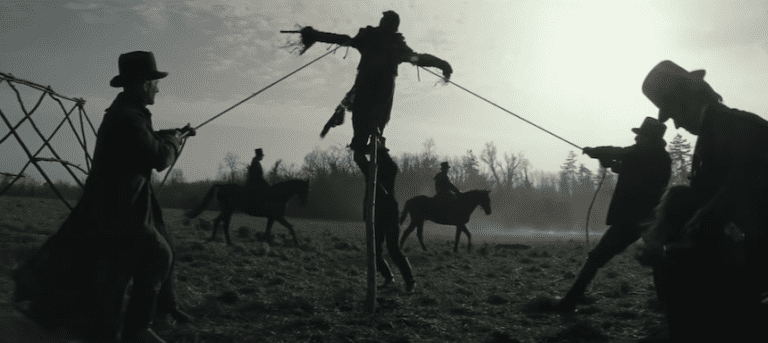
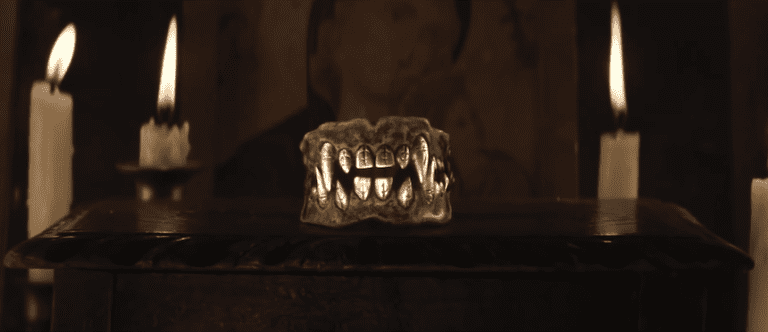
But not so fast, Seamus! As his mercenaries slowly torture and kill the last two surviving Roma—chopping the hands and feet off of one before turning him into a dying scarecrow, and burying the other alive—they cast a curse on Seamus and his . And they cement the act with a set of silver, wolf-like dentures that are buried with the second victim.
Soon, children in the surrounding environs start having nightmares filled with creepy scarecrows and pecking magpies and a desire to dig something up. It’s not long before those kids swap stories and head into the fields to investigate. Sure enough, they come to the old Roma camp, still marked by the now (surely dead) scarecrow man. One teen digs and finds the teeth—and he promptly uses them to bite Edward, Seamus’ son.
It’s here where The Cursed really dives into the meat of the story (if you will). Edward gets sick and runs into the forest, soon turning into a werewolf (though it’s not ever called one). Meanwhile, a pathologist named John McBride—sort of the story’s Van Helsing—comes to town seemingly by happenstance, hoping to track down the same sort of monster that decimated his own village. The Cursed is, in many ways, a classic monster movie, straight and simple.
But the film is also riddled with spirituality. And on that count, we might as well begin with the teeth.
From The Cursed, screen shot courtesy LD Entertainment
Something to Bite Into
The teeth were made, we learn, from the very silver that Judas was paid with to betray Jesus. And soon, a couple of teens arm themselves with pages from the Bible bearing telling passages. One details Judas’ betrayal. The other, Ezekiel 22:22, goes like this: “As silver is melted in a furnace, so you will be melted in the midst of it, and you shall know that I am the Lord; I have poured out my wrath upon you.”
The context of that passage is even more interesting: Ezekiel was talking about the sins of Israel, detailing all the ways that the people of Jerusalem had forgotten God. Many of those sins detailed in chapter 22 could refer to Seamus and his cronies, too.
“O city who brings her own doom by shedding blood within her walls and making idols to defile herself, you are guilty of the blood you have shed, and you are defiled by the idols you have made,” we read in verses 3 and 4. The land itself—and the power derived from it—was Seamus’ idol. And by slaughtering the Roma encampment, he shed blood within his own metaphorical walls.
The werewolf has often been used as a representation of man’s bestial side—the lowly, often terrifying urges we do our best to overcome. In fairy tales, wolves have often represented the chaos outside our own civilized walls—echoes, perhaps, of who were before we built those walls to begin with. Werewolves could be seen as the fear that that we could all slip back into beast mode—a horrible understanding that monsters can lurk underneath the skin.
But in The Cursed, we see a different sort of sin at play—not bestial, exactly, but still base: greed.

Alistair Petrie in The Cursed, screen shot courtesy LD Entertainment
Werewolves Within
Back to the teeth molded from Judas’ cursed silver. Judas’ act of betrayal was one of greed. “What are you willing to give me if I deliver [Jesus] over to you?” he asked the Pharisees.
That’s echoed by Seamus and his desire to kill to keep claim to his land. His own greed brought about the curse. And when our hero pathologist McBride discovers this, he realizes that the werewolf is really the secondary monster here.
“You don’t have to hunt for it,” he tells Seamus, “because it will hunt you for what you have done.”
Lord Seamus forgot his own Lord. The werewolf is, yes, a monster. But it’s also presented as a divine instrument of justice—even if that “justice” isn’t particularly discriminating.
Loads of innocent people meet their doom through the werewolf, and it’s not the type of creature who’ll sink into the shadows once Seamus is punished. How does one take care of a werewolf?
Well, a silver bullet has to come into play, right? And it does. Just as cursed silver brought about the beast, so silver—long a symbol of purity—helps eliminate it.
But The Cursed goes a step farther. Silver isn’t the only tool here, and it might not even be the most important. Rather, it’s in the counterpoint virtue to Seamus’ vice: charity. Not charity as we understand it, but as the Bible did.
“Charity, in Christian thought, [is] the highest form of love, signifying the reciprocal love between God and man that is made manifest in unselfish love of one’s fellow men,” according to Britannica. Without giving too much away, that sacrificial love creates a condition that not only brings the reign of the werewolf to an end, but allows for the salvation of the monster itself. Just as, in fact, Jesus’ own sacrifice saved us monsters, too.
The Cursed is indeed a bloody, bloody movie. I might not see a bloodier one this year. But embedded in all of its gore is a reminder that blood can also save.

Next Post

February 28, 2022 In Cyrano, Great Love Meets the Greatest Sin: Pride.
Browse Our Archives
Select a Category books celebrities Editor's Choice games movies music news sports superheroes television Uncategorized
Select a Month May 2026 April 2026 March 2026 December 2025 October 2025 July 2025 June 2025 May 2025 February 2025 January 2025 December 2024 July 2024 June 2024 May 2024 April 2024 March 2024 February 2024 January 2024 December 2023 September 2023 March 2023 February 2023 December 2022 November 2022 October 2022 September 2022 August 2022 July 2022 June 2022 May 2022 April 2022 March 2022 February 2022 December 2021 October 2021 August 2021 July 2021 June 2021 May 2021 April 2021 March 2021 October 2020 August 2020 July 2020 June 2020 May 2020 April 2020 March 2020 February 2020 January 2020 December 2019 November 2019 October 2019 September 2019 August 2019 July 2019 June 2019 May 2019 April 2019 March 2019 February 2019 January 2019 December 2018 November 2018 October 2018 September 2018 August 2018 July 2018 June 2018 May 2018 April 2018 March 2018 February 2018 January 2018 December 2017 November 2017 October 2017 September 2017 August 2017 July 2017 June 2017 May 2017 April 2017 March 2017 February 2017 January 2017 December 2016 November 2016 October 2016 September 2016 August 2016 July 2016 June 2016 May 2016 April 2016 March 2016 February 2016 January 2016 December 2015 November 2015 October 2015 September 2015 August 2015 July 2015 June 2015 May 2015 April 2015 March 2015 February 2015 January 2015 December 2014 November 2014 October 2014 September 2014
Follow Us!
TAKE THE
Religious Wisdom Quiz
True or False: According to Hebrews, faith is the substance of things hoped for and the evidence of things not seen.
Select your answer to see how you score.
FALSE TRUE
Books by This Author Books by Paul Asay
Related posts from Watching God

Finding Forgiveness in the Great Horror Film ‘Hokum’

What makes a hero? These 7 Cinematic Characters...

Finding God's Grace in ‘Project Hail Mary’

Watching God’s Top 10 Movies of 2025
TRENDING AT PATHEOS Religious Music & Entertainment

"Les Diabolique" and Transgression
Alongside something like Arrival, Vertigo, or Charade, Les Diaboliques is a...

"The Plague Dogs" and Mortality
So, flashback to the late 70s, early 80s. Walt Disney Studios is...

With the recent and highly successful release of Christopher Nolan’s epic film,...

"L'avventura" and Human Weakness
Today's piece is going to be a little different for a few...

I first want to apologize for not posting or writing anything. I'm...

I've engaged in the multi-year project of reading through the Church Fathers,...
view all Religious Music & Entertainment blogs
Ad-Free & Subscriber Log-In Subscription Support
- About Us
- 2026 Calendar
- Videos
- Podcasts
- Library of World Religions
- Faith In Media Tracker
- Advertise With Us
- Write for Us
- Privacy Policy
- Terms of Service
- Do Not Sell My Data
- Contact Us
- Radiant Digital
- Manage Newsletter Subscriptions
- Unsubscribe From Notifications
- Sitemap
Copyright 2008-2026, Patheos. All rights reserved.
Subscription Support Ad-Free & Subscriber Log-In
Follow Patheos