
BuddhistCatholicContemplativeEvangelicalGeneral ChristianHinduJewishLatter-day SaintMuslimNew VisionsProgressive Christian
Beliefs
- Buddhist
- Catholic
- Contemplative
- Evangelical
- General Christian
- Hindu
- Jewish
- Latter-day Saint
- More Voices
- Muslim
- New Visions
- Pagan
- Progressive Christian
Topics
- Religion News
- Food and Religion
- Sports and Religion
- Religious Art
- Religious Music and Entertainment
- Religious Events
- History and Religion
- Style and Religion
- Politics and Religion
- Women in Religion
- Recreation Outdoors and Religion
- Business Finance and Religion
- Careers Workplace and Religion
- Education and Religion
- Family Parenting and Religion
- Health Fitness and Religion
- Home and Religion
- Relationships and Religion
- Technology and Religion
- Travel and Religion
Columnists
- Buddhist Columnists
- Business Finance and Religion Columnists
- Careers Workplace and Religion Columnists
- Catholic Columnists
- Contemplative Columnists
- Education and Religion Columnists
- Evangelists Columnists
- Family Parenting and Religion Columnists
- General Christian Columnists
- Health Fitness and Religion Columnists
- Hindu Columnists
- History and Religion Columnists
- Home and Religion Columnists
- Jewish Columnists
- More Voices Columnists
- Latter Day Columnists
- Muslim Columnists
- New Visions Columnists
- Nonreligious Columnists
- Pagan Columnists
- Politics and Religion Columnists
- Progressive Columnists
- Recreation Outdoors and Religion Columnists
- Relationships and Religion Columnists
- Religion News Columnists
- Religious Art Columnists
- Religious Events Columnists
- Religious Music and Entertainment Columnists
- Sports and Religion Columnists
- Style and Religion Columnists
- Technology and Religion Columnists
- Travel and Religion Columnists
- Women in Religion Columnists
Resource Library
- 2026 Calendar
- Library of World Religions
- The 100 Most Holy Places on Earth
- Patheos Answers
- Podcasts
- Videos
- Faith Leaders Database
- Anglican Episcopalian
- Bahai
- Baptist
- Buddhism
- Christianity
- Confucianism
- Eastern Orthodoxy
- Hinduism
- Holiness and Pentecostal
- ISKCON
- Islam
- Judaism
- Lutheran
- Methodist
- The Church of Jesus Christ of Latter-day Saints
- New Age
- Paganism
- Presbytarian and Reformed
- Protestantism
- Religion Behind the Scenes
- Roman Catholic
- Scientology
- Shia Islam
- Sikhism
- Sufism
- Sunni Islam
- Taoism
- Zen
- See all religions
Research Tools
 Ad-Free & Subscriber Log-In Subscription Support
Ad-Free & Subscriber Log-In Subscription Support
Follow Patheos 

- Trending:
- Forgiveness
- |
- Marriage
- |
- Consciousness
- |
- Death Penalty
- |
- Election
- |
- Halloween

- Home
- Religious Music & Entertainment
- In Cyrano, Great Love Meets the Greatest Sin: Pride.
In Cyrano, Great Love Meets the Greatest Sin: Pride.
Last updated on: February 28, 2022 at 11:09 am by Paul Asay
In Cyrano, Great Love Meets the Greatest Sin: Pride. 2022-02-28T11:09:19-06:00 Paul Asay
Patheos Explore the world's faith through different perspectives on religion and spirituality! Patheos has the views of the prevalent religions and spiritualities of the world.
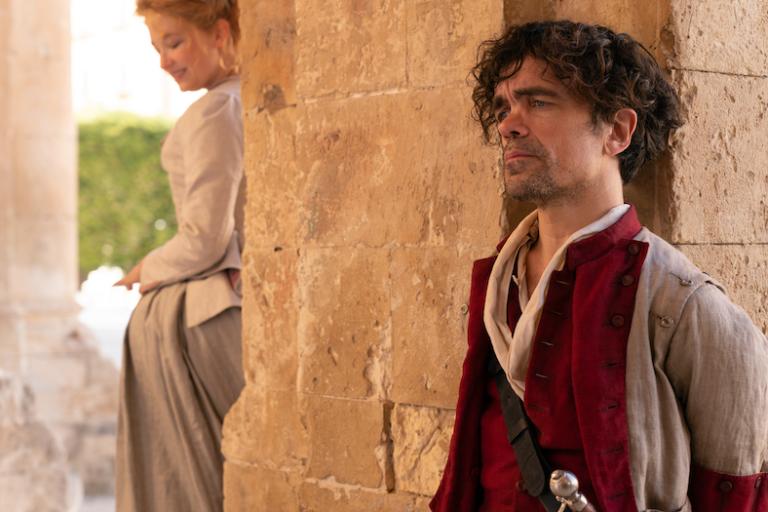
Haley Bennett and Peter Dinklage Cyrano. Photo courtesy Metro Goldwyn Mayer Pictures
Cyrano, the musical based on Edmond Rostand’s 1897 play Cyrano de Bergerac, is predicated on one of literature’s greatest, most unusual love stories: That of Cyrano for his beautiful best friend, Roxanne. And in many respects, that love manifests in what would seem to be a great deal of selflessness by the vertically challenged Cyrano: Allowing another suitor to claim Cyrano’s beautiful words as his own to woo the beauty.
But the musical’s poignant final words (and yes, we’re going to get into some spoilers in this blog) point to a deeper, more textured understanding of Cyrano and his love. “I loved my pride,” he said. And that centers on what writer C.S. Lewis called the world’s most problematic sin.
Short Stature, Towering Figure
The word pride is a tricky one. Culture encourages us to be proud—proud of ourselves, our families, our achievements, our country, etc. What child doesn’t long to hear her mom or dad say, “I’m proud of you.”? And should we not take pride when we’ve done something particularly worthwhile? Back in Cyrano’s day, the idea of pride and honor was incredibly potent—so much so that in Cyrano’s France was considered the dueling capital of Europe. One’s pride and honor was constantly under attack, it seems and honor demanded satisfaction.
We see that sense of pride in Joe Wright’s Oscar-nominated Cyrano. Sure, the guy’s barely four feet tall. (In the original play, of course, Cyrano’s main physical challenge was a ridiculously large nose.) But that hasn’t stopped the soldier from becoming one of Paris’s most feared duelists and celebrated wits. He can fence with anyone, physically or verbally, and he does both quite often. In the movie’s opening moments, in fact, he forces a celebrated (but past-his-prime) actor off a French stage, refunds the audience’s money from his own pockets and duels with an arrogant aristocrat.
All are acts of pride, and Cyrano underlines that by having the lead character take the stage himself. All the scene’s attention is honed in on the character. He becomes the star attraction and the audience’s generous benefactor.
But while Cyrano certainly takes (arguably justifiable) pride in his abilities, his swagger hides a long-standing secret: He’s in love with Roxanne, one of Paris’s most beautiful women, and he has been for ever so long. In fact, Cyrano calls loving her his “soul purpose on this earth.”
Though the two have been friends since childhood, Cyrano believes that his stature prevents he and Roxanne from ever becoming a thing. She could never love him, Cyrano fears. He has a moment of hope when Roxanne asks for a private meeting with him, but it’s quickly dashed: Sure, Roxanne indeed wanted to tell Cyrano that she was in love—but not with him. Rather, with a soon-to-be soldier in Cyrano’s own guard unit named Christian. And like a note-swapping middle-schooler, Roxanne begs Cyrano to tell Christian how she feels.
Heartbroken, Cyrano nevertheless agrees. And soon, he agrees to much more. See, Roxanne loves eloquence in her beaus, and handsome Christian isn’t eloquent. But he and Cyrano strike a bargain: Cyrano will write love letters to Roxanne ostensibly from Christian, allowing the soldier a fighting chance with the fair belle.
There’s an obvious flaw in the plan: Even if the ruse works perfectly, Christian can’t communicate to Roxanne through letters for the rest of their lives, can he?
Still, it works well enough. Christian and Roxanne marry in secret, though Christian and Cyrano are both swept immediately to war after the ceremony. And it’s there, at the front, that Christian learns definitively that Cyrano’s been in love with Roxanne all this time. Moreover, he realizes that Roxanne doesn’t love Christian; she loves Cyrano, even if she doesn’t know it.
“You must tell her!” Christian says to Cyrano. “It’s a moral obligation!”
But Cyrano doesn’t. Not then, not after Christian dies in battle, not after Roxanne has spent years in a convent, pining for the man she thinks she married.
Why does Cyrano hold his tongue? Sure, maybe he’s a little scared. We all fear rejection. But it’s much more than that.
Before Christian dies, Roxanne has already confessed to him (Christian) that she loves him for his soul—that is, the man who reveals himself in the letters she reads: That letter writer could come back from the war horribly disfigured, and it’d not change her feelings for him one jot.
No, it’s pride that keeps Cyrano silent—pride in the promise he made to himself to always keep his love a secret.

Peter Dinklage in Cyrano. Photo courtesy Metro Goldwyn Mayer Pictures
Pride Goes Before a Fall
Cyrano’s entire story arc is flecked with that sort of pride—pride that can sometimes look like selflessness. When he shames the actor off the stage and refunds the audience’s money, he does so out of his own pocket—even though it means spending every penny he has. He refuses the charity of others repeatedly. He prides himself on his self-sufficiency—and that pride ultimately dooms him. Even in the movie’s closing scenes, he refuses soup from the sisters at the convent, preferring to (as he thinks) suffer bravely.
Cyrano said his purpose on earth was to love Roxanne. But in the end, he failed, and it was all because of his pride. He never loved her at all—not in any real way. Love isn’t just a flood of emotions left to burble impotently within. It’s always an outpouring: To say you love a child and not feed him is not love. To say you love humanity while stepping over a homeless man on the street is not love. To say you love someone and not tell them—and worse, to let them suffer because you won’t—ultimately, that’s not love at all.
Cyrano’s pride sentenced both he and Roxanne to years of misery.
Despite the primacy of pride in Cyrano’s 17th-century France, theologians have often said that pride was the worst of the Seven Deadly Sins—the sin from which all others spring from. It’s a sneaky sin, too, given that it can masquerade as virtue: The prideful, like Cyrano, can often mistake it as an honorable quality. But the pride that Cyrano shows, in all its self-sufficiency, ultimately downplays or disregards God’s primacy—the reality that we need Him. And by extension, we need other people, too.
Cyrano pretends otherwise. He blames God for his height but takes credit for his wit and swordsmanship and (as the original play says) his “panache”. He considers himself a self-made man. He depends only on his own strength, his own skill, his own wit. To accept help—from God or anyone else—is an affront to his character.
I think that our current age is just susceptible to that curious sense of pride as in Cyrano’s day—perhaps moreso. I know that prideful self-sufficiency is something I slip into all too readily. We embrace plenty of clichés that we think are about strength and self-reliance—pulling ourselves up by our bootstraps, carrying our own weight, etc.–but which might be more about our own pride than we care to admit.
God never designed us to do the world alone. He designed us to live in community—to help others and to be helped in return. To love others and allow ourselves to be loved in return.
Cyrano only understood that at the end. But maybe, curiously, there’s hope for him yet.

Haley Bennett and Peter Dinklage in Cyrano. Photo courtesy Metro Goldwyn Mayer Pictures
Humility, and Love, at Last
At the end of the movie, Cyrano knows he’s dying. He’s kept his prideful promise to this point, but as his time on this earth ticks down to mere hours, he begins to wonder whether he had it all wrong. And when he arrives at the convent where Roxanne lives now, he speaks to a nun who, we’re told, has done her best to “convert” him—and also show him kindness.
Cyrano turns to her and says, “Tonight, I will let you pray for me,” as if this opening for charity is a gift.
“I have not waited for your permission,” the nun tells him.
Cyrano has done his best, all his life, to make it impossible for people to love him in any real sense. His pride has always gotten in the way. But God’s love is so powerful, so potent, that perhaps—like water—it can squeeze through the walls, seep into the barricades and cause, finally, a bit of softening.
Cyrano doesn’t keep his promise to the grave, as he swore he would. He tells. He opens his heart to love at the very last. And while it makes for a heartbreaking conclusion to the film Cyrano, we know that in his last moments, Cyrano’s pride finally fell away. And it was only then that he saw what love truly was.
Previous Post

February 21, 2022
In The Cursed, the Monsters Aren’t Just the Ones With Fangs
Next Post

March 3, 2022 Yes, The Batman is Grim. But Not as Grim as You Might Think.
Browse Our Archives
Select a Category books celebrities Editor's Choice games movies music news sports superheroes television Uncategorized
Select a Month May 2026 April 2026 March 2026 December 2025 October 2025 July 2025 June 2025 May 2025 February 2025 January 2025 December 2024 July 2024 June 2024 May 2024 April 2024 March 2024 February 2024 January 2024 December 2023 September 2023 March 2023 February 2023 December 2022 November 2022 October 2022 September 2022 August 2022 July 2022 June 2022 May 2022 April 2022 March 2022 February 2022 December 2021 October 2021 August 2021 July 2021 June 2021 May 2021 April 2021 March 2021 October 2020 August 2020 July 2020 June 2020 May 2020 April 2020 March 2020 February 2020 January 2020 December 2019 November 2019 October 2019 September 2019 August 2019 July 2019 June 2019 May 2019 April 2019 March 2019 February 2019 January 2019 December 2018 November 2018 October 2018 September 2018 August 2018 July 2018 June 2018 May 2018 April 2018 March 2018 February 2018 January 2018 December 2017 November 2017 October 2017 September 2017 August 2017 July 2017 June 2017 May 2017 April 2017 March 2017 February 2017 January 2017 December 2016 November 2016 October 2016 September 2016 August 2016 July 2016 June 2016 May 2016 April 2016 March 2016 February 2016 January 2016 December 2015 November 2015 October 2015 September 2015 August 2015 July 2015 June 2015 May 2015 April 2015 March 2015 February 2015 January 2015 December 2014 November 2014 October 2014 September 2014
Follow Us!
TAKE THE
Religious Wisdom Quiz
Who was the only daughter of Jacob mentioned by name in Genesis?
Select your answer to see how you score.
Dinah Judith Sarah Rahab
Books by This Author Books by Paul Asay
Related posts from Watching God

Finding Forgiveness in the Great Horror Film ‘Hokum’

What makes a hero? These 7 Cinematic Characters...

Finding God's Grace in ‘Project Hail Mary’

Watching God’s Top 10 Movies of 2025
TRENDING AT PATHEOS Religious Music & Entertainment

"Les Diabolique" and Transgression
Alongside something like Arrival, Vertigo, or Charade, Les Diaboliques is a...

"The Plague Dogs" and Mortality
So, flashback to the late 70s, early 80s. Walt Disney Studios is...

With the recent and highly successful release of Christopher Nolan’s epic film,...

"L'avventura" and Human Weakness
Today's piece is going to be a little different for a few...

I first want to apologize for not posting or writing anything. I'm...

I've engaged in the multi-year project of reading through the Church Fathers,...
view all Religious Music & Entertainment blogs
Ad-Free & Subscriber Log-In Subscription Support
- About Us
- 2026 Calendar
- Videos
- Podcasts
- Library of World Religions
- Faith In Media Tracker
- Advertise With Us
- Write for Us
- Privacy Policy
- Terms of Service
- Do Not Sell My Data
- Contact Us
- Radiant Digital
- Manage Newsletter Subscriptions
- Unsubscribe From Notifications
- Sitemap
Copyright 2008-2026, Patheos. All rights reserved.
Subscription Support Ad-Free & Subscriber Log-In
Follow Patheos