
BuddhistCatholicContemplativeEvangelicalGeneral ChristianHinduJewishLatter-day SaintMuslimNew VisionsProgressive Christian
Beliefs
- Buddhist
- Catholic
- Contemplative
- Evangelical
- General Christian
- Hindu
- Jewish
- Latter-day Saint
- More Voices
- Muslim
- New Visions
- Pagan
- Progressive Christian
Topics
- Religion News
- Food and Religion
- Sports and Religion
- Religious Art
- Religious Music and Entertainment
- Religious Events
- History and Religion
- Style and Religion
- Politics and Religion
- Women in Religion
- Recreation Outdoors and Religion
- Business Finance and Religion
- Careers Workplace and Religion
- Education and Religion
- Family Parenting and Religion
- Health Fitness and Religion
- Home and Religion
- Relationships and Religion
- Technology and Religion
- Travel and Religion
Columnists
- Buddhist Columnists
- Business Finance and Religion Columnists
- Careers Workplace and Religion Columnists
- Catholic Columnists
- Contemplative Columnists
- Education and Religion Columnists
- Evangelists Columnists
- Family Parenting and Religion Columnists
- General Christian Columnists
- Health Fitness and Religion Columnists
- Hindu Columnists
- History and Religion Columnists
- Home and Religion Columnists
- Jewish Columnists
- More Voices Columnists
- Latter Day Columnists
- Muslim Columnists
- New Visions Columnists
- Nonreligious Columnists
- Pagan Columnists
- Politics and Religion Columnists
- Progressive Columnists
- Recreation Outdoors and Religion Columnists
- Relationships and Religion Columnists
- Religion News Columnists
- Religious Art Columnists
- Religious Events Columnists
- Religious Music and Entertainment Columnists
- Sports and Religion Columnists
- Style and Religion Columnists
- Technology and Religion Columnists
- Travel and Religion Columnists
- Women in Religion Columnists
Resource Library
- 2026 Calendar
- Library of World Religions
- The 100 Most Holy Places on Earth
- Patheos Answers
- Podcasts
- Videos
- Faith Leaders Database
- Anglican Episcopalian
- Bahai
- Baptist
- Buddhism
- Christianity
- Confucianism
- Eastern Orthodoxy
- Hinduism
- Holiness and Pentecostal
- ISKCON
- Islam
- Judaism
- Lutheran
- Methodist
- The Church of Jesus Christ of Latter-day Saints
- New Age
- Paganism
- Presbytarian and Reformed
- Protestantism
- Religion Behind the Scenes
- Roman Catholic
- Scientology
- Shia Islam
- Sikhism
- Sufism
- Sunni Islam
- Taoism
- Zen
- See all religions
Research Tools
 Ad-Free & Subscriber Log-In Subscription Support
Ad-Free & Subscriber Log-In Subscription Support
Follow Patheos 

- Trending:
- Forgiveness
- |
- Marriage
- |
- Consciousness
- |
- Death Penalty
- |
- Election
- |
- Halloween

- Home
- Religious Music & Entertainment
- ‘Spider-Man: No Way Home’ Spins a Web of Second Chances
‘Spider-Man: No Way Home’ Spins a Web of Second Chances
Last updated on: December 20, 2021 at 10:45 am by Paul Asay
‘Spider-Man: No Way Home’ Spins a Web of Second Chances 2021-12-20T10:45:53-06:00 Paul Asay
Patheos Explore the world's faith through different perspectives on religion and spirituality! Patheos has the views of the prevalent religions and spiritualities of the world.
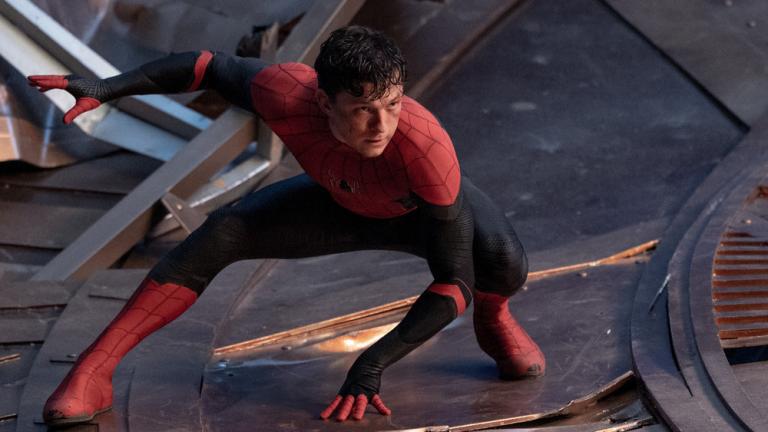
Tom Holland in Columbia Pictures’ Spider-Man: No Way Home, still courtesy Sony Pictures Publicity
Spider-Man: No Way Home snared a staggering $253 million in its sticky North American web this weekend—an unheard-of amount in the age of COVID. At a time when roughly half of us are still uncomfortable going to a theater, Spider-Man was just the ticket to drag us back to our friendly neighborhood cinema.
If you ask me, it’s worth the trip. No Way Home is a curious blend of past and present, as well as a high-flying introduction to the future of the Marvel Cinematic Universe. And it has some spiritual power to it, as well.
But I’m getting ahead of things a bit. First, let’s set the groundwork for the movie itself. (And while I’ll try to avoid any massive spoilers, I may touch on a few minor ones.)
No Way Home picks up almost exactly where Spider Man: Far From Home left off: J. Jonah Jameson (played by J.K. Simmons) is accusing Spider-Man of killing the heroic Mysterio (Jake Gyllenhaal) and has revealed Spidey’s secret identity—Peter Parker (Tom Holland). News crews, protesters and a bunch of curious New Yorkers soon swarm college-bound Peter and his friends everywhere they go. And because of all that controversial publicity, prestigious MIT refuses to even consider Peter’s application. Or that of his girlfriend, M.J. Or that of his best friend, Ned.
In desperation, Peter decides to seek out Doctor Strange (Benedict Cumberbatch) and ask for a huge favor. Can you rewind time just a teensy little bit? Or, barring that, cast a spell that might make everyone forget he’s Spider-Man?
Strange says he can, but the spell goes awry—sending tiny hairline, Peter Parker-specific cracks across the universe. And before you know it, Spidey villains from other universes start squeezing in.
Now clearly, you can’t have a bunch of new bad guys just running around the planet without doing something about it. Doctor Strange figures out a solution: If Spider-Man can capture these antagonistic anomalies, Strange can send them back to their own universes with a literal push of a button.
But turns out, there’s a catch: If they go back, chances are they’ll die.
Strange doesn’t much care: “It’s their fate,” he tells Peter. “You can’t change that any more than you can change who they are.” But Peter’s Aunt May (Marisa Tomei) disagrees. She runs a charity that’s predicated on the belief that people can and do change. So instead of following the advice of his fellow Avenger, Peter decides to try to help these dastardly supervillains.
That decision comes with danger and at a terrible price. It’s a decision based in grace and mercy—hard, crazy grace (as it so often is). And it gives No Way Home its spiritual, and I’d argue Christian, pop. Here’s why.
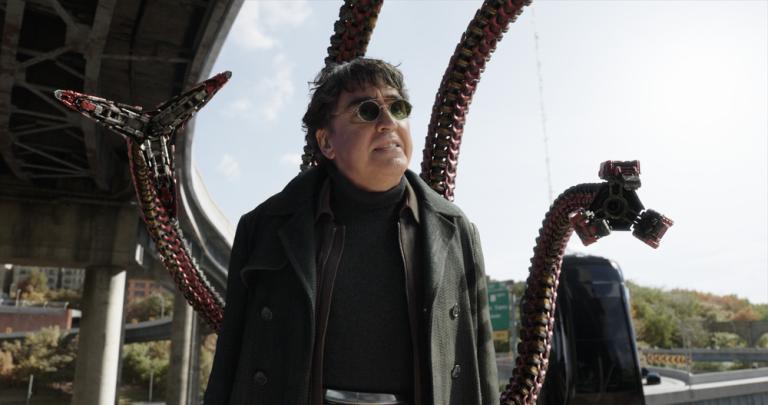
Alfred Molina as Doc Ock in Columbia Pictures’ Spider-Man: No Way Home
Fallen Creatures. The villains we see here—Doc Ock, the Green Goblin, Sandman, etc.—are villainous, to be sure. But many of them have pretty tragic origin stories, too. Otto Octavius (Alfred Molina) was a brilliant and well-meaning scientist before his techno-tentacles took over. Norman Osborn (Willem Dafoe) went insane thanks to one of his own experiments going awry. Sandman (Thomas Haden Church) originally turned to a life of crime to pay for medical treatments for his daughter.
Few of Spidey’s villains are blameless for their falls. Hubris plays into many an origin story. Most certainly had problems before they turned to superpowered evil. But they weren’t just born bad: Life twisted them. This fallen world joined with their own fallen natures to make them who they became.
And that’s the way it is with us.
That’s the funny thing about superhero movies: I think most of us put ourselves in the shoes of the hero, thinking ourselves more likely to save the world than ruin it. And I think that can be true. But honestly, most of us share more in common with the villains than we’d like to admit. We sometimes run after things we shouldn’t, turning our backs on the things we should. And the world often pushes us down some pretty bad paths: Bad upbringings can fracture us. Torn relationships can tear us, too. Life isn’t fair sometimes, and when we dwell on that—seek vengeance on those who’ve done us wrong or rage against circumstances beyond our control—we change. We might not change as dramatically or as obviously as Sandman or Electro or any other supervillain, but it still eats away at our souls, and it moves us farther from the people that God created us to be.
The Seduction of the Bad. But here’s the thing. Sometimes when we fall, we like where we land.
That’s what happens to the villains in No Way Home. Without exception, none of them want Peter’s help. Doc Ock’s tentacles enjoy being in control of Otto. Osbourne and the Green Goblin have a sort of Smeagol/Gollum relationship, and the Goblin often has the upper hand. Electro (Jamie Foxx) loves the power he can draw from this new universe.
We see echoes of that in our own lives, too—strongly, deeply and often tragically. Those with addiction issues know how hard they can be to shake. Even when we’re in the middle of a pretty run-of-the-mill squabble with someone we love, we all know how hard it can be to let go of our anger or resentment. And like these supervillains, sometimes it feels like those negative elements make us stronger. We feel powerful when we rage. We feel in control when we scheme. We feel better when we use drugs, more at peace when we drink. Temptations wouldn’t tempt if they didn’t have their own twisted elements of beauty.
And unlike in No Way Home, where cures for supervillainy can be foisted upon an unwilling villain, in the real world we have to want to change for change to happen.
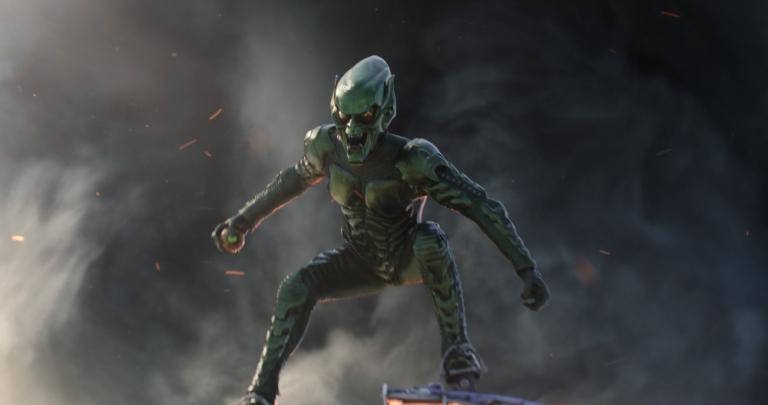
Green Goblin from Columbia Pictures’ Spider-Man: No Way Home
Second Chances. But we can change. And sometimes, we do.
That’s what Christianity is really built on—the idea that if we turn to Christ, we can die to those old bad selves of ours and become something new, something better. We can have a second chance.
In No Way Home, Doctor Strange is truly an avatar of fate—a representative for what should happen. It’s not like he’s vindictive, or that he wants these villains to suffer and die. But he believes that the universe operates by a set of rules. Their appearance in this universe is an aberration, and to make things “right” again demands some hard choices.
And so Christian doctrine says it is with us. God designed us to be His children, but we left His way and made our own. And because we fell out of line with His design, there’s only one logical way that fall can end: With our destruction.
Only it doesn’t work that way.
Jesus, a little like Aunt May, becomes our intercessor. He steps in front of the firing squad, asking for a teensy little favor: To upend the universe and give us a second chance.
The concept of that “second chance” runs throughout No Way Home, including an explicit call-out to the Statue of Liberty (called one of the most potent symbols of the second chance). We know that the villains arrayed against Spider-Man have done some terrible things (and continue to do them). We know what they deserve. We know how much cleaner and more expedient it would be to just press the button and send them “home,” to face their tragic fates.
But Spider-Man—who, like Jesus, has been called out as a villain, has been battered and bruised, has lost so much—continues to fight for these terribly flawed people, not against them.
You can find threads of Christianity throughout Marvel’s Cinematic Universe—its themes of good and evil, duty and sacrifice, truth and mercy and so on. But even as the MCU turns weirder and sometimes more spiritual in more discomforting ways (see Eternals on that count), it seems to be leaning harder into not just fighting evil, but asking what it is—and whether even in the midst of that evil, there still might be some kernel of something to save. Some person worth redeeming.
I like that trend, even if the endings aren’t quite as clean or cathartic. Because if Doc Ock can be saved, that means we’ve got a shot, too.
Previous Post

October 22, 2021
Mass Effect: What the Movie Mass Says About Grief and Forgiveness
Next Post

December 28, 2021 Watching God’s Top 10 Movies for 2021
Browse Our Archives
Select a Category books celebrities Editor's Choice games movies music news sports superheroes television Uncategorized
Select a Month May 2026 April 2026 March 2026 December 2025 October 2025 July 2025 June 2025 May 2025 February 2025 January 2025 December 2024 July 2024 June 2024 May 2024 April 2024 March 2024 February 2024 January 2024 December 2023 September 2023 March 2023 February 2023 December 2022 November 2022 October 2022 September 2022 August 2022 July 2022 June 2022 May 2022 April 2022 March 2022 February 2022 December 2021 October 2021 August 2021 July 2021 June 2021 May 2021 April 2021 March 2021 October 2020 August 2020 July 2020 June 2020 May 2020 April 2020 March 2020 February 2020 January 2020 December 2019 November 2019 October 2019 September 2019 August 2019 July 2019 June 2019 May 2019 April 2019 March 2019 February 2019 January 2019 December 2018 November 2018 October 2018 September 2018 August 2018 July 2018 June 2018 May 2018 April 2018 March 2018 February 2018 January 2018 December 2017 November 2017 October 2017 September 2017 August 2017 July 2017 June 2017 May 2017 April 2017 March 2017 February 2017 January 2017 December 2016 November 2016 October 2016 September 2016 August 2016 July 2016 June 2016 May 2016 April 2016 March 2016 February 2016 January 2016 December 2015 November 2015 October 2015 September 2015 August 2015 July 2015 June 2015 May 2015 April 2015 March 2015 February 2015 January 2015 December 2014 November 2014 October 2014 September 2014
Follow Us!
TAKE THE
Religious Wisdom Quiz
Who was Abraham asked to offer as a sacrifice?
Select your answer to see how you score.
Shem Ishmael Isaac Jacob
Books by This Author Books by Paul Asay
Related posts from Watching God

Finding Forgiveness in the Great Horror Film ‘Hokum’

What makes a hero? These 7 Cinematic Characters...

Finding God's Grace in ‘Project Hail Mary’

Watching God’s Top 10 Movies of 2025
TRENDING AT PATHEOS Religious Music & Entertainment

"Les Diabolique" and Transgression
Alongside something like Arrival, Vertigo, or Charade, Les Diaboliques is a...

"The Plague Dogs" and Mortality
So, flashback to the late 70s, early 80s. Walt Disney Studios is...

With the recent and highly successful release of Christopher Nolan’s epic film,...

"L'avventura" and Human Weakness
Today's piece is going to be a little different for a few...

I first want to apologize for not posting or writing anything. I'm...

I've engaged in the multi-year project of reading through the Church Fathers,...
view all Religious Music & Entertainment blogs
Ad-Free & Subscriber Log-In Subscription Support
- About Us
- 2026 Calendar
- Videos
- Podcasts
- Library of World Religions
- Faith In Media Tracker
- Advertise With Us
- Write for Us
- Privacy Policy
- Terms of Service
- Do Not Sell My Data
- Contact Us
- Radiant Digital
- Manage Newsletter Subscriptions
- Unsubscribe From Notifications
- Sitemap
Copyright 2008-2026, Patheos. All rights reserved.
Subscription Support Ad-Free & Subscriber Log-In
Follow Patheos