
BuddhistCatholicContemplativeEvangelicalGeneral ChristianHinduJewishLatter-day SaintMuslimNew VisionsProgressive Christian
Beliefs
- Buddhist
- Catholic
- Contemplative
- Evangelical
- General Christian
- Hindu
- Jewish
- Latter-day Saint
- More Voices
- Muslim
- New Visions
- Pagan
- Progressive Christian
Topics
- Religion News
- Food and Religion
- Sports and Religion
- Religious Art
- Religious Music and Entertainment
- Religious Events
- History and Religion
- Style and Religion
- Politics and Religion
- Women in Religion
- Recreation Outdoors and Religion
- Business Finance and Religion
- Careers Workplace and Religion
- Education and Religion
- Family Parenting and Religion
- Health Fitness and Religion
- Home and Religion
- Relationships and Religion
- Technology and Religion
- Travel and Religion
Columnists
- Buddhist Columnists
- Business Finance and Religion Columnists
- Careers Workplace and Religion Columnists
- Catholic Columnists
- Contemplative Columnists
- Education and Religion Columnists
- Evangelists Columnists
- Family Parenting and Religion Columnists
- General Christian Columnists
- Health Fitness and Religion Columnists
- Hindu Columnists
- History and Religion Columnists
- Home and Religion Columnists
- Jewish Columnists
- More Voices Columnists
- Latter Day Columnists
- Muslim Columnists
- New Visions Columnists
- Nonreligious Columnists
- Pagan Columnists
- Politics and Religion Columnists
- Progressive Columnists
- Recreation Outdoors and Religion Columnists
- Relationships and Religion Columnists
- Religion News Columnists
- Religious Art Columnists
- Religious Events Columnists
- Religious Music and Entertainment Columnists
- Sports and Religion Columnists
- Style and Religion Columnists
- Technology and Religion Columnists
- Travel and Religion Columnists
- Women in Religion Columnists
Resource Library
- 2026 Calendar
- Library of World Religions
- The 100 Most Holy Places on Earth
- Patheos Answers
- Podcasts
- Videos
- Faith Leaders Database
- Anglican Episcopalian
- Bahai
- Baptist
- Buddhism
- Christianity
- Confucianism
- Eastern Orthodoxy
- Hinduism
- Holiness and Pentecostal
- ISKCON
- Islam
- Judaism
- Lutheran
- Methodist
- The Church of Jesus Christ of Latter-day Saints
- New Age
- Paganism
- Presbytarian and Reformed
- Protestantism
- Religion Behind the Scenes
- Roman Catholic
- Scientology
- Shia Islam
- Sikhism
- Sufism
- Sunni Islam
- Taoism
- Zen
- See all religions
Research Tools
 Ad-Free & Subscriber Log-In Subscription Support
Ad-Free & Subscriber Log-In Subscription Support
Follow Patheos 

- Trending:
- Forgiveness
- |
- Marriage
- |
- Consciousness
- |
- Death Penalty
- |
- Election
- |
- Halloween

- Home
- Religious Music & Entertainment
- Roma Downey, ‘Resurrection’ and Bringing Easter Down to Earth
Roma Downey, ‘Resurrection’ and Bringing Easter Down to Earth
Last updated on: March 28, 2021 at 10:42 am by Paul Asay
Roma Downey, ‘Resurrection’ and Bringing Easter Down to Earth 2021-03-28T10:42:54-06:00 Paul Asay
Patheos Explore the world's faith through different perspectives on religion and spirituality! Patheos has the views of the prevalent religions and spiritualities of the world.
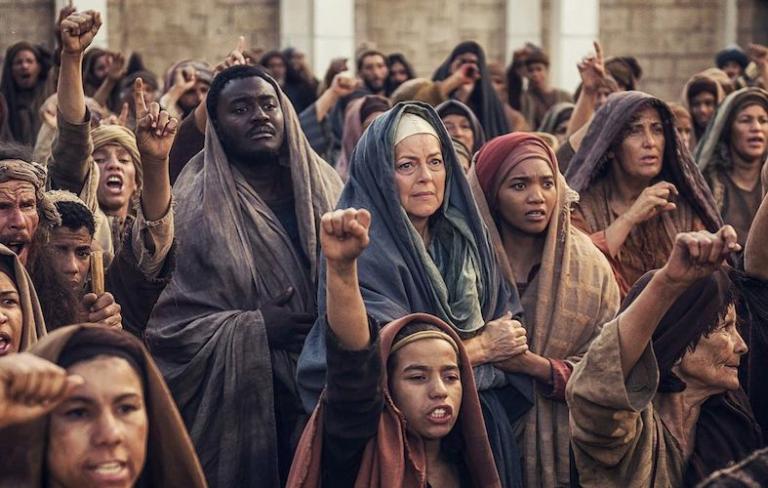
Babou Ceesay (John), Greta Scacchi (Mother Mary) Chipo Chung (Mary) in Resurrection, streaming on Discovery+. Photo courtesy Grace Hill Media and LightWorkers
Resurrection, the newest faith-based movie from Hollywood power couple Roma Downey and Mark Burnett (and just launched on Discovery+), takes a different tack than most movies about Jesus. While many concentrate on his life, teaching and crucifixion, they run the credits shortly thereafter. Mel Gibson’s bloody hit The Passion of the Christ spent most of its two-hour runtime on Christ’s suffering, and maybe 90 seconds on His triumphant return. And I get why. By then all the story’s innate tension and drama has been cleared up. Jesus’ resurrection makes for the ultimate happy ending: No need to belabor what comes after, right? Plus the hero of the story moves from being fully human to something … other. It’s kind of hard to grasp what that “other” really looks like. And honestly, details in the Bible are pretty sparse.
As such, Resurrection takes up a particularly daunting challenge: Infusing the important events after Jesus’ crucifixion with a little humanity. According to Downey, the key was to shift the focus to the drama’s all-too-human players.
“We know from Scripture that only John, the beloved, was at the foot of the cross with Mary Magdalene and Mary mother of Jesus,” Downey told me during an interview with Plugged In. “Judas had betrayed Jesus, but where were the 10 others? Where did they go?”
Downey and the movie’s other makers surmised they probably scattered–running away from the Roman authorities that might come after them next. Downey says they were probably terrified and heartbroken and, quite frankly, confused. The man they’d dedicated years of their lives to was dead now. They’d given up so much to follow Him. What were they going to do next, and without him?
“What we liked about crafting that story, is that it allows the audience to relate in ways that – they’ve been described here as real humans,” Downey said. “We see their humanity. We see their vulnerabilities, you know? And we realize that courage isn’t the absence of fear, that courage is having fear, but still stepping out.”
The movie feels as much the story of those disciples–Peter and John especially–as it does Jesus’ story. Peter makes for an especially interesting character, morphing from the terrified, despairing disciple who denied Jesus three times to the man who’d eventually become “the Rock” of a new faith.
Christians believe that Jesus is fully human and fully divine. That paradox has posed challenges to people telling Jesus’ story almost from the very beginning–balancing that humanity and divinity in a way that feels both real and reverent.
It’s not easy, and almost every movie or book or television show about Jesus eventually shades toward one side or the other. When I think of, say, 1977’s Jesus of Nazareth or even a lot of Downey and Burnett’s works, Christ feels pretty holy–and sometimes as a result, a bit less approachable. VidAngel’s runaway success The Chosen purposefully emphasizes Christ’s humanity, only hinting at His divinity. But that, of course, comes with its own problems.
And it strikes me that, often, artists and storytellers have tried to solve this conundrum through a bit of redirection. They turn our attention to those very human players that surrounded Jesus, and they let us see Christ through their eyes.
Back in the Middle Ages, depictions of Jesus and other biblical figures were symbolic and pretty stilted. Artists were all about representing the holiness and, in Jesus’ case, the divinity of their subjects, and telling a story through whatever symbolic objects they might decide to throw in there. They can be beautiful and powerful, as in this mosaic:
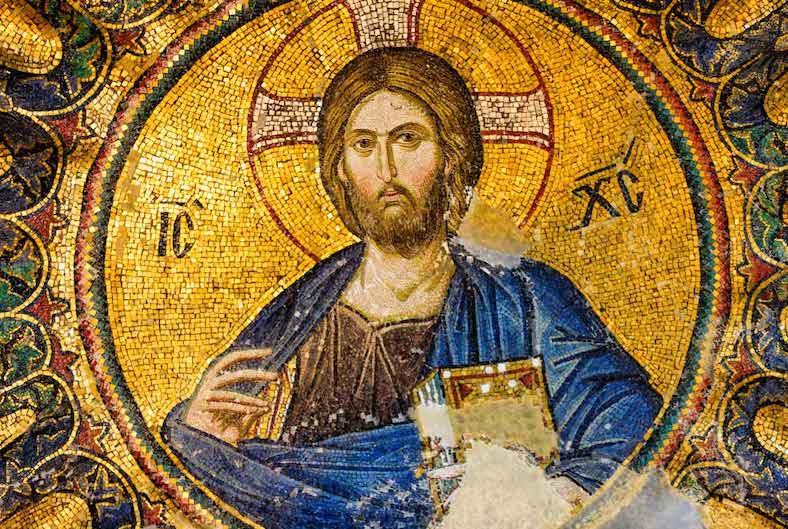
Mosaic from the Church of the Holy Saviour in Chora, now the Kariye Mosque in Istanbul.
But Medieval artists stuck to a pretty rigid formula in how they depicted Jesus or any number of other biblical characters. This mosaic in Chora doesn’t look that different from a mosaic of Jesus found in the Hagia Sophia just down the road.
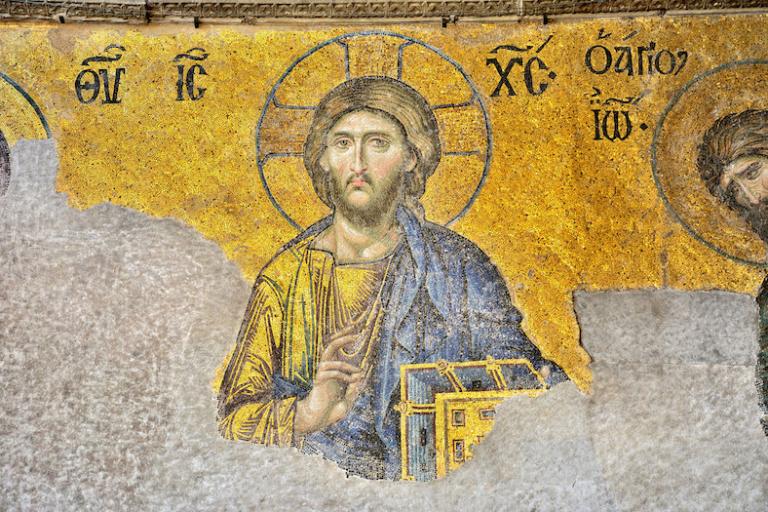
From the Hagia Sophia in Istanbul
A Middle-age picture of Mother Mary with her baby Jesus in Italy would look much like one in France or the Byzantine Empire, with both mom and child looking remarkably peaceful and serene. Even depictions of Jesus’ crucifixion can feel chilly. It’s also interesting that many of these great works of Medieval art were put in places where normal people couldn’t reach them–at the altar, often, or in the case of these two mosaics, on the ceiling. Sure, Jesus here is depicted as sitting in heaven, enthroned and looking down on us. The ceiling’s a fitting place for Him in that case. But the positioning came with another, perhaps unintended, message: He was unreachable.
Indeed, many of these pictures depict players as especially holy–holier certainly than you and me. And while that might be true, and while that might offer a bit of an aspirational prod (“say your prayers, and maybe you can be in a stained glass window one day!”), it did keep the heroes of the faith and the everyday worshippers pretty distant from one another.
But that began to change.
Around the 13th century, a young artistic upstart named Giotto di Bondone started doing something different with his work: He infused a bit of humanity into it. Probably the most famous example is his Lamentation (Mourning of Christ).
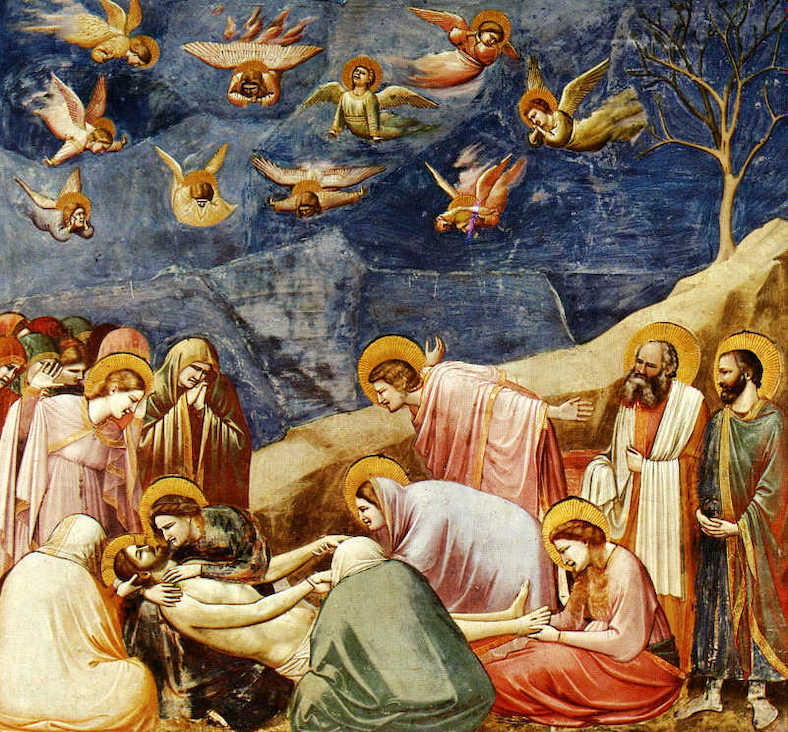
Giotto’s Lamentation, located in Scrovegni Chapel in Padua, Italy
Everyone still has halos. No one looks exactly true to nature. But when you look at the faces–particularly that of Mary, holding her child, and the angels above–you can see the grief etched on their faces. This is no formalized portrait, but an attempt to get to the real grief and heartbreak so many must’ve felt in that moment.
Giotto helped kickstart the Renaissance with this work, where artists pushed past formalized symbolism and tried to portray things as they looked to you and me, humanizing even the most solemn religious stories as they did so.
I was reminded of this picture, actually, while talking with Downey, when I asked her what moved her about the movie especially. Even though the movie deals mostly with the events after Jesus’ death, Downey returned to Jesus’ crucifixion, which takes place just 15-20 minutes in.
“I don’t know whether it’s because I’m a mother and I have a mother’s heart, but I never can watch this movie, or any movie, that has Mary, the mother of Jesus standing and remaining at the foot of the cross,” she told me. “Because you can’t imagine the strength and courage needed to see your child being murdered before your eyes. And yet I feel certain that she stood there, looking up, so that when He would look down, he would see the face of love. That the last thing Jesus would see from His earthly life would be the loving eyes of His mother.”
The divinity we find in Jesus is so important. It’s what our faith is built on, after all. But it’s the humanity that brings it home–the human face that God wore for us, and how He interacted with the fallen, fallible humans all around us. That’s something that Resurrection reminded me of, and something I’m mindful as Holy Week begins. It’s not just the story of how Christ died, but how He lived. Just like us.
Previous Post

October 28, 2020
The Christian Paradox of Pan’s Labyrinth
Next Post

April 3, 2021 Godzilla vs. Kong is the Tower of Babel All Over Again
Browse Our Archives
Select a Category books celebrities Editor's Choice games movies music news sports superheroes television Uncategorized
Select a Month May 2026 April 2026 March 2026 December 2025 October 2025 July 2025 June 2025 May 2025 February 2025 January 2025 December 2024 July 2024 June 2024 May 2024 April 2024 March 2024 February 2024 January 2024 December 2023 September 2023 March 2023 February 2023 December 2022 November 2022 October 2022 September 2022 August 2022 July 2022 June 2022 May 2022 April 2022 March 2022 February 2022 December 2021 October 2021 August 2021 July 2021 June 2021 May 2021 April 2021 March 2021 October 2020 August 2020 July 2020 June 2020 May 2020 April 2020 March 2020 February 2020 January 2020 December 2019 November 2019 October 2019 September 2019 August 2019 July 2019 June 2019 May 2019 April 2019 March 2019 February 2019 January 2019 December 2018 November 2018 October 2018 September 2018 August 2018 July 2018 June 2018 May 2018 April 2018 March 2018 February 2018 January 2018 December 2017 November 2017 October 2017 September 2017 August 2017 July 2017 June 2017 May 2017 April 2017 March 2017 February 2017 January 2017 December 2016 November 2016 October 2016 September 2016 August 2016 July 2016 June 2016 May 2016 April 2016 March 2016 February 2016 January 2016 December 2015 November 2015 October 2015 September 2015 August 2015 July 2015 June 2015 May 2015 April 2015 March 2015 February 2015 January 2015 December 2014 November 2014 October 2014 September 2014
Follow Us!
TAKE THE
Religious Wisdom Quiz
What does God question Job about, showing His wisdom in creation?
Select your answer to see how you score.
Animals and nature Kingdoms Battles Religious rituals
Books by This Author Books by Paul Asay
Related posts from Watching God

Finding Forgiveness in the Great Horror Film ‘Hokum’

What makes a hero? These 7 Cinematic Characters...

Finding God's Grace in ‘Project Hail Mary’

Watching God’s Top 10 Movies of 2025
TRENDING AT PATHEOS Religious Music & Entertainment

"Les Diabolique" and Transgression
Alongside something like Arrival, Vertigo, or Charade, Les Diaboliques is a...

"The Plague Dogs" and Mortality
So, flashback to the late 70s, early 80s. Walt Disney Studios is...

With the recent and highly successful release of Christopher Nolan’s epic film,...

"L'avventura" and Human Weakness
Today's piece is going to be a little different for a few...

I first want to apologize for not posting or writing anything. I'm...

I've engaged in the multi-year project of reading through the Church Fathers,...
view all Religious Music & Entertainment blogs
Ad-Free & Subscriber Log-In Subscription Support
- About Us
- 2026 Calendar
- Videos
- Podcasts
- Library of World Religions
- Faith In Media Tracker
- Advertise With Us
- Write for Us
- Privacy Policy
- Terms of Service
- Do Not Sell My Data
- Contact Us
- Radiant Digital
- Manage Newsletter Subscriptions
- Unsubscribe From Notifications
- Sitemap
Copyright 2008-2026, Patheos. All rights reserved.
Subscription Support Ad-Free & Subscriber Log-In
Follow Patheos