
BuddhistCatholicContemplativeEvangelicalGeneral ChristianHinduJewishLatter-day SaintMuslimNew VisionsProgressive Christian
Beliefs
- Buddhist
- Catholic
- Contemplative
- Evangelical
- General Christian
- Hindu
- Jewish
- Latter-day Saint
- More Voices
- Muslim
- New Visions
- Pagan
- Progressive Christian
Topics
- Religion News
- Food and Religion
- Sports and Religion
- Religious Art
- Religious Music and Entertainment
- Religious Events
- History and Religion
- Style and Religion
- Politics and Religion
- Women in Religion
- Recreation Outdoors and Religion
- Business Finance and Religion
- Careers Workplace and Religion
- Education and Religion
- Family Parenting and Religion
- Health Fitness and Religion
- Home and Religion
- Relationships and Religion
- Technology and Religion
- Travel and Religion
Columnists
- Buddhist Columnists
- Business Finance and Religion Columnists
- Careers Workplace and Religion Columnists
- Catholic Columnists
- Contemplative Columnists
- Education and Religion Columnists
- Evangelists Columnists
- Family Parenting and Religion Columnists
- General Christian Columnists
- Health Fitness and Religion Columnists
- Hindu Columnists
- History and Religion Columnists
- Home and Religion Columnists
- Jewish Columnists
- More Voices Columnists
- Latter Day Columnists
- Muslim Columnists
- New Visions Columnists
- Nonreligious Columnists
- Pagan Columnists
- Politics and Religion Columnists
- Progressive Columnists
- Recreation Outdoors and Religion Columnists
- Relationships and Religion Columnists
- Religion News Columnists
- Religious Art Columnists
- Religious Events Columnists
- Religious Music and Entertainment Columnists
- Sports and Religion Columnists
- Style and Religion Columnists
- Technology and Religion Columnists
- Travel and Religion Columnists
- Women in Religion Columnists
Resource Library
- 2026 Calendar
- Library of World Religions
- The 100 Most Holy Places on Earth
- Patheos Answers
- Podcasts
- Videos
- Faith Leaders Database
- Anglican Episcopalian
- Bahai
- Baptist
- Buddhism
- Christianity
- Confucianism
- Eastern Orthodoxy
- Hinduism
- Holiness and Pentecostal
- ISKCON
- Islam
- Judaism
- Lutheran
- Methodist
- The Church of Jesus Christ of Latter-day Saints
- New Age
- Paganism
- Presbytarian and Reformed
- Protestantism
- Religion Behind the Scenes
- Roman Catholic
- Scientology
- Shia Islam
- Sikhism
- Sufism
- Sunni Islam
- Taoism
- Zen
- See all religions
Research Tools
 Ad-Free & Subscriber Log-In Subscription Support
Follow Patheos 

- Trending:
- Advent
- |
- Forgiveness
- |
- Thanksgiving
- |
- Election
- |
- Seasonal Holidays
- |
- Marriage

- Home
- Religious Music & Entertainment
- The Christian Paradox of Pan’s Labyrinth
The Christian Paradox of Pan’s Labyrinth
Last updated on: October 28, 2020 at 8:10 pm by Paul Asay
The Christian Paradox of Pan’s Labyrinth 2020-10-28T20:10:22-06:00 Paul Asay
Patheos Explore the world's faith through different perspectives on religion and spirituality! Patheos has the views of the prevalent religions and spiritualities of the world.
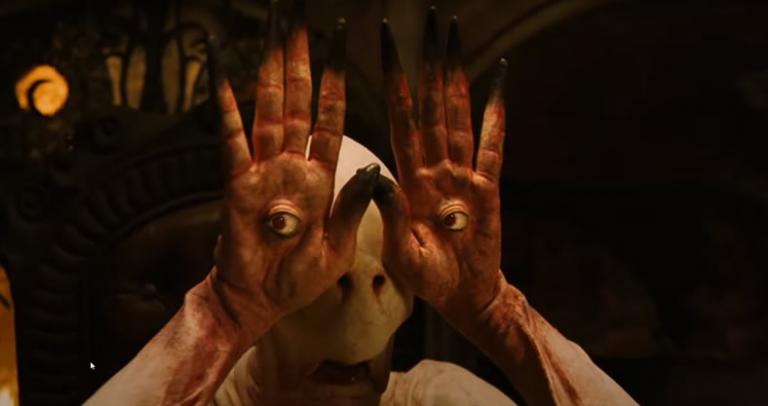
The Pale Man from Pan’s Labyrinth, screen shot from the movie.
Pan’s Labyrinth is not, exactly, a horror movie—no matter what my podcast partner might say. Guillermo del Toro’s freaky fable is more like a dark fantasy tale spliced together with, admittedly, an all-too-horrifically real war drama. So to post this on Halloween week feels a little like cheating.
But the film includes many elements that’d be right at home in supernatural horror movies: monsters, magic and some surprisingly deep reflections on the nature of evil. It’s also deeply interested in faith and religion. What does Labyrinth say about them? Well, that seems to depend on who’s watching.
Much of the story takes place in a wooded corner of fascist Spain. A quiet mill has become a military outpost, commanded by the sadistic Captain Vidal (played by Sergi Lopez). The Catholic Church, it seems, has sided with the Captain and fascism (as it did, of course, in real life): A priest is one of the Captain’s dinner guests early in the movie, and when one guest balks at the Captain’s suggestion that each nearby family should get just one ration card, the priest says they’ll be just fine. “God has already saved their souls,” he insists. “What happens to their bodies hardly matters to Him.”
Later, the Captain’s own troops offer a perverted nod to the Lord’s Prayer: “This is our daily bread in Franco’s Spain!” one soldier shouts at the people waiting in line for food, adding that the government will supply every Spaniard’s needs. The meaning is clear: Sure, the Church still has a role in fascist Spain—but only to glorify the country’s real god: Franco.
That above-ground reality is horrifically mirrored, in a way, down below. For as Captain Vidal works to augment his power and destroy the rebels in the nearby hills, his stepdaughter, Ofelia (Ivana Baquero), is dealing with her own problems.
Ofelia’s mother recently married the Captain and is pregnant with the Captain’s baby. The Captain insisted on bringing his wife and Ofelia to the mill, despite the fact that the pregnancy is not going particularly well. Soon after she and Ofelia arrive, the 10-year-old girl discovers an ancient stone maze that leads to a stone stairway. She goes down and meets a Faun, who tells her that she’s secretly a princess! But to reclaim her long-vacant throne, she’ll need to undergo three terrifying tasks.
The second task is probably the movie’s most memorable: Ofelia’s encounter with the Pale Man. That scene, too, takes the shape of a feast, and it plays heavy with a spiritual, Catholic flavor. The Pale Man’s lair feels a lot like a church, what with its pillars and arches and even the half-dome above the Pale Man himself—a naked, flabby creature whose eyes sit on a plate. Pictures of the Pale Man surround the room, depicting him killing and eating children. In substance, they’re horrific. But in style, they feel like illustrations one might find in a Medieval Bible, or even a chronicle that blasphemously mirrors the Stations of the Cross.
Del Toro’s views on what the Pale Man represents have expanded over time. But in an interview with Twitch Film in 2006, he said, “The Pale Man represents the Church for me, y’know? Represents fascism and the Church eating the children when they have a perversely abundant banquet in front of them.”
Certainly through the first part of the film, Del Toro positions the Catholic Church as an adversary, both in his realistic and fantastic worlds. A pagan ethos—represented by Del Toro’s faun and fairies and in some ways culminating with a magic spell involving a mandrake root, milk and blood—seems to offer the film’s hope of salvation.
But that’s not entirely accurate. Indeed, the story takes a twist, with layers that perhaps even Del Toro didn’t fully anticipate. Writing for The Guardian, Del Toro says:
I … have a fear of reason and dogma; it gives me the shivers. But maybe my upbringing keeps getting in the way. When I showed Pan’s Labyrinth to my friend Alejandro González Iñárritu [director of The Revenant], he said: “That’s a truly Catholic film.” And there was me thinking that it was a truly profane film, a layman’s riff on Catholic dogma. It’s true what they say: once a Catholic, always a Catholic.
We’re diving into spoiler territory, so be warned.
During the funeral of the Captain’s wife, who dies during childbirth, the movie’s Catholicism takes a quick turn—moving away from corrupt institutionalism to something more ethereal and honest. The priest offers a powerful, enigmatic psalm that embraces the mystery of faith itself:
Because the paths to the Lord are inscrutable; because the essence of His forgiveness lies in His word and in His mystery; because although God sends us the message, it is our task to decipher it. Because when we open our arms, the earth takes in only a hollow and senseless shell. Far away now is the soul in its eternal glory, because it is in pain that we find the meaning of life, and the state of grace that we lose when we are born; because God, in His infinite wisdom, puts the solution in our hands; and because it is only in His physical absence that the place He occupies in our souls is reaffirmed.
I love that last line: “Only in His physical absence that the place He occupies in our souls is reaffirmed.”
The funeral presages *Pan’s Labyrinth’*s last difficult act.
Ofelia fails a portion of her test with the Pale Man, and the faun initially casts her out: She’s not the princess, he tells her. She will live and die in this horrible, above-ground world of hers. Later, the faun seems to have a change of heart—but he warns Ofelia that she must obey him—follow his orders without question.
And then he demands that Ofelia give her brother to him for sacrifice. “Just a drop of blood,” the faun reassures her. “A pinprick, that’s all.” But she, and we, don’t believe him.
The faun asks if she’s willing to sacrifice her throne, her rights, for a “brat you barely know.” A brat, incidentally, that indirectly caused the death of Ofelia’s mother. He asks if this little baby, who’s caused her such pain and humiliation, is worth it. Ofelia says that he is: She will sacrifice whatever she has to to protect this infant.
“As you wish, your highness,” the faun says.
And with those words, Captain Vidal—who snuck stealthily behind Ofelia—shoots her.
Ofelia is hardly a perfect Christ figure. For one thing, the child is wholly innocent. Jesus died for the guilty, and we are more like Captain Vidal than we’d like to admit. But Ofelia gives up a kingdom to save someone who’s done nothing to earn her favor; she bleeds and dies for him, in fact—and in her sacrifice, she finds herself snatched up into the movie’s definition of glory, earning crowns in an underground heaven.
In Captain Vidal’s view of the world, sacrificing the weaker for good of the strong would make perfect sense. It is, in fact, the way the real world sometimes works. But Ofelia was operating not in the world’s power, but in something stronger, subtler, gentler. The whole scene reminded me of “the deep magic” we hear about in C.S. Lewis’ The Lion, The Witch and the Wardrobe—the magic that required a horrible sacrifice to rescue a guilty child. Underneath that magic, we learn, is a deeper magic still.
Pan’s Labyrinth is saturated in magic—the magic found in dark fairy tales and druidic circles. But underneath that magic is a deeper magic: One built on mercy and grace and losing one’s life for another. In that deeper magic, death is not the end. What is lost will be found again.

Next Post

March 28, 2021 Roma Downey, 'Resurrection' and Bringing Easter Down to Earth
Browse Our Archives
Select a Category books celebrities Editor's Choice games movies music news sports superheroes television Uncategorized
Select a Month October 2026 May 2026 April 2026 March 2026 December 2025 October 2025 July 2025 June 2025 May 2025 February 2025 January 2025 December 2024 July 2024 June 2024 May 2024 April 2024 March 2024 February 2024 January 2024 December 2023 September 2023 March 2023 February 2023 December 2022 November 2022 October 2022 September 2022 August 2022 July 2022 June 2022 May 2022 April 2022 March 2022 February 2022 December 2021 October 2021 August 2021 July 2021 June 2021 May 2021 April 2021 March 2021 October 2020 August 2020 July 2020 June 2020 May 2020 April 2020 March 2020 February 2020 January 2020 December 2019 November 2019 October 2019 September 2019 August 2019 July 2019 June 2019 May 2019 April 2019 March 2019 February 2019 January 2019 December 2018 November 2018 October 2018 September 2018 August 2018 July 2018 June 2018 May 2018 April 2018 March 2018 February 2018 January 2018 December 2017 November 2017 October 2017 September 2017 August 2017 July 2017 June 2017 May 2017 April 2017 March 2017 February 2017 January 2017 December 2016 November 2016 October 2016 September 2016 August 2016 July 2016 June 2016 May 2016 April 2016 March 2016 February 2016 January 2016 December 2015 November 2015 October 2015 September 2015 August 2015 July 2015 June 2015 May 2015 April 2015 March 2015 February 2015 January 2015 December 2014 November 2014 October 2014 September 2014
Follow Us!
TAKE THE
Religious Wisdom Quiz
A gentle answer turns away wrath, but harsh words stir up what?
Select your answer to see how you score.
Hatred Trouble Anger Strife
Books by This Author Books by Paul Asay
Related posts from Watching God

Great Spiritual Horror Films of the 20th Century...
Finding Forgiveness in the Great Horror Film ‘Hokum’

What makes a hero? These 7 Cinematic Characters...
Finding God's Grace in ‘Project Hail Mary’
TRENDING AT PATHEOS Religious Music & Entertainment

A Christian, a Narnia Fan, and a Filmmaker...
Watching The Narnia Trailer As A Fan And A Filmmaker Ever since...

Great Spiritual Horror Films of the 20th Century...
For the Christian, horror movies are often troubling—and many would say that...

"Les Diabolique" and Transgression
Alongside something like Arrival, Vertigo, or Charade, Les Diaboliques is a...

"The Plague Dogs" and Mortality
So, flashback to the late 70s, early 80s. Walt Disney Studios is...

With the recent and highly successful release of Christopher Nolan’s epic film,...

"L'avventura" and Human Weakness
Today's piece is going to be a little different for a few...
view all Religious Music & Entertainment blogs
Ad-Free & Subscriber Log-In Subscription Support
- About Us
- 2026 Calendar
- Videos
- Podcasts
- Library of World Religions
- Faith In Media Tracker
- Advertise With Us
- Write for Us
- Privacy Policy
- Terms of Service
- Do Not Sell My Data
- Contact Us
- Radiant Digital
- Manage Newsletter Subscriptions
- Unsubscribe From Notifications
- Sitemap
Copyright 2008-2026, Patheos, part of the Radiant Digital network of media brands. All rights reserved.
Subscription Support Ad-Free & Subscriber Log-In
Follow Patheos