
BuddhistCatholicContemplativeEvangelicalGeneral ChristianHinduJewishLatter-day SaintMuslimNew VisionsProgressive Christian
Beliefs
- Buddhist
- Catholic
- Contemplative
- Evangelical
- General Christian
- Hindu
- Jewish
- Latter-day Saint
- More Voices
- Muslim
- New Visions
- Pagan
- Progressive Christian
Topics
- Religion News
- Food and Religion
- Sports and Religion
- Religious Art
- Religious Music and Entertainment
- Religious Events
- History and Religion
- Style and Religion
- Politics and Religion
- Women in Religion
- Recreation Outdoors and Religion
- Business Finance and Religion
- Careers Workplace and Religion
- Education and Religion
- Family Parenting and Religion
- Health Fitness and Religion
- Home and Religion
- Relationships and Religion
- Technology and Religion
- Travel and Religion
Columnists
- Buddhist Columnists
- Business Finance and Religion Columnists
- Careers Workplace and Religion Columnists
- Catholic Columnists
- Contemplative Columnists
- Education and Religion Columnists
- Evangelists Columnists
- Family Parenting and Religion Columnists
- General Christian Columnists
- Health Fitness and Religion Columnists
- Hindu Columnists
- History and Religion Columnists
- Home and Religion Columnists
- Jewish Columnists
- More Voices Columnists
- Latter Day Columnists
- Muslim Columnists
- New Visions Columnists
- Nonreligious Columnists
- Pagan Columnists
- Politics and Religion Columnists
- Progressive Columnists
- Recreation Outdoors and Religion Columnists
- Relationships and Religion Columnists
- Religion News Columnists
- Religious Art Columnists
- Religious Events Columnists
- Religious Music and Entertainment Columnists
- Sports and Religion Columnists
- Style and Religion Columnists
- Technology and Religion Columnists
- Travel and Religion Columnists
- Women in Religion Columnists
Resource Library
- 2026 Calendar
- Library of World Religions
- The 100 Most Holy Places on Earth
- Patheos Answers
- Podcasts
- Videos
- Faith Leaders Database
- Anglican Episcopalian
- Bahai
- Baptist
- Buddhism
- Christianity
- Confucianism
- Eastern Orthodoxy
- Hinduism
- Holiness and Pentecostal
- ISKCON
- Islam
- Judaism
- Lutheran
- Methodist
- The Church of Jesus Christ of Latter-day Saints
- New Age
- Paganism
- Presbytarian and Reformed
- Protestantism
- Religion Behind the Scenes
- Roman Catholic
- Scientology
- Shia Islam
- Sikhism
- Sufism
- Sunni Islam
- Taoism
- Zen
- See all religions
Research Tools
 Ad-Free & Subscriber Log-In Subscription Support
Ad-Free & Subscriber Log-In Subscription Support
Follow Patheos 

- Trending:
- Forgiveness
- |
- Marriage
- |
- Consciousness
- |
- Death Penalty
- |
- Election
- |
- Halloween

- Home
- Religious Music & Entertainment
- ‘Stories are What Get Us Through Hard Times.’ An Interview With ‘The Quarry’ Director Scott Teems
‘Stories are What Get Us Through Hard Times.’ An Interview With ‘The Quarry’ Director Scott Teems
Last updated on: April 20, 2020 at 12:56 pm by Paul Asay
‘Stories are What Get Us Through Hard Times.’ An Interview With ‘The Quarry’ Director Scott Teems 2020-04-20T12:56:26-06:00 Paul Asay
Patheos Explore the world's faith through different perspectives on religion and spirituality! Patheos has the views of the prevalent religions and spiritualities of the world.
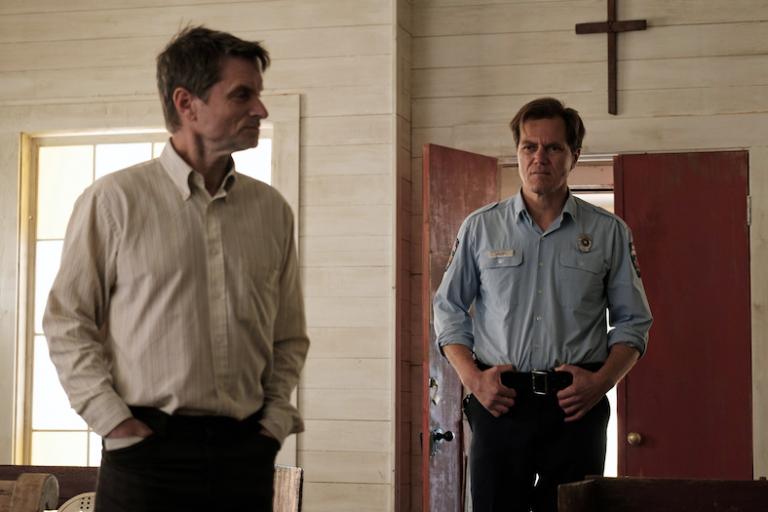
Shea Whigham and Michael Shannon in The Quarry, photo by John-Carlo Monti and courtesy of Lionsgate.
Asay: You had a chance to work with two pretty amazing actors in Shea Whigham and Michael Shannon. And it struck me while watching that so much of the interaction between these two characters wasn’t through dialogue. Just stares, glances, gestures. So much of their acting was wordless.
Teems: There’s an old adage that directing is 80%, and that’s certainly proven to be true in my experience. When you have great actors, it allows you to really let the story unfold in a more natural way. Great actors, they can hold the frame. Great actors, they tell you so much without saying a word. There’s so much going on behind the eyes. And you need that tension to engage in this cat-and-mouse game in which they engage in, you really, it just requires actors who are intelligent human beings and deep thinkers, and thoughtful people, and those two guys are certainly that.
They’re also old friends and that comes to bear in a lot of ways, because I think they really respect each other and they really, because they respect each other so much, as individuals, as friends, as actors, they both bring their A game whenever they show up. They really want to be there, to be present for the other actor. And that raises the stakes and raises the game for all the people on set.
Asay: One of the underlying currents in this movie is a sense of religious hypocrisy, the sense that preachers that have come to town before didn’t always walk the walk. Right from the get-go, this preacher feels different to the townspeople. And in part, it seems because he doesn’t know anything. He just goes up to the pulpit and reads from the Bible without embellishment, and with the growing realization that he really is, as he quotes the Apostle Paul, chief among sinners.
Teems: That was a small detail, and I’m glad you picked up on it. It was certainly something that I was interested in. It’s far down the list of things that are like the focus on the movie, but it’s a detail, that hopefully to observant viewer will take. He doesn’t go up there and editorialize or sermonize. Or talk about himself or his own point of view. And so therefore, if there’s any transformation or connection that happens in that congregation, it’s not because of what he said. And I think that’s a lesson that a lot of us could stand to learn. And certainly in the realm of American evangelical Christianity, I think that’s something we could stand to learn and be the better for it.
Asay: Are there lessons that you’d like viewers to walk away with after watching this movie? Things you think are worth chewing on?
Teems: I’m certainly not interested in giving an answer to take away, but I think there are questions here that I hope people would wrestle with. I think that that’s what the best art does. It asks questions.
There’s this great quote that I do not know who to attribute it to, but it says, ‘The problem with many Christian artists is that they want to give us the answer before they’ve lived the question.’ And that is really something that I take to heart. I think that our job as artists is to provoke and to ask questions and to make you think about something in a new way. And go away and chew on that for a little bit. I want you to feel a little unsettled by this movie in terms of what it says about forgiveness and redemption and grace and who is worthy of that. And who is not. And what does it look like when it happens. If you can walk away doing that, asking those questions, that’s a victory for me.
Previous Post

April 3, 2020
Religion is a Part of The Other Lamb. A Bad, Baaaaad Part
Next Post

May 29, 2020 The Truth Is Out There, Somewhere, in Amazon’s ‘The Vast of Night.’
Browse Our Archives
Select a Category books celebrities Editor's Choice games movies music news sports superheroes television Uncategorized
Select a Month May 2026 April 2026 March 2026 December 2025 October 2025 July 2025 June 2025 May 2025 February 2025 January 2025 December 2024 July 2024 June 2024 May 2024 April 2024 March 2024 February 2024 January 2024 December 2023 September 2023 March 2023 February 2023 December 2022 November 2022 October 2022 September 2022 August 2022 July 2022 June 2022 May 2022 April 2022 March 2022 February 2022 December 2021 October 2021 August 2021 July 2021 June 2021 May 2021 April 2021 March 2021 October 2020 August 2020 July 2020 June 2020 May 2020 April 2020 March 2020 February 2020 January 2020 December 2019 November 2019 October 2019 September 2019 August 2019 July 2019 June 2019 May 2019 April 2019 March 2019 February 2019 January 2019 December 2018 November 2018 October 2018 September 2018 August 2018 July 2018 June 2018 May 2018 April 2018 March 2018 February 2018 January 2018 December 2017 November 2017 October 2017 September 2017 August 2017 July 2017 June 2017 May 2017 April 2017 March 2017 February 2017 January 2017 December 2016 November 2016 October 2016 September 2016 August 2016 July 2016 June 2016 May 2016 April 2016 March 2016 February 2016 January 2016 December 2015 November 2015 October 2015 September 2015 August 2015 July 2015 June 2015 May 2015 April 2015 March 2015 February 2015 January 2015 December 2014 November 2014 October 2014 September 2014
Follow Us!
TAKE THE
Religious Wisdom Quiz
What did Elisha heal by throwing salt into it?
Select your answer to see how you score.
A fig tree River Jordan A spring of water A pot of stew
Books by This Author Books by Paul Asay
Related posts from Watching God

Finding Forgiveness in the Great Horror Film ‘Hokum’

What makes a hero? These 7 Cinematic Characters...

Finding God's Grace in ‘Project Hail Mary’

Watching God’s Top 10 Movies of 2025
TRENDING AT PATHEOS Religious Music & Entertainment

"Les Diabolique" and Transgression
Alongside something like Arrival, Vertigo, or Charade, Les Diaboliques is a...

"The Plague Dogs" and Mortality
So, flashback to the late 70s, early 80s. Walt Disney Studios is...

With the recent and highly successful release of Christopher Nolan’s epic film,...

"L'avventura" and Human Weakness
Today's piece is going to be a little different for a few...

I first want to apologize for not posting or writing anything. I'm...

I've engaged in the multi-year project of reading through the Church Fathers,...
view all Religious Music & Entertainment blogs
Ad-Free & Subscriber Log-In Subscription Support
- About Us
- 2026 Calendar
- Videos
- Podcasts
- Library of World Religions
- Faith In Media Tracker
- Advertise With Us
- Write for Us
- Privacy Policy
- Terms of Service
- Do Not Sell My Data
- Contact Us
- Radiant Digital
- Manage Newsletter Subscriptions
- Unsubscribe From Notifications
- Sitemap
Copyright 2008-2026, Patheos. All rights reserved.
Subscription Support Ad-Free & Subscriber Log-In
Follow Patheos