
BuddhistCatholicContemplativeEvangelicalGeneral ChristianHinduJewishLatter-day SaintMuslimNew VisionsProgressive Christian
Beliefs
- Buddhist
- Catholic
- Contemplative
- Evangelical
- General Christian
- Hindu
- Jewish
- Latter-day Saint
- More Voices
- Muslim
- New Visions
- Pagan
- Progressive Christian
Topics
- Religion News
- Food and Religion
- Sports and Religion
- Religious Art
- Religious Music and Entertainment
- Religious Events
- History and Religion
- Style and Religion
- Politics and Religion
- Women in Religion
- Recreation Outdoors and Religion
- Business Finance and Religion
- Careers Workplace and Religion
- Education and Religion
- Family Parenting and Religion
- Health Fitness and Religion
- Home and Religion
- Relationships and Religion
- Technology and Religion
- Travel and Religion
Columnists
- Buddhist Columnists
- Business Finance and Religion Columnists
- Careers Workplace and Religion Columnists
- Catholic Columnists
- Contemplative Columnists
- Education and Religion Columnists
- Evangelists Columnists
- Family Parenting and Religion Columnists
- General Christian Columnists
- Health Fitness and Religion Columnists
- Hindu Columnists
- History and Religion Columnists
- Home and Religion Columnists
- Jewish Columnists
- More Voices Columnists
- Latter Day Columnists
- Muslim Columnists
- New Visions Columnists
- Nonreligious Columnists
- Pagan Columnists
- Politics and Religion Columnists
- Progressive Columnists
- Recreation Outdoors and Religion Columnists
- Relationships and Religion Columnists
- Religion News Columnists
- Religious Art Columnists
- Religious Events Columnists
- Religious Music and Entertainment Columnists
- Sports and Religion Columnists
- Style and Religion Columnists
- Technology and Religion Columnists
- Travel and Religion Columnists
- Women in Religion Columnists
Resource Library
- 2026 Calendar
- Library of World Religions
- The 100 Most Holy Places on Earth
- Patheos Answers
- Podcasts
- Videos
- Faith Leaders Database
- Anglican Episcopalian
- Bahai
- Baptist
- Buddhism
- Christianity
- Confucianism
- Eastern Orthodoxy
- Hinduism
- Holiness and Pentecostal
- ISKCON
- Islam
- Judaism
- Lutheran
- Methodist
- The Church of Jesus Christ of Latter-day Saints
- New Age
- Paganism
- Presbytarian and Reformed
- Protestantism
- Religion Behind the Scenes
- Roman Catholic
- Scientology
- Shia Islam
- Sikhism
- Sufism
- Sunni Islam
- Taoism
- Zen
- See all religions
Research Tools
 Ad-Free & Subscriber Log-In Subscription Support
Ad-Free & Subscriber Log-In Subscription Support
Follow Patheos 

- Trending:
- Forgiveness
- |
- Marriage
- |
- Consciousness
- |
- Death Penalty
- |
- Election
- |
- Halloween

- Home
- Religious Music & Entertainment
- A Beautiful Day in the Neighborhood is a Beautiful Movie. It’s Also All About Pain.
A Beautiful Day in the Neighborhood is a Beautiful Movie. It’s Also All About Pain.
Last updated on: November 21, 2019 at 3:12 pm by Paul Asay
A Beautiful Day in the Neighborhood is a Beautiful Movie. It’s Also All About Pain. 2019-11-21T15:12:35-06:00 Paul Asay
Patheos Explore the world's faith through different perspectives on religion and spirituality! Patheos has the views of the prevalent religions and spiritualities of the world.
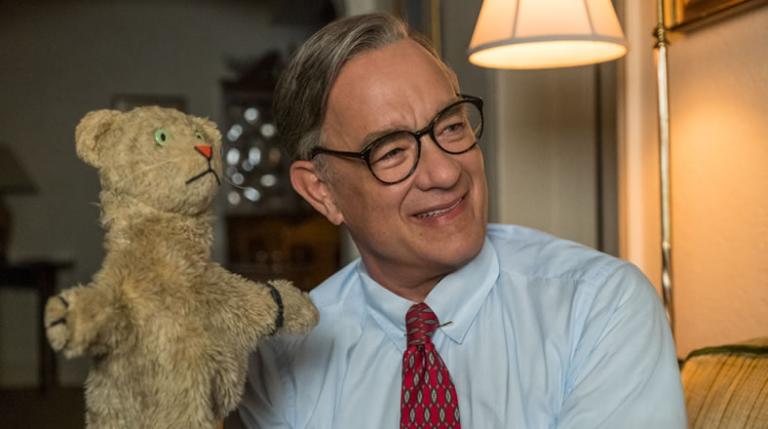
Tom Hanks in A Beautiful Day in the Neighborhood, photo by Lacey Terrell
I’ve got a friend who’s prone to make lists, and he recently gave me one of the 20 happiest moments of his life. It made for a pretty fascinating read: Some I remembered (we’ve been friends since childhood), some I didn’t. And after I read it, I started thinking what would make my own list.
I noticed something funny after writing a few entries, though: How often the memories I most treasured were also deeply painful. Talking with my grandmother when she was slipping into Alzheimer’s. The night I spent with a loved one in the ER after he overdosed. These are moments that, on many levels, I wish I never experienced. But they’re also the ones that I never want to forget.
“There is no normal life that is free from pain,” Fred Rogers says in A Beautiful Day in the Neighborhood, which comes out tomorrow. In many ways, pain forms the movie’s narrative thread, distinguishing between pain that can bring us together and the pain that drives us apart.
A Beautiful Day is based on one of my all-time favorite magazine pieces, Esquire’s “Can You Say … Hero?” by Tom Junod. It’s a beautiful, deeply insightful piece that shows why a children’s television show host (who died in 2003) still holds such sway over the culture. The film uses the real story and pushes it halfway into the Neighborhood of Make-Believe.
In the film, Junod becomes cynical magazine writer Lloyd Vogel (played by Matthew Rhys) who was deeply wounded by his father years before and seems to take it out on his subjects. He’s asked to write a simple 400-word piece on Fred Rogers (Tom Hanks) for Esquire’s “heroes” edition. Lloyd protests: Mister Rogers, a hero? He’s supposed to interview a guy “because he plays with puppets for a living?” Yes, his editor tells him. Why? Because no one else on Esquire’s list would sit down with him. Only Fred Rogers would dare talk with the fearsome journalist.
Later, Lloyd learns that Fred didn’t just agree to sit down with him: He asked for Lloyd. “He likes everybody,” someone tells Lloyd. “But he loves people like you.” Hard people. Broken people. People in pain.
That gets, I think, to the central paradox of the real Mister Rogers and his ever-beautiful neighborhood. Throughout his career, Fred and his gentle persona was relentlessly mocked on late-night television and jaded teens (many of them who’d grown up watching Mister Rogers’ Neighborhood as children). Why? For me, once being one of those too-cool-for-school teens, it came down to one basic thing: It all felt just too nice. Mister Rogers (who was an ordained minister and thought of his show as a ministry) was aggressively nice. His neighbors were relentlessly nice. His neighborhood was ridiculously nice. It all felt unrealistic, a neighborhood not grounded in a fallen world.
I was wrong, of course: In an age of groundbreaking children’s television shows such as Sesame Street and The Electric Company, Mister Rogers’ Neighborhood was the only one that ever truly dealt with pain or loss or fear or sadness. I still remember, as a kid, watching Mister Rogers scoop a dead fish out of his fish tank and talk about grief.
We knocked Mister Rogers’ Neighborhood for not dealing with the messiness of life. But if you look closer, he was the guy who embraced it. He wasn’t nice—that sort of milquetoast nice that lives oblivious to pain. He was kind, a kindness born in a world of pain and, perhaps, born of it.
A Beautiful Day in the Neighborhood notes that Mister Rogers’ Neighborhood dealt with really heavy issues: divorce, war, racism, assassination. It reminds us that, of all the puppets that Fred “played” with, Daniel Striped Tiger was the closest to who Fred was deep inside—a puppet that often felt shame and fear in a way instantly recognizable to the 4-year-olds watching. It might’ve always been a beautiful day in that fictional neighborhood, but Fred never stopped pain at its border. Fred acknowledged it and accepted it. He didn’t try to make-believe it away; he cut it down to size.
Throughout the movie, Lloyd tries to get under Fred’s skin. In one scene, he asks the television show host about his strained relationship with his own sons. In a masterful scene by Hanks, we watch as the emotions play underneath Mister Rogers’ face—the anger at the question, the pain of the truth. That’s when he says that every life comes with pain. He acknowledges that it couldn’t have been easy for his boys, to grow up as Mister Rogers’ sons. And he thanks Lloyd—thanks him—for that perspective.
But all the while Lloyd’s working at Fred, Fred’s working on Lloyd, too—digging deeper into why the reporter is the way he is, the pain at the root of it all. And when Lloyd finally confesses his hurt and anger—and that his father is the source of them—Fred reminds him, gently, that his imperfect, deeply flawed father is still worth loving and even honoring.
“He helped you become what you are,” he says.
There’s a profound, somber truth in that, I think. Our pain makes us who we are. But how we respond to that pain … that’s the secret to life. We can’t avoid most of our hurts. But we can determine what, and how, it makes us.
The film offers a nice twist, too, to that problem of pain. Without giving too much away, we see how pain doesn’t always drive people apart. It can bring them together. In that pain, a new sense of intimacy grows, a love is rekindled. Not a shut-your-eyes-and-pretend sort of love, but a love born in spite and in the midst of hurt, of knowing the brokenness in our lives and our circumstances and loving each other in spite of it.
In one of my favorite scenes in the movie, Fred says that sometimes he too feels anger. Sometimes he feels scared or sad. He describes those emotions in terms of music—like hitting all the lowest keys of a piano. “BOMMMM!” he sings in a growl. And toward the end of the movie, we see Fred do exactly that on his own piano—hammer the keys in frustration. But then he recovers and plays himself and plays a gentle tune before he walks away.
Every day of his professional life, A Beautiful Day in the Neighborhood suggests, Fred Rogers chose to take the harsh, low notes of life and make music with them. And that makes A Beautiful Day a pretty beautiful movie.
Previous Post

October 3, 2019
The Real Horror of Joker

Browse Our Archives
Select a Category books celebrities Editor's Choice games movies music news sports superheroes television Uncategorized
Select a Month May 2026 April 2026 March 2026 December 2025 October 2025 July 2025 June 2025 May 2025 February 2025 January 2025 December 2024 July 2024 June 2024 May 2024 April 2024 March 2024 February 2024 January 2024 December 2023 September 2023 March 2023 February 2023 December 2022 November 2022 October 2022 September 2022 August 2022 July 2022 June 2022 May 2022 April 2022 March 2022 February 2022 December 2021 October 2021 August 2021 July 2021 June 2021 May 2021 April 2021 March 2021 October 2020 August 2020 July 2020 June 2020 May 2020 April 2020 March 2020 February 2020 January 2020 December 2019 November 2019 October 2019 September 2019 August 2019 July 2019 June 2019 May 2019 April 2019 March 2019 February 2019 January 2019 December 2018 November 2018 October 2018 September 2018 August 2018 July 2018 June 2018 May 2018 April 2018 March 2018 February 2018 January 2018 December 2017 November 2017 October 2017 September 2017 August 2017 July 2017 June 2017 May 2017 April 2017 March 2017 February 2017 January 2017 December 2016 November 2016 October 2016 September 2016 August 2016 July 2016 June 2016 May 2016 April 2016 March 2016 February 2016 January 2016 December 2015 November 2015 October 2015 September 2015 August 2015 July 2015 June 2015 May 2015 April 2015 March 2015 February 2015 January 2015 December 2014 November 2014 October 2014 September 2014
Follow Us!
TAKE THE
Religious Wisdom Quiz
According to Titus, what appeared to all people, bringing salvation?
Select your answer to see how you score.
The gospel Jesus Christ The grace of God God's mercy
Books by This Author Books by Paul Asay
Related posts from Watching God

Finding Forgiveness in the Great Horror Film ‘Hokum’

What makes a hero? These 7 Cinematic Characters...

Finding God's Grace in ‘Project Hail Mary’

Watching God’s Top 10 Movies of 2025
TRENDING AT PATHEOS Religious Music & Entertainment

"Les Diabolique" and Transgression
Alongside something like Arrival, Vertigo, or Charade, Les Diaboliques is a...

"The Plague Dogs" and Mortality
So, flashback to the late 70s, early 80s. Walt Disney Studios is...

With the recent and highly successful release of Christopher Nolan’s epic film,...

"L'avventura" and Human Weakness
Today's piece is going to be a little different for a few...

I first want to apologize for not posting or writing anything. I'm...

I've engaged in the multi-year project of reading through the Church Fathers,...
view all Religious Music & Entertainment blogs
Ad-Free & Subscriber Log-In Subscription Support
- About Us
- 2026 Calendar
- Videos
- Podcasts
- Library of World Religions
- Faith In Media Tracker
- Advertise With Us
- Write for Us
- Privacy Policy
- Terms of Service
- Do Not Sell My Data
- Contact Us
- Radiant Digital
- Manage Newsletter Subscriptions
- Unsubscribe From Notifications
- Sitemap
Copyright 2008-2026, Patheos. All rights reserved.
Subscription Support Ad-Free & Subscriber Log-In
Follow Patheos