
BuddhistCatholicContemplativeEvangelicalGeneral ChristianHinduJewishLatter-day SaintMuslimNew VisionsProgressive Christian
Beliefs
- Buddhist
- Catholic
- Contemplative
- Evangelical
- General Christian
- Hindu
- Jewish
- Latter-day Saint
- More Voices
- Muslim
- New Visions
- Pagan
- Progressive Christian
Topics
- Religion News
- Food and Religion
- Sports and Religion
- Religious Art
- Religious Music and Entertainment
- Religious Events
- History and Religion
- Style and Religion
- Politics and Religion
- Women in Religion
- Recreation Outdoors and Religion
- Business Finance and Religion
- Careers Workplace and Religion
- Education and Religion
- Family Parenting and Religion
- Health Fitness and Religion
- Home and Religion
- Relationships and Religion
- Technology and Religion
- Travel and Religion
Columnists
- Buddhist Columnists
- Business Finance and Religion Columnists
- Careers Workplace and Religion Columnists
- Catholic Columnists
- Contemplative Columnists
- Education and Religion Columnists
- Evangelists Columnists
- Family Parenting and Religion Columnists
- General Christian Columnists
- Health Fitness and Religion Columnists
- Hindu Columnists
- History and Religion Columnists
- Home and Religion Columnists
- Jewish Columnists
- More Voices Columnists
- Latter Day Columnists
- Muslim Columnists
- New Visions Columnists
- Nonreligious Columnists
- Pagan Columnists
- Politics and Religion Columnists
- Progressive Columnists
- Recreation Outdoors and Religion Columnists
- Relationships and Religion Columnists
- Religion News Columnists
- Religious Art Columnists
- Religious Events Columnists
- Religious Music and Entertainment Columnists
- Sports and Religion Columnists
- Style and Religion Columnists
- Technology and Religion Columnists
- Travel and Religion Columnists
- Women in Religion Columnists
Resource Library
- 2026 Calendar
- Library of World Religions
- The 100 Most Holy Places on Earth
- Patheos Answers
- Podcasts
- Videos
- Faith Leaders Database
- Anglican Episcopalian
- Bahai
- Baptist
- Buddhism
- Christianity
- Confucianism
- Eastern Orthodoxy
- Hinduism
- Holiness and Pentecostal
- ISKCON
- Islam
- Judaism
- Lutheran
- Methodist
- The Church of Jesus Christ of Latter-day Saints
- New Age
- Paganism
- Presbytarian and Reformed
- Protestantism
- Religion Behind the Scenes
- Roman Catholic
- Scientology
- Shia Islam
- Sikhism
- Sufism
- Sunni Islam
- Taoism
- Zen
- See all religions
Research Tools
 Ad-Free & Subscriber Log-In Subscription Support
Ad-Free & Subscriber Log-In Subscription Support
Follow Patheos 

- Trending:
- Forgiveness
- |
- Marriage
- |
- Consciousness
- |
- Death Penalty
- |
- Election
- |
- Halloween

- Home
- Religious Music & Entertainment
- Storytelling is Not a Democracy.
Storytelling is Not a Democracy.
Last updated on: May 21, 2019 at 12:12 pm by Paul Asay
Storytelling is Not a Democracy. 2019-05-21T12:12:09-06:00 Paul Asay
Patheos Explore the world's faith through different perspectives on religion and spirituality! Patheos has the views of the prevalent religions and spiritualities of the world.
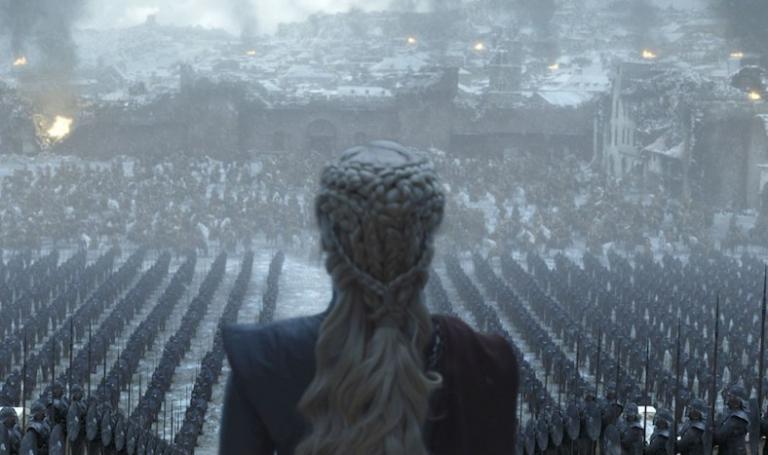
Emilia Clarke from the Game of Thrones finale, photo courtesy HBO
In the closing moments of HBO’s Game of Thrones, a haggard Tyrion Lannister suggests that neither gold nor armies nor patriotic pride rule the world. It’s story.
“There’s nothing in the world more powerful than a good story,” he says. “Nothing can stop it. No enemy can defeat it.”
For eight seasons, Game of Thrones has been one of the most popular and compelling stories in culture. And then last night—according to some fans—the whole thing crumbled like King’s Landing.
Let’s set aside for a moment how violent and tawdry and often misogynistic the show’s been from its opening bell and accept that Game of Thrones became a cultural phenomenon with reason. Taking its cues from author George R.R. Martin, HBO’s Thrones engulfed viewers into a strangely realistic fantasy realm where high ideals ran headlong into brutal, sadistic cynicism. The characters were richly layered. The special effects were top-notch. With all due respect to Peter Jackson’s Lord of the Rings, I’m not sure if I’ve seen a more complex treatment of a made-up world on screen.
But according to longtime fans, Season Eight has been (to put it generously) uneven. Viewers particularly excoriated the show’s last two episodes (even as ratings for those same episodes set records for HBO). People have complained about Daenerys’ turn to the dark side. Some were upset that Sansa didn’t take the throne (though Sophie Turner, Sansa herself, was just fine with it). They were furious that Brienne got all sentimental about her ex-beau, Jaime, and have even been editing what she wrote in the Book of Brothers. And they’re not happy that another inappropriate drinking vessel found its way to Westeros—this time, apparently, a water bottle.
Sir Arthur Conan Doyle could tell us that fan rage is nothing new. The Sherlock Holmes author killed off his most famous detective in 1893, only to have fans demand his return. Doyle acquiesced, and Holmes technically outlived his creator. But such public outcries were rare.
Social media—the great democratizer of public discourse—changed that, of course, as it has so many other things. No longer do we simply consume stories (and perhaps grumble privately if they feel to meet their expectations): We can, in a way, participate in them. Shape them. And, if their favorite stories fail us in some way, we can flay them—and their creators—like an upstanding member of House Bolton.
About 60% of fans disliked the Game of Thrones finale, according to a non-scientific poll by USA Today. And some of the haters really hated the thing*.* Fans have been circulating an online petition to force HBO to “remake Game of Thrones Season 8 with competent writers.” (While Sophie Turner says the petition is “disrespectful,” that hasn’t stopped 1.3 million people from signing it.)
But all this outrage does not eliminate a sobering truth. Storytelling is not a democracy. It is a dictatorship. And it should be.
Listen, I get angry when people muck around in my favorite stories and misunderstand my favorite characters, too. (Don’t get me started on Zack Snyder’s take on Batman.) And admittedly, today’s most popular stories—those we see in movies and on television—have lots of hands in the kettle. Game of Thrones was the product of the work of hundreds of people, if not thousands. And many of them—from the writers to the directors to the actors—were able to, through their own talents and takes on the story and characters, shape the story itself.
But Game of Thrones really owes its success to its first storyteller, George R.R. Martin. He created a world utterly unique, one impossible to craft by committee. The narrative chances he took in his books, especially early on, would never earn raves from test audiences or thumbs-up from skittish marketing execs. Remember the death of Ned Stark? The Red Wedding? You think the majority of fans would’ve given those a stamp of approval? I read Martin’s novels, but man. If I was in charge, I would’ve had Roose Bolton get eaten by a kraken or something by the second book.
The best stories have one teller. One vision. Even in ultra-collaborative efforts like the Marvel Cinematic Universe, you see the thousands of folks involved submit and serve the dictates of the story and vision itself. Thor: Ragnarok was so successful because the its bill-payers and check-signers submitted to the singular, quirky vision of director Taika Waititi. But he, in turn, also submitted to create a story within the greater framework of the MCU—and the overall vision of MCU producer Kevin Feige.
‘Course, the worst stories are often singular visions, too. Many a Star Wars fan wishes George Lucas would’ve turned over The Phantom Menace to a committee. But I do believe that storytellers—even bad or misguided storytellers—have the right to tell the stories they want to tell. In the end, those who love these stories are just along for the ride. If we get on the bus, we don’t get to tell the driver to take a right at Albuquerque. Sure, we can get off if the destination or direction displeases us. But I don’t think we have the moral authority to take the wheel.
I wonder whether our frustrations with how other people’s stories reflect the frustration we feel with our own.
When I hear many critiques of Game of Thrones, it’s about what characters should’ve done—and what the writers shouldn’t have. Daenerys shouldn’t have turned into a vengeance-seeking despot in the penultimate episode (even if the entire series offered hints that such a turn was possible). Sansa should’ve claimed the Iron Throne because, gosh-darn it, she’s had a hard go of it and she deserved it as much as anyone. Brienne should’ve written her own story in the Book of Brothers, not penned an homage to her imperfect one-time lover.
We want to give the characters we love the ending we feel like they deserve. We feel like our characters should behave as we think they should.
But then again, Game of Thrones was meant to be realistic, as fantasy stories go. And in the real world, even we don’t always act as we should or as we’d like. And not all of our stories end as they ought.
Maybe we want to erase the inconsistencies of our favorite characters because we can’t seem to do it in ourselves.
We all think of ourselves as the heroes in our own stories, and so we are. But we’re our stories’ unreliable narrators, too. Even, at moments, its villains. We fail. We panic. We whine. And sometimes, we just don’t make sense. Even to ourselves.
We love stories for a lot of reasons, but in part it’s because they tend to be relatively tidy things. They weave a world that somehow makes sense. Through stories, we see purpose to it all—even in the worst of our characters’ times or their most difficult of circumstances.
“It’s like in the great stories, Mr. Frodo,” Sam Gamgee says in The Two Towers. “The ones that really mattered. Full of darkness and danger they were. And sometimes you didn’t want to know the end… because how could the end be happy? How could the world go back to the way it was when so much bad had happened? But in the end, it’s only a passing thing… this shadow.”
Game of Thrones was inherently and intentionally much messier than J.R.R. Tolkien’s Lord of the Rings. And yet, even in its imperfect conclusion, it offered the same message. There was purpose behind it all—even in the midst of its failings and imperfections.
In some ways, Jon Snow himself sums up the story’s mess in its final minutes, even as his half-brother Bran stresses the purpose.
“I’m sorry I wasn’t there when you needed me,” Jon says.
“You were exactly where you were supposed to be,” Bran insists.
We live in a world of stories, even as we live inside our own. And even though we’re our novel’s own author, the story reads better when we submit to a greater Creator. We find ourselves characters in a much more titanic work—one filled with purpose and power and meaning.
And, God willing in the end, we learn that we’re exactly where we were supposed to be.
Next Post

June 4, 2019 New Doc Beautifully Tells a Story of Tragedy and Forgiveness
Browse Our Archives
Select a Category books celebrities Editor's Choice games movies music news sports superheroes television Uncategorized
Select a Month May 2026 April 2026 March 2026 December 2025 October 2025 July 2025 June 2025 May 2025 February 2025 January 2025 December 2024 July 2024 June 2024 May 2024 April 2024 March 2024 February 2024 January 2024 December 2023 September 2023 March 2023 February 2023 December 2022 November 2022 October 2022 September 2022 August 2022 July 2022 June 2022 May 2022 April 2022 March 2022 February 2022 December 2021 October 2021 August 2021 July 2021 June 2021 May 2021 April 2021 March 2021 October 2020 August 2020 July 2020 June 2020 May 2020 April 2020 March 2020 February 2020 January 2020 December 2019 November 2019 October 2019 September 2019 August 2019 July 2019 June 2019 May 2019 April 2019 March 2019 February 2019 January 2019 December 2018 November 2018 October 2018 September 2018 August 2018 July 2018 June 2018 May 2018 April 2018 March 2018 February 2018 January 2018 December 2017 November 2017 October 2017 September 2017 August 2017 July 2017 June 2017 May 2017 April 2017 March 2017 February 2017 January 2017 December 2016 November 2016 October 2016 September 2016 August 2016 July 2016 June 2016 May 2016 April 2016 March 2016 February 2016 January 2016 December 2015 November 2015 October 2015 September 2015 August 2015 July 2015 June 2015 May 2015 April 2015 March 2015 February 2015 January 2015 December 2014 November 2014 October 2014 September 2014
Follow Us!
TAKE THE
Religious Wisdom Quiz
What does Paul say is the greatest of faith, hope, and love?
Select your answer to see how you score.
Hope Love Grace Faith
Books by This Author Books by Paul Asay
Related posts from Watching God

Finding Forgiveness in the Great Horror Film ‘Hokum’

What makes a hero? These 7 Cinematic Characters...

Finding God's Grace in ‘Project Hail Mary’

Watching God’s Top 10 Movies of 2025
TRENDING AT PATHEOS Religious Music & Entertainment

"Les Diabolique" and Transgression
Alongside something like Arrival, Vertigo, or Charade, Les Diaboliques is a...

"The Plague Dogs" and Mortality
So, flashback to the late 70s, early 80s. Walt Disney Studios is...

With the recent and highly successful release of Christopher Nolan’s epic film,...

"L'avventura" and Human Weakness
Today's piece is going to be a little different for a few...

I first want to apologize for not posting or writing anything. I'm...

I've engaged in the multi-year project of reading through the Church Fathers,...
view all Religious Music & Entertainment blogs
Ad-Free & Subscriber Log-In Subscription Support
- About Us
- 2026 Calendar
- Videos
- Podcasts
- Library of World Religions
- Faith In Media Tracker
- Advertise With Us
- Write for Us
- Privacy Policy
- Terms of Service
- Do Not Sell My Data
- Contact Us
- Radiant Digital
- Manage Newsletter Subscriptions
- Unsubscribe From Notifications
- Sitemap
Copyright 2008-2026, Patheos. All rights reserved.
Subscription Support Ad-Free & Subscriber Log-In
Follow Patheos