
BuddhistCatholicContemplativeEvangelicalGeneral ChristianHinduJewishLatter-day SaintMuslimNew VisionsProgressive Christian
Beliefs
- Buddhist
- Catholic
- Contemplative
- Evangelical
- General Christian
- Hindu
- Jewish
- Latter-day Saint
- More Voices
- Muslim
- New Visions
- Pagan
- Progressive Christian
Topics
- Religion News
- Food and Religion
- Sports and Religion
- Religious Art
- Religious Music and Entertainment
- Religious Events
- History and Religion
- Style and Religion
- Politics and Religion
- Women in Religion
- Recreation Outdoors and Religion
- Business Finance and Religion
- Careers Workplace and Religion
- Education and Religion
- Family Parenting and Religion
- Health Fitness and Religion
- Home and Religion
- Relationships and Religion
- Technology and Religion
- Travel and Religion
Columnists
- Buddhist Columnists
- Business Finance and Religion Columnists
- Careers Workplace and Religion Columnists
- Catholic Columnists
- Contemplative Columnists
- Education and Religion Columnists
- Evangelists Columnists
- Family Parenting and Religion Columnists
- General Christian Columnists
- Health Fitness and Religion Columnists
- Hindu Columnists
- History and Religion Columnists
- Home and Religion Columnists
- Jewish Columnists
- More Voices Columnists
- Latter Day Columnists
- Muslim Columnists
- New Visions Columnists
- Nonreligious Columnists
- Pagan Columnists
- Politics and Religion Columnists
- Progressive Columnists
- Recreation Outdoors and Religion Columnists
- Relationships and Religion Columnists
- Religion News Columnists
- Religious Art Columnists
- Religious Events Columnists
- Religious Music and Entertainment Columnists
- Sports and Religion Columnists
- Style and Religion Columnists
- Technology and Religion Columnists
- Travel and Religion Columnists
- Women in Religion Columnists
Resource Library
- 2026 Calendar
- Library of World Religions
- The 100 Most Holy Places on Earth
- Patheos Answers
- Podcasts
- Videos
- Faith Leaders Database
- Anglican Episcopalian
- Bahai
- Baptist
- Buddhism
- Christianity
- Confucianism
- Eastern Orthodoxy
- Hinduism
- Holiness and Pentecostal
- ISKCON
- Islam
- Judaism
- Lutheran
- Methodist
- The Church of Jesus Christ of Latter-day Saints
- New Age
- Paganism
- Presbytarian and Reformed
- Protestantism
- Religion Behind the Scenes
- Roman Catholic
- Scientology
- Shia Islam
- Sikhism
- Sufism
- Sunni Islam
- Taoism
- Zen
- See all religions
Research Tools
 Ad-Free & Subscriber Log-In Subscription Support
Ad-Free & Subscriber Log-In Subscription Support
Follow Patheos 

- Trending:
- Forgiveness
- |
- Marriage
- |
- Consciousness
- |
- Death Penalty
- |
- Election
- |
- Halloween

- Home
- Religious Music & Entertainment
- Amazing Grace is a Messy Masterpiece
Amazing Grace is a Messy Masterpiece
Last updated on: April 10, 2019 at 9:49 am by Paul Asay
Amazing Grace is a Messy Masterpiece 2019-04-10T09:49:37-06:00 Paul Asay
Patheos Explore the world's faith through different perspectives on religion and spirituality! Patheos has the views of the prevalent religions and spiritualities of the world.
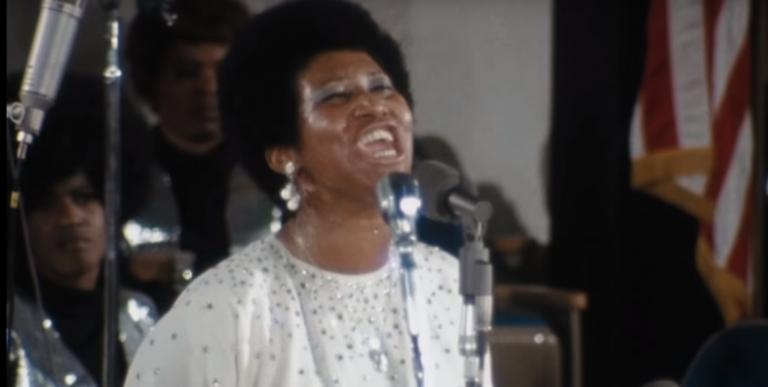
Aretha Franklin in Amazing Grace, photo from the Neon trailer
Singer Aretha Franklin was at her peak in 1972. She’d recorded more than 20 albums, won five Grammys and was already the undisputed Queen of Soul.
But now, in a way, she was coming home—to the music she grew up with, the music that still meant so much to her.
Over the course of two January nights at the New Temple Missionary Baptist Church in Los Angeles, Aretha Franklin recorded Amazing Grace—a collection of gospel songs that eventually sold more than 2 million copies. It’s still the highest-selling live gospel album in history.
The two-disc album was originally supposed to come with a movie, too—a documentary by rising directorial star Sydney Pollack. Now, 47 years later, we finally get to see it. And boy, was it worth the wait.
The story of this star-crossed documentary is almost as riveting as the doc itself. Pollack, who’d never done a project like this, didn’t use a clapperboard. The upshot: He couldn’t sync the video and audio, meaning all the video he shot was essentially useless. After six weeks, Pollack and his team gave up trying, and the material sat in a vault for 38 years until producer Alan Elliott bought it in 2008.
Elliott spent two years syncing the footage from that two-night performance. But then, just as he’d finished the film, its star decided she didn’t want anyone to see it. Why? No one really knows. Even though Franklin publicly said she loved the film, her bassist Chuck Rainey told The New York Times that she didn’t like it at all. According to Times writer Natalie Rinn, Rainey believed that “her resistance derived from a feeling that the film wound up being more about style and celebrity than about the music or the worship—or even about Franklin.”
Rainey’s got a point. The film is, in part, about style and celebrity and the show. The church is a circus of activity, and the Rev. James Cleveland—a gospel legend in his own right—is its ringleader. He charms the audience, directs the players, and he comically grouses when he’s not able to showcase his own musical chops. Franklin’s backup singers—the Southern California Community Choir led by the electrifying Alexander Hamilton—collectively walks down the church aisle bedecked in shimmering sequined vests. Pollack’s cameras pick out The Rolling Stones’ Mick Jagger and Charlie Watts in the audience. Cameras are everywhere. Electrical cords run up and down the church carpet like snakes.
“This is a church,” Cleveland says at the outset, “and we’re here for a religious service.” But who’s he kidding? Some in the audience aren’t looking to hear from God, but Aretha Franklin.
But when Franklin settles behind the piano and starts singing, everything changes.
Marianne Faithfull once said that Franklin was “the voice of God,” but here—in New Temple’s sweltering sanctuary—Franklin herself exposes that lie. The Voice of God becomes the servant of God, belting out song after song as sweat pours down her face and tears leak from her eyes. This is work, this celebration of the Almighty—joyous, glorious, rapturous work. It’s easy to forget that when we just hear Franklin sing: When we close our eyes and listen, we imagine it’s all so easy for her. But when we see Franklin at work, we know it’s not easy, this raw power and beauty. It’s not easy to inflect gospel with butterfly beauty and muscle-car torque simultaneously.
But Franklin’s a maestro. Yes, God gave her a marvelous gift, but she honed it and shaped it into the instrument it is. And in Amazing Grace, she throws that voice to the back walls, to the rafters, to the sky … back to Him. People rise from their seats, dance in the aisles, laugh, cry, raise their hands. It’s beautiful.
But almost as telling? The silence that follows the song.
We hear Franklin sing plenty in Amazing Grace, but we hardly ever hear her talk. Between songs, she’s serene, almost sphinx like, letting James Cleveland run the show. Yes, those two nights of gospel were shows, in a sense. But not for Franklin. She, above all, heeded Cleveland’s reminder that this was church, and she was engaged in worship. It’s almost as if, through her silence, she was telling her audience that she was nothing more than a tool in the hands of God. Instead of soaking up the adulation, she deflected it back to Him.
I like how Craig Jenkins put it in Vulture:
Aretha’s posture during Amazing Grace—stately, demure, joyful, eyes smiling—is not the same as her commanding presence during her Fillmore West gig from the spring of 1971. At Fillmore, Aretha wanted you to know that you were in the presence of greatness. At New Temple, you were in the presence of the Lord.
In a way, Amazing Grace—through its imperfections and off-screen drama—reflects what Church is. What Christianity is. We come to the altar not with the purest of hearts. Too often we focus ourselves on we, not thou. We’re distracted by the circus and look to proclaim ourselves in its lights.
But when we turn our attention heavenward, when we give our gifts to the giver, that’s when the Church’s real, all-too-infrequent beauty is unveiled. When miracles happen. And our failings, whatever they are, are blended into the holy whole.
Amazing Grace is an amazing doc—a snapshot of an unmatched artist in her full power and glory. But more than that, it points where that power and glory came from.
Previous Post

April 9, 2019
Seeing the Power of Faith in The Curse of La Llorona
Next Post

April 15, 2019 Notre Dame's Fire Was Horrible. But We Can Find Hope There, Too
Browse Our Archives
Select a Category books celebrities Editor's Choice games movies music news sports superheroes television Uncategorized
Select a Month May 2026 April 2026 March 2026 December 2025 October 2025 July 2025 June 2025 May 2025 February 2025 January 2025 December 2024 July 2024 June 2024 May 2024 April 2024 March 2024 February 2024 January 2024 December 2023 September 2023 March 2023 February 2023 December 2022 November 2022 October 2022 September 2022 August 2022 July 2022 June 2022 May 2022 April 2022 March 2022 February 2022 December 2021 October 2021 August 2021 July 2021 June 2021 May 2021 April 2021 March 2021 October 2020 August 2020 July 2020 June 2020 May 2020 April 2020 March 2020 February 2020 January 2020 December 2019 November 2019 October 2019 September 2019 August 2019 July 2019 June 2019 May 2019 April 2019 March 2019 February 2019 January 2019 December 2018 November 2018 October 2018 September 2018 August 2018 July 2018 June 2018 May 2018 April 2018 March 2018 February 2018 January 2018 December 2017 November 2017 October 2017 September 2017 August 2017 July 2017 June 2017 May 2017 April 2017 March 2017 February 2017 January 2017 December 2016 November 2016 October 2016 September 2016 August 2016 July 2016 June 2016 May 2016 April 2016 March 2016 February 2016 January 2016 December 2015 November 2015 October 2015 September 2015 August 2015 July 2015 June 2015 May 2015 April 2015 March 2015 February 2015 January 2015 December 2014 November 2014 October 2014 September 2014
Follow Us!
TAKE THE
Religious Wisdom Quiz
According to Jesus, "Blessed are those who hunger and thirst for." what?
Select your answer to see how you score.
Power Popularity Righteousness Money
Books by This Author Books by Paul Asay
Related posts from Watching God

Finding Forgiveness in the Great Horror Film ‘Hokum’

What makes a hero? These 7 Cinematic Characters...

Finding God's Grace in ‘Project Hail Mary’

Watching God’s Top 10 Movies of 2025
TRENDING AT PATHEOS Religious Music & Entertainment

"Les Diabolique" and Transgression
Alongside something like Arrival, Vertigo, or Charade, Les Diaboliques is a...

"The Plague Dogs" and Mortality
So, flashback to the late 70s, early 80s. Walt Disney Studios is...

With the recent and highly successful release of Christopher Nolan’s epic film,...

"L'avventura" and Human Weakness
Today's piece is going to be a little different for a few...

I first want to apologize for not posting or writing anything. I'm...

I've engaged in the multi-year project of reading through the Church Fathers,...
view all Religious Music & Entertainment blogs
Ad-Free & Subscriber Log-In Subscription Support
- About Us
- 2026 Calendar
- Videos
- Podcasts
- Library of World Religions
- Faith In Media Tracker
- Advertise With Us
- Write for Us
- Privacy Policy
- Terms of Service
- Do Not Sell My Data
- Contact Us
- Radiant Digital
- Manage Newsletter Subscriptions
- Unsubscribe From Notifications
- Sitemap
Copyright 2008-2026, Patheos. All rights reserved.
Subscription Support Ad-Free & Subscriber Log-In
Follow Patheos