
BuddhistCatholicContemplativeEvangelicalGeneral ChristianHinduJewishLatter-day SaintMuslimNew VisionsProgressive Christian
Beliefs
- Buddhist
- Catholic
- Contemplative
- Evangelical
- General Christian
- Hindu
- Jewish
- Latter-day Saint
- More Voices
- Muslim
- New Visions
- Pagan
- Progressive Christian
Topics
- Religion News
- Food and Religion
- Sports and Religion
- Religious Art
- Religious Music and Entertainment
- Religious Events
- History and Religion
- Style and Religion
- Politics and Religion
- Women in Religion
- Recreation Outdoors and Religion
- Business Finance and Religion
- Careers Workplace and Religion
- Education and Religion
- Family Parenting and Religion
- Health Fitness and Religion
- Home and Religion
- Relationships and Religion
- Technology and Religion
- Travel and Religion
Columnists
- Buddhist Columnists
- Business Finance and Religion Columnists
- Careers Workplace and Religion Columnists
- Catholic Columnists
- Contemplative Columnists
- Education and Religion Columnists
- Evangelists Columnists
- Family Parenting and Religion Columnists
- General Christian Columnists
- Health Fitness and Religion Columnists
- Hindu Columnists
- History and Religion Columnists
- Home and Religion Columnists
- Jewish Columnists
- More Voices Columnists
- Latter Day Columnists
- Muslim Columnists
- New Visions Columnists
- Nonreligious Columnists
- Pagan Columnists
- Politics and Religion Columnists
- Progressive Columnists
- Recreation Outdoors and Religion Columnists
- Relationships and Religion Columnists
- Religion News Columnists
- Religious Art Columnists
- Religious Events Columnists
- Religious Music and Entertainment Columnists
- Sports and Religion Columnists
- Style and Religion Columnists
- Technology and Religion Columnists
- Travel and Religion Columnists
- Women in Religion Columnists
Resource Library
- 2026 Calendar
- Library of World Religions
- The 100 Most Holy Places on Earth
- Patheos Answers
- Podcasts
- Videos
- Faith Leaders Database
- Anglican Episcopalian
- Bahai
- Baptist
- Buddhism
- Christianity
- Confucianism
- Eastern Orthodoxy
- Hinduism
- Holiness and Pentecostal
- ISKCON
- Islam
- Judaism
- Lutheran
- Methodist
- The Church of Jesus Christ of Latter-day Saints
- New Age
- Paganism
- Presbytarian and Reformed
- Protestantism
- Religion Behind the Scenes
- Roman Catholic
- Scientology
- Shia Islam
- Sikhism
- Sufism
- Sunni Islam
- Taoism
- Zen
- See all religions
Research Tools
 Ad-Free & Subscriber Log-In Subscription Support
Ad-Free & Subscriber Log-In Subscription Support
Follow Patheos 

- Trending:
- Forgiveness
- |
- Marriage
- |
- Consciousness
- |
- Death Penalty
- |
- Election
- |
- Halloween

- Home
- Religious Music & Entertainment
- ‘If Someone is Allowed to Touch History, Then It Sticks With Them.’ Scholar Robert Cargill Talks About the History Channel’s New Show About Jesus
‘If Someone is Allowed to Touch History, Then It Sticks With Them.’ Scholar Robert Cargill Talks About the History Channel’s New Show About Jesus
Last updated on: March 22, 2019 at 10:34 am by Paul Asay
‘If Someone is Allowed to Touch History, Then It Sticks With Them.’ Scholar Robert Cargill Talks About the History Channel’s New Show About Jesus 2019-03-22T10:34:39-06:00 Paul Asay
Patheos Explore the world's faith through different perspectives on religion and spirituality! Patheos has the views of the prevalent religions and spiritualities of the world.
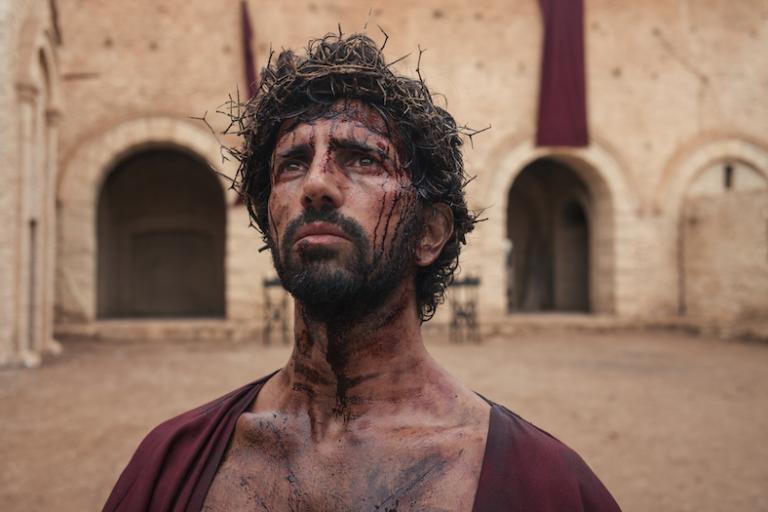
Greg Barnett in Jesus: His Life, photo courtesy the History Channel and Grace Hill Media
The History Channel will unveil a new eight-part miniseries based on the life of Jesus March 25—and it’s a little different than most of the docudramas we’ve seen about Christ before.
Titled Jesus: His Life, the program shows this Man from Galilee through the eyes of other people: Folks who loved him, like his mother Mary and disciple Peter, to folks who wound up sending him to His death, like the Jewish leader Caiaphas and the Roman Prefect Pontius Pilate. Throughout the dramatizations, experts come on screen to give us a little more perspective on what we’re watching, with scholars and religious leaders alike providing historical, literary and theological context.

Dr. Robert Cargill teaches Classics and Religious Studies.
Robert Cargill, an assistant professor on Judaism and Christianity at the University of Iowa, is one such expert. Editor of Biblical Archaeology Review, Cargill has also produced and hosted lots of shows centered on biblical history, and he was involved with Jesus: His Life from its earliest stages.
I talked with Cargill a couple of days ago, and he has some fascinating things to say about this show, his job and the state of biblical literacy in the United States today. (I’ve edited the conversation a bit for length and clarity.)
Paul Asay: How did you fall into this curious field of yours?
Robert Cargill: I got into the field of biblical archaeology as a pre-med student. … I was trained in the sciences, so I knew the sciences as an undergraduate very well, but I always had questions about my faith. So I chose to go to Pepperdine [University] to pursue a master’s degree in divinity, and one of the first classes I had there was a course in backgrounds of the new testament and another course I had was a course in biblical archaeology. … I was absolutely sold from day one. Here’s the perfect thing for me, [I thought]—a kid who grew up in central California playing in the dirt, and now I get to play in dirt for a living.
Asay: You mentioned that your career began with questions of your own faith. As you know, some people will come away from this show with their own questions. In Jesus: His Life, you’re one of voices of science, suggesting that maybe not everything in the Bible literally happened the way it says it did. A lot of people of faith may be challenged by that. What would you say to them?
Cargill: The more someone is challenged by a lack of evidence, the more someone is required to rely on faith. I encourage people to ask hard questions. And I’ve always told my students and learned to tell myself, if God is who people says he is, if God is who he says he is in the Bible, He can handle some hard questions. What I’ve found, especially with this program, is that it allows us to do is go back into the first century and view Jesus the way that people in the first century viewed Jesus. Those that saw him for the first time.
Most of us approach the Bible already knowing the end of the story. Surprise, he comes back, right? We know the end of the story, we know he’s the son of God and we have the whole theological approach. What we forget, what we struggle with sometimes, is not only Jesus’s opponents, but even those who became his disciples, struggled with who he was early in their lives. So what this show does, by giving us all these different views of Jesus, we actually get this very keen view of Jesus as a human. And we get to struggle along with these people—many of whom became disciples of Jesus—as they try to work out what would become their faith. We get to struggle with them as they work through the evidence. We know this, but we’ve experienced this, how do we reconcile the two? And I think that’s what most people of faith are basically struggling with today, if I can use that word. That’s what they’re working through in their lives. How do I reconcile the evidence with my experience? And this program really, really allows viewers to do that.
Asay: Why is it important today for people to understand this history? Why do people need to understand the greater historical context in which Jesus’ story takes place?
Cargill: Context is everything. I don’t care if you’re talking about modern politics or you’re talking about ancient biblical studies. I tell students when I take them overseas to go digging—I lead students to go digging over in Israel—and on the weekends I take them to go see the Western Wall, or to the Church of the Holy Sepulchre. And if someone is allowed to touch history, then it sticks with them. You can actually walk them through history, and it becomes a part of them. And once you experience history, once you actually know the physical context in which these biblical stories are actually written, then the text becomes that much more alive to you. It’s like you’re peeling back layers of the text. All those words between the theological nuggets that we’re taught to gleen from it, all those words start to come alive. They start to have meaning and significance. And that’s where the context is important. So you can’t just pull from it what you think you want it to mean. There is some structure in the Bible that says, ‘no, this is significant that Jesus says this or does this in this particular place.’ Studying the context is key to understanding the Bible.
Asay: It’s interesting, because when we think back to when the Bible was first written, the people who were reading it or hearing it back then, they would’ve understood that context, right?
Cargill: That’s right. And this is the importance of scholarship. A lot of the context would’ve just been known. It would’ve been very common, it would’ve been assumed. Everyone would’ve understood the significance of, let’s say, of Jesus marching from the Mount of Olives through the Kidron Valley up into Jerusalem. Maybe it’s lost on the modern reader is what Jesus is doing is re-enacting the coronation ceremony of the kings of Israel. That’s not a humble little donkey ride up to Jerusalem. He’s actually making a very, very profound statement. … Context really allows a person of faith to see a depth within the Scriptures that they might otherwise miss.
Asay: What do you think is the status of biblical literacy today?
Cargill: Certainly people don’t know the biblical text as well as, let’s say, 50 years ago. And I think that’s been replaced by something that I think is even more, if I can say, toxic. It’s not just been replaced with an ignorance of Scripture, but it’s been replaced with a false understanding of what the Bible says. And by that I mean, when you read the Hebrew prophetic texts, and when you read what Jesus says about money, about immigration, about things having to do with how we treat others, there’s a pretty consistent theme throughout these texts that doesn’t always get communicated in what passes for modern Christianity today.
So I think we have two things going on. One, people just aren’t as well read in the Bible as they used to be, but what’s even more frightening is it’s being replaced by what people are being told is in the Bible instead of what’s actually there. And what they’re being told is actually not what Jesus taught. If I’m in a classroom teaching students who don’t know anything about the Bible, that’s fine. I can just introduce them to the text. But if I’m having to un-learn them, if I’m having to teach them, ‘no, what you think you know isn’t true,’ … if I have to do that, then it’s that much more difficult.
I think biblical literacy is important. But it’s got to be done the right way, and unfortunately what a lot of people say today when they mean biblical literacy is they want indoctrination. They want a particular theological point of view taught in let’s say public schools. And that’s illegal. What I want is true biblical literacy. What’s the archaeology, what’s the history, what does the text say. Not trying to convince people of a particular theological viewpoint. And that’s what this show does. This show is not preaching, this show does not try to convert or de-convert. This show brings an incredible diversity of modern religious opinion, it brings an incredible diversity of, something I’ve never seen before, of ethnicity, of gender. There’s just this beautiful diversity of scholarly opinion that reflects the diversity of opinion about Jesus from the first century. And I’m really impressed and proud of that about this show.
**
Jesus: His Life*, begins its eight-episode, four-week run on the History Channel March 25.*
Previous Post

March 21, 2019
Walking in the Shadow of Death in The Long Goodbye
Next Post

March 25, 2019 This is ‘Us.’ And It’s Horrifyingly Spiritual
Browse Our Archives
Select a Category books celebrities Editor's Choice games movies music news sports superheroes television Uncategorized
Select a Month May 2026 April 2026 March 2026 December 2025 October 2025 July 2025 June 2025 May 2025 February 2025 January 2025 December 2024 July 2024 June 2024 May 2024 April 2024 March 2024 February 2024 January 2024 December 2023 September 2023 March 2023 February 2023 December 2022 November 2022 October 2022 September 2022 August 2022 July 2022 June 2022 May 2022 April 2022 March 2022 February 2022 December 2021 October 2021 August 2021 July 2021 June 2021 May 2021 April 2021 March 2021 October 2020 August 2020 July 2020 June 2020 May 2020 April 2020 March 2020 February 2020 January 2020 December 2019 November 2019 October 2019 September 2019 August 2019 July 2019 June 2019 May 2019 April 2019 March 2019 February 2019 January 2019 December 2018 November 2018 October 2018 September 2018 August 2018 July 2018 June 2018 May 2018 April 2018 March 2018 February 2018 January 2018 December 2017 November 2017 October 2017 September 2017 August 2017 July 2017 June 2017 May 2017 April 2017 March 2017 February 2017 January 2017 December 2016 November 2016 October 2016 September 2016 August 2016 July 2016 June 2016 May 2016 April 2016 March 2016 February 2016 January 2016 December 2015 November 2015 October 2015 September 2015 August 2015 July 2015 June 2015 May 2015 April 2015 March 2015 February 2015 January 2015 December 2014 November 2014 October 2014 September 2014
Follow Us!
TAKE THE
Religious Wisdom Quiz
What was Barnabas' original name?
Select your answer to see how you score.
Mark Silas Timothy Joseph
Books by This Author Books by Paul Asay
Related posts from Watching God

Finding Forgiveness in the Great Horror Film ‘Hokum’

What makes a hero? These 7 Cinematic Characters...

Finding God's Grace in ‘Project Hail Mary’

Watching God’s Top 10 Movies of 2025
TRENDING AT PATHEOS Religious Music & Entertainment

"Les Diabolique" and Transgression
Alongside something like Arrival, Vertigo, or Charade, Les Diaboliques is a...

"The Plague Dogs" and Mortality
So, flashback to the late 70s, early 80s. Walt Disney Studios is...

With the recent and highly successful release of Christopher Nolan’s epic film,...

"L'avventura" and Human Weakness
Today's piece is going to be a little different for a few...

I first want to apologize for not posting or writing anything. I'm...

I've engaged in the multi-year project of reading through the Church Fathers,...
view all Religious Music & Entertainment blogs
Ad-Free & Subscriber Log-In Subscription Support
- About Us
- 2026 Calendar
- Videos
- Podcasts
- Library of World Religions
- Faith In Media Tracker
- Advertise With Us
- Write for Us
- Privacy Policy
- Terms of Service
- Do Not Sell My Data
- Contact Us
- Radiant Digital
- Manage Newsletter Subscriptions
- Unsubscribe From Notifications
- Sitemap
Copyright 2008-2026, Patheos. All rights reserved.
Subscription Support Ad-Free & Subscriber Log-In
Follow Patheos