
BuddhistCatholicContemplativeEvangelicalGeneral ChristianHinduJewishLatter-day SaintMuslimNew VisionsProgressive Christian
Beliefs
- Buddhist
- Catholic
- Contemplative
- Evangelical
- General Christian
- Hindu
- Jewish
- Latter-day Saint
- More Voices
- Muslim
- New Visions
- Pagan
- Progressive Christian
Topics
- Religion News
- Food and Religion
- Sports and Religion
- Religious Art
- Religious Music and Entertainment
- Religious Events
- History and Religion
- Style and Religion
- Politics and Religion
- Women in Religion
- Recreation Outdoors and Religion
- Business Finance and Religion
- Careers Workplace and Religion
- Education and Religion
- Family Parenting and Religion
- Health Fitness and Religion
- Home and Religion
- Relationships and Religion
- Technology and Religion
- Travel and Religion
Columnists
- Buddhist Columnists
- Business Finance and Religion Columnists
- Careers Workplace and Religion Columnists
- Catholic Columnists
- Contemplative Columnists
- Education and Religion Columnists
- Evangelists Columnists
- Family Parenting and Religion Columnists
- General Christian Columnists
- Health Fitness and Religion Columnists
- Hindu Columnists
- History and Religion Columnists
- Home and Religion Columnists
- Jewish Columnists
- More Voices Columnists
- Latter Day Columnists
- Muslim Columnists
- New Visions Columnists
- Nonreligious Columnists
- Pagan Columnists
- Politics and Religion Columnists
- Progressive Columnists
- Recreation Outdoors and Religion Columnists
- Relationships and Religion Columnists
- Religion News Columnists
- Religious Art Columnists
- Religious Events Columnists
- Religious Music and Entertainment Columnists
- Sports and Religion Columnists
- Style and Religion Columnists
- Technology and Religion Columnists
- Travel and Religion Columnists
- Women in Religion Columnists
Resource Library
- 2026 Calendar
- Library of World Religions
- The 100 Most Holy Places on Earth
- Patheos Answers
- Podcasts
- Videos
- Faith Leaders Database
- Anglican Episcopalian
- Bahai
- Baptist
- Buddhism
- Christianity
- Confucianism
- Eastern Orthodoxy
- Hinduism
- Holiness and Pentecostal
- ISKCON
- Islam
- Judaism
- Lutheran
- Methodist
- The Church of Jesus Christ of Latter-day Saints
- New Age
- Paganism
- Presbytarian and Reformed
- Protestantism
- Religion Behind the Scenes
- Roman Catholic
- Scientology
- Shia Islam
- Sikhism
- Sufism
- Sunni Islam
- Taoism
- Zen
- See all religions
Research Tools
 Ad-Free & Subscriber Log-In Subscription Support
Ad-Free & Subscriber Log-In Subscription Support
Follow Patheos 

- Trending:
- Forgiveness
- |
- Marriage
- |
- Consciousness
- |
- Death Penalty
- |
- Election
- |
- Halloween

- Home
- Religious Music & Entertainment
- Glass Isn’t Just About Superheroes: It’s About Belief
Glass Isn’t Just About Superheroes: It’s About Belief
Last updated on: January 18, 2019 at 10:47 am by Paul Asay
Glass Isn’t Just About Superheroes: It’s About Belief 2019-01-18T10:47:34-06:00 Paul Asay
Patheos Explore the world's faith through different perspectives on religion and spirituality! Patheos has the views of the prevalent religions and spiritualities of the world.
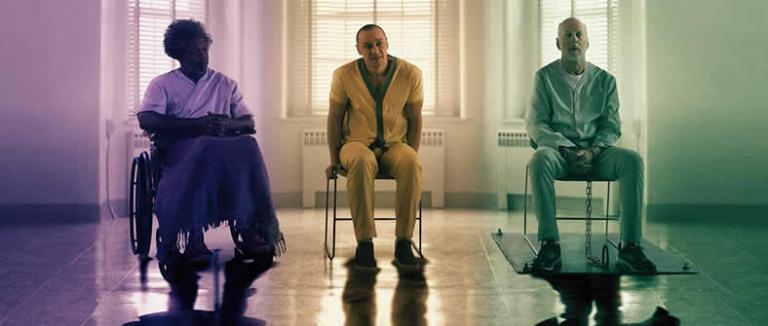
Samuel L. Jackson, James McAvoy and Bruce Willis in Glass, photo courtesy Universal Pictures
Ultimately Glass, M. Night Shyamalan’s newest twisty adventure, didn’t work that well for me, at least as a movie. To get to its finale, Shyamalan lost sight of some of the story’s characters, under-developing some and underserving others. Watchable? Sure, if you know some of the backstory. But it’s not one of Shyamalan’s best.
But if the movie itself disappointed, it does drill down into a concept critical and deeply spiritual: The idea of belief.
The real crux of Glass—and where it works best—is when its main characters are held in a sanitarium under the supervision of Dr. Ellie Staple (played by Sarah Paulson). Staple specializes in treating a very special sort of delusion, the delusion that you’re a superhero.
When she looks at David Dunn (Bruce Willis, who first appeared as the character in 2000’s Unbreakable), she doesn’t see an indestructible vigilante, but a guy with a brain defect and a painful, hidden, childhood memory. Same goes for the Horde—a collection of split personalities (played by James McAvoy, here and in 2016’s Split) with a penchant for kidnapping and killing teenage girls. The Horde worships the biggest and strongest personality in the stew, a super-strong, wall-climbing entity known as The Beast. The bars The Beast bent? Staple just says that they were made of old, faulty iron—not easy to bend, but possible. As for Mr. Glass (Samuel L. Jackson) himself—a man with incredibly brittle bones and who fashions himself as a Lex Luthor-like supervillain—Staples keeps him safely sedated. Yes, she admits he’s smart. But superhuman smart? Hardly.
Slowly, Staple tries to chip away at the confidence of these characters, especially David and the Beast, suggesting that everything “superhuman” they’ve been able to do is well within the bounds of the natural world. They’re not special, she says. They’re sick.
But Glass, eventually, pushes back.
“Everything extraordinary can be explained away,” he says. “And yet it’s true.”
I love that line.
The movie’s premise suggests that its characters are far more capable than Dr. Staple insists. When personalities in the Horde begin to express doubts, it’s up to The Beast to prove them wrong. “I believe, I believe!” shouts one of those personalities, her doubt vanquished finally.
The movie’s concept of belief and faith manifests itself in more humanistic terms, admittedly. It suggests we’re all capable of great things if we just believe in ourselves. And I get that. Any truly great artist or visionary, it seems, must have an almost unbelievable level of confidence in his or her own talents and abilities: To do something truly special, you have to believe you can do it first, even if that belief seems to others (as it invariably does) as delusional.
But I think we find the same dynamic in faith, too.
Listen, I think that the Christian faith is rational and intellectually defensible. You can point to physics and biology and any number of sciences and show how they can point to a divine Creator; we can use archeology and history and all manner of arts to draw a line to Jesus and His remarkable influence in the world. Reasoned and diligent researchers can reach a point where Christianity feels, to a point, naturally and historically plausible.
But to believe, we have to go further. We have to believe in something that, on its face, feels outlandish: That God would manifest Himself in a human body. And that that body would die (as all bodies do) and, somehow, rise and live again.
By happenstance, I was reading Stephen King’s book Desperation before my screening of Glass.
Early in the book, a boy named David—a boy who is deeply religious, and whose own sense of unwavering faith serves as the book’s anchor and the characters’ only hope—prays fervently, desperately, inside a jail cell in the hellish small town of Desperation. He knows that he’ll need to squeeze through the bars to escape and save not just himself, but everyone who’s trapped there with him. It seems impossible, but he has to try. He strips off his clothes, lathers himself up with a green bar of soap and, improbably, pops free.
It seems like just an outstanding feat of contortion when it happens—remarkable, sure, but within reason. But then someone mentions that David’s head never should’ve been able to squeeze through the bars. Even if everything got through, the skull would’ve stopped him cold.
That’s the thing about having real faith. Sometimes the head gets in the way.
Sometimes the head prevents us from believing in miracles. In a Creator who loves us and cares about what we do. In a man who was killed, buried and rose again.
“Everything extraordinary can be explained away. And yet it’s true.”
Glass didn’t always work for me. But M. Night Shyamalan’s latest contains one message of improbable, outlandish truth. And that made it worthwhile.
Previous Post

January 7, 2019
Christian Bale Makes a Devil of an Acceptance Speech
Next Post

January 30, 2019 Oscar Loses Its Religion
Browse Our Archives
Select a Category books celebrities Editor's Choice games movies music news sports superheroes television Uncategorized
Select a Month May 2026 April 2026 March 2026 December 2025 October 2025 July 2025 June 2025 May 2025 February 2025 January 2025 December 2024 July 2024 June 2024 May 2024 April 2024 March 2024 February 2024 January 2024 December 2023 September 2023 March 2023 February 2023 December 2022 November 2022 October 2022 September 2022 August 2022 July 2022 June 2022 May 2022 April 2022 March 2022 February 2022 December 2021 October 2021 August 2021 July 2021 June 2021 May 2021 April 2021 March 2021 October 2020 August 2020 July 2020 June 2020 May 2020 April 2020 March 2020 February 2020 January 2020 December 2019 November 2019 October 2019 September 2019 August 2019 July 2019 June 2019 May 2019 April 2019 March 2019 February 2019 January 2019 December 2018 November 2018 October 2018 September 2018 August 2018 July 2018 June 2018 May 2018 April 2018 March 2018 February 2018 January 2018 December 2017 November 2017 October 2017 September 2017 August 2017 July 2017 June 2017 May 2017 April 2017 March 2017 February 2017 January 2017 December 2016 November 2016 October 2016 September 2016 August 2016 July 2016 June 2016 May 2016 April 2016 March 2016 February 2016 January 2016 December 2015 November 2015 October 2015 September 2015 August 2015 July 2015 June 2015 May 2015 April 2015 March 2015 February 2015 January 2015 December 2014 November 2014 October 2014 September 2014
Follow Us!
TAKE THE
Religious Wisdom Quiz
What happened to Jesus 40 days after His resurrection?
Select your answer to see how you score.
He performed one last miracle He visited the temple He went back into hiding He ascended into heaven
Books by This Author Books by Paul Asay
Related posts from Watching God

Finding Forgiveness in the Great Horror Film ‘Hokum’

What makes a hero? These 7 Cinematic Characters...

Finding God's Grace in ‘Project Hail Mary’

Watching God’s Top 10 Movies of 2025
TRENDING AT PATHEOS Religious Music & Entertainment

"Les Diabolique" and Transgression
Alongside something like Arrival, Vertigo, or Charade, Les Diaboliques is a...

"The Plague Dogs" and Mortality
So, flashback to the late 70s, early 80s. Walt Disney Studios is...

With the recent and highly successful release of Christopher Nolan’s epic film,...

"L'avventura" and Human Weakness
Today's piece is going to be a little different for a few...

I first want to apologize for not posting or writing anything. I'm...

I've engaged in the multi-year project of reading through the Church Fathers,...
view all Religious Music & Entertainment blogs
Ad-Free & Subscriber Log-In Subscription Support
- About Us
- 2026 Calendar
- Videos
- Podcasts
- Library of World Religions
- Faith In Media Tracker
- Advertise With Us
- Write for Us
- Privacy Policy
- Terms of Service
- Do Not Sell My Data
- Contact Us
- Radiant Digital
- Manage Newsletter Subscriptions
- Unsubscribe From Notifications
- Sitemap
Copyright 2008-2026, Patheos. All rights reserved.
Subscription Support Ad-Free & Subscriber Log-In
Follow Patheos