
BuddhistCatholicContemplativeEvangelicalGeneral ChristianHinduJewishLatter-day SaintMuslimNew VisionsProgressive Christian
Beliefs
- Buddhist
- Catholic
- Contemplative
- Evangelical
- General Christian
- Hindu
- Jewish
- Latter-day Saint
- More Voices
- Muslim
- New Visions
- Pagan
- Progressive Christian
Topics
- Religion News
- Food and Religion
- Sports and Religion
- Religious Art
- Religious Music and Entertainment
- Religious Events
- History and Religion
- Style and Religion
- Politics and Religion
- Women in Religion
- Recreation Outdoors and Religion
- Business Finance and Religion
- Careers Workplace and Religion
- Education and Religion
- Family Parenting and Religion
- Health Fitness and Religion
- Home and Religion
- Relationships and Religion
- Technology and Religion
- Travel and Religion
Columnists
- Buddhist Columnists
- Business Finance and Religion Columnists
- Careers Workplace and Religion Columnists
- Catholic Columnists
- Contemplative Columnists
- Education and Religion Columnists
- Evangelists Columnists
- Family Parenting and Religion Columnists
- General Christian Columnists
- Health Fitness and Religion Columnists
- Hindu Columnists
- History and Religion Columnists
- Home and Religion Columnists
- Jewish Columnists
- More Voices Columnists
- Latter Day Columnists
- Muslim Columnists
- New Visions Columnists
- Nonreligious Columnists
- Pagan Columnists
- Politics and Religion Columnists
- Progressive Columnists
- Recreation Outdoors and Religion Columnists
- Relationships and Religion Columnists
- Religion News Columnists
- Religious Art Columnists
- Religious Events Columnists
- Religious Music and Entertainment Columnists
- Sports and Religion Columnists
- Style and Religion Columnists
- Technology and Religion Columnists
- Travel and Religion Columnists
- Women in Religion Columnists
Resource Library
- 2026 Calendar
- Library of World Religions
- The 100 Most Holy Places on Earth
- Patheos Answers
- Podcasts
- Videos
- Faith Leaders Database
- Anglican Episcopalian
- Bahai
- Baptist
- Buddhism
- Christianity
- Confucianism
- Eastern Orthodoxy
- Hinduism
- Holiness and Pentecostal
- ISKCON
- Islam
- Judaism
- Lutheran
- Methodist
- The Church of Jesus Christ of Latter-day Saints
- New Age
- Paganism
- Presbytarian and Reformed
- Protestantism
- Religion Behind the Scenes
- Roman Catholic
- Scientology
- Shia Islam
- Sikhism
- Sufism
- Sunni Islam
- Taoism
- Zen
- See all religions
Research Tools
 Ad-Free & Subscriber Log-In Subscription Support
Ad-Free & Subscriber Log-In Subscription Support
Follow Patheos 

- Trending:
- Forgiveness
- |
- Marriage
- |
- Consciousness
- |
- Death Penalty
- |
- Election
- |
- Halloween

- Home
- Religious Music & Entertainment
- Leviathan: The Meg, Moby Dick and Power from the Deep
Leviathan: The Meg, Moby Dick and Power from the Deep
Last updated on: August 10, 2018 at 5:36 am by Paul Asay
Leviathan: The Meg, Moby Dick and Power from the Deep 2018-08-09T14:37:47-06:00 Paul Asay
Patheos Explore the world's faith through different perspectives on religion and spirituality! Patheos has the views of the prevalent religions and spiritualities of the world.
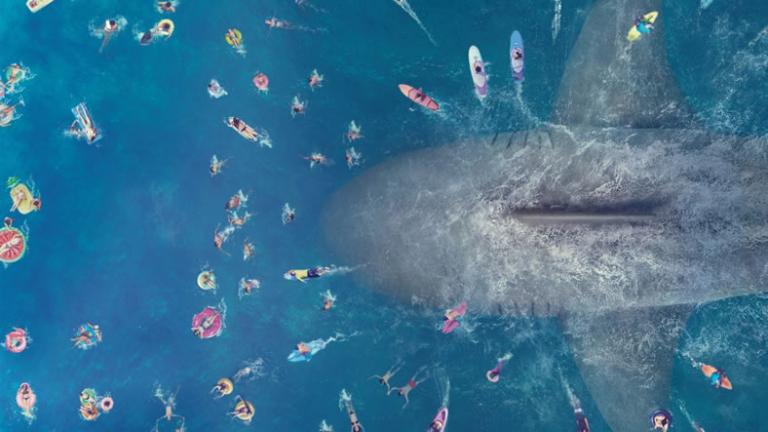
Promotional art from The Meg, courtesy Warner Bros.
The Meg paddles into theaters this weekend, and the makers of this Jason Statham action vehicle surely hopes it gobbles up dollars like the prehistoric shark does swimmers. I haven’t seen The Meg, and I doubt it has deep spiritual undertones. But its very presence gives us an opportunity to consider the enduring fascination and fear we have for these and similar creatures.
Let me tell you a little secret: I’m kinda scared of big fish. I’m not particularly phobic about them, and oddly, it doesn’t extend to sharks. Sharks are familiar. They’re supposed to be big, toothy and scary. Big, traditional fish, on the other hand, feel surreal to me. I’m fascinated and freaked out by them. I sometimes have nightmares about being in some sort of body of water and sensing something mostly unseen but obviously massive swimming near me. And then it brushes against my leg …
That’s part of what makes these undersea monsters so scary for us. The ocean is a big place, and it hides lots of secrets, and secrets we might never see coming from the watery gloom. From the time of Jaws and probably before, shark movies have made hay (and money) from that sense of unseen terror—the lurking, underwater other. Stephen Spielberg famously kept the shark in Jaws out of sight, revealed only by the tip of a dorsal fin and a telltale musical “du-dun, du-dun.” Though Spielberg’s hand was forced by a cantankerous mechanical shark (three of them, actually, collectively nicknamed “Bruce“), he knew that the animal’s power and terror came from its inherent mystery—how sneaky it was, and how alien it felt.
From the very beginning, it seems, we’ve been left in awe and terror of the big, bad, curiously beautiful beasties of the deep. The creation story in Genesis refers to the tanninim created on the fifth day (translated in the King James Bible to “great whales”), and the leviathan is namechecked no less than six times in the Good Book—sometimes as a beautiful creation, sometimes as a terrible demon, but always something in which we look on with awe. “Can you pull in the leviathan with a fishhook or tie down his tongue with a rope?” Job 41 says. ” … Any hope of subduing him is false; the mere sight of him is overpowering. No one is fierce enough to rouse him. Who then is able to stand against me?”
But culture’s most enduring leviathan (using the term loosely) isn’t the shark in Jaws and almost certainly won’t be the megalodon in The Meg. It’d be Herman Melville’s great white whale, Moby Dick.
Moby Dick, the book, just might be the greatest American novel ever. It’s filled with depth and mystery, much like the subject sea itself, and it reveals itself in layers. Many have seen reflections of faith within Melville’s most famous work—with Moby Dick either a deep-dwelling demon or, more popularly, a manifestation of God Himself—an avatar of the awesome, incomprehensible Almighty.
Theologian R.C. Sproul unpacked those religious undertones in a brief, sparkling essay, that the whale was a symbol of God, and that “Ahab’s pursuit of the whale is not a righteous pursuit of God but natural man’s futile attempt in his hatred of God to destroy the omnipotent deity.”
In his essay, Sproul dwells, as Melville did, on the creature’s whiteness—an absence of color and a blending of all colors, of which Melville wrote “at times by its intensity completely overpowered all the rest; and yet so mystical and well nigh ineffable was it, that I almost despair of putting it in a comprehensible form.”
Sproul writes:
If the whale embodies everything that is symbolized by whiteness—that which is terrifying; that which is pure; that which is excellent; that which is horrible and ghastly; that which is mysterious and incomprehensible—does he not embody those traits that are found in the fullness of the perfections in the being of God Himself?
Sproul gives us a view of God often lost today, I think—not just one that concentrates on His grace and goodness, as we like to concentrate on, but on His power and mystery and blinding majesty. We think of God as someone we could walk up to and slap on the back. But when we read about folks who truly encountered Him, more often they would fall to their knees and shake in holy terror and awe.
Only one other book I’ve read has touched this sense of a God so huge, so terrible, so wholly incomprehensible: G.K. Chesterton’s The Man Who Was Thursday. It just might be the oddest book I’ve ever read—in part it’s because of the incredibly strange twists the book takes as our hero and his surprising cadre of helpmates pursue the book’s own Great White Whale, the apparent anarchist President Sunday.
One man, Syme, describes his first impressions of Sunday—how when he saw him from the back, he looked “apish” and had the “stoop of an ox.” “I had at once the revolting fancy that this was not a man at all, but a beast dressed up in men’s clothes.” But then, when Syme saw him from the front, “His face frightened me, as it did everyone; but not because it was brutal, not because it was evil. On the contrary, it frightened me because it was so beautiful, because it was so good.
It was like the face of some ancient archangel, judging justly after heroic wars. There was laughter in the eyes, and in the mouth honour and sorrow. There was the same white hair, the same great, grey-clad shoulders that I had seen from behind. But when I saw him from behind I was certain he was an animal, and when I saw him in front I knew he was a god.
Sounds a lot like Moby Dick, really: The beast that Ahab saw (and inherently, almost always its back), the godlike beauty and power and mystery glimpsed at times by the narrator.
I doubt moviegoers will see much of any sort of god in The Meg. But the movie is a nice excuse to reflect on what makes such creatures so tantalizing and terrifying, how we’re entranced and repulsed by their power and mystery—and how these leviathans may, in their own strange ways, point to the most unfathomable and holy mystery of all.
Previous Post

August 9, 2018
Move Over, Odysseus: Christopher Robin Takes a Classic Hero's Journey
Next Post

August 16, 2018 Aretha Franklin, 'A Gift From God,' Goes Home
Browse Our Archives
Select a Category books celebrities Editor's Choice games movies music news sports superheroes television Uncategorized
Select a Month May 2026 April 2026 March 2026 December 2025 October 2025 July 2025 June 2025 May 2025 February 2025 January 2025 December 2024 July 2024 June 2024 May 2024 April 2024 March 2024 February 2024 January 2024 December 2023 September 2023 March 2023 February 2023 December 2022 November 2022 October 2022 September 2022 August 2022 July 2022 June 2022 May 2022 April 2022 March 2022 February 2022 December 2021 October 2021 August 2021 July 2021 June 2021 May 2021 April 2021 March 2021 October 2020 August 2020 July 2020 June 2020 May 2020 April 2020 March 2020 February 2020 January 2020 December 2019 November 2019 October 2019 September 2019 August 2019 July 2019 June 2019 May 2019 April 2019 March 2019 February 2019 January 2019 December 2018 November 2018 October 2018 September 2018 August 2018 July 2018 June 2018 May 2018 April 2018 March 2018 February 2018 January 2018 December 2017 November 2017 October 2017 September 2017 August 2017 July 2017 June 2017 May 2017 April 2017 March 2017 February 2017 January 2017 December 2016 November 2016 October 2016 September 2016 August 2016 July 2016 June 2016 May 2016 April 2016 March 2016 February 2016 January 2016 December 2015 November 2015 October 2015 September 2015 August 2015 July 2015 June 2015 May 2015 April 2015 March 2015 February 2015 January 2015 December 2014 November 2014 October 2014 September 2014
Follow Us!
TAKE THE
Religious Wisdom Quiz
Who was the major prophet during King Hezekiah's reign in Judah?
Select your answer to see how you score.
Daniel Ezekiel Isaiah Jeremiah
Books by This Author Books by Paul Asay
Related posts from Watching God

Finding Forgiveness in the Great Horror Film ‘Hokum’

What makes a hero? These 7 Cinematic Characters...

Finding God's Grace in ‘Project Hail Mary’

Watching God’s Top 10 Movies of 2025
TRENDING AT PATHEOS Religious Music & Entertainment

"Les Diabolique" and Transgression
Alongside something like Arrival, Vertigo, or Charade, Les Diaboliques is a...

"The Plague Dogs" and Mortality
So, flashback to the late 70s, early 80s. Walt Disney Studios is...

With the recent and highly successful release of Christopher Nolan’s epic film,...

"L'avventura" and Human Weakness
Today's piece is going to be a little different for a few...

I first want to apologize for not posting or writing anything. I'm...

I've engaged in the multi-year project of reading through the Church Fathers,...
view all Religious Music & Entertainment blogs
Ad-Free & Subscriber Log-In Subscription Support
- About Us
- 2026 Calendar
- Videos
- Podcasts
- Library of World Religions
- Faith In Media Tracker
- Advertise With Us
- Write for Us
- Privacy Policy
- Terms of Service
- Do Not Sell My Data
- Contact Us
- Radiant Digital
- Manage Newsletter Subscriptions
- Unsubscribe From Notifications
- Sitemap
Copyright 2008-2026, Patheos. All rights reserved.
Subscription Support Ad-Free & Subscriber Log-In
Follow Patheos