
BuddhistCatholicContemplativeEvangelicalGeneral ChristianHinduJewishLatter-day SaintMuslimNew VisionsProgressive Christian
Beliefs
- Buddhist
- Catholic
- Contemplative
- Evangelical
- General Christian
- Hindu
- Jewish
- Latter-day Saint
- More Voices
- Muslim
- New Visions
- Pagan
- Progressive Christian
Topics
- Religion News
- Food and Religion
- Sports and Religion
- Religious Art
- Religious Music and Entertainment
- Religious Events
- History and Religion
- Style and Religion
- Politics and Religion
- Women in Religion
- Recreation Outdoors and Religion
- Business Finance and Religion
- Careers Workplace and Religion
- Education and Religion
- Family Parenting and Religion
- Health Fitness and Religion
- Home and Religion
- Relationships and Religion
- Technology and Religion
- Travel and Religion
Columnists
- Buddhist Columnists
- Business Finance and Religion Columnists
- Careers Workplace and Religion Columnists
- Catholic Columnists
- Contemplative Columnists
- Education and Religion Columnists
- Evangelists Columnists
- Family Parenting and Religion Columnists
- General Christian Columnists
- Health Fitness and Religion Columnists
- Hindu Columnists
- History and Religion Columnists
- Home and Religion Columnists
- Jewish Columnists
- More Voices Columnists
- Latter Day Columnists
- Muslim Columnists
- New Visions Columnists
- Nonreligious Columnists
- Pagan Columnists
- Politics and Religion Columnists
- Progressive Columnists
- Recreation Outdoors and Religion Columnists
- Relationships and Religion Columnists
- Religion News Columnists
- Religious Art Columnists
- Religious Events Columnists
- Religious Music and Entertainment Columnists
- Sports and Religion Columnists
- Style and Religion Columnists
- Technology and Religion Columnists
- Travel and Religion Columnists
- Women in Religion Columnists
Resource Library
- 2026 Calendar
- Library of World Religions
- The 100 Most Holy Places on Earth
- Patheos Answers
- Podcasts
- Videos
- Faith Leaders Database
- Anglican Episcopalian
- Bahai
- Baptist
- Buddhism
- Christianity
- Confucianism
- Eastern Orthodoxy
- Hinduism
- Holiness and Pentecostal
- ISKCON
- Islam
- Judaism
- Lutheran
- Methodist
- The Church of Jesus Christ of Latter-day Saints
- New Age
- Paganism
- Presbytarian and Reformed
- Protestantism
- Religion Behind the Scenes
- Roman Catholic
- Scientology
- Shia Islam
- Sikhism
- Sufism
- Sunni Islam
- Taoism
- Zen
- See all religions
Research Tools
 Ad-Free & Subscriber Log-In Subscription Support
Ad-Free & Subscriber Log-In Subscription Support
Follow Patheos 

- Trending:
- Forgiveness
- |
- Marriage
- |
- Consciousness
- |
- Death Penalty
- |
- Election
- |
- Halloween

- Home
- Religious Music & Entertainment
- Pope Francis May Be ‘a Man of His Word,’ But What Does He Say?
Pope Francis May Be ‘a Man of His Word,’ But What Does He Say?
Last updated on: May 16, 2018 at 2:48 pm by Paul Asay
Pope Francis May Be ‘a Man of His Word,’ But What Does He Say? 2018-05-16T14:48:14-06:00 Paul Asay
Patheos Explore the world's faith through different perspectives on religion and spirituality! Patheos has the views of the prevalent religions and spiritualities of the world.
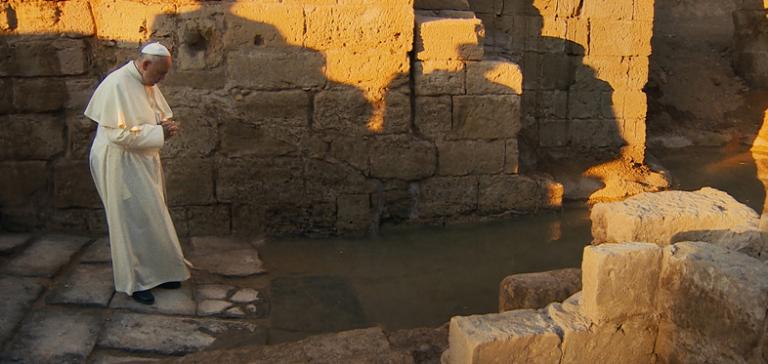
Pope Francis in Pope Francis: A Man of His Word, photo from Focus Features
A paradox lies at the heart of the new documentary Pope Francis: A Man of His Word, and it’s this: Actions speak louder.
As Christians, what we do is far more eloquent than what we say. How we behave is far more persuasive than how we speak. Again and again in the doc, Francis drives home a truth often lost in the midst our noisy world: How important it is to listen. Listen. Listen.
Admittedly, Francis says a lot in A Man of His Word. In the doc, in theaters May 18, he expounds on seemingly dozens of topics: poverty and the environment; consumerism and technology; the beauty of labor, the mystery of suffering and the Catholic Church’s own shameful scandals.
But in some ways, I think the film is at its most powerful when it shows Francis simply interacting with folks, sometimes in utter silence.
He walks through Jerusalem’s Dome of the Rock, one of the holiest sites in Islam, with somber, respectful gravity. He’s seen smiling with Patriarch Kirill, leader of the Eastern Orthodox Church—an unprecedented meeting between the figureheads of two bitterly separated wings of Christianity, divorced for more than 1,000 years. We see him walk through African hospitals filled with sick and dying children, quietly touching their heads, blessing them and their mothers.
And when he stands before victims of a destructive hurricane in the Philippines, his message is simplicity itself: “I don’t know what to say to you,” he says, “other than to keep silent.”
Pope Francis became a multicultural superstar when first elected on the basis of his actions. News reports trumpeted how the one-time Cardinal of Buenos Aires, Jorge Mario Bergoglio, carried his own luggage into Rome, how he eschewed the traditional Apostolic Palace in favor of a modest two-bedroom apartment; how he was whisked through the streets of the United States in a tiny Fiat 500 instead of a stretch limo or hulking SUV.
It’s one thing to say you have a heart for the poor. It’s another to step out and quietly, respectfully walk with them, as Francis does often here.
“I wanted the pope’s ideas and his message to be the centre of this documentary, his work of reform and his answers to today’s global questions,” writes director Wim Wenders in a preface to the movie’s production notes.
Wenders was given (according to the press notes) “unprecedented” access to Pope Francis, and A Man of His Word represents a two-year journey with the pontiff, ranging from the halls of the Vatican to the refugee camps in Greece to the streets of Benin.
While Wenders was given “carte blanche” by the Vatican and the right to the final cut, it’s pretty obvious from the get-go that this is no grand work of investigative journalism. The cynical reporter in me would call this an unremitting “puff piece” on the Pope—a one-sided narrative that excludes any dissenting voices and gives the floor to Francis, and Francis alone. That’s by design, according to Wenders: “This is not a biographical movie,” the director says. “It’s more like a biography of his ideas—it’s a film with him more than one about him.”
But while Wenders probably won’t snag a fourth Oscar nomination for a work that feels so hagiographic, the doc feels surprisingly resonant. It might not have challenged its subject, but it’s subject did challenge me.
Wenders’ Francis is, in many respects, a countercultural figure. As open-handed and humble as the pope seems here, Francis does his share of scolding, and he begins with the Catholic Church itself—suggesting to a group of frowning Cardinals that perhaps the church itself has grown too enamored and reliant on wealth and reminding them that it can’t serve “two masters.”
But he doesn’t stop there: “We must all consider if we can’t become a bit poorer” ourselves, he says, to alleviate the crushing poverty around the world.
But I don’t want to become poorer! part of me protests. I’ve worked hard for what I have. I like taking vacations. I like eating out. I like …
But Francis, caretaker, in some respects, of all the Catholic Church’s history and art and priceless treasure, lives in a two-bedroom apartment. He speaks and hugs the poor and the destitute—people who sometimes I pretend not to see.
“We wanted people to walk away from this movie with a sense of hope and a sense of longing for a different world,” Wenders says. But Francis insists that a different world requires our participation. It’s not enough to say we care. We have to show it.
“We are all responsible,” Francis says in the film. “none of us can say, ‘I have nothing to do with it.'”
Being a Christian in America is a strange thing, filled with its perpetual ironies. As I sat in the movie, I realized that many of my fellow evangelical Christians would be deeply challenged, perhaps dismissive, of Francis’ concerns over the environment and climate change and our role as (as Francis says) earth’s “caretakers.” Some might be appalled at Francis’ open-handed stance toward homosexuality, when he says, simply, “who am I to judge?”
But then, in the next breath, Francis challenges me to really consider what it means to be a Christian. To question whether I’m doing near enough. To make me ask whether I’ve lost what, according to Pope Francis, is a critical aspect of expressing my faith well: The capacity to listen.
Of his namesake, Francis of Assisi, the pope says, “He was an apostle of the ear … knowing how to listen.”
I used to think of myself as a pretty good listener. But we live in noisy times, where most of us are rewarded for talking and tweeting, opining and pontificating. Just as I’m doing now.
Listening to other people a little better won’t get us more likes or retweets or pats on the back. But perhaps Francis is right: Maybe the world would be a little bit better—a little bit more Godly—if we learned to listen just a bit more.
Pope Francis: A Man of His Word will be in theaters this Friday, May 18.
Previous Post

May 8, 2018
Finding Hope in Horror: A Talk With Wraith Director Michael Sajbel

Browse Our Archives
Select a Category books celebrities Editor's Choice games movies music news sports superheroes television Uncategorized
Select a Month May 2026 April 2026 March 2026 December 2025 October 2025 July 2025 June 2025 May 2025 February 2025 January 2025 December 2024 July 2024 June 2024 May 2024 April 2024 March 2024 February 2024 January 2024 December 2023 September 2023 March 2023 February 2023 December 2022 November 2022 October 2022 September 2022 August 2022 July 2022 June 2022 May 2022 April 2022 March 2022 February 2022 December 2021 October 2021 August 2021 July 2021 June 2021 May 2021 April 2021 March 2021 October 2020 August 2020 July 2020 June 2020 May 2020 April 2020 March 2020 February 2020 January 2020 December 2019 November 2019 October 2019 September 2019 August 2019 July 2019 June 2019 May 2019 April 2019 March 2019 February 2019 January 2019 December 2018 November 2018 October 2018 September 2018 August 2018 July 2018 June 2018 May 2018 April 2018 March 2018 February 2018 January 2018 December 2017 November 2017 October 2017 September 2017 August 2017 July 2017 June 2017 May 2017 April 2017 March 2017 February 2017 January 2017 December 2016 November 2016 October 2016 September 2016 August 2016 July 2016 June 2016 May 2016 April 2016 March 2016 February 2016 January 2016 December 2015 November 2015 October 2015 September 2015 August 2015 July 2015 June 2015 May 2015 April 2015 March 2015 February 2015 January 2015 December 2014 November 2014 October 2014 September 2014
Follow Us!
TAKE THE
Religious Wisdom Quiz
How did Job's friends initially show their sympathy?
Select your answer to see how you score.
Brought gifts Wept and tore clothes Offered sacrifices Sat in silence seven days
Books by This Author Books by Paul Asay
Related posts from Watching God

Finding Forgiveness in the Great Horror Film ‘Hokum’

What makes a hero? These 7 Cinematic Characters...

Finding God's Grace in ‘Project Hail Mary’

Watching God’s Top 10 Movies of 2025
TRENDING AT PATHEOS Religious Music & Entertainment

"Les Diabolique" and Transgression
Alongside something like Arrival, Vertigo, or Charade, Les Diaboliques is a...

"The Plague Dogs" and Mortality
So, flashback to the late 70s, early 80s. Walt Disney Studios is...

With the recent and highly successful release of Christopher Nolan’s epic film,...

"L'avventura" and Human Weakness
Today's piece is going to be a little different for a few...

I first want to apologize for not posting or writing anything. I'm...

I've engaged in the multi-year project of reading through the Church Fathers,...
view all Religious Music & Entertainment blogs
Ad-Free & Subscriber Log-In Subscription Support
- About Us
- 2026 Calendar
- Videos
- Podcasts
- Library of World Religions
- Faith In Media Tracker
- Advertise With Us
- Write for Us
- Privacy Policy
- Terms of Service
- Do Not Sell My Data
- Contact Us
- Radiant Digital
- Manage Newsletter Subscriptions
- Unsubscribe From Notifications
- Sitemap
Copyright 2008-2026, Patheos. All rights reserved.
Subscription Support Ad-Free & Subscriber Log-In
Follow Patheos