
BuddhistCatholicContemplativeEvangelicalGeneral ChristianHinduJewishLatter-day SaintMuslimNew VisionsProgressive Christian
Beliefs
- Buddhist
- Catholic
- Contemplative
- Evangelical
- General Christian
- Hindu
- Jewish
- Latter-day Saint
- More Voices
- Muslim
- New Visions
- Pagan
- Progressive Christian
Topics
- Religion News
- Food and Religion
- Sports and Religion
- Religious Art
- Religious Music and Entertainment
- Religious Events
- History and Religion
- Style and Religion
- Politics and Religion
- Women in Religion
- Recreation Outdoors and Religion
- Business Finance and Religion
- Careers Workplace and Religion
- Education and Religion
- Family Parenting and Religion
- Health Fitness and Religion
- Home and Religion
- Relationships and Religion
- Technology and Religion
- Travel and Religion
Columnists
- Buddhist Columnists
- Business Finance and Religion Columnists
- Careers Workplace and Religion Columnists
- Catholic Columnists
- Contemplative Columnists
- Education and Religion Columnists
- Evangelists Columnists
- Family Parenting and Religion Columnists
- General Christian Columnists
- Health Fitness and Religion Columnists
- Hindu Columnists
- History and Religion Columnists
- Home and Religion Columnists
- Jewish Columnists
- More Voices Columnists
- Latter Day Columnists
- Muslim Columnists
- New Visions Columnists
- Nonreligious Columnists
- Pagan Columnists
- Politics and Religion Columnists
- Progressive Columnists
- Recreation Outdoors and Religion Columnists
- Relationships and Religion Columnists
- Religion News Columnists
- Religious Art Columnists
- Religious Events Columnists
- Religious Music and Entertainment Columnists
- Sports and Religion Columnists
- Style and Religion Columnists
- Technology and Religion Columnists
- Travel and Religion Columnists
- Women in Religion Columnists
Resource Library
- 2026 Calendar
- Library of World Religions
- The 100 Most Holy Places on Earth
- Patheos Answers
- Podcasts
- Videos
- Faith Leaders Database
- Anglican Episcopalian
- Bahai
- Baptist
- Buddhism
- Christianity
- Confucianism
- Eastern Orthodoxy
- Hinduism
- Holiness and Pentecostal
- ISKCON
- Islam
- Judaism
- Lutheran
- Methodist
- The Church of Jesus Christ of Latter-day Saints
- New Age
- Paganism
- Presbytarian and Reformed
- Protestantism
- Religion Behind the Scenes
- Roman Catholic
- Scientology
- Shia Islam
- Sikhism
- Sufism
- Sunni Islam
- Taoism
- Zen
- See all religions
Research Tools
 Ad-Free & Subscriber Log-In Subscription Support
Ad-Free & Subscriber Log-In Subscription Support
Follow Patheos 

- Trending:
- Forgiveness
- |
- Marriage
- |
- Consciousness
- |
- Death Penalty
- |
- Election
- |
- Halloween

- Home
- Religious Music & Entertainment
- The Story of God: Finding Heaven in Hell
The Story of God: Finding Heaven in Hell
Last updated on: January 20, 2017 at 9:29 am by Paul Asay
The Story of God: Finding Heaven in Hell 2017-01-20T09:29:10-06:00 Paul Asay
Patheos Explore the world's faith through different perspectives on religion and spirituality! Patheos has the views of the prevalent religions and spiritualities of the world.

Morgan Freeman from National Geographic’s The Story of God.
What is heaven? What is hell? And how do they impact how we live right now?
“Heaven and Hell,” the latest episode of The Story of God With Morgan Freeman (airing Jan. 23) grapples with those questions. They’re questions that have fascinated me, too. They always have, ever since I was a little boy.
In the episode, Freeman and others take an interfaith trip through the Good Place and Bad Place. The show takes us to a cave in Tennessee used by the ancient forerunners of the Cherokee, said to contain artwork depicting the first representations of “heaven” and “hell.” We travel to Cambodia’s beautiful Angkor Wat, where nearly a thousand years ago a king tried to build a Hindu heaven on earth. We visit a Pentecostal church in Albuquerque and a Coptic cathedral in Ethiopia, where the lines between spiritual and earthly realms seem to thin, according to believers.
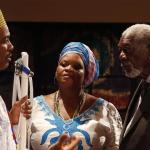
But I was most intrigued—most challenged, I suppose—by Freeman’s short visit with a pair of Assyrian Christians, a mother and son, newly arrived in the United States.
I’d love to learn more about Assyrian Christianity. According to the show, it’s perhaps the faith’s oldest branch. And its theology of heaven and hell is remarkably, attractively simple: Heaven, Freeman explains, is when you’re close to God. Hell is when you’re far away from Him. I like that. It reminds me of Dante’s Inferno, where hell’s nine circles progressively sink farther and farther from God and heaven, finally terminating in the icy center of the earth.
And yet, Freeman tells us that this Assyrian mom and son fled “hell on earth.” Islamic extremists blew up churches and threatened to kill her and kidnap her son. They fled to Syria, which shortly thereafter was overrun by ISIS. Only once they came to the United States could they feel safe again.
If heaven is being close to God, what happened? Had God moved away from them?
Their story resonates with me, in part, because I recently saw Martin Scorsese’s Silence—a profound, sometimes troubling rumination on faith and persecution, and God’s own unsettling silence in the midst of it all.
The 17th Century Japanese Christians in Scorsese’s film (and the Shūsaku Endō book which inspired it) are likewise under withering attack. The faith is illegal in the Japan of that era: To say you’re a Christian is to hand yourself over to martyrdom. Many are indeed martyred in horrific, torturous ways. So they place their hopes in “paradise,” the heaven beyond.
Relatively early, a handful of Christians are tied to crosses placed along a rocky shoreline. When the tide comes in, the water rises to their necks, battering their bodies as it crashes through them. When the tide goes out, the Christians are exposed to the elements. It takes days for them to die like this. In the movie, we’re told, one lasted a week, singing a hymn toward the end.
In the book, a Jesuit priest named Rodrigues struggles to understand why these Christians must endure so much. In a letter back to his superiors, he writes:
‘Like the numerous Japanese martyrs who have gone before, they now enjoy everlasting happiness.’ I also, of course, am convinced of all this. And yet, why does this feeling of grief remain in my heart? Why does the song of the exhausted Mokichi, bound to the stake, gnaw constantly at my heart:
We’re on our way, we’re on our way,
We’re on our way to the temple of Paradise,
To the temple of Paradise …
To the great Temple …I have heard from the people of Tomogi that many Christians when dragged off to the place of execution sang this hymn—a melody filled with dark sadness. Life in this world is too painful for these Japanese peasants. Only by relying on ‘the temple of Paradise’ have they been able to go on living. Such is the sadness which fills this song.
Haunting.
Freeman suggests in the show that, for some people, heaven is found in home. It’s a place where you feel loved. Where you belong.
I’d agree that “home,” whatever that looks like, can give us a hint of heaven. But it’s because, I believe, heaven is our real home. Heaven is an eternal place. Our home, all too often, is not. And sometimes it can become a hell. It can feel far from God indeed.
The Iraq that Freeman’s Assyrian Christians once knew as home became a far different place. The Japan that Rodrigues sees—this black “swamp,” as Endo so often describes—was once home to hundreds of thousands of Christians who could worship freely. And even though most of us here will thankfully never deal with such terrors as these, we also know that home—however we define it on this earth—is not always heavenly. Some of us may feel like we never truly “belong” anywhere.
And so we cast our eyes to heaven, to paradise. We’ve seen hints of real home and believe it exists … just not here. We’re on our way to the temple of Paradise, we sing. And as we deal with the pain and difficulty of life, be they big or small, it gives us hope. We believe, as Christians for two millennia have always believed, that even our darkest hells must recoil before the light of dawn.
Previous Post

January 13, 2017
The Story of God: Are We All Chosen?
Next Post
January 25, 2017 The Story of God: Is There Anybody Out There?
Browse Our Archives
Select a Category books celebrities Editor's Choice games movies music news sports superheroes television Uncategorized
Select a Month May 2026 April 2026 March 2026 December 2025 October 2025 July 2025 June 2025 May 2025 February 2025 January 2025 December 2024 July 2024 June 2024 May 2024 April 2024 March 2024 February 2024 January 2024 December 2023 September 2023 March 2023 February 2023 December 2022 November 2022 October 2022 September 2022 August 2022 July 2022 June 2022 May 2022 April 2022 March 2022 February 2022 December 2021 October 2021 August 2021 July 2021 June 2021 May 2021 April 2021 March 2021 October 2020 August 2020 July 2020 June 2020 May 2020 April 2020 March 2020 February 2020 January 2020 December 2019 November 2019 October 2019 September 2019 August 2019 July 2019 June 2019 May 2019 April 2019 March 2019 February 2019 January 2019 December 2018 November 2018 October 2018 September 2018 August 2018 July 2018 June 2018 May 2018 April 2018 March 2018 February 2018 January 2018 December 2017 November 2017 October 2017 September 2017 August 2017 July 2017 June 2017 May 2017 April 2017 March 2017 February 2017 January 2017 December 2016 November 2016 October 2016 September 2016 August 2016 July 2016 June 2016 May 2016 April 2016 March 2016 February 2016 January 2016 December 2015 November 2015 October 2015 September 2015 August 2015 July 2015 June 2015 May 2015 April 2015 March 2015 February 2015 January 2015 December 2014 November 2014 October 2014 September 2014
Follow Us!
TAKE THE
Religious Wisdom Quiz
What animals attacked and killed Job's servants, according to the messengers?
Select your answer to see how you score.
Sabeans and Chaldeans Philistines and Moabites Ammonites and Edomites Syrians and Egyptians
Books by This Author Books by Paul Asay
Related posts from Watching God

Finding Forgiveness in the Great Horror Film ‘Hokum’

Finding God's Grace in ‘Project Hail Mary’

Watching God’s Top 10 Movies of 2025

Finding a Life of Meaning in 'The Life...
TRENDING AT PATHEOS Religious Music & Entertainment

"Les Diabolique" and Transgression
Alongside something like Arrival, Vertigo, or Charade, Les Diaboliques is a...

"The Plague Dogs" and Mortality
So, flashback to the late 70s, early 80s. Walt Disney Studios is...

With the recent and highly successful release of Christopher Nolan’s epic film,...

"L'avventura" and Human Weakness
Today's piece is going to be a little different for a few...

I first want to apologize for not posting or writing anything. I'm...

I've engaged in the multi-year project of reading through the Church Fathers,...
view all Religious Music & Entertainment blogs
Ad-Free & Subscriber Log-In Subscription Support
- About Us
- 2026 Calendar
- Videos
- Podcasts
- Library of World Religions
- Faith In Media Tracker
- Advertise With Us
- Write for Us
- Privacy Policy
- Terms of Service
- Do Not Sell My Data
- Contact Us
- Radiant Digital
- Manage Newsletter Subscriptions
- Unsubscribe From Notifications
- Sitemap
Copyright 2008-2026, Patheos. All rights reserved.
Subscription Support Ad-Free & Subscriber Log-In
Follow Patheos