
BuddhistCatholicContemplativeEvangelicalGeneral ChristianHinduJewishLatter-day SaintMuslimNew VisionsProgressive Christian
Beliefs
- Buddhist
- Catholic
- Contemplative
- Evangelical
- General Christian
- Hindu
- Jewish
- Latter-day Saint
- More Voices
- Muslim
- New Visions
- Pagan
- Progressive Christian
Topics
- Religion News
- Food and Religion
- Sports and Religion
- Religious Art
- Religious Music and Entertainment
- Religious Events
- History and Religion
- Style and Religion
- Politics and Religion
- Women in Religion
- Recreation Outdoors and Religion
- Business Finance and Religion
- Careers Workplace and Religion
- Education and Religion
- Family Parenting and Religion
- Health Fitness and Religion
- Home and Religion
- Relationships and Religion
- Technology and Religion
- Travel and Religion
Columnists
- Buddhist Columnists
- Business Finance and Religion Columnists
- Careers Workplace and Religion Columnists
- Catholic Columnists
- Contemplative Columnists
- Education and Religion Columnists
- Evangelists Columnists
- Family Parenting and Religion Columnists
- General Christian Columnists
- Health Fitness and Religion Columnists
- Hindu Columnists
- History and Religion Columnists
- Home and Religion Columnists
- Jewish Columnists
- More Voices Columnists
- Latter Day Columnists
- Muslim Columnists
- New Visions Columnists
- Nonreligious Columnists
- Pagan Columnists
- Politics and Religion Columnists
- Progressive Columnists
- Recreation Outdoors and Religion Columnists
- Relationships and Religion Columnists
- Religion News Columnists
- Religious Art Columnists
- Religious Events Columnists
- Religious Music and Entertainment Columnists
- Sports and Religion Columnists
- Style and Religion Columnists
- Technology and Religion Columnists
- Travel and Religion Columnists
- Women in Religion Columnists
Resource Library
- 2026 Calendar
- Library of World Religions
- The 100 Most Holy Places on Earth
- Patheos Answers
- Podcasts
- Videos
- Faith Leaders Database
- Anglican Episcopalian
- Bahai
- Baptist
- Buddhism
- Christianity
- Confucianism
- Eastern Orthodoxy
- Hinduism
- Holiness and Pentecostal
- ISKCON
- Islam
- Judaism
- Lutheran
- Methodist
- The Church of Jesus Christ of Latter-day Saints
- New Age
- Paganism
- Presbytarian and Reformed
- Protestantism
- Religion Behind the Scenes
- Roman Catholic
- Scientology
- Shia Islam
- Sikhism
- Sufism
- Sunni Islam
- Taoism
- Zen
- See all religions
Research Tools
 Ad-Free & Subscriber Log-In Subscription Support
Ad-Free & Subscriber Log-In Subscription Support
Follow Patheos 

- Trending:
- Forgiveness
- |
- Marriage
- |
- Consciousness
- |
- Death Penalty
- |
- Election
- |
- Halloween

- Home
- Religious Music & Entertainment
- Can the Big Bang and Genesis Both Be True?
Can the Big Bang and Genesis Both Be True?
Last updated on: April 19, 2016 at 7:44 pm by Paul Asay
Can the Big Bang and Genesis Both Be True? 2016-04-19T19:44:29-06:00 Paul Asay
Patheos Explore the world's faith through different perspectives on religion and spirituality! Patheos has the views of the prevalent religions and spiritualities of the world.
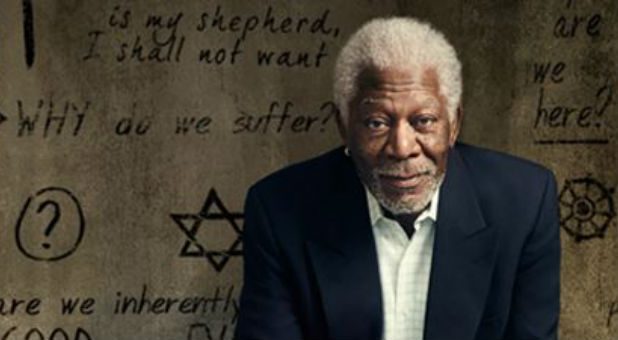
Morgan Freeman in artwork from National Geographic’s The Story of God.
In National Geographic’s April 24 episode of The Story of God, “Creation,” host Morgan Freeman explores the supposed divide between faith and science—and gives us a hint of one of the reasons why, perhaps, he drifted away from his own traditional Christian upbringing.
Freeman goes back to his old church in Mississippi and shares that he found Christianity’s own creation story to be a “profound mystery.” He stresses the apparent disparity between the Big Bang Theory—how most scientists currently think the universe was created—and the Genesis creation stories. And he asks, “Can science and religion agree on creation?”
I believe the answer to be yes. In fact, I don’t think there’s any real disagreement at all. And let me explain why not with a story of my own.
This weekend, I found a batch of chocolate chip cookies cooling in the kitchen. I was pleased at this little act of creation, being partial to warm chocolate chip cookies. But I had to ask myself: How did these cookies get here?
There are scientific answers to that question: The biology of how the cocoa and sugar were grown over time, the chemistry of how these disparate elements bonded together under the process of mixing and heat; how physics and mechanics pushed the dough into shape and propelled them into the oven.
But there’s also a deeply personal answer: My daughter made ‘em.
These answers do not conflict. They are both true. One is not more true than the other.
I think the same can be said of creation as a whole. Science is the oven, if you will, in which the physical universe was baked. But I don’t believe that eliminates the possibility—indeed, the necessity, in my opinion—of a baker.
Now, it’s not particularly important to my faith as to whether the creation stories of Genesis are scientifically factual or not. I believe them to be true, but whether that truth is literal or metaphorical is not my fight. But for me, there is ultimately no tension between science and faith—not if my God is real and my faith is true. If God exists, He’s certainly not pacing up and down the heavens cursing Charles Darwin.
In those moments when faith and science seem to clash, I believe it’s due to the limitations of our own minds: We misunderstand the nature of God, the nature of the universe or, very likely, both. And even though we’re always learning and discovering new things about the world around us and the One who created it, I doubt we’ll ever truly know either—not in this lifetime. Our understanding of science, in particular, is always changing as we learn more.
Take, for instance, the Big Bang theory at the center of the episode. It wasn’t so long ago that the theory would’ve been considered, by many scientists, heretical. Before it came in vogue, most scientists believed that the universe was infinitely old. There was no moment of creation, these learned men said: What we see was always there. (After all, they mused, who would’ve created it?) The Big Bang—the idea that the universe began at a moment in time in a massive, mysterious explosion of matter—resonates deeply with me as a Christian. For me, it dovetails nicely with the beautiful poetry of Genesis:
“Now the earth was formless and empty, darkness was over the surface of the deep, and the Spirit of God was hovering over the waters. And God said, ‘Let there be light,’ and there was light.”
As Freeman says, “One moment there was nothing, the next, everything.” He could be talking Genesis. He could be referring to the Big Bang. To me, they’re both telling, essentially, the same story. And even if science can someday definitively answer the what and where and how of creation, only religion dares touch the why.
Previous Post

April 17, 2016
The Terrible, Awful, No-Good Generosity of 'The Lady in the Van'
Next Post
April 21, 2016 The Faith of Harriet Tubman, New Face of the 20 Dollar Bill
Browse Our Archives
Select a Category books celebrities Editor's Choice games movies music news sports superheroes television Uncategorized
Select a Month May 2026 April 2026 March 2026 December 2025 October 2025 July 2025 June 2025 May 2025 February 2025 January 2025 December 2024 July 2024 June 2024 May 2024 April 2024 March 2024 February 2024 January 2024 December 2023 September 2023 March 2023 February 2023 December 2022 November 2022 October 2022 September 2022 August 2022 July 2022 June 2022 May 2022 April 2022 March 2022 February 2022 December 2021 October 2021 August 2021 July 2021 June 2021 May 2021 April 2021 March 2021 October 2020 August 2020 July 2020 June 2020 May 2020 April 2020 March 2020 February 2020 January 2020 December 2019 November 2019 October 2019 September 2019 August 2019 July 2019 June 2019 May 2019 April 2019 March 2019 February 2019 January 2019 December 2018 November 2018 October 2018 September 2018 August 2018 July 2018 June 2018 May 2018 April 2018 March 2018 February 2018 January 2018 December 2017 November 2017 October 2017 September 2017 August 2017 July 2017 June 2017 May 2017 April 2017 March 2017 February 2017 January 2017 December 2016 November 2016 October 2016 September 2016 August 2016 July 2016 June 2016 May 2016 April 2016 March 2016 February 2016 January 2016 December 2015 November 2015 October 2015 September 2015 August 2015 July 2015 June 2015 May 2015 April 2015 March 2015 February 2015 January 2015 December 2014 November 2014 October 2014 September 2014
Follow Us!
TAKE THE
Religious Wisdom Quiz
Who was the slave who became a Christian and whose master was Philemon?
Select your answer to see how you score.
Onesimus Barnabas Sosthenes Tychicus
Books by This Author Books by Paul Asay
Related posts from Watching God

We Have to Talk About 'The Acolyte'

'Dune: Part Two' Asks Explosive Questions About Religion
Watching God’s Top 10 Movies of 2023

New Doc ‘The Mission’ Asks Important Questions About...
TRENDING AT PATHEOS Religious Music & Entertainment

"Les Diabolique" and Transgression
Alongside something like Arrival, Vertigo, or Charade, Les Diaboliques is a...

"The Plague Dogs" and Mortality
So, flashback to the late 70s, early 80s. Walt Disney Studios is...

With the recent and highly successful release of Christopher Nolan’s epic film,...

"L'avventura" and Human Weakness
Today's piece is going to be a little different for a few...

I first want to apologize for not posting or writing anything. I'm...

I've engaged in the multi-year project of reading through the Church Fathers,...
view all Religious Music & Entertainment blogs
Ad-Free & Subscriber Log-In Subscription Support
- About Us
- 2026 Calendar
- Videos
- Podcasts
- Library of World Religions
- Faith In Media Tracker
- Advertise With Us
- Write for Us
- Privacy Policy
- Terms of Service
- Do Not Sell My Data
- Contact Us
- Radiant Digital
- Manage Newsletter Subscriptions
- Unsubscribe From Notifications
- Sitemap
Copyright 2008-2026, Patheos. All rights reserved.
Subscription Support Ad-Free & Subscriber Log-In
Follow Patheos