
BuddhistCatholicContemplativeEvangelicalGeneral ChristianHinduJewishLatter-day SaintMuslimNew VisionsProgressive Christian
Beliefs
- Buddhist
- Catholic
- Contemplative
- Evangelical
- General Christian
- Hindu
- Jewish
- Latter-day Saint
- More Voices
- Muslim
- New Visions
- Pagan
- Progressive Christian
Topics
- Religion News
- Food and Religion
- Sports and Religion
- Religious Art
- Religious Music and Entertainment
- Religious Events
- History and Religion
- Style and Religion
- Politics and Religion
- Women in Religion
- Recreation Outdoors and Religion
- Business Finance and Religion
- Careers Workplace and Religion
- Education and Religion
- Family Parenting and Religion
- Health Fitness and Religion
- Home and Religion
- Relationships and Religion
- Technology and Religion
- Travel and Religion
Columnists
- Buddhist Columnists
- Business Finance and Religion Columnists
- Careers Workplace and Religion Columnists
- Catholic Columnists
- Contemplative Columnists
- Education and Religion Columnists
- Evangelists Columnists
- Family Parenting and Religion Columnists
- General Christian Columnists
- Health Fitness and Religion Columnists
- Hindu Columnists
- History and Religion Columnists
- Home and Religion Columnists
- Jewish Columnists
- More Voices Columnists
- Latter Day Columnists
- Muslim Columnists
- New Visions Columnists
- Nonreligious Columnists
- Pagan Columnists
- Politics and Religion Columnists
- Progressive Columnists
- Recreation Outdoors and Religion Columnists
- Relationships and Religion Columnists
- Religion News Columnists
- Religious Art Columnists
- Religious Events Columnists
- Religious Music and Entertainment Columnists
- Sports and Religion Columnists
- Style and Religion Columnists
- Technology and Religion Columnists
- Travel and Religion Columnists
- Women in Religion Columnists
Resource Library
- 2026 Calendar
- Library of World Religions
- The 100 Most Holy Places on Earth
- Patheos Answers
- Podcasts
- Videos
- Faith Leaders Database
- Anglican Episcopalian
- Bahai
- Baptist
- Buddhism
- Christianity
- Confucianism
- Eastern Orthodoxy
- Hinduism
- Holiness and Pentecostal
- ISKCON
- Islam
- Judaism
- Lutheran
- Methodist
- The Church of Jesus Christ of Latter-day Saints
- New Age
- Paganism
- Presbytarian and Reformed
- Protestantism
- Religion Behind the Scenes
- Roman Catholic
- Scientology
- Shia Islam
- Sikhism
- Sufism
- Sunni Islam
- Taoism
- Zen
- See all religions
Research Tools
 Ad-Free & Subscriber Log-In Subscription Support
Ad-Free & Subscriber Log-In Subscription Support
Follow Patheos 

- Trending:
- Forgiveness
- |
- Marriage
- |
- Consciousness
- |
- Death Penalty
- |
- Election
- |
- Halloween

- Home
- Religious Music & Entertainment
- There’s a Reason Why Batman v Superman Was Released Easter Weekend
There’s a Reason Why Batman v Superman Was Released Easter Weekend
Last updated on: March 26, 2016 at 9:38 am by Paul Asay
There’s a Reason Why Batman v Superman Was Released Easter Weekend 2016-03-26T09:38:34-06:00 Paul Asay
Patheos Explore the world's faith through different perspectives on religion and spirituality! Patheos has the views of the prevalent religions and spiritualities of the world.
I wanted to like Batman v Superman: Dawn of Justice. I really did. The first superheroes I ever knew were from the D.C. stable, and back when I was 7 years old, my best friend and I played Superman and Batman until our capes practically wore out.
Alas, Batman v Superman felt less like a movie than it did a cynical corporate product—a movie whose primary purpose was to launch a lucrative franchise universe (to compete with Marvel’s litany of superhero titles) than draw moviegoers into an exciting, enthralling story. Sure, Wonder Woman (Gal Gadot) was pretty cool, and I liked the look of the new Batmobile. But for the most part, the superheroes themselves were shallow, two-dimensional creatures. And Batman—never the cheeriest of do-gooders anyway—was a dark, bitter mess. Some of the things that Batman did here made me wonder, frankly, if Director Zack Snyder had a firm grasp of the character, or whether he just read Frank Miller’s uber-dark, non-canonical The Dark Knight Returns and decided, “nope, not bleak enough.”
But as disappointed as I was with the movie, it did have some interesting spiritual elements. Indeed, it may help answer why Warner Brothers decided to release this surefire blockbuster on Easter weekend rather than waiting for the superhero-friendly summer. Turns out, Batman v Superman is a bit of an Easter story itself. (Caution: Spoilers Ahead)
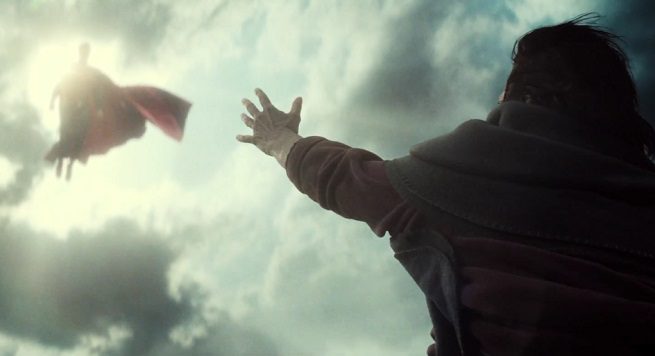
From Batman v Superman, photo courtesy Warner Bros.
Misunderstood Superhero
Ever since the movie’s trailers landed online—heck, ever since 2013’s Man of Steel—it was pretty clear that Snyder and Co. were treating Superman (played by Henry Cavill) as more than just a super-strong guy in a red cape: He’s an unmitigated Messiah figure—a visitor from far, far away who has come to save us. When we see him on screen, it’s often on salvific terms: He’s shown hovering in the sunlight like an angel or surrounded by would-be worshippers straining simply to touch his hem. At one point we see an angel or saint depicted in a stained-glass window, draped tellingly in blue and red.
He is, in his own way, a miracle worker—one Snyder uses to echo an altogether more important miracle worker who walked the earth a good 2,000 years earlier.
But the world doesn’t necessarily know how to deal with these strange, powerful visitors. While some worshipped and followed Jesus, others were deeply fearful. Some believed he was possessed or in league with the devil. And the Jewish leaders of the day accused him of not adhering to Mosaic Law.
So it’s fascinating that Superman also is having trouble with the law—not of healing people on the Sabbath, like Jesus, but of saving people without the OK from the State. “In a democracy, good is a conversation, not a unilateral decision,” says Senator Finch (Holly Hunter). Superman, she believes, must be held accountable—even if it seems forcing such accountability would be impossible.
“He will not answer to you,” a critic of Superman tells Finch. “He answers to no one. Not even, I think, to God.”
As Congress holds its hearings, other experts debate Superman’s nature and significance—much as Jews and Romans did of Jesus back in the day. “Maybe he’s not just some sort of a devil or Jesus,” one expert suggests, “but a guy trying to do the right thing.”
Lex Luthor (Jesse Eisenberg) isn’t buying that. He suggests to Finch that Superman is a demon. Suitably attired in red boots. “Devils don’t come from hell beneath us,” he hisses. “Not, they come from the sky.”

Jesse Eisenberg as Lex Luthor in Batman v Superman. Photo courtesy Warner Bros.
But does Lex believe that? Why does he hate Superman so much? It’s not really clear in this murky movie—a fault, I believe, but one that still filters into the spiritual subtext. In Hebrew, Satan means, simply, “adversary,” and Lex Luthor seems to fit that definition here: Perhaps Lex is scared of Superman’s power or loathes his goodness or just doesn’t appreciate his fashion sense. But whatever the reason, the hatred is primal, unquenchable. Lex despises Superman because he must.
Lex refers to Superman repeatedly as a god—often calling him the God. But he’s no believer in a just, loving deity. He’s an antitheist—a stance, it’s suggested, that stemmed from the beatings he suffered at the hands of his father. “If God is all powerful, he cannot be all good,” he says. “And if he is all good, he cannot be all powerful.” He manipulates events so that Superman and Batman will eventually have a showdown to the death: “God versus man,” Lex says. “Day versus night.”
Batman (Ben Affleck), too, has the air of an adversary—looking even a bit devilish himself in his pointy-eared cowl. But the Dark Knight’s motives are not akin to Lex’s pure hatred. It’s more like those of the Pharisees in Jesus’ day, confronted with a Messiah they didn’t expect: Batman’s trying to protect the world as he knows it from a force that he doesn’t. He will persecute Superman because, in Batman’s eyes, Superman needs to be persecuted.
“Tell me, do you bleed?” Batman asks. “You will.”

Ben Affleck and Henry Cavill in Batman v Superman. Photo courtesy Warner Bros.
The Passion of the Supes
Superman, like Jesus, winds up submitting to authority—even though, given his abilities, there’s no reason why he has to. He answers a summons to Congress and appears before Finch as a massive crowd of protesters cheer and jeer him outside.
But the “trial,” such as it is, does not go well. Lex makes sure of that. And in the aftermath of the disaster, the world at large begins to doubt Superman’s ultimate goodness. And he’s taken his power elsewhere.
Only temporarily, of course. Circumstances bring him back and force Superman to take an active part in—surprise—saving the world.
But Batman stands in his way. At the Dark Knight’s hands, Superman does bleed. He suffers in a way that you wouldn’t think a god could or should.
But when Superman calls out his mother’s name—Martha—Batman sees Superman in a new light. Yes, Superman’s an alien. Yet, somehow, he’s fully human, too. He sees Supes for, really, the first time—as if scales had fallen from his eyes. And he offers to help the guy.
Together, the two superheroes fly into action against a very disappointed Lex Luthor. “If man, can’t kill god, the devil will do it,” he says, and unleashes a fearsome beast that, unless it’s stopped, will surely destroy the world.
Worse yet, the beast is a creation of Krypton, too—nigh immortal, nigh indestructible, just like Superman himself. Only one thing can kill the beast: Kryptonite. But only one man can bring that bit of kryptonite to the monster’s heart: Superman. How can the Man of Steel defeat this evil without dying himself?
We shan’t get too specific here, but let’s just say that Superman does what Superman has often done since his creation in 1938: He showed a strain of sacrificial love, showing his willingness to die that the world might live.
“This is my world,” Superman tells Lois Lane in the movie’s closing minutes. “You are my world.”
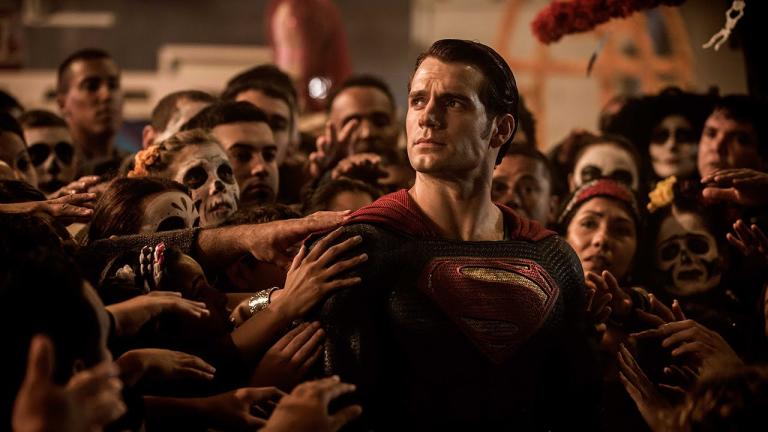
Henry Cavill in Batman v Superman. Photo courtesy Warner Bros.
It’s a statement that, again, reflects Jesus’ own sacrifice on the cross. “For God so loved the world,” we’re told in John 3:16, “that he gave his only Son, that whoever believes in him should not perish but have eternal life.” The sacrifice was about the world. But it was also about us. Even if the world had a population of one—you—God still would’ve made the same sacrifice.
Batman v Superman could’ve been better. A lot better. But despite its flaws, I find this spiritual thread in the movie interesting—maybe even a bit redeeming.
Previous Post

March 22, 2016
Daredevil Goes to Church
Next Post

March 30, 2016 Producer James Younger Talks About NatGeo's 'The Story of God'
Browse Our Archives
Select a Category books celebrities Editor's Choice games movies music news sports superheroes television Uncategorized
Select a Month May 2026 April 2026 March 2026 December 2025 October 2025 July 2025 June 2025 May 2025 February 2025 January 2025 December 2024 July 2024 June 2024 May 2024 April 2024 March 2024 February 2024 January 2024 December 2023 September 2023 March 2023 February 2023 December 2022 November 2022 October 2022 September 2022 August 2022 July 2022 June 2022 May 2022 April 2022 March 2022 February 2022 December 2021 October 2021 August 2021 July 2021 June 2021 May 2021 April 2021 March 2021 October 2020 August 2020 July 2020 June 2020 May 2020 April 2020 March 2020 February 2020 January 2020 December 2019 November 2019 October 2019 September 2019 August 2019 July 2019 June 2019 May 2019 April 2019 March 2019 February 2019 January 2019 December 2018 November 2018 October 2018 September 2018 August 2018 July 2018 June 2018 May 2018 April 2018 March 2018 February 2018 January 2018 December 2017 November 2017 October 2017 September 2017 August 2017 July 2017 June 2017 May 2017 April 2017 March 2017 February 2017 January 2017 December 2016 November 2016 October 2016 September 2016 August 2016 July 2016 June 2016 May 2016 April 2016 March 2016 February 2016 January 2016 December 2015 November 2015 October 2015 September 2015 August 2015 July 2015 June 2015 May 2015 April 2015 March 2015 February 2015 January 2015 December 2014 November 2014 October 2014 September 2014
Follow Us!
TAKE THE
Religious Wisdom Quiz
How old was Abraham when Sarah died?
Select your answer to see how you score.
137 years 147 years 117 years 127 years
Books by This Author Books by Paul Asay
Related posts from Watching God

Finding Forgiveness in the Great Horror Film ‘Hokum’

What makes a hero? These 7 Cinematic Characters...

Finding God's Grace in ‘Project Hail Mary’

Watching God’s Top 10 Movies of 2025
TRENDING AT PATHEOS Religious Music & Entertainment

"Les Diabolique" and Transgression
Alongside something like Arrival, Vertigo, or Charade, Les Diaboliques is a...

"The Plague Dogs" and Mortality
So, flashback to the late 70s, early 80s. Walt Disney Studios is...

With the recent and highly successful release of Christopher Nolan’s epic film,...

"L'avventura" and Human Weakness
Today's piece is going to be a little different for a few...

I first want to apologize for not posting or writing anything. I'm...

I've engaged in the multi-year project of reading through the Church Fathers,...
view all Religious Music & Entertainment blogs
Ad-Free & Subscriber Log-In Subscription Support
- About Us
- 2026 Calendar
- Videos
- Podcasts
- Library of World Religions
- Faith In Media Tracker
- Advertise With Us
- Write for Us
- Privacy Policy
- Terms of Service
- Do Not Sell My Data
- Contact Us
- Radiant Digital
- Manage Newsletter Subscriptions
- Unsubscribe From Notifications
- Sitemap
Copyright 2008-2026, Patheos. All rights reserved.
Subscription Support Ad-Free & Subscriber Log-In
Follow Patheos