
BuddhistCatholicContemplativeEvangelicalGeneral ChristianHinduJewishLatter-day SaintMuslimNew VisionsProgressive Christian
Beliefs
- Buddhist
- Catholic
- Contemplative
- Evangelical
- General Christian
- Hindu
- Jewish
- Latter-day Saint
- More Voices
- Muslim
- New Visions
- Pagan
- Progressive Christian
Topics
- Religion News
- Food and Religion
- Sports and Religion
- Religious Art
- Religious Music and Entertainment
- Religious Events
- History and Religion
- Style and Religion
- Politics and Religion
- Women in Religion
- Recreation Outdoors and Religion
- Business Finance and Religion
- Careers Workplace and Religion
- Education and Religion
- Family Parenting and Religion
- Health Fitness and Religion
- Home and Religion
- Relationships and Religion
- Technology and Religion
- Travel and Religion
Columnists
- Buddhist Columnists
- Business Finance and Religion Columnists
- Careers Workplace and Religion Columnists
- Catholic Columnists
- Contemplative Columnists
- Education and Religion Columnists
- Evangelists Columnists
- Family Parenting and Religion Columnists
- General Christian Columnists
- Health Fitness and Religion Columnists
- Hindu Columnists
- History and Religion Columnists
- Home and Religion Columnists
- Jewish Columnists
- More Voices Columnists
- Latter Day Columnists
- Muslim Columnists
- New Visions Columnists
- Nonreligious Columnists
- Pagan Columnists
- Politics and Religion Columnists
- Progressive Columnists
- Recreation Outdoors and Religion Columnists
- Relationships and Religion Columnists
- Religion News Columnists
- Religious Art Columnists
- Religious Events Columnists
- Religious Music and Entertainment Columnists
- Sports and Religion Columnists
- Style and Religion Columnists
- Technology and Religion Columnists
- Travel and Religion Columnists
- Women in Religion Columnists
Resource Library
- 2026 Calendar
- Library of World Religions
- The 100 Most Holy Places on Earth
- Patheos Answers
- Podcasts
- Videos
- Faith Leaders Database
- Anglican Episcopalian
- Bahai
- Baptist
- Buddhism
- Christianity
- Confucianism
- Eastern Orthodoxy
- Hinduism
- Holiness and Pentecostal
- ISKCON
- Islam
- Judaism
- Lutheran
- Methodist
- The Church of Jesus Christ of Latter-day Saints
- New Age
- Paganism
- Presbytarian and Reformed
- Protestantism
- Religion Behind the Scenes
- Roman Catholic
- Scientology
- Shia Islam
- Sikhism
- Sufism
- Sunni Islam
- Taoism
- Zen
- See all religions
Research Tools
 Ad-Free & Subscriber Log-In Subscription Support
Ad-Free & Subscriber Log-In Subscription Support
Follow Patheos 

- Trending:
- Forgiveness
- |
- Marriage
- |
- Consciousness
- |
- Death Penalty
- |
- Election
- |
- Halloween

- Home
- Religious Music & Entertainment
- What’s a Life Worth? Oscar’s Best Pictures Tell Us
What’s a Life Worth? Oscar’s Best Pictures Tell Us
Last updated on: February 26, 2016 at 1:35 pm by Paul Asay
What’s a Life Worth? Oscar’s Best Pictures Tell Us 2016-02-26T13:35:36-06:00 Paul Asay
Patheos Explore the world's faith through different perspectives on religion and spirituality! Patheos has the views of the prevalent religions and spiritualities of the world.
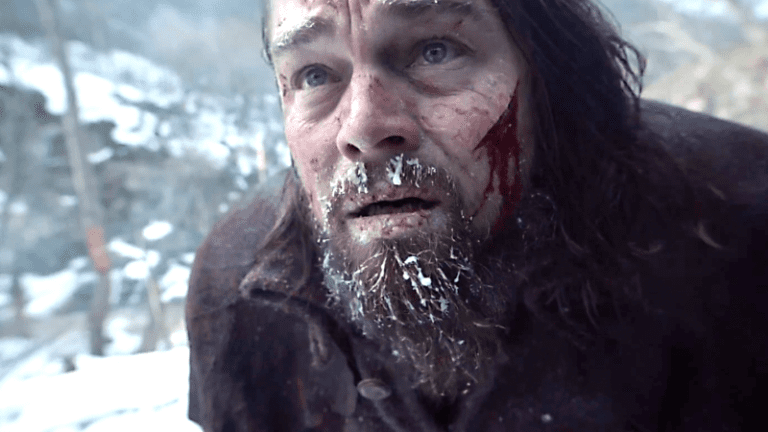
Leonardo DiCaprio in The Revenant, photo courtesy 20th Century Fox
The value of a human life depends on who you ask. If we look at the value of just our raw material, we log in at around $160. But most folks agree that we’re worth more than just the sum of our parts: According to the Environmental Protection Agency, a human life is worth around $9.1 million—a figure they used in asking for stronger (and costlier) environmental regulations. The Food and Drug Administration suggests $7.9 million. Insurance agencies typically pay far less.
This year’s Academy Award Best Picture nominees ask what a human life is worth, too—all in their own unique ways.
In The Martian, astronaut botanist Mark Watney (Matt Damon) has been stranded on Mars, and he must figure out how to survive for months, perhaps years, on a very, very dead planet. But none of that will matter if no one shows up to rescue him. It’s not like he can Gilligan Island up a spacecraft to take him home. He’s got to rely on other people to bring him back, and a rescue operation would be pretty pricey—$200 billion, according to some. And yet, even in an age of budget cuts and uncertainty, Watney’s government ponies up that and more, and much of the world bands together to bring this one man home. In this case, the value of life is inestimable.

Tom Hanks in Bridge of Spies, photo courtesy 20th Century Fox
Like The Martian, Steven Spielberg’s Bridge of Spies is predicated on the value of life—specifically, the lives of two American “spies” locked behind the Cold War’s Iron Curtain. One—Francis Gary Powers—is a high-value agent, shot down over Soviet Russia while flying the super-secret U2 spy plane. The government desperately wants him back: the secrets locked away in Powers’ noggin are of inestimable value. Meanwhile the other guy, Frederic Pryor, isn’t even a spy: He’s just an economics graduate student who wound up on the wrong side of the Berlin Wall at just the wrong time.
The government hires insurance attorney James Donovan (Tom Hanks) to negotiate for the release of Powers. Pryor may be a fine student, but he’s no priority for Uncle Sam. But Donovan refuses to leave either man behind. He’s determined to bring them both home—no what the guys in Washington say. “Every person matters,” he says.
These two films reflect, I think, a biblical notion of life—that its value is incalculable. We made in the image of God, we’re told. Moreover, we’re made by Him, and He loves us in ways we literally can’t comprehend. “Before I formed you in the womb I knew you,” he tells us in Jeremiah. We are beyond worth to God. We are priceless.
Sometimes we remember our value—and the value of others. We see that at the edges of Brooklyn and its story of Ellis (Saoirse Ronan), a young woman who just immigrated to New York from Ireland. While Brooklyn is mainly an old-fashioned love story—her romance with both her new beau Tony (Emory Cohen) and the new nation she’s discovered—this story would’ve never happened had it not been for the sacrifices others made to send her to America. We learn that the Catholic Church has practically given her a whole new life—a job, a place to stay, a circle of companions. We see how deeply she’s missed back in Ireland, especially by her sister, Rose. Ellis’ life was made possible through sacrifice.
But many of the year’s Best Picture nominees remind us how, sadly, we sometimes forget our innate worth—and how sometimes we’re treated as less than we are.
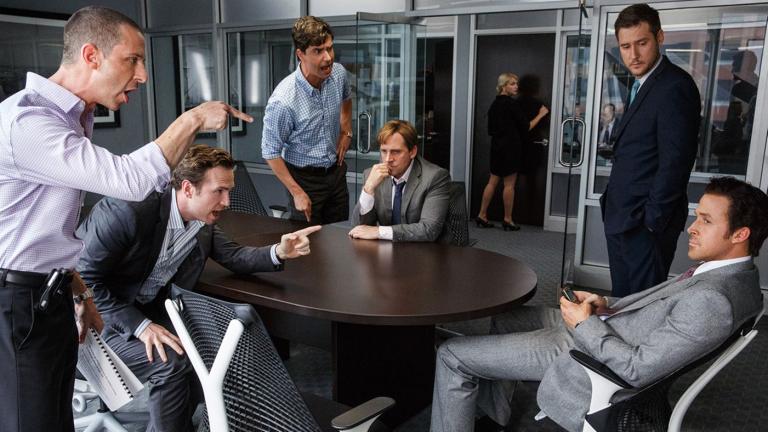
The Big Short, photo courtesy Paramount Pictures
In The Big Short, lives are reduced to numbers and dollar signs—tools in a freaky game of chance. The movie explores the subprime mortgage boom of the late 2000’s, and how the system commoditized the American Dream. It forgot about the very people it was supposed to serve—not to mention the scads of folks caught in the aftermath.
Even *The Big Short’*s “heroes” are not so heroic. As the movie’s savvy financial investors bet on the American economy to go belly-up, Ben Rickert (Brad Pitt) reminds them (and us) of the very human cost of winning. “If we’re right, people lose homes. People lose jobs. People lose retirement savings, people lose pensions. You know what I hate about f—ing banking? It reduces people to numbers. Here’s a number—every 1 percent unemployment goes up, 40,000 people die.”
Spotlight takes on another institutional tragedy—the Catholic pedophilic priest scandal that The Boston Globe exposed in 2002. Here, a handful of priests forgot the sacred value of human life and treated children as commodities—outlets for their worst inclinations. One victim says that the abuse wasn’t just physical, but spiritual. “You know why I went along with everything?” he says. “Because priests are supposed to be the good guys.”
But Spotlight takes care to remind us that the tragedy extended beyond the Catholic Church. the entire community was complicit—including the Globe itself. “If it takes a village to raise a child,” we’re soberly told, “it takes a village to abuse one.”
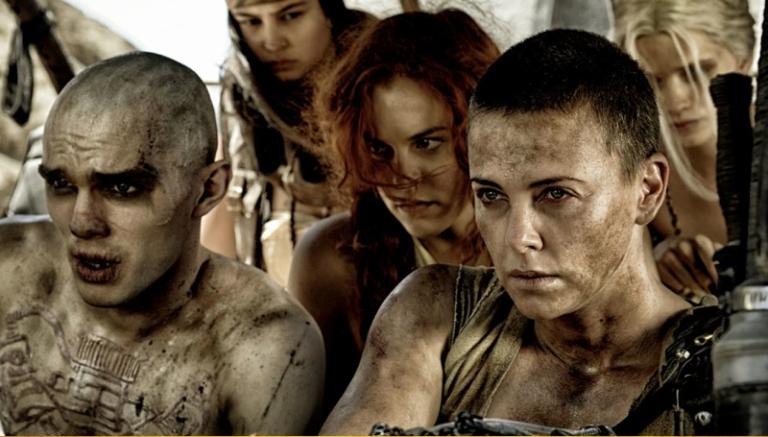
Mad Max: Fury Road, photo courtesy Warner Bros.
In Mad Max: Fury Road, people are again treated like commodities, to be used or abused at will by the movie’s villain, Immortan Joe. His War Boys are simply tools, easily and willingly discarded. The women in his harem are mere toys. “We are not things!” one says. But when the women escape, bringing along a first-unwilling War Boy named Nux along for the ride, their trek becomes a holy quest in a way, where they eventually discover their true value. And in a beautiful twist, Nux—a creature whose life was treated as currency by his blasphemous savior, to be spent at will—sacrifices himself for another in a truly priceless way.
Room also shows us how tragically life can be commoditized. Joy (Brie Larson), known mostly as Ma, has been trapped for seven years in a garden shed, a slave to her captor’s whims. No one but Old Nick knows she’s even alive, and Nick makes it clear that he can change that status anytime he wishes. And if she’s so worthless in his eyes, what does that make her 5-year-old son, Jack?
But if little Jack (Jacob Tremblay) is just a thing behind a wardrobe door to Nick, he is the most precious thing in the world to his mother. He is her reason for living. Her savior. “Once upon a time, before I came, you cried and cried and watched TV all day, until you were a zombie,” Jack tells her. “But then I zoomed down from Heaven, through skylight, into Room. And I was kicking you from the inside. Boom boom! And then I shot out onto Rug with my eyes wide open, and you cut the cord and said, ‘Hello Jack!'” Because of each other, they know they have value. And they’ll both go to tremendous lengths to save each other.
What is a life worth? That question haunts The Revenant perhaps like no other. When the movie begins, Hugh Glass (Leonardo DiCaprio) is a valuable member of this 1820 trapping party. But after he’s nearly killed by a bear, his usefulness is at an end. And as the party is forced to drag him along through increasingly dangerous lands, we in the audience can feel the question—mostly unspoken—running through their minds. Is it worth it? Is it worth risking so many other lives for this breathing corpse?
Eventually, most of the party leaves Glass in the care of three men—including, ironically, John Fitzgerald, Glass’s most ardent critic. Even though he promises to watch over Glass until he takes his last breath, Fitz decides to hurry the process along. It’s pointless to go on, Fitz whispers. Your life is worthless. You’re putting other lives in danger through this selfish act of survival.
But Glass here’s another voice—his own, speaking to his son so long ago when he was gravely hurt.
“Breathe,” he told his boy. “As long as you can still grab a breath, you fight. You breathe.”
Life. We take it for granted so often. We can commoditize ourselves at times, or treat our ongoing breath as if it was a burden. Sometimes we forget what a precious gift it is. For all their weaknesses, many of this year’s crop of Oscar nominees remind us that life that life is a gift—one that we should never take for granted, one we should never waste.

Next Post

March 7, 2016 The Problem with R-Rated Superheroes
Browse Our Archives
Select a Category books celebrities Editor's Choice games movies music news sports superheroes television Uncategorized
Select a Month May 2026 April 2026 March 2026 December 2025 October 2025 July 2025 June 2025 May 2025 February 2025 January 2025 December 2024 July 2024 June 2024 May 2024 April 2024 March 2024 February 2024 January 2024 December 2023 September 2023 March 2023 February 2023 December 2022 November 2022 October 2022 September 2022 August 2022 July 2022 June 2022 May 2022 April 2022 March 2022 February 2022 December 2021 October 2021 August 2021 July 2021 June 2021 May 2021 April 2021 March 2021 October 2020 August 2020 July 2020 June 2020 May 2020 April 2020 March 2020 February 2020 January 2020 December 2019 November 2019 October 2019 September 2019 August 2019 July 2019 June 2019 May 2019 April 2019 March 2019 February 2019 January 2019 December 2018 November 2018 October 2018 September 2018 August 2018 July 2018 June 2018 May 2018 April 2018 March 2018 February 2018 January 2018 December 2017 November 2017 October 2017 September 2017 August 2017 July 2017 June 2017 May 2017 April 2017 March 2017 February 2017 January 2017 December 2016 November 2016 October 2016 September 2016 August 2016 July 2016 June 2016 May 2016 April 2016 March 2016 February 2016 January 2016 December 2015 November 2015 October 2015 September 2015 August 2015 July 2015 June 2015 May 2015 April 2015 March 2015 February 2015 January 2015 December 2014 November 2014 October 2014 September 2014
Follow Us!
TAKE THE
Religious Wisdom Quiz
What holiday celebrates Jesus rising from the dead?
Select your answer to see how you score.
Christmas Pentecost Passover Easter
Books by This Author Books by Paul Asay
Related posts from Watching God

Finding Forgiveness in the Great Horror Film ‘Hokum’

What makes a hero? These 7 Cinematic Characters...

Finding God's Grace in ‘Project Hail Mary’

Watching God’s Top 10 Movies of 2025
TRENDING AT PATHEOS Religious Music & Entertainment

"Les Diabolique" and Transgression
Alongside something like Arrival, Vertigo, or Charade, Les Diaboliques is a...

"The Plague Dogs" and Mortality
So, flashback to the late 70s, early 80s. Walt Disney Studios is...

With the recent and highly successful release of Christopher Nolan’s epic film,...

"L'avventura" and Human Weakness
Today's piece is going to be a little different for a few...

I first want to apologize for not posting or writing anything. I'm...

I've engaged in the multi-year project of reading through the Church Fathers,...
view all Religious Music & Entertainment blogs
Ad-Free & Subscriber Log-In Subscription Support
- About Us
- 2026 Calendar
- Videos
- Podcasts
- Library of World Religions
- Faith In Media Tracker
- Advertise With Us
- Write for Us
- Privacy Policy
- Terms of Service
- Do Not Sell My Data
- Contact Us
- Radiant Digital
- Manage Newsletter Subscriptions
- Unsubscribe From Notifications
- Sitemap
Copyright 2008-2026, Patheos. All rights reserved.
Subscription Support Ad-Free & Subscriber Log-In
Follow Patheos