
BuddhistCatholicContemplativeEvangelicalGeneral ChristianHinduJewishLatter-day SaintMuslimNew VisionsProgressive Christian
Beliefs
- Buddhist
- Catholic
- Contemplative
- Evangelical
- General Christian
- Hindu
- Jewish
- Latter-day Saint
- More Voices
- Muslim
- New Visions
- Pagan
- Progressive Christian
Topics
- Religion News
- Food and Religion
- Sports and Religion
- Religious Art
- Religious Music and Entertainment
- Religious Events
- History and Religion
- Style and Religion
- Politics and Religion
- Women in Religion
- Recreation Outdoors and Religion
- Business Finance and Religion
- Careers Workplace and Religion
- Education and Religion
- Family Parenting and Religion
- Health Fitness and Religion
- Home and Religion
- Relationships and Religion
- Technology and Religion
- Travel and Religion
Columnists
- Buddhist Columnists
- Business Finance and Religion Columnists
- Careers Workplace and Religion Columnists
- Catholic Columnists
- Contemplative Columnists
- Education and Religion Columnists
- Evangelists Columnists
- Family Parenting and Religion Columnists
- General Christian Columnists
- Health Fitness and Religion Columnists
- Hindu Columnists
- History and Religion Columnists
- Home and Religion Columnists
- Jewish Columnists
- More Voices Columnists
- Latter Day Columnists
- Muslim Columnists
- New Visions Columnists
- Nonreligious Columnists
- Pagan Columnists
- Politics and Religion Columnists
- Progressive Columnists
- Recreation Outdoors and Religion Columnists
- Relationships and Religion Columnists
- Religion News Columnists
- Religious Art Columnists
- Religious Events Columnists
- Religious Music and Entertainment Columnists
- Sports and Religion Columnists
- Style and Religion Columnists
- Technology and Religion Columnists
- Travel and Religion Columnists
- Women in Religion Columnists
Resource Library
- 2026 Calendar
- Library of World Religions
- The 100 Most Holy Places on Earth
- Patheos Answers
- Podcasts
- Videos
- Faith Leaders Database
- Anglican Episcopalian
- Bahai
- Baptist
- Buddhism
- Christianity
- Confucianism
- Eastern Orthodoxy
- Hinduism
- Holiness and Pentecostal
- ISKCON
- Islam
- Judaism
- Lutheran
- Methodist
- The Church of Jesus Christ of Latter-day Saints
- New Age
- Paganism
- Presbytarian and Reformed
- Protestantism
- Religion Behind the Scenes
- Roman Catholic
- Scientology
- Shia Islam
- Sikhism
- Sufism
- Sunni Islam
- Taoism
- Zen
- See all religions
Research Tools
 Ad-Free & Subscriber Log-In Subscription Support
Ad-Free & Subscriber Log-In Subscription Support
Follow Patheos 

- Trending:
- Forgiveness
- |
- Marriage
- |
- Consciousness
- |
- Death Penalty
- |
- Election
- |
- Halloween

- Home
- Religious Music & Entertainment
- Movies Get Preachy. (But Should We Listen to the Sermon?)
Movies Get Preachy. (But Should We Listen to the Sermon?)
Last updated on: February 17, 2016 at 5:45 pm by Paul Asay
Movies Get Preachy. (But Should We Listen to the Sermon?) 2016-02-17T17:45:20-06:00 Paul Asay
Patheos Explore the world's faith through different perspectives on religion and spirituality! Patheos has the views of the prevalent religions and spiritualities of the world.
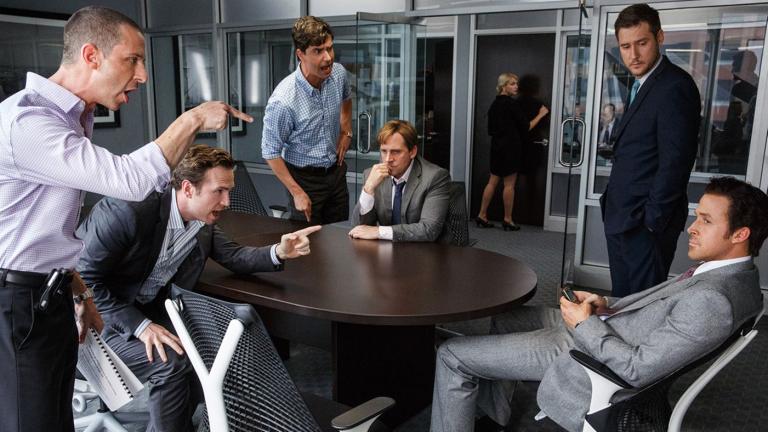
From The Big Short, photo courtesy Paramount PIctures
Editors’ Note: This article is part of the Patheos Public Square. This month we’re asking: Has Hollywood Become Our National Conscience? Read other perspectives here.
Economics is boring, and there’s really only one way to make the subject sexy: Turn it into an A-list, Oscar-nominated movie.
The Big Short tackles subjects that might put even most finance majors to sleep: subprime mortgages, collateralized debt obligations, complicated hedge funds. But when Christian Bale, Brad Pitt and Margot Robbie in a bubble bath are discussing them, we’re riveted. Thanks to the skill of director Adam McKay and the collective charisma of its all-star cast, The Big Short has earned more than $64 million and been nominated for five Oscars.
It’s the best lecture I’ve ever seen about American finance—and a pretty good sermon to boot.
That’s right: sermon. The Big Short is, in its own way, a big, profane morality play. Not only does itteach its audience about the American economy (specifically how it relates to the housing crisis and the Great Recession of 2007), but it tells us what to think about it. This is a deeply preachy movie, pointing out the Recession’s biggest sinners and condemning them to, if not hell, at least cinematic purgatory—to be publicly shamed on screen as if locked in a pillory.
While The Big Short’s overt sermonizing is unusual for a mainstream movie, its purpose—to teach, to sway, to convict—is not. Most stories are, and have always been, morality tales. From the Bible and the Bhagavad Gita, from Aesop’s fables to Jesus’ parables, stories have been used to illustrate for us what’s right and wrong, what’s good and what’s bad. Movies are simply bright, expensive extensions of our storytelling inclinations—and the medium, arguably, is as an effective a conduit for moral teaching as we’ve ever seen.
But these days, cinema is wading ever more confidently into ethical waters. Many of Oscar’s Best Picture winners in the 21st century—12 Years a Slave, The King’s Speech, Crash—seem deeply interested in teaching their audience something. And the medium’s moral authority seems to grow as other, more obvious sources of morality wane.
In Hollywood’s Golden Age of the 1930s and ’40s, movie-based morality was more of a passive thing, used to support the real teachers of the age. Back then, we had more faith in our schools, our government and our religious institutions. Movies—thanks to a strict and formal code of ethics instituted in 1930—reflected the relatively homogeneous values of the day. You didn’t see any sex on the big screen in those days. You didn’t hear any profanity. And movies were forbidden from mocking the clergy.
But the code eventually crumbled, and not too long thereafter, our collective trust in those institutions crumbled, too. “Politician” is one of America’s least-respected occupations now, right alongside prostitutes and car salesmen. Religious affiliation is declining across the board, while people who claim none has skyrocketed in the last seven years.
Little surprise that, in this entertainment-soaked age of ours, movies are filling some of that moral vacuum.
Look at today’s animated kids’ flicks, and you’ll see far more ethical depth than we did 30 years ago. Charlie Brown in The Peanuts Movie is a guy of unshakeable (if uncool) integrity—and it’s his trueness of purpose that eventually wins him the praise of the Little Red-Haired Girl. Inside Out is as emotionally rich and as morally deep as movies come. Even Minions is about the power of friendship and sacrifice.
We expect a bit of teaching in our children’s movies. But adult films are no less moral. Look at the year’s bevy of Oscar-nominated pictures, and you’ll see that most of them have an ethical soul to them—be it the pointed critiques of The Big Short and Spotlight to the more general, life-affirming messages of The Martian and Bridge of Spies. Few movies are simply story-for-story’s sake: There’s a point to them. A message.
All that’s good—as far as it goes.
But here’s the thing: Because movies can be so persuasive, we often forget they’re teaching us at all. Sometimes, because they move us so, we forget to analyze them critically. We forget to question them the way we might our other institutions. We can be shaped by them in ways we’re not even aware of.
Most everything I know about the housing crisis of 2007 I owe to The Big Short. It’d be very easy to just embrace the movie’s message uncritically. But what if the story isn’t quite so black-and-white as the movie made it seem? How would I know? It goes without saying that movies come with a built-in bias, but it’s an important reminder all the same.
I believe that we have to ask questions of the films we watch—just as we would for any other institution that tries to tell us what’s right and wrong. Just as we question our political and religious leaders, we should do the same of our movies. Even sometimes when we agree with them.
Hollywood isn’t the bastion of amorality that some suggest it to be. The film industry is, in its own way, deeply moral, and growing more so. But the morals it teaches can be sharply different from those we’ve learned, from those we try to pass on.
It’s fine if movies try to teach us a thing or two. Sometimes the lessons are good. And even when they’re not, they can serve as a great springboard for thought and discussion. But we should never, ever forget that, even with a bag of popcorn in our laps, we’re in class. And it’s good to ask a challenging question now and then.
Previous Post

February 15, 2016
To Kill or Not To Kill? That is the Question For Superheroes
Next Post

February 21, 2016 It’s not just Jesus who rises again in Risen: It’s Christian filmmaking.
Browse Our Archives
Select a Category books celebrities Editor's Choice games movies music news sports superheroes television Uncategorized
Select a Month May 2026 April 2026 March 2026 December 2025 October 2025 July 2025 June 2025 May 2025 February 2025 January 2025 December 2024 July 2024 June 2024 May 2024 April 2024 March 2024 February 2024 January 2024 December 2023 September 2023 March 2023 February 2023 December 2022 November 2022 October 2022 September 2022 August 2022 July 2022 June 2022 May 2022 April 2022 March 2022 February 2022 December 2021 October 2021 August 2021 July 2021 June 2021 May 2021 April 2021 March 2021 October 2020 August 2020 July 2020 June 2020 May 2020 April 2020 March 2020 February 2020 January 2020 December 2019 November 2019 October 2019 September 2019 August 2019 July 2019 June 2019 May 2019 April 2019 March 2019 February 2019 January 2019 December 2018 November 2018 October 2018 September 2018 August 2018 July 2018 June 2018 May 2018 April 2018 March 2018 February 2018 January 2018 December 2017 November 2017 October 2017 September 2017 August 2017 July 2017 June 2017 May 2017 April 2017 March 2017 February 2017 January 2017 December 2016 November 2016 October 2016 September 2016 August 2016 July 2016 June 2016 May 2016 April 2016 March 2016 February 2016 January 2016 December 2015 November 2015 October 2015 September 2015 August 2015 July 2015 June 2015 May 2015 April 2015 March 2015 February 2015 January 2015 December 2014 November 2014 October 2014 September 2014
Follow Us!
TAKE THE
Religious Wisdom Quiz
According to James, what should elders do for someone who is sick?
Select your answer to see how you score.
Pray over them and anoint them with oil Give them holy water Fast for them Lay hands on them
Books by This Author Books by Paul Asay
Related posts from Watching God

Finding Forgiveness in the Great Horror Film ‘Hokum’

What makes a hero? These 7 Cinematic Characters...

Finding God's Grace in ‘Project Hail Mary’

Watching God’s Top 10 Movies of 2025
TRENDING AT PATHEOS Religious Music & Entertainment

"Les Diabolique" and Transgression
Alongside something like Arrival, Vertigo, or Charade, Les Diaboliques is a...

"The Plague Dogs" and Mortality
So, flashback to the late 70s, early 80s. Walt Disney Studios is...

With the recent and highly successful release of Christopher Nolan’s epic film,...

"L'avventura" and Human Weakness
Today's piece is going to be a little different for a few...

I first want to apologize for not posting or writing anything. I'm...

I've engaged in the multi-year project of reading through the Church Fathers,...
view all Religious Music & Entertainment blogs
Ad-Free & Subscriber Log-In Subscription Support
- About Us
- 2026 Calendar
- Videos
- Podcasts
- Library of World Religions
- Faith In Media Tracker
- Advertise With Us
- Write for Us
- Privacy Policy
- Terms of Service
- Do Not Sell My Data
- Contact Us
- Radiant Digital
- Manage Newsletter Subscriptions
- Unsubscribe From Notifications
- Sitemap
Copyright 2008-2026, Patheos. All rights reserved.
Subscription Support Ad-Free & Subscriber Log-In
Follow Patheos