
BuddhistCatholicContemplativeEvangelicalGeneral ChristianHinduJewishLatter-day SaintMuslimNew VisionsProgressive Christian
Beliefs
- Buddhist
- Catholic
- Contemplative
- Evangelical
- General Christian
- Hindu
- Jewish
- Latter-day Saint
- More Voices
- Muslim
- New Visions
- Pagan
- Progressive Christian
Topics
- Religion News
- Food and Religion
- Sports and Religion
- Religious Art
- Religious Music and Entertainment
- Religious Events
- History and Religion
- Style and Religion
- Politics and Religion
- Women in Religion
- Recreation Outdoors and Religion
- Business Finance and Religion
- Careers Workplace and Religion
- Education and Religion
- Family Parenting and Religion
- Health Fitness and Religion
- Home and Religion
- Relationships and Religion
- Technology and Religion
- Travel and Religion
Columnists
- Buddhist Columnists
- Business Finance and Religion Columnists
- Careers Workplace and Religion Columnists
- Catholic Columnists
- Contemplative Columnists
- Education and Religion Columnists
- Evangelists Columnists
- Family Parenting and Religion Columnists
- General Christian Columnists
- Health Fitness and Religion Columnists
- Hindu Columnists
- History and Religion Columnists
- Home and Religion Columnists
- Jewish Columnists
- More Voices Columnists
- Latter Day Columnists
- Muslim Columnists
- New Visions Columnists
- Nonreligious Columnists
- Pagan Columnists
- Politics and Religion Columnists
- Progressive Columnists
- Recreation Outdoors and Religion Columnists
- Relationships and Religion Columnists
- Religion News Columnists
- Religious Art Columnists
- Religious Events Columnists
- Religious Music and Entertainment Columnists
- Sports and Religion Columnists
- Style and Religion Columnists
- Technology and Religion Columnists
- Travel and Religion Columnists
- Women in Religion Columnists
Resource Library
- 2026 Calendar
- Library of World Religions
- The 100 Most Holy Places on Earth
- Patheos Answers
- Podcasts
- Videos
- Faith Leaders Database
- Anglican Episcopalian
- Bahai
- Baptist
- Buddhism
- Christianity
- Confucianism
- Eastern Orthodoxy
- Hinduism
- Holiness and Pentecostal
- ISKCON
- Islam
- Judaism
- Lutheran
- Methodist
- The Church of Jesus Christ of Latter-day Saints
- New Age
- Paganism
- Presbytarian and Reformed
- Protestantism
- Religion Behind the Scenes
- Roman Catholic
- Scientology
- Shia Islam
- Sikhism
- Sufism
- Sunni Islam
- Taoism
- Zen
- See all religions
Research Tools
 Ad-Free & Subscriber Log-In Subscription Support
Ad-Free & Subscriber Log-In Subscription Support
Follow Patheos 

- Trending:
- Forgiveness
- |
- Marriage
- |
- Consciousness
- |
- Death Penalty
- |
- Election
- |
- Halloween

- Home
- Religious Music & Entertainment
- The Hateful Eight: Nothing But the Blood
The Hateful Eight: Nothing But the Blood
Last updated on: January 4, 2016 at 5:18 pm by Paul Asay
The Hateful Eight: Nothing But the Blood 2016-01-04T17:18:15-06:00 Paul Asay
Patheos Explore the world's faith through different perspectives on religion and spirituality! Patheos has the views of the prevalent religions and spiritualities of the world.

Samuel L. Jackson from The Hateful Eight, screen capture courtesy The Weinstein Company
Quentin Tarantino frustrates the snot out of me. He is, unquestionably, a master craftsman. He has an eye for breathtaking visuals, an ear for mesmerizing, often gorgeous dialogue. But he has a taste for blood, too—so much so that his movies require a separate budget for it. And it often spoils his movies.
I know, I know. The blood is all for show, I’m told. It’s meant to look fake and stylized and, in some strange way, pull us out of the story. To remind us that we’re just watching a movie. If someone got a paper cut in a Tarantino movie, that someone would most likely use a half a pint of “Tarantino Red” before tracking down a Band-Aid.
But for me, Tarantino’s reliance on blood and gore is both disgusting and distracting—the director’s 14-year-old id coming out to spoil the lavish story that the adult Tarantino wanted to tell. The Hateful Eight is a particularly infuriating movie to watch: I loved how Dana Stevens of Slate put it: “The Hateful Eight is bold, gorgeous, verbally clever, morally repellent, and, in some way I am still struggling to put my finger on, possibly somehow evil.”
Tarantino clearly loves his blood. But why? Is there something deeper going on here than just the deep red that spatters the screen? As much as I tire of Tarantino’s obsession with spatter, I think there’s also something interesting at work here. Caution: Spoilers ahead.

From The Hateful Eight, courtesy The Weinstein Company
Tarantino’s Altar
Blood is a big deal. We need it to live. Without it, we’re dead. Vampires—those undead creatures of the night—drink it by the pint for a reason.
Naturally, blood has always been a critical component in religion. Almost every faith tradition has featured blood sacrifices as an important part of its past—often to appease a bloodthirsty deity of some sort. If blood is life, the taking and/or giving of that blood is a powerful act—not just temporally, but spiritually, as well.
No surprise, then, that blood’s a huge deal within Old Testament Judaism and Christianity. Jews painted it on their doors so the angel of death would pass over their homes. They would sprinkle or splash it on their altars. Blood was the most valuable thing that someone could possess or give, and so naturally it was a powerful symbol of sacrifice. And most importantly, it was the only thing that could wash away someone’s sins. “For the life of the flesh is in the blood, and I have given it for you on the altar to make atonement for your souls,” God says in Leviticus 17:11 (ESV), “for it is the blood that makes atonement by the life.”
That’s one of the reasons why, in Christianity, Jesus’ death on the cross is so significant: The blood He spilled was enough (we Christians believe) to scrub clean all our sins. His sacrifice eliminated our need for all those bloody sacrifices.
We see Jesus in The Hateful Eight. Indeed, He’s the very first real thing we see in the movie—a snow-covered statue of Christ that the camera slowly, slowly pulls way from to reveal a pure, whitewashed landscape and a distant stagecoach rumbling closer.
No accident that Tarantino featured that statue so prominently. The guy’s too good for that. No accident, either, that this is the last we see of Jesus—this lingering, passing shot. Jesus is literally left out in the cold. In this story, there is no place for His substitutional sacrifice. These characters don’t deserve it, Tarantino seems to tell us. He’s gonna get Old Testament on these sinners.
So it has been throughout much of Tarantino’s career. He is the master of the revenge epic, wherein those too heinous for salvation (Nazis, slave owners, sadomasochistic shopkeepers) are sacrificed by the aggrieved. We saw it in the Kill Bill saga, in Inglourious Basterds, in Django Unchained. Tarantino’s heroes never explicitly good people, mind you, but they serve almost a divine purpose, at least in the director’s eyes. They are his angels of death, come to slaughter the unworthy.
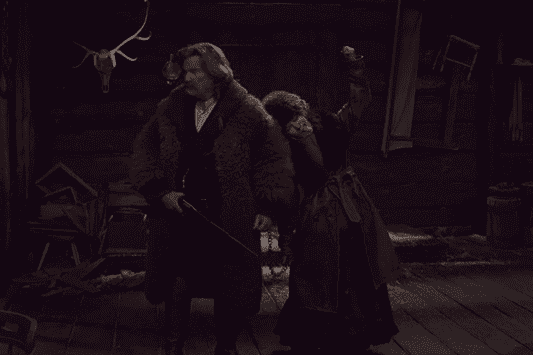
Kurt Russell and Jennifer Jason Leigh from The Hateful Eight, courtesy The Weinstein Company
Baptism by Blood
That presents something of a problem in The Hateful Eight. All of them are hateful—and frankly, worthy of our hate. Granted, Daisy Domergue (Jennifer Jason Leigh) is the one being transported for the hangman’s noose, but the rest are hardly better. Bounty hunter John “The Hangman” Ruth (Kurt Russell) constantly cuffs his quarry, and Daisy’s face is a mess of bruises when they finally arrive at Minnie’s Haberdashery. Marjor Marquis Warren (Samuel L. Jackson, of course) is perhaps the character we feel the most affinity for, but he’s no saint: He’s killed dozens, it’s suggested—many innocent, and torturing some before they go. Chris Mannix (Walter Goggins) may have a sheriff’s badge, but he spent much of the Civil War—and perhaps sometime after—killing indiscriminately.
Each of the Hateful Eight deserves, in Tarantino’s bloody calculus, death. Each one can only find peace in blood. Their own.
And so the slaughter begins. Blood spatters the haberdashery—the walls, the floors, the furniture, the bed. Characters dribble, spurt and spew red by the gallon. These sinners sanctify Tarantino’s temple with their essence—bad men making the world a little purer by their bloody passing.
Only one character seems to hold onto most of her blood: Daisy Domergue, arguably the worst of the lot. She sparks this festival of gore without lifting a finger. She’s the only one who was already sentenced to die at the outset. And in Tarantino’s strangely sacrificial ethos, she deserves neither the quick death of a bullet nor the baptism in and of her own blood.
“You only need to hang mean b–tards,” John Ruth says. “But mean b–tards you need to hang.”
For Tarantino, at least in this film, Daisy’s inability to die in her own bloodpool is the equivalent of being buried in unconsecrated ground. For the director here, blood is a release, a catharsis, a strange, grotesque cleansing. And even though Daisy is covered in the blood and gore of many of our main characters before the movie’s done, none of it is her own. She hangs, literally, outside Tarantino’s grace. The blood cannot save her.
Tarantino is a talented director. And while I wish he’d use his talents sometimes for something other than these strange, twisted morality stories, the blood here isn’t used without reason. In Tarantino’s movies, there is no room for grace. Blood—gallons of blood—is the only thing that can atone for sin.
Previous Post

December 30, 2015
Watching God's "Best" Movies of 2015
Next Post

January 8, 2016 2016 Will Be Huge For Entertainment and Religion
Browse Our Archives
Select a Category books celebrities Editor's Choice games movies music news sports superheroes television Uncategorized
Select a Month May 2026 April 2026 March 2026 December 2025 October 2025 July 2025 June 2025 May 2025 February 2025 January 2025 December 2024 July 2024 June 2024 May 2024 April 2024 March 2024 February 2024 January 2024 December 2023 September 2023 March 2023 February 2023 December 2022 November 2022 October 2022 September 2022 August 2022 July 2022 June 2022 May 2022 April 2022 March 2022 February 2022 December 2021 October 2021 August 2021 July 2021 June 2021 May 2021 April 2021 March 2021 October 2020 August 2020 July 2020 June 2020 May 2020 April 2020 March 2020 February 2020 January 2020 December 2019 November 2019 October 2019 September 2019 August 2019 July 2019 June 2019 May 2019 April 2019 March 2019 February 2019 January 2019 December 2018 November 2018 October 2018 September 2018 August 2018 July 2018 June 2018 May 2018 April 2018 March 2018 February 2018 January 2018 December 2017 November 2017 October 2017 September 2017 August 2017 July 2017 June 2017 May 2017 April 2017 March 2017 February 2017 January 2017 December 2016 November 2016 October 2016 September 2016 August 2016 July 2016 June 2016 May 2016 April 2016 March 2016 February 2016 January 2016 December 2015 November 2015 October 2015 September 2015 August 2015 July 2015 June 2015 May 2015 April 2015 March 2015 February 2015 January 2015 December 2014 November 2014 October 2014 September 2014
Follow Us!
TAKE THE
Religious Wisdom Quiz
Who said, "As for me, I know that my redeemer lives"?
Select your answer to see how you score.
Moses Joseph Abraham Job
Books by This Author Books by Paul Asay
Related posts from Watching God

Finding Forgiveness in the Great Horror Film ‘Hokum’

What makes a hero? These 7 Cinematic Characters...

Finding God's Grace in ‘Project Hail Mary’

Watching God’s Top 10 Movies of 2025
TRENDING AT PATHEOS Religious Music & Entertainment

"Les Diabolique" and Transgression
Alongside something like Arrival, Vertigo, or Charade, Les Diaboliques is a...

"The Plague Dogs" and Mortality
So, flashback to the late 70s, early 80s. Walt Disney Studios is...

With the recent and highly successful release of Christopher Nolan’s epic film,...

"L'avventura" and Human Weakness
Today's piece is going to be a little different for a few...

I first want to apologize for not posting or writing anything. I'm...

I've engaged in the multi-year project of reading through the Church Fathers,...
view all Religious Music & Entertainment blogs
Ad-Free & Subscriber Log-In Subscription Support
- About Us
- 2026 Calendar
- Videos
- Podcasts
- Library of World Religions
- Faith In Media Tracker
- Advertise With Us
- Write for Us
- Privacy Policy
- Terms of Service
- Do Not Sell My Data
- Contact Us
- Radiant Digital
- Manage Newsletter Subscriptions
- Unsubscribe From Notifications
- Sitemap
Copyright 2008-2026, Patheos. All rights reserved.
Subscription Support Ad-Free & Subscriber Log-In
Follow Patheos