
BuddhistCatholicContemplativeEvangelicalGeneral ChristianHinduJewishLatter-day SaintMuslimNew VisionsProgressive Christian
Beliefs
- Buddhist
- Catholic
- Contemplative
- Evangelical
- General Christian
- Hindu
- Jewish
- Latter-day Saint
- More Voices
- Muslim
- New Visions
- Pagan
- Progressive Christian
Topics
- Religion News
- Food and Religion
- Sports and Religion
- Religious Art
- Religious Music and Entertainment
- Religious Events
- History and Religion
- Style and Religion
- Politics and Religion
- Women in Religion
- Recreation Outdoors and Religion
- Business Finance and Religion
- Careers Workplace and Religion
- Education and Religion
- Family Parenting and Religion
- Health Fitness and Religion
- Home and Religion
- Relationships and Religion
- Technology and Religion
- Travel and Religion
Columnists
- Buddhist Columnists
- Business Finance and Religion Columnists
- Careers Workplace and Religion Columnists
- Catholic Columnists
- Contemplative Columnists
- Education and Religion Columnists
- Evangelists Columnists
- Family Parenting and Religion Columnists
- General Christian Columnists
- Health Fitness and Religion Columnists
- Hindu Columnists
- History and Religion Columnists
- Home and Religion Columnists
- Jewish Columnists
- More Voices Columnists
- Latter Day Columnists
- Muslim Columnists
- New Visions Columnists
- Nonreligious Columnists
- Pagan Columnists
- Politics and Religion Columnists
- Progressive Columnists
- Recreation Outdoors and Religion Columnists
- Relationships and Religion Columnists
- Religion News Columnists
- Religious Art Columnists
- Religious Events Columnists
- Religious Music and Entertainment Columnists
- Sports and Religion Columnists
- Style and Religion Columnists
- Technology and Religion Columnists
- Travel and Religion Columnists
- Women in Religion Columnists
Resource Library
- 2026 Calendar
- Library of World Religions
- The 100 Most Holy Places on Earth
- Patheos Answers
- Podcasts
- Videos
- Faith Leaders Database
- Anglican Episcopalian
- Bahai
- Baptist
- Buddhism
- Christianity
- Confucianism
- Eastern Orthodoxy
- Hinduism
- Holiness and Pentecostal
- ISKCON
- Islam
- Judaism
- Lutheran
- Methodist
- The Church of Jesus Christ of Latter-day Saints
- New Age
- Paganism
- Presbytarian and Reformed
- Protestantism
- Religion Behind the Scenes
- Roman Catholic
- Scientology
- Shia Islam
- Sikhism
- Sufism
- Sunni Islam
- Taoism
- Zen
- See all religions
Research Tools
 Ad-Free & Subscriber Log-In Subscription Support
Ad-Free & Subscriber Log-In Subscription Support
Follow Patheos 

- Trending:
- Forgiveness
- |
- Marriage
- |
- Consciousness
- |
- Death Penalty
- |
- Election
- |
- Halloween

- Home
- Religious Music & Entertainment
- Frankenstein: Still Crazy (and Relevant) After All These Years
Frankenstein: Still Crazy (and Relevant) After All These Years
Last updated on: October 14, 2015 at 9:46 am by Paul Asay
Frankenstein: Still Crazy (and Relevant) After All These Years 2015-10-14T09:46:11-06:00 Paul Asay
Patheos Explore the world's faith through different perspectives on religion and spirituality! Patheos has the views of the prevalent religions and spiritualities of the world.
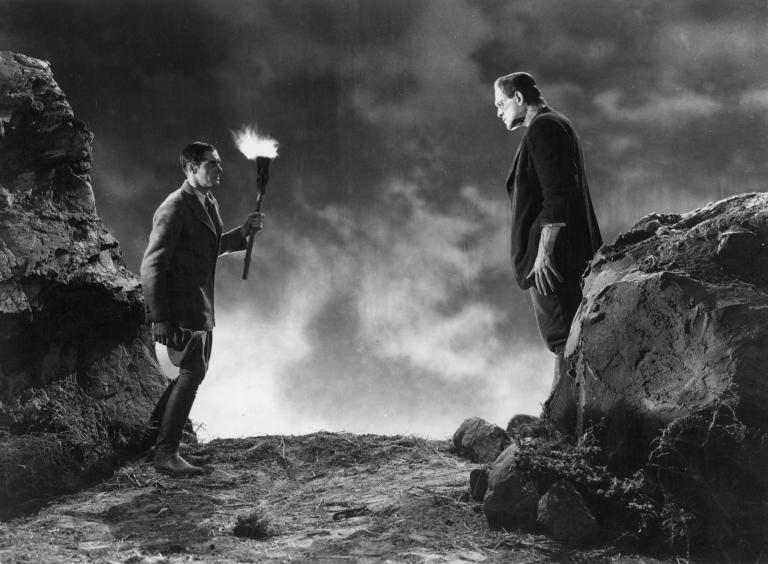
From Frankenstein, Universal Pictures
Frankenstein, the 1931 classic Universal monster movie, probably doesn’t have the oomph to terrify folks like it did back in the day. Most horror movies base their effectiveness on the fear of the unknown, and after 84 years, this flick is hardly that. Boris Karloff’s classic look as “the Monster” is so much a part of the culture that most 4-year-olds know what “Frankenstein” looks like.
But even though the first site of the Monster isn’t enough to cause hardened 21st-century moviegoers to faint dead away, the movie is still capable of tapping into a sense of real unease—a fear that we may feel more keenly now than in 1931. And it has an obvious spiritual bent to it, too—one that the movie itself addresses in its own introduction.
“We are about to unfold the story of Frankenstein, a man of science who sought to create a man after his own image without reckoning upon God,” actor Edward Van Sloan tells us.
Henry Frankenstein (Colin Clive) really had everything that a German noble could want: wealth, prestige, brains and a pretty fiancée, Elizabeth (Mae Clarke). Forget the Great Depression: For Dr. Frankenstein, the good times were still rolling along. But those sorts of earthbound pleasures weren’t enough for the guy: He wanted to do something extraordinary—and forbidden.
He and his assistant Fritz (Dwight Frye) began scouring graveyards and gallows for body parts: They weren’t too particular—just as long as they were fresh. Fritz steals a brain, too. Not a nice, normal one like Frankenstein had planned, but an abnormal brain from someone whose “life was one of brutality, violence and murder,” according to Doctor Waldman (Van Sloan).
Frankenstein stitches everything together (though, clearly, his sewing skills are not the greatest) and, during a climactic thunderstorm in a decaying ruin, he brings the Monster to life.
“It’s alive! In the name of God, now I know what it’s like to be God!”
It’s a pretty controversial statement—so controversial, in fact, that several states cut the line before allowing it to play.
Ironically, that well-meaning edit cut out much of the moral subtext of Frankenstein. Pretending to be God never works out well, the movie means to tell us. The Monster, once it gets up and moving, proves to be pretty unmanageable, and it’s not long before the thing escapes, kills people and eventually winds up trapped in a burning windmill, left to die.

From Frankenstein, Universal Pictures
One of the greatest achievements of Frankenstein is that Karloff’s creature is more than the Monster: He’s a victim, too. Sure, he’s the size of a small car and cursed with an abnormal brain, but the Monster feels like a child—lost, bewildered, alone. He didn’t ask to be part of this twisted science experiment. One of the movie’s most poignant moments is watching the Monster reach for the light of the sun, then lower his arms in mute resignation when Dr. Frankenstein slowly covers it.
It seems so relevant in an age in which we, too, may be playing God a bit—attempting to create life in our own image.
We’re not really interested in stitching together a bunch of body parts these days, but we are very interested in artificial intelligence. While AI has moved incrementally forward, it’s still pretty rudimentary to the staggering flexibility of the human brain. Sure, computers can beat us at chess, but can that same computer cook an egg or flush a toilet? Nah. But some scientists are pushing computers to engage in “unsupervised learning”—the sort of learning we do really well—and it’s thought that this could lead to machines that can really, truly think. And once they start programming themselves, where does that leave us?
Potentially not in a very good place, speculates Stephen Hawking. While the scientist believes that AI has enormous potential, he worries that a little bug—an abnormality in the AI brain, if you will—could be devastating.
“A superintelligent AI will be extremely good at accomplishing its goals, and if those goals aren’t aligned with ours, we’re in trouble,” Hawking said on a Reddit conversation recently. “You’re probably not an evil ant-hater who steps on ants out of malice, but if you’re in charge of a hydroelectric green energy project and there’s an anthill in the region to be flooded, too bad for the ants. Let’s not place humanity in the position of those ants.”
And should that come to pass, of course, the fault wouldn’t really lie with our AI creations, but with us, their creators. Perhaps we can give them life. But can we give them light? Can we instill in them a sense of sacred awe and duty that, I think, is key to living life well? Can we give them a sense of morality, when the concept is so imperfect even in us? Writes author John C. Havens, “How will machines know what we value if we don’t know ourselves?”
In Frankenstein, maybe we see the real threat of AI: That maybe someday we’ll know how to create it, but we won’t really know how, or what, to teach it. Our very own flaws and failings will doom our greatest creations … and perhaps, by extension, ourselves.
There’ve been a lot of movies that have played on our unease of artificial intelligence and, by extension, playing God. But for my money, I don’t think any of them tackle the subject with the poignant horror of Frankenstein—a man who watched a scientific triumph turn tragic, a monster who was never given a chance to be anything but.
Previous Post

October 11, 2015
Should Christians Watch Horror Movies?
Next Post
October 15, 2015 Woodlawn Asks if We Believe in Miracles
Browse Our Archives
Select a Category books celebrities Editor's Choice games movies music news sports superheroes television Uncategorized
Select a Month May 2026 April 2026 March 2026 December 2025 October 2025 July 2025 June 2025 May 2025 February 2025 January 2025 December 2024 July 2024 June 2024 May 2024 April 2024 March 2024 February 2024 January 2024 December 2023 September 2023 March 2023 February 2023 December 2022 November 2022 October 2022 September 2022 August 2022 July 2022 June 2022 May 2022 April 2022 March 2022 February 2022 December 2021 October 2021 August 2021 July 2021 June 2021 May 2021 April 2021 March 2021 October 2020 August 2020 July 2020 June 2020 May 2020 April 2020 March 2020 February 2020 January 2020 December 2019 November 2019 October 2019 September 2019 August 2019 July 2019 June 2019 May 2019 April 2019 March 2019 February 2019 January 2019 December 2018 November 2018 October 2018 September 2018 August 2018 July 2018 June 2018 May 2018 April 2018 March 2018 February 2018 January 2018 December 2017 November 2017 October 2017 September 2017 August 2017 July 2017 June 2017 May 2017 April 2017 March 2017 February 2017 January 2017 December 2016 November 2016 October 2016 September 2016 August 2016 July 2016 June 2016 May 2016 April 2016 March 2016 February 2016 January 2016 December 2015 November 2015 October 2015 September 2015 August 2015 July 2015 June 2015 May 2015 April 2015 March 2015 February 2015 January 2015 December 2014 November 2014 October 2014 September 2014
Follow Us!
TAKE THE
Religious Wisdom Quiz
How many years did the Israelites wander in the wilderness?
Select your answer to see how you score.
10 years 25 years 40 years 100 years
Books by This Author Books by Paul Asay
Related posts from Watching God

Finding Forgiveness in the Great Horror Film ‘Hokum’

What makes a hero? These 7 Cinematic Characters...

Finding God's Grace in ‘Project Hail Mary’

Watching God’s Top 10 Movies of 2025
TRENDING AT PATHEOS Religious Music & Entertainment

"Les Diabolique" and Transgression
Alongside something like Arrival, Vertigo, or Charade, Les Diaboliques is a...

"The Plague Dogs" and Mortality
So, flashback to the late 70s, early 80s. Walt Disney Studios is...

With the recent and highly successful release of Christopher Nolan’s epic film,...

"L'avventura" and Human Weakness
Today's piece is going to be a little different for a few...

I first want to apologize for not posting or writing anything. I'm...

I've engaged in the multi-year project of reading through the Church Fathers,...
view all Religious Music & Entertainment blogs
Ad-Free & Subscriber Log-In Subscription Support
- About Us
- 2026 Calendar
- Videos
- Podcasts
- Library of World Religions
- Faith In Media Tracker
- Advertise With Us
- Write for Us
- Privacy Policy
- Terms of Service
- Do Not Sell My Data
- Contact Us
- Radiant Digital
- Manage Newsletter Subscriptions
- Unsubscribe From Notifications
- Sitemap
Copyright 2008-2026, Patheos. All rights reserved.
Subscription Support Ad-Free & Subscriber Log-In
Follow Patheos