
BuddhistCatholicContemplativeEvangelicalGeneral ChristianHinduJewishLatter-day SaintMuslimNew VisionsProgressive Christian
Beliefs
- Buddhist
- Catholic
- Contemplative
- Evangelical
- General Christian
- Hindu
- Jewish
- Latter-day Saint
- More Voices
- Muslim
- New Visions
- Pagan
- Progressive Christian
Topics
- Religion News
- Food and Religion
- Sports and Religion
- Religious Art
- Religious Music and Entertainment
- Religious Events
- History and Religion
- Style and Religion
- Politics and Religion
- Women in Religion
- Recreation Outdoors and Religion
- Business Finance and Religion
- Careers Workplace and Religion
- Education and Religion
- Family Parenting and Religion
- Health Fitness and Religion
- Home and Religion
- Relationships and Religion
- Technology and Religion
- Travel and Religion
Columnists
- Buddhist Columnists
- Business Finance and Religion Columnists
- Careers Workplace and Religion Columnists
- Catholic Columnists
- Contemplative Columnists
- Education and Religion Columnists
- Evangelists Columnists
- Family Parenting and Religion Columnists
- General Christian Columnists
- Health Fitness and Religion Columnists
- Hindu Columnists
- History and Religion Columnists
- Home and Religion Columnists
- Jewish Columnists
- More Voices Columnists
- Latter Day Columnists
- Muslim Columnists
- New Visions Columnists
- Nonreligious Columnists
- Pagan Columnists
- Politics and Religion Columnists
- Progressive Columnists
- Recreation Outdoors and Religion Columnists
- Relationships and Religion Columnists
- Religion News Columnists
- Religious Art Columnists
- Religious Events Columnists
- Religious Music and Entertainment Columnists
- Sports and Religion Columnists
- Style and Religion Columnists
- Technology and Religion Columnists
- Travel and Religion Columnists
- Women in Religion Columnists
Resource Library
- 2026 Calendar
- Library of World Religions
- The 100 Most Holy Places on Earth
- Patheos Answers
- Podcasts
- Videos
- Faith Leaders Database
- Anglican Episcopalian
- Bahai
- Baptist
- Buddhism
- Christianity
- Confucianism
- Eastern Orthodoxy
- Hinduism
- Holiness and Pentecostal
- ISKCON
- Islam
- Judaism
- Lutheran
- Methodist
- The Church of Jesus Christ of Latter-day Saints
- New Age
- Paganism
- Presbytarian and Reformed
- Protestantism
- Religion Behind the Scenes
- Roman Catholic
- Scientology
- Shia Islam
- Sikhism
- Sufism
- Sunni Islam
- Taoism
- Zen
- See all religions
Research Tools
 Ad-Free & Subscriber Log-In Subscription Support
Ad-Free & Subscriber Log-In Subscription Support
Follow Patheos 

- Trending:
- Forgiveness
- |
- Marriage
- |
- Consciousness
- |
- Death Penalty
- |
- Election
- |
- Halloween

- Home
- Religious Music & Entertainment
- Orson Welles, Ultron and a Longing for Home
Orson Welles, Ultron and a Longing for Home
Last updated on: May 6, 2015 at 2:10 pm by Paul Asay
Orson Welles, Ultron and a Longing for Home 2015-05-06T14:10:10-06:00 Paul Asay
Patheos Explore the world's faith through different perspectives on religion and spirituality! Patheos has the views of the prevalent religions and spiritualities of the world.
 If he was alive, Orson Welles would’ve celebrated his 100th birthday today. Perhaps he’d celebrate it by watching his cameo in The Muppet Movie (where I first saw him) and sipping a glass of inexpensive wine.
Welles might be one of the most influential entertainers ever. The guy did a little bit of everything, from avant-garde Shakespearian stage productions to headline-grabbing radio theater (his 1938 War of the Worlds broadcast triggered nationwide panic) to, of course, movies. Citizen Kane, his very first film, released in 1941, was a masterpiece—one that almost didn’t see the light of day, thanks to William Randolph Hearst (who believed, with good reason, that the film was about him). It’s still considered to be the best American film in history.
It’s not an overtly religious pic. But its main theme is as old and as true as the Bible itself: You can’t fill your soul with stuff. No matter how big you build your house, it won’t necessarily be home.
We first see Charles Foster Kane, the movie’s flawed protagonist, as an old man about to die, muttering the enigmatic word “Rosebud” as a snowglobe tumbles from his hand. From thereon, his character is peeled like an onion, layer by layer. We learn about his life through a series of interviews—his days as a hungry newspaper publisher, his failed run at politics, his fractured and troublesome love life. We learn that, as a child, he was taken from his parents to go live with a wealthy banker in order to be given all the advantages wealth can bring. Through this winding, tumbling story, we meet a man whose talent and ambition drove him to unimagined heights, and yet his life seems curiously empty. His massive castle Xanadu is stuffed with treasures he’s never bothered to unpack. His wealth is squandered on gold plating and zoo animals. When he dies, he dies practically alone.
Rosebud (seven-decade-old spoiler alert) was the name of his childhood sleigh. When Kane died, his last thoughts turned to a youth he never had, to a life he could never find. Kane had it all. But what he wanted was something else entirely: He wanted Home.
Those sorts of themes are pretty common in movies, I suppose. Ever since Macbeth—heck, maybe ever since King Saul—we’ve seen that wealth and power and unimaginable advantages don’t equal happiness. And, in a strange way, you can even see a twist on that theme in Avengers: Age of Ultron.
There’s a little bit of Charles Foster Kane in our superheroes. Combined, they’ve got loads of super strength and super agility and super-full bank accounts and super charisma. They lack for nothing, it would seem.
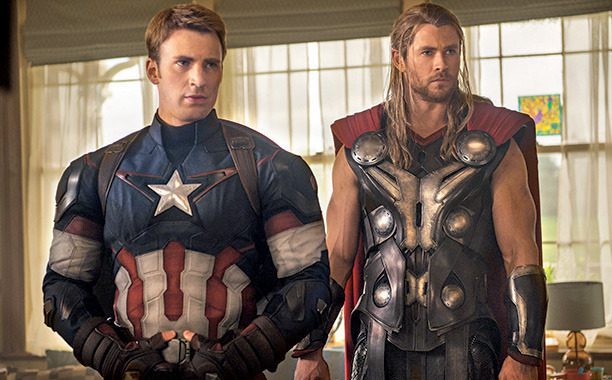 And yet when Wanda Maximoff starts playing with their psyches—when they’re touched by fear and doubt and guilt—how does she twist their thoughts? Toward what they can’t have. Steve Rogers/Captain America imagines his one true love, Peggy, young and vibrant. Natasha/Black Widow recalls her horrific youth, maybe after she was yanked away, Citizen Kane-style, from her own family. Bruce Banner longs to be normal, to have a regular life complete with wife and kids. Tony Stark is
practically the superhero embodiment of Kane, what with his smarts and ambition and unimaginable wealth. But when Wanda touches his mind, he imagines losing what, perhaps, he values almost above it all—this makeshift family of Avengers.
Each, in their own way, has their thoughts turn home—not a house, but a sense of belonging and community and love that lies at our understanding of home. For them, home is a fragile thing. It’s often been lost—lost in becoming who they are.
I love the fact that, when they go to regroup after Wanda’s interference, they go “home”—not to Avengers’ headquarters, but to a picture-perfect farmhouse. Turns out that Clint Barton (Hawkeye), when he’s not saving the world, is a family man with a great wife and cute kids and a list of home-improvement projects. ‘Cause that’s the thing about home, isn’t it? It may be great, but if you love the place, you always think it can be better.
And when we see Clint’s family and farmhouse, we understand him so much better—and the real risks he takes when he’s off fighting aliens and robots. He’s risking an empty spot at the dinner table or a Sunday afternoon tea party with his daughter. He’s risking not just his life, but his role as a husband and father. He’s risking it all. And in a way, his family is risking it with him.
Superheroes often reject a real home life to do their work. But because Clint has a home life, I think we understand the sacrifice a little better. They’re heroes, sure. But they don’t have a home. Not really.
 Now, obviously, the concept of home—of hearth and family, homecooked meals and LEGOs and all the feelings of love and comfort that those things just ooze—isn’t a uniquely Christian concept. But it is, I think, a spiritual one. Our longing for home is one of the soul. Physically, we need shelter. Intellectually, we need a place where we can run our lives as efficiently and as comfortably as possible. Emotionally, we may crave granite countertops in our kitchen or a sunny master bedroom. But when we think of home, it’s about more than running water or a living room with a wall for your big-screen TV. something that can’t be empirically measured. There’s a little bit of mystery to home—something maybe even a little transcendent.
There’s a reason why when we think of heaven, we think of it as our ultimate home. We don’t know what it’ll look like, exactly. But we know how it should feel. Because all of us know the feeling—and when it’s missing, we feel its absence.
Rosebud, Kane said. It’s just the name of a silly sled. Part of the genius of Orson Welles is that he made it stand for so much more.
Previous Post

May 4, 2015
Age of Ultron May Be the Most Spiritual Superhero Movie Yet
Next Post

May 11, 2015 Noble Works
Browse Our Archives
Select a Category books celebrities Editor's Choice games movies music news sports superheroes television Uncategorized
Select a Month May 2026 April 2026 March 2026 December 2025 October 2025 July 2025 June 2025 May 2025 February 2025 January 2025 December 2024 July 2024 June 2024 May 2024 April 2024 March 2024 February 2024 January 2024 December 2023 September 2023 March 2023 February 2023 December 2022 November 2022 October 2022 September 2022 August 2022 July 2022 June 2022 May 2022 April 2022 March 2022 February 2022 December 2021 October 2021 August 2021 July 2021 June 2021 May 2021 April 2021 March 2021 October 2020 August 2020 July 2020 June 2020 May 2020 April 2020 March 2020 February 2020 January 2020 December 2019 November 2019 October 2019 September 2019 August 2019 July 2019 June 2019 May 2019 April 2019 March 2019 February 2019 January 2019 December 2018 November 2018 October 2018 September 2018 August 2018 July 2018 June 2018 May 2018 April 2018 March 2018 February 2018 January 2018 December 2017 November 2017 October 2017 September 2017 August 2017 July 2017 June 2017 May 2017 April 2017 March 2017 February 2017 January 2017 December 2016 November 2016 October 2016 September 2016 August 2016 July 2016 June 2016 May 2016 April 2016 March 2016 February 2016 January 2016 December 2015 November 2015 October 2015 September 2015 August 2015 July 2015 June 2015 May 2015 April 2015 March 2015 February 2015 January 2015 December 2014 November 2014 October 2014 September 2014
Follow Us!
TAKE THE
Religious Wisdom Quiz
What Christian group believes in a "Memorial" instead of a traditional communion?
Select your answer to see how you score.
Jehovah’s Witnesses Lutherans Catholics Anglicans
Books by This Author Books by Paul Asay
Related posts from Watching God

Finding Forgiveness in the Great Horror Film ‘Hokum’

What makes a hero? These 7 Cinematic Characters...

Finding God's Grace in ‘Project Hail Mary’

Watching God’s Top 10 Movies of 2025
TRENDING AT PATHEOS Religious Music & Entertainment

"Les Diabolique" and Transgression
Alongside something like Arrival, Vertigo, or Charade, Les Diaboliques is a...

"The Plague Dogs" and Mortality
So, flashback to the late 70s, early 80s. Walt Disney Studios is...

With the recent and highly successful release of Christopher Nolan’s epic film,...

"L'avventura" and Human Weakness
Today's piece is going to be a little different for a few...

I first want to apologize for not posting or writing anything. I'm...

I've engaged in the multi-year project of reading through the Church Fathers,...
view all Religious Music & Entertainment blogs
Ad-Free & Subscriber Log-In Subscription Support
- About Us
- 2026 Calendar
- Videos
- Podcasts
- Library of World Religions
- Faith In Media Tracker
- Advertise With Us
- Write for Us
- Privacy Policy
- Terms of Service
- Do Not Sell My Data
- Contact Us
- Radiant Digital
- Manage Newsletter Subscriptions
- Unsubscribe From Notifications
- Sitemap
Copyright 2008-2026, Patheos. All rights reserved.
Subscription Support Ad-Free & Subscriber Log-In
Follow Patheos