
BuddhistCatholicContemplativeEvangelicalGeneral ChristianHinduJewishLatter-day SaintMuslimNew VisionsProgressive Christian
Beliefs
- Buddhist
- Catholic
- Contemplative
- Evangelical
- General Christian
- Hindu
- Jewish
- Latter-day Saint
- More Voices
- Muslim
- New Visions
- Pagan
- Progressive Christian
Topics
- Religion News
- Food and Religion
- Sports and Religion
- Religious Art
- Religious Music and Entertainment
- Religious Events
- History and Religion
- Style and Religion
- Politics and Religion
- Women in Religion
- Recreation Outdoors and Religion
- Business Finance and Religion
- Careers Workplace and Religion
- Education and Religion
- Family Parenting and Religion
- Health Fitness and Religion
- Home and Religion
- Relationships and Religion
- Technology and Religion
- Travel and Religion
Columnists
- Buddhist Columnists
- Business Finance and Religion Columnists
- Careers Workplace and Religion Columnists
- Catholic Columnists
- Contemplative Columnists
- Education and Religion Columnists
- Evangelists Columnists
- Family Parenting and Religion Columnists
- General Christian Columnists
- Health Fitness and Religion Columnists
- Hindu Columnists
- History and Religion Columnists
- Home and Religion Columnists
- Jewish Columnists
- More Voices Columnists
- Latter Day Columnists
- Muslim Columnists
- New Visions Columnists
- Nonreligious Columnists
- Pagan Columnists
- Politics and Religion Columnists
- Progressive Columnists
- Recreation Outdoors and Religion Columnists
- Relationships and Religion Columnists
- Religion News Columnists
- Religious Art Columnists
- Religious Events Columnists
- Religious Music and Entertainment Columnists
- Sports and Religion Columnists
- Style and Religion Columnists
- Technology and Religion Columnists
- Travel and Religion Columnists
- Women in Religion Columnists
Resource Library
- 2026 Calendar
- Library of World Religions
- The 100 Most Holy Places on Earth
- Patheos Answers
- Podcasts
- Videos
- Faith Leaders Database
- Anglican Episcopalian
- Bahai
- Baptist
- Buddhism
- Christianity
- Confucianism
- Eastern Orthodoxy
- Hinduism
- Holiness and Pentecostal
- ISKCON
- Islam
- Judaism
- Lutheran
- Methodist
- The Church of Jesus Christ of Latter-day Saints
- New Age
- Paganism
- Presbytarian and Reformed
- Protestantism
- Religion Behind the Scenes
- Roman Catholic
- Scientology
- Shia Islam
- Sikhism
- Sufism
- Sunni Islam
- Taoism
- Zen
- See all religions
Research Tools
 Ad-Free & Subscriber Log-In Subscription Support
Ad-Free & Subscriber Log-In Subscription Support
Follow Patheos 

- Trending:
- Forgiveness
- |
- Marriage
- |
- Consciousness
- |
- Death Penalty
- |
- Election
- |
- Halloween

- Home
- Religious Music & Entertainment
- How Good, Evil and Faith Intersect at the Aurora Shooting Trial
How Good, Evil and Faith Intersect at the Aurora Shooting Trial
Last updated on: April 27, 2015 at 2:51 pm by Paul Asay
How Good, Evil and Faith Intersect at the Aurora Shooting Trial 2015-04-27T14:51:55-06:00 Paul Asay
Patheos Explore the world's faith through different perspectives on religion and spirituality! Patheos has the views of the prevalent religions and spiritualities of the world.
 The Dark Knight Rises, the most anticipated movie of the year, was opening at midnight across the country, including Century 16 in Aurora, Colo. Hundreds of Batman fans filed into the theater, many in costume. No one thought much about the guy with the shock-orange hair that July night in 2012. Not until he started shooting.
About 30 minutes after the movie started, James Holmes—wearing a gas mask—threw a couple of smoke bombs and fired a 12-gauge shotgun into the audience. He killed 12 people that night, injured another 70. When police captured him, he is said to have called himself The Joker.
Holmes pled guilty by reason of insanity. His trial starts today. If he’s found legally sane, he could face the death penalty. And at the crux of his sanity is a deceptively simple question: Did Holmes know right from wrong?
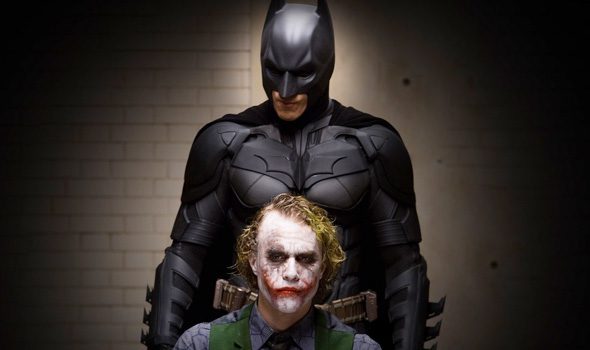
I’ve written a lot about Batman over the last few years. My book, God on the Streets of Gotham, was published just two months before the Aurora shooting. That question of sanity—whether Holmes knew right from wrong—eerily echoes a theme found in Batman’s mythos and fleshed out so effectively by Christopher Nolan in 2008’s The Dark Knight. There’s a reason why so many of Batman’s foes wind up in Arkham Asylum: They can’t tell the difference between right and wrong. And that’s particularly true of the Joker.
To be sane, we must know what good and evil are. “Everybody knows it,” I heard someone say on the radio this morning. “Everybody knows the difference between right and wrong.”
But the Joker would argue that such particulars are difficult to parse. Concepts of good and evil are malleable. And the Joker’s not the only one who might say so.
Many philosophers, including Friedrich Nietzsche, have rejected the notion of good and evil. “That which an age feels to be evil is usually an untimely echo of what was normally considered good,” he writes. Right and wrong, he and others might say, is contextual. Cultural. It is liable to change with the times. No sane man would suggest that what Holmes was anything but wrong, of course. But if we follow the logic that right and wrong is a manmade thing, there’s also no cosmic check to make sure the deed always stays wrong. Today, only an insane or evil man would kill innocent moviegoers. It’s not likely that society would ever say differently. But could it? It seems that, conceivably, it could.
Unless, that is, some innate sense of right and wrong stopped us. Unless we believed that morality exists apart from the ethical fashions of the day. And that, I think, requires God.
Let’s unpack this a bit more, just for a moment. An amoral universe certainly doesn’t much care about us or what we do. Without God, human life can’t be sacred. It is not inherently valuable, cosmically speaking. Our lives may be wonderfully complex and we may find ourselves attached to them. But in the grand scope of things, life—and the preservation of it—is neither right nor wrong. Life, simply, is. We’ve chosen to give it value—much as we’ve imbued gold or money with value. But if society determined that human life—or at least some types of human life—aren’t to be valued (as certain segments of society have tried to do over the centuries, and some do even now), that value goes away.
 If we create right and wrong, than we can change it, too. Perhaps Nietzsche understood the implications, as he himself spent the last years of his life in an asylum. Societies influenced by Nietzsche, most notably Nazi Germany, understood. And in The Dark Knight, The Joker understands it as well. Morality, if self-made, will tend to crumble under pressures of survival and self-interest.
“Their morals, their code, it’s a bad joke,” he tells Batman. “Dropped at the first sign of trouble. They’re only as good as the world allows them to be. I’ll show you. When the chips are down, these civilized people, they’ll eat each other. See, I’m not a monster. I’m just ahead of the curve.”
But society doesn’t buy it. Most of us believe in right and wrong. We believe in good and evil—that some things are just plain wrong, no matter what our culture says now or may say in the future. And such notions are predicated on faith. I think they have to be. “True inner righteousness does not judge according to custom but by the measure of the most perfect law of God Almighty by which the mores of various places and times were adapted to those places and times,” Augustine says. Good and evil are unchanging. They were set before we were born and will last after we die. If we buy into that notion, we buy into the idea that there’s something beyond our own predilections that determines right and wrong. “Everybody knows it,” the man said on the radio. You’d have to be insane not to.
We may not think in those terms on a day-to-day basis. But when Batman flips around the city in spite of governmental pressure not to, he’s following a higher sense of right and wrong than our manmade rules. Even if the whole of mankind determined tomorrow that certain people were not worthy of protection, or of life, Batman would know it was wrong. He’d know that there are some rules that transcend human understanding and cannot be changed through human initiative. And so do we.
Previous Post

April 24, 2015
A Digression: The Little Prince
Next Post

April 30, 2015 Are the Avengers Religious?
Browse Our Archives
Select a Category books celebrities Editor's Choice games movies music news sports superheroes television Uncategorized
Select a Month May 2026 April 2026 March 2026 December 2025 October 2025 July 2025 June 2025 May 2025 February 2025 January 2025 December 2024 July 2024 June 2024 May 2024 April 2024 March 2024 February 2024 January 2024 December 2023 September 2023 March 2023 February 2023 December 2022 November 2022 October 2022 September 2022 August 2022 July 2022 June 2022 May 2022 April 2022 March 2022 February 2022 December 2021 October 2021 August 2021 July 2021 June 2021 May 2021 April 2021 March 2021 October 2020 August 2020 July 2020 June 2020 May 2020 April 2020 March 2020 February 2020 January 2020 December 2019 November 2019 October 2019 September 2019 August 2019 July 2019 June 2019 May 2019 April 2019 March 2019 February 2019 January 2019 December 2018 November 2018 October 2018 September 2018 August 2018 July 2018 June 2018 May 2018 April 2018 March 2018 February 2018 January 2018 December 2017 November 2017 October 2017 September 2017 August 2017 July 2017 June 2017 May 2017 April 2017 March 2017 February 2017 January 2017 December 2016 November 2016 October 2016 September 2016 August 2016 July 2016 June 2016 May 2016 April 2016 March 2016 February 2016 January 2016 December 2015 November 2015 October 2015 September 2015 August 2015 July 2015 June 2015 May 2015 April 2015 March 2015 February 2015 January 2015 December 2014 November 2014 October 2014 September 2014
Follow Us!
TAKE THE
Religious Wisdom Quiz
Who advised Moses to appoint judges to help lead the people?
Select your answer to see how you score.
Jethro Joshua Miriam Aaron
Books by This Author Books by Paul Asay
Related posts from Watching God

Finding Forgiveness in the Great Horror Film ‘Hokum’

What makes a hero? These 7 Cinematic Characters...

Finding God's Grace in ‘Project Hail Mary’

Watching God’s Top 10 Movies of 2025
TRENDING AT PATHEOS Religious Music & Entertainment

"Les Diabolique" and Transgression
Alongside something like Arrival, Vertigo, or Charade, Les Diaboliques is a...

"The Plague Dogs" and Mortality
So, flashback to the late 70s, early 80s. Walt Disney Studios is...

With the recent and highly successful release of Christopher Nolan’s epic film,...

"L'avventura" and Human Weakness
Today's piece is going to be a little different for a few...

I first want to apologize for not posting or writing anything. I'm...

I've engaged in the multi-year project of reading through the Church Fathers,...
view all Religious Music & Entertainment blogs
Ad-Free & Subscriber Log-In Subscription Support
- About Us
- 2026 Calendar
- Videos
- Podcasts
- Library of World Religions
- Faith In Media Tracker
- Advertise With Us
- Write for Us
- Privacy Policy
- Terms of Service
- Do Not Sell My Data
- Contact Us
- Radiant Digital
- Manage Newsletter Subscriptions
- Unsubscribe From Notifications
- Sitemap
Copyright 2008-2026, Patheos. All rights reserved.
Subscription Support Ad-Free & Subscriber Log-In
Follow Patheos