
BuddhistCatholicContemplativeEvangelicalGeneral ChristianHinduJewishLatter-day SaintMuslimNew VisionsProgressive Christian
Beliefs
- Buddhist
- Catholic
- Contemplative
- Evangelical
- General Christian
- Hindu
- Jewish
- Latter-day Saint
- More Voices
- Muslim
- New Visions
- Pagan
- Progressive Christian
Topics
- Religion News
- Food and Religion
- Sports and Religion
- Religious Art
- Religious Music and Entertainment
- Religious Events
- History and Religion
- Style and Religion
- Politics and Religion
- Women in Religion
- Recreation Outdoors and Religion
- Business Finance and Religion
- Careers Workplace and Religion
- Education and Religion
- Family Parenting and Religion
- Health Fitness and Religion
- Home and Religion
- Relationships and Religion
- Technology and Religion
- Travel and Religion
Columnists
- Buddhist Columnists
- Business Finance and Religion Columnists
- Careers Workplace and Religion Columnists
- Catholic Columnists
- Contemplative Columnists
- Education and Religion Columnists
- Evangelists Columnists
- Family Parenting and Religion Columnists
- General Christian Columnists
- Health Fitness and Religion Columnists
- Hindu Columnists
- History and Religion Columnists
- Home and Religion Columnists
- Jewish Columnists
- More Voices Columnists
- Latter Day Columnists
- Muslim Columnists
- New Visions Columnists
- Nonreligious Columnists
- Pagan Columnists
- Politics and Religion Columnists
- Progressive Columnists
- Recreation Outdoors and Religion Columnists
- Relationships and Religion Columnists
- Religion News Columnists
- Religious Art Columnists
- Religious Events Columnists
- Religious Music and Entertainment Columnists
- Sports and Religion Columnists
- Style and Religion Columnists
- Technology and Religion Columnists
- Travel and Religion Columnists
- Women in Religion Columnists
Resource Library
- 2026 Calendar
- Library of World Religions
- The 100 Most Holy Places on Earth
- Patheos Answers
- Podcasts
- Videos
- Faith Leaders Database
- Anglican Episcopalian
- Bahai
- Baptist
- Buddhism
- Christianity
- Confucianism
- Eastern Orthodoxy
- Hinduism
- Holiness and Pentecostal
- ISKCON
- Islam
- Judaism
- Lutheran
- Methodist
- The Church of Jesus Christ of Latter-day Saints
- New Age
- Paganism
- Presbytarian and Reformed
- Protestantism
- Religion Behind the Scenes
- Roman Catholic
- Scientology
- Shia Islam
- Sikhism
- Sufism
- Sunni Islam
- Taoism
- Zen
- See all religions
Research Tools
 Ad-Free & Subscriber Log-In Subscription Support
Ad-Free & Subscriber Log-In Subscription Support
Follow Patheos 

- Trending:
- Forgiveness
- |
- Marriage
- |
- Consciousness
- |
- Death Penalty
- |
- Election
- |
- Halloween

- Home
- Religious Music & Entertainment
- G.K. Chesterton: The Sinner Who Might Be a Saint
G.K. Chesterton: The Sinner Who Might Be a Saint
Last updated on: March 20, 2015 at 7:01 pm by Paul Asay
G.K. Chesterton: The Sinner Who Might Be a Saint 2015-03-20T19:01:35-06:00 Paul Asay
Patheos Explore the world's faith through different perspectives on religion and spirituality! Patheos has the views of the prevalent religions and spiritualities of the world.
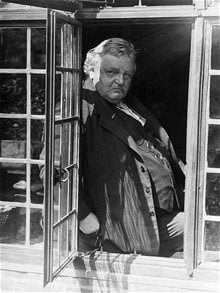 There is a move afoot to have G. K. Chesterton canonized as a Catholic saint. There’s a certain irony in this push to sainthood, given the man’s less-than-saintly appetites. He sometimes drank heavily (he allegedly joked that “one pint is enough, two pints is one too many, three pints isn’t half enough”), smoked heavily and ate heavily. Indeed, he weighed so much at the time of his death in 1936 that, when they put him in his coffin, it had to be carried out a second-story window rather than carried down the narrow stairs. More disturbing are the accusations that Chesterton may have been anti-Semitic (a charge that many of his supporters refute).
But if Chesterton’s candidacy for sainthood has a hint of paradox to it, that (paradoxically) fits the man. Chesterton knew his paradoxes, and it was one of the things he loved about Christianity. He wrote extensively about the faith’s many paradoxes—and when he was first investigating the faith, he marveled how its critics could find it so wrong in so many diametrically opposed ways: So Pollyannishly giving, according to one, so puritanically judgmental, according to another; So inclined to deny every joy, and yet so apt to indulge in wild extravagance. He writes in Orthodoxy:
I did not conclude that the attack on Christianity was all wrong. I only concluded that if Christianity was wrong, it was very wrong indeed. Such hostile horrors might be combined in one thing, but that thing must be very strange and solitary. There are men who are misers, and also spendthrifts; but they are rare. There are men sensual and also ascetic; but they are rare. But if this mass of mad contradictions really existed, quakerish and bloodthirsty, too gorgeous and too thread-bare, austere, yet pandering preposterously to the lust of the eye, the enemy of women and their foolish refuge, a solemn pessimist and a silly optimist, if this evil existed, then there was in this evil something quite supreme and unique.
Chesterton eventually concluded that some people saw Christianity as excessive (in one way or another) because the critics were themselves excessive (in one way or another), but did not deny that Christianity was indeed a bundle of contradictions. “Christianity got over the difficulty of combining furious opposites, by keeping them both, and keeping them both furious,” he wrote. “The Church was positive on both points. One can hardly think too little of one’s self. One can hardly think too much of one’s soul.”
We evangelicals don’t do saints. If we did, C.S. Lewis would’ve been the 20th century lay apologist more likely to be canonized. His Mere Christianity is the first book that many evangelicals thrust under the noses of our unbelieving friends. He’s a wonderful thinker and a fantastic writer and frankly, I think most of us feel smugly pleased that he’s part of our tribe. “We’ve got a Cambridge scholar and Narnia on our side! Hurrah!”
No disrespect for Lewis, but for me, Chesterton has been even more instrumental in my walk of faith. If Lewis’ Mere Christianity speaks to the reasonable 20th-century modernist in us—”Christianity makes sense, and this is why”—Chesterton’s Orthodoxy has a wild, witty 21st-century tang to it: It speaks of paradox and the power of story, of not just the truth of the faith, but its beauty and glory and inherent rightness. Mere Christianity speaks to the logician in me. Orthodoxy touches the poet.
And the guy’s a killer writer. He wrote everything—novels (The Man Who Was Thursday), short mysteries (he created the priestly detective Father Brown), essays, newspaper articles, encyclopedia entries, poetry and, of course, his works of Christian discourse. I haven’t read everything Chesterton wrote—because, really, given that he wrote 80 books and 4,000 essays, who could—but everything I have read has been pretty great. My favorite is Orthodoxy—I re-read or re-listen to it about every year—but all of his work seems filled with pithy, profound and sometimes zany quotes. My personal favorite is, “You cannot grow a beard in a moment of passion,” but he has others that make great refrigerator fodder:
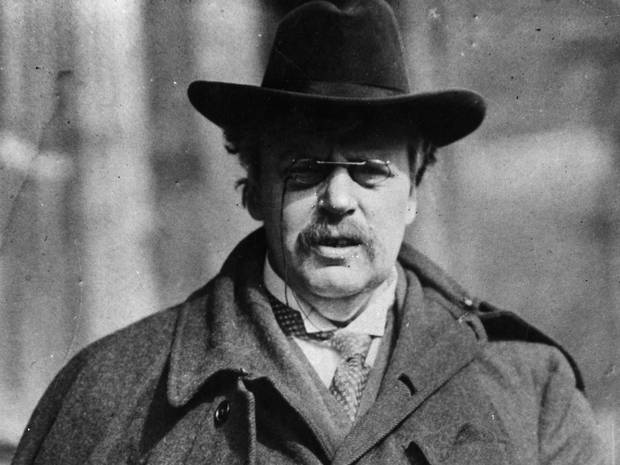 “The Bible tells us to love our neighbors, and also to love our enemies; probably because generally they are the same people.”
“Just going to church doesn’t make you a Christian any more than standing in your garage makes you a car.”
“The word ‘good’ has many meanings. For example, if a man were to shoot his grandmother at a range of five hundred yards, I should call him a good shot, but not necessarily a good man.”
If Chesterton does become a saint, I would suggest he becomes the patron saint of Twitter. No one would be able to fill a feed so wonderfully.
And Chesterton is cool—like Madonna cool, Mr. Rogers cool, the guy in high school who could mingle with the jocks and the goths and the nerd and be pretty much liked by everyone. He’s a rebuttal to every disparaging (and sometimes true) stereotype slathered on Christians: He’s funny, charming, brilliant. Writes James Parker or The Atlantic:
Chesterton was a journalist; he was a metaphysician. He was a reactionary; he was a radical. He was a modernist, acutely alive to the rupture in consciousness that produced Eliot’s “The Hollow Men”; he was an anti-modernist (he hated Eliot’s “The Hollow Men”). He was a parochial Englishman and a post-Victorian gasbag; he was a mystic wedded to eternity. All of these cheerfully contradictory things are true, and none of them would matter in the slightest were it not for the final, resolving fact that he was a genius. Touched once by the live wire of his thought, you don’t forget it. And what is genius? Genius is Hammy the squirrel, in DreamWorks Animation’s 2006 classic Over the Hedge, five seconds after he gulps down an energy drink. The Earth stutters on its axis and then stops turning, the soundtrack comes to a soupy halt, and Hammy saunters through a sudden, humming immobility, past the transfixed pest-control guy and around the frozen laser beams of the lawn-alarm system. He is, of course, moving at incredible speed—but with supernatural nonchalance. His ecstatic velocity has put everything around him into the slowness and vagueness of a dream. That’s what geniuses do.
And one last telling trait: Even as he brazenly and hilariously took down some of his age’s greatest writers—Oscar Wilde, Edmund Bentley and George Bernard Shaw, among many others—he was on friendly terms with many of these self-same writers. Chesterton and Shaw got along particularly famously. When Chesterton came across his ever-so-skinny friend one day, he said, “I see there has been a famine in the land.” Shaw looked at Chesterton’s rotundity and quipped, “And I see he cause of it.”
Imagine, people who disagree so strongly with each other and still able to exhibit a strange, familiar cordiality. That’s something almost unheard of these days … and something I think that we could all use a little bit more of.
“The Christian ideal has not been tried and found wanting,” Chesterton famously said. “It has been found difficult and left untried.” I can’t say whether Chesterton embodied the Christian ideal, or at least embodied it enough for sainthood. (Even saints, after all, aren’t perfect.) But the fact that he embodied a different sort of Christian—a paradoxical contrast to the morose, incurious, judgmental Christian that so many people seem to picture when they think of the term—I’m very grateful for.
Previous Post
March 16, 2015
Television Gets Religion
Next Post

March 23, 2015 The Apostles are Like The Avengers. (Just Not As Ripped.)
Browse Our Archives
Select a Category books celebrities Editor's Choice games movies music news sports superheroes television Uncategorized
Select a Month May 2026 April 2026 March 2026 December 2025 October 2025 July 2025 June 2025 May 2025 February 2025 January 2025 December 2024 July 2024 June 2024 May 2024 April 2024 March 2024 February 2024 January 2024 December 2023 September 2023 March 2023 February 2023 December 2022 November 2022 October 2022 September 2022 August 2022 July 2022 June 2022 May 2022 April 2022 March 2022 February 2022 December 2021 October 2021 August 2021 July 2021 June 2021 May 2021 April 2021 March 2021 October 2020 August 2020 July 2020 June 2020 May 2020 April 2020 March 2020 February 2020 January 2020 December 2019 November 2019 October 2019 September 2019 August 2019 July 2019 June 2019 May 2019 April 2019 March 2019 February 2019 January 2019 December 2018 November 2018 October 2018 September 2018 August 2018 July 2018 June 2018 May 2018 April 2018 March 2018 February 2018 January 2018 December 2017 November 2017 October 2017 September 2017 August 2017 July 2017 June 2017 May 2017 April 2017 March 2017 February 2017 January 2017 December 2016 November 2016 October 2016 September 2016 August 2016 July 2016 June 2016 May 2016 April 2016 March 2016 February 2016 January 2016 December 2015 November 2015 October 2015 September 2015 August 2015 July 2015 June 2015 May 2015 April 2015 March 2015 February 2015 January 2015 December 2014 November 2014 October 2014 September 2014
Follow Us!
TAKE THE
Religious Wisdom Quiz
Who was Abraham asked to offer as a sacrifice?
Select your answer to see how you score.
Shem Ishmael Isaac Jacob
Books by This Author Books by Paul Asay
Related posts from Watching God

Finding Forgiveness in the Great Horror Film ‘Hokum’

Finding God's Grace in ‘Project Hail Mary’

Watching God’s Top 10 Movies of 2025

'Frankenstein' and the Monsters Among Us
TRENDING AT PATHEOS Religious Music & Entertainment

"Les Diabolique" and Transgression
Alongside something like Arrival, Vertigo, or Charade, Les Diaboliques is a...

"The Plague Dogs" and Mortality
So, flashback to the late 70s, early 80s. Walt Disney Studios is...

With the recent and highly successful release of Christopher Nolan’s epic film,...

"L'avventura" and Human Weakness
Today's piece is going to be a little different for a few...

I first want to apologize for not posting or writing anything. I'm...

I've engaged in the multi-year project of reading through the Church Fathers,...
view all Religious Music & Entertainment blogs
Ad-Free & Subscriber Log-In Subscription Support
- About Us
- 2026 Calendar
- Videos
- Podcasts
- Library of World Religions
- Faith In Media Tracker
- Advertise With Us
- Write for Us
- Privacy Policy
- Terms of Service
- Do Not Sell My Data
- Contact Us
- Radiant Digital
- Manage Newsletter Subscriptions
- Unsubscribe From Notifications
- Sitemap
Copyright 2008-2026, Patheos. All rights reserved.
Subscription Support Ad-Free & Subscriber Log-In
Follow Patheos