
BuddhistCatholicContemplativeEvangelicalGeneral ChristianHinduJewishLatter-day SaintMuslimNew VisionsProgressive Christian
Beliefs
- Buddhist
- Catholic
- Contemplative
- Evangelical
- General Christian
- Hindu
- Jewish
- Latter-day Saint
- More Voices
- Muslim
- New Visions
- Pagan
- Progressive Christian
Topics
- Religion News
- Food and Religion
- Sports and Religion
- Religious Art
- Religious Music and Entertainment
- Religious Events
- History and Religion
- Style and Religion
- Politics and Religion
- Women in Religion
- Recreation Outdoors and Religion
- Business Finance and Religion
- Careers Workplace and Religion
- Education and Religion
- Family Parenting and Religion
- Health Fitness and Religion
- Home and Religion
- Relationships and Religion
- Technology and Religion
- Travel and Religion
Columnists
- Buddhist Columnists
- Business Finance and Religion Columnists
- Careers Workplace and Religion Columnists
- Catholic Columnists
- Contemplative Columnists
- Education and Religion Columnists
- Evangelists Columnists
- Family Parenting and Religion Columnists
- General Christian Columnists
- Health Fitness and Religion Columnists
- Hindu Columnists
- History and Religion Columnists
- Home and Religion Columnists
- Jewish Columnists
- More Voices Columnists
- Latter Day Columnists
- Muslim Columnists
- New Visions Columnists
- Nonreligious Columnists
- Pagan Columnists
- Politics and Religion Columnists
- Progressive Columnists
- Recreation Outdoors and Religion Columnists
- Relationships and Religion Columnists
- Religion News Columnists
- Religious Art Columnists
- Religious Events Columnists
- Religious Music and Entertainment Columnists
- Sports and Religion Columnists
- Style and Religion Columnists
- Technology and Religion Columnists
- Travel and Religion Columnists
- Women in Religion Columnists
Resource Library
- 2026 Calendar
- Library of World Religions
- The 100 Most Holy Places on Earth
- Patheos Answers
- Podcasts
- Videos
- Faith Leaders Database
- Anglican Episcopalian
- Bahai
- Baptist
- Buddhism
- Christianity
- Confucianism
- Eastern Orthodoxy
- Hinduism
- Holiness and Pentecostal
- ISKCON
- Islam
- Judaism
- Lutheran
- Methodist
- The Church of Jesus Christ of Latter-day Saints
- New Age
- Paganism
- Presbytarian and Reformed
- Protestantism
- Religion Behind the Scenes
- Roman Catholic
- Scientology
- Shia Islam
- Sikhism
- Sufism
- Sunni Islam
- Taoism
- Zen
- See all religions
Research Tools
 Ad-Free & Subscriber Log-In Subscription Support
Ad-Free & Subscriber Log-In Subscription Support
Follow Patheos 

- Trending:
- Forgiveness
- |
- Marriage
- |
- Consciousness
- |
- Death Penalty
- |
- Election
- |
- Halloween

- Home
- Religious Music & Entertainment
- All the Best Picture Nominees Have Something in Common
All the Best Picture Nominees Have Something in Common
Last updated on: February 6, 2015 at 3:38 pm by Paul Asay
All the Best Picture Nominees Have Something in Common 2015-02-06T15:38:47-06:00 Paul Asay
Patheos Explore the world's faith through different perspectives on religion and spirituality! Patheos has the views of the prevalent religions and spiritualities of the world.
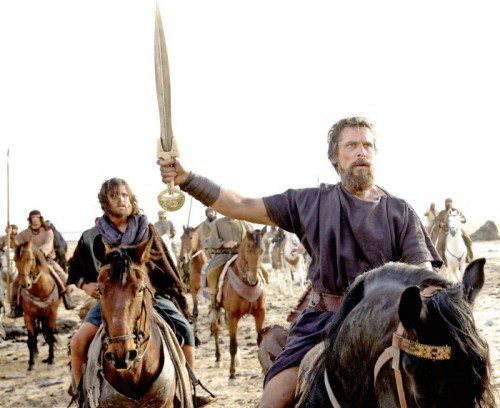 Late last year, Ridley Scott unveiled his ambitious, controversial epic Exodus: Gods and Kings, with Christian Bale as Moses. It was the story of a man who had it all, lost it all, found something better and dragged a whole nation to a strange land promised to them by God.
It was not nominated for an Academy Award. Not even for Best Performance by Locusts.
But Exodus: Gods and Kings actually shares a bit in common with most of the year’s Best Picture nominees: The idea of a spiritual journey.
Sure, only one of the year’s nominees includes a literal trip to the Middle East, and what Chris Kyle found in American Sniper was far from a land of milk and honey. Some of our Best Picture protagonists don’t travel much at all, and one—Eddie Redmayne’s Stephen Hawking in The Theory of Everything—ends the movie barely able to move. None of our protagonists are explicitly searching for the Promised Land, and few seek God’s guidance.
But in each movie, people leave the comfort of home (or a manifestation thereof) for the promise of something greater. They’re looking for many of the same things that Moses and his people were: Freedom. Truth. Happiness. Redemption. Each feels the tug of something bigger than themselves, pulling them in new, unexpected and sometimes frightening directions.
Each of our Oscar protagonists is on a pilgrimage—a spiritual journey of discovery and meaning. Let me show you what I mean.
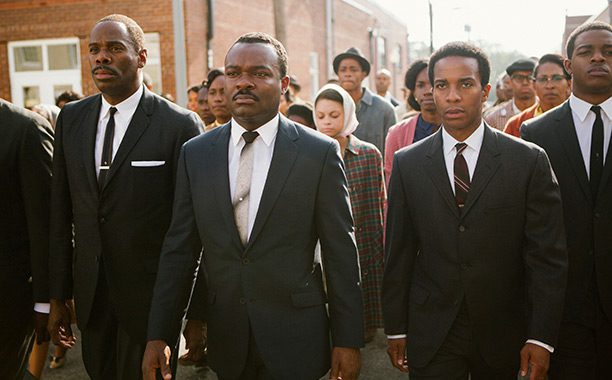 The walk taken by Martin Luther King Jr. and his followers in Selma is not a long one compared to that of the Exodus—just 54 miles to Montgomery. But these Civil Rights protesters, like the Hebrews, believed it was a walk toward freedom—specifically the freedom to vote. King, like Scott’s Moses, left the comfort of home and risked everything because he felt that’s what God wanted him to do. The journey is not without risk: The established powers in Selma don’t want to let their people go, and they’ll beat them to keep them exactly where they are. But those forces are eventually swept away, not by the Red Sea, but by waves of racial progress.
M. Gustave, legendary concierge for The Grand Budapest Hotel, is also on a quest for freedom, and quite literally. Thrown in the clink for a murder he didn’t commit, Gustave busts out and, with the help of his loyal bellboy, Zero, goes on a zany but ultimately successful journey to clear his name and redeem his reputation. You could say he even finds the Promised Land—ownership of a priceless painting and the deed to the hotel itself. But He and Zero find an even greater treasure: A loyal, enduring friendship. Their adventure turned out to be a spiritual journey of discovery as much as a physical one. But as it was for the Hebrews, Gustave’s own postscript fell short of happily ever after.
Mason makes quite the journey in Boyhood, too, but his pilgrimage is not as much through space as time. He, too, seeks freedom—the sort of freedom that all children seek and most eventually claim: The freedom to make his own decisions and to live his own life. Growing up isn’t just a physical and mental trek to maturity. It’s a inherently spiritual one, too—a journey of self-discovery. We, like Mason, begin to wonder who we are and, more importantly, who we want to be. Like Scott’s Moses, none of us really have a choice about leaving the relatively comfortable confines of our immature “home.” We’re kicked out of Egypt. We know the walk toward adulthood will be difficult and sometimes dangerous. No getting around that. But we also have a choice on which directions will go. And while Mason, like Moses, takes some bad turns here and there, there’s still hope that he’ll find a new and hopeful future.
 Sometimes, a spiritual trek isn’t a journey through space or time, but through our own brains and souls. In two movies, the Promised Land isn’t a place as much as a goal—a tireless quest for excellence and understanding. In The Imitation Game, Alan Turing isn’t just out to understand Nazi codes, but explore the boundaries of synthetic intelligence—a journey that eventually leads him to create the world’s first computers. The Theory of Everything shows how Stephen Hawking, even has his physical body was slowly imploding, sent his mind on the deepest, most exciting of journeys—through black holes and across the universe and brushing against the boundaries of space and time. These brilliant men are a little like Moses: They have access to insights that the rest of us simply can’t understand—revelations that can feel even preposterous to doubters. And to follow such men (particularly in The Imitation Game) becomes a matter of faith. Turing’s team follows him because they believe in his insights and ideals, even when proof is frustratingly elusive. And eventually that faith pays off.
But sometimes, faith—blind faith—can lead us astray.
Whiplash gives us Andrew, another protagonist diving deep inside himself to find truth and understanding—in his case, to grasp the ethereal, near spiritual elements of music and become a truly great jazz drummer. It gives us another enigmatic leader in Fletcher, who drives his followers with sadistic verve. But even though Andrew definitely meets the criteria of going on a spiritual quest, Whiplash is a tricky film to view through this particular lens we’re using. Just who is Fletcher? Is he a Moses, who drags his people through pain and misery because he knows it’s the only way to reach the promised land? Or is he more like a false prophet or Pharaoh, more liable to lead his followers to destruction? Or is he a bit of both?
 In Birdman, Riggan makes both a physical journey—from the West to the East Coast—and a deeply spiritual one when he tries to find success and redemption on Broadway. Riggan’s a lot like Moses. He found a home and comfort in Hollywood. And yet something led him to return to the Great White Way—to dive into the spiritual essence of acting and, somehow, find the key to his own professional and personal salvation. He, like Moses, risked everything on this journey. (And he, like at least Scott’s Moses, had a strange spirit visible to only him, giving him whispered advice.) It’s hard to know whether Riggan’s pilgrimage was successful, but I’d like to think so: He realized that salvation doesn’t lie in on-stage success, but through love and relationship.
The same could be said of Chris Kyle in American Sniper. His physical journey led him into the sand of Iraq, but his spiritual journey pointed the opposite way—and it, if anything, was a harder one to take. He, like Moses, wandered in the wilderness for years. Even as the SEAL did his military duty, he knew that eventually he had to find his way home. But as time went on, it became more and more difficult to stop his wanderings. It’s telling, I think, that right before he decides to return, Kyle’s caught in a wicked sandstorm—where it’s almost impossible to see or hear or have any sense of direction. In that moment, Kyle’s lost—physically and spiritually. And while it doesn’t take him 40 years to find his way back to his wife and family, it’s a frustratingly long journey. But eventually he finds his promised land—a place that he knew once before but had lost along the way. He found his way not just to a land of milk and honey, but home.
Previous Post

February 2, 2015
Boyhood: Chasing After the Wind
Next Post

February 9, 2015 Jupiter Ascending: Some Weighty Messages (in a Mess of a Movie)
Browse Our Archives
Select a Category books celebrities Editor's Choice games movies music news sports superheroes television Uncategorized
Select a Month May 2026 April 2026 March 2026 December 2025 October 2025 July 2025 June 2025 May 2025 February 2025 January 2025 December 2024 July 2024 June 2024 May 2024 April 2024 March 2024 February 2024 January 2024 December 2023 September 2023 March 2023 February 2023 December 2022 November 2022 October 2022 September 2022 August 2022 July 2022 June 2022 May 2022 April 2022 March 2022 February 2022 December 2021 October 2021 August 2021 July 2021 June 2021 May 2021 April 2021 March 2021 October 2020 August 2020 July 2020 June 2020 May 2020 April 2020 March 2020 February 2020 January 2020 December 2019 November 2019 October 2019 September 2019 August 2019 July 2019 June 2019 May 2019 April 2019 March 2019 February 2019 January 2019 December 2018 November 2018 October 2018 September 2018 August 2018 July 2018 June 2018 May 2018 April 2018 March 2018 February 2018 January 2018 December 2017 November 2017 October 2017 September 2017 August 2017 July 2017 June 2017 May 2017 April 2017 March 2017 February 2017 January 2017 December 2016 November 2016 October 2016 September 2016 August 2016 July 2016 June 2016 May 2016 April 2016 March 2016 February 2016 January 2016 December 2015 November 2015 October 2015 September 2015 August 2015 July 2015 June 2015 May 2015 April 2015 March 2015 February 2015 January 2015 December 2014 November 2014 October 2014 September 2014
Follow Us!
TAKE THE
Religious Wisdom Quiz
Who denied Jesus three times before the rooster crowed?
Select your answer to see how you score.
Judas Paul Peter John
Books by This Author Books by Paul Asay
Related posts from Watching God

Finding Forgiveness in the Great Horror Film ‘Hokum’

What makes a hero? These 7 Cinematic Characters...

Finding God's Grace in ‘Project Hail Mary’

Watching God’s Top 10 Movies of 2025
TRENDING AT PATHEOS Religious Music & Entertainment

"Les Diabolique" and Transgression
Alongside something like Arrival, Vertigo, or Charade, Les Diaboliques is a...

"The Plague Dogs" and Mortality
So, flashback to the late 70s, early 80s. Walt Disney Studios is...

With the recent and highly successful release of Christopher Nolan’s epic film,...

"L'avventura" and Human Weakness
Today's piece is going to be a little different for a few...

I first want to apologize for not posting or writing anything. I'm...

I've engaged in the multi-year project of reading through the Church Fathers,...
view all Religious Music & Entertainment blogs
Ad-Free & Subscriber Log-In Subscription Support
- About Us
- 2026 Calendar
- Videos
- Podcasts
- Library of World Religions
- Faith In Media Tracker
- Advertise With Us
- Write for Us
- Privacy Policy
- Terms of Service
- Do Not Sell My Data
- Contact Us
- Radiant Digital
- Manage Newsletter Subscriptions
- Unsubscribe From Notifications
- Sitemap
Copyright 2008-2026, Patheos. All rights reserved.
Subscription Support Ad-Free & Subscriber Log-In
Follow Patheos