
BuddhistCatholicContemplativeEvangelicalGeneral ChristianHinduJewishLatter-day SaintMuslimNew VisionsProgressive Christian
Beliefs
- Buddhist
- Catholic
- Contemplative
- Evangelical
- General Christian
- Hindu
- Jewish
- Latter-day Saint
- More Voices
- Muslim
- New Visions
- Pagan
- Progressive Christian
Topics
- Religion News
- Food and Religion
- Sports and Religion
- Religious Art
- Religious Music and Entertainment
- Religious Events
- History and Religion
- Style and Religion
- Politics and Religion
- Women in Religion
- Recreation Outdoors and Religion
- Business Finance and Religion
- Careers Workplace and Religion
- Education and Religion
- Family Parenting and Religion
- Health Fitness and Religion
- Home and Religion
- Relationships and Religion
- Technology and Religion
- Travel and Religion
Columnists
- Buddhist Columnists
- Business Finance and Religion Columnists
- Careers Workplace and Religion Columnists
- Catholic Columnists
- Contemplative Columnists
- Education and Religion Columnists
- Evangelists Columnists
- Family Parenting and Religion Columnists
- General Christian Columnists
- Health Fitness and Religion Columnists
- Hindu Columnists
- History and Religion Columnists
- Home and Religion Columnists
- Jewish Columnists
- More Voices Columnists
- Latter Day Columnists
- Muslim Columnists
- New Visions Columnists
- Nonreligious Columnists
- Pagan Columnists
- Politics and Religion Columnists
- Progressive Columnists
- Recreation Outdoors and Religion Columnists
- Relationships and Religion Columnists
- Religion News Columnists
- Religious Art Columnists
- Religious Events Columnists
- Religious Music and Entertainment Columnists
- Sports and Religion Columnists
- Style and Religion Columnists
- Technology and Religion Columnists
- Travel and Religion Columnists
- Women in Religion Columnists
Resource Library
- 2026 Calendar
- Library of World Religions
- The 100 Most Holy Places on Earth
- Patheos Answers
- Podcasts
- Videos
- Faith Leaders Database
- Anglican Episcopalian
- Bahai
- Baptist
- Buddhism
- Christianity
- Confucianism
- Eastern Orthodoxy
- Hinduism
- Holiness and Pentecostal
- ISKCON
- Islam
- Judaism
- Lutheran
- Methodist
- The Church of Jesus Christ of Latter-day Saints
- New Age
- Paganism
- Presbytarian and Reformed
- Protestantism
- Religion Behind the Scenes
- Roman Catholic
- Scientology
- Shia Islam
- Sikhism
- Sufism
- Sunni Islam
- Taoism
- Zen
- See all religions
Research Tools
 Ad-Free & Subscriber Log-In Subscription Support
Ad-Free & Subscriber Log-In Subscription Support
Follow Patheos 

- Trending:
- Forgiveness
- |
- Marriage
- |
- Consciousness
- |
- Death Penalty
- |
- Election
- |
- Halloween

- Home
- Religious Music & Entertainment
- Oscars Missed a Good One in Calvary
Oscars Missed a Good One in Calvary
Last updated on: January 16, 2015 at 9:52 am by Paul Asay
Oscars Missed a Good One in Calvary 2015-01-16T09:52:19-06:00 Paul Asay
Patheos Explore the world's faith through different perspectives on religion and spirituality! Patheos has the views of the prevalent religions and spiritualities of the world.
 Nominations for the Academy Awards came out yesterday morning. Among the eight Best Picture nominees, the Academy lauded the creative triumph Boyhood, the artistic weirdness of Birdman, the inspirational story of Selma and even the very Anderson-esque Wes Anderson movie The Grand Budapest Hotel. All the nominees make sense, I suppose, even as pundits from across the Interweb lament some obvious snubs.
But the worst snub, in my opinion, was one that not many are discussing: The complete shutout of one of the best movies of the year, Calvary.
I think many folks simply forgot about the pic. After all, it was released in August—not exactly a hot release month for Oscarbait—and made just $3.6 million this year (unlike early releases like Boyhood and Grand Budapest). And perhaps the subject matter was discomforting. Religion is often ignored in prestige movies. And when it is showcased, it’s often shown in a positive but somewhat untouchable light (see Selma, for instance). Not many films dare ask the unanswerable question: What is religion, really? What is it good for? Calvary dares ask, and that can make it uncomfortable viewing. Set in Ireland, Calvary is the story of a good priest dealing with a disinterested, increasingly hostile parish; a holy man walking through the land of Ninevah.
The movie opens in a confession booth, where an unknown parishioner details the abuse he suffered as a child at the hands of a priest. He confesses this deep, lingering hurt to the righteous, well-meaning Father James (Brendan Gleeson) … and in recompense for his suffering, threatens to kill the priest in seven days.
“There’s no point in killing a bad priest,” the parishioner tells him. “But killing a good one? That would be a shocker.”
And so begins the worst week of Father James’ life—even though that life doesn’t look that much different at first. The priest goes about doing his work, trying to encourage his parishioners in times of trouble, exhorting them in his own understated way to be better people.
But it’s clear, to both him and us, that he’s doing precious little for these people. They disregard his advice and openly mock he and his faith. “Run along now, father,” an abusive adulterer tells him. “Your sermon is finished.”
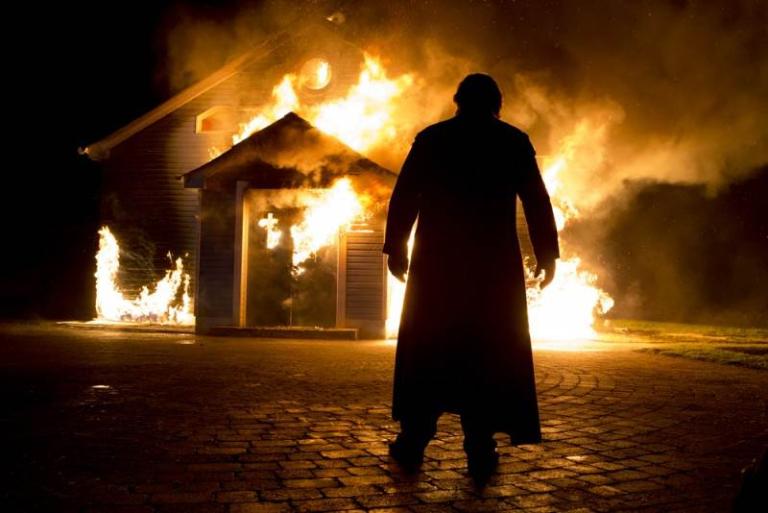 Many of his flock are openly disgusted by the Catholic Church. They talk about its perceived wealth as they themselves lose their businesses. They dwell on the pedophile priest scandal. They drag up some of the most shameful events of the Church’s long, checkered history. “When you have a history of screwing the Jews out of their money and collaborating with Nazis, it’s like the pot calling the kettle black, isn’t it?” one says, shrugging off James’ advice. They poke Father James with terrible anecdotes that suggest God is either callous to human suffering or not around at all. And when Father James’ sanctuary burns to the ground, people stand about the sacred bonfire, staring at the spectacle. Some laugh. No one, except, Father James himself, seems to see it as much of a loss.
“Your time is gone, and you don’t even f—ing realize it,” a barkeeper tells James. It’s a dark thought that becomes even darker because James suspects the barkeep might be right. The priest feels it. And he begins to wonder whether he’s doing any good at all. And he wonders whether it’d be better if he just left. Left the parish. Left the faith. Run away from it all.
But then, in strange, dark moments, the beauty of faith sneaks beside him and grasps his hand.
One black night, Father James settles beside a new widow in a hospital, grieving over the unexpected loss of her husband.
“He was a good man, your husband?” he asks.
“Yes,” the woman says. “He was a good man. We had a very good life together. We loved each other very much. And now, he has gone. And that is not unfair. That is just what happened. But many people don’t live good lives. They don’t feel love. That is why it’s unfair. I feel sorry for them.”
The two talk for a bit. James admits that some people’s faith can be shaken in moments like these. Some turn to religion because they fear death. They long to find some solace for that mysterious hereafter. But when that fearful moment comes too close, they find their faith vanishes like a wraith.
“It must not have been much of a faith to begin with, if it is so easy to lose it,” the woman says.
She is a woman of strong faith, this widow. Her husband is dead, yes. But it does not invalidate her belief in a good, loving God. James came to offer comfort. Instead, he walks away comforted.
Father James does not run away from his faith or fate. He stays true to his people, even as they leave him. Even on what may be his last day, James visits his flock and spreads what advice and comfort and even joy that he can. He faces his apparent killer with peace and love.
 “I think there’s too much talk about sins, to be honest,” he tells someone earlier. “And not enough talk about virtues.” And when he’s asked what the greatest virtue is, he answers forgiveness. “I think forgiveness has been highly underrated.”
In that moment, standing before a man with a gun, Father James forgives his would-be killer—whether he pulls the trigger or not. In the face of death, James offers life. In the midst of sin, he models virtue—perhaps the greatest virtue of them all. He is a good man to be apparently killed for the sins of others, perhaps for his whole Church. He doesn’t know what he’s doing, perhaps James thinks. Father, forgive him.
James admits that he regrets never having finished Moby Dick. The killer recaps it quickly: Captain Ahab eventually grapples with the massive white beast, and the two plunge to the ocean’s bottom, taking the ship with him.
Director John Michael McDonagh is suggesting, I think, that the church is society’s great white whale, harpooned by the Ahabs of our culture. He does not suggest that the beast of religion is without its problems. But in killing it, McDonagh wonders we might also be destroying ourselves.
Previous Post
January 12, 2015
Selma: The Fearsome Power of Faith
Next Post

January 19, 2015 American Sniper: Holding Out for a Hero
Browse Our Archives
Select a Category books celebrities Editor's Choice games movies music news sports superheroes television Uncategorized
Select a Month May 2026 April 2026 March 2026 December 2025 October 2025 July 2025 June 2025 May 2025 February 2025 January 2025 December 2024 July 2024 June 2024 May 2024 April 2024 March 2024 February 2024 January 2024 December 2023 September 2023 March 2023 February 2023 December 2022 November 2022 October 2022 September 2022 August 2022 July 2022 June 2022 May 2022 April 2022 March 2022 February 2022 December 2021 October 2021 August 2021 July 2021 June 2021 May 2021 April 2021 March 2021 October 2020 August 2020 July 2020 June 2020 May 2020 April 2020 March 2020 February 2020 January 2020 December 2019 November 2019 October 2019 September 2019 August 2019 July 2019 June 2019 May 2019 April 2019 March 2019 February 2019 January 2019 December 2018 November 2018 October 2018 September 2018 August 2018 July 2018 June 2018 May 2018 April 2018 March 2018 February 2018 January 2018 December 2017 November 2017 October 2017 September 2017 August 2017 July 2017 June 2017 May 2017 April 2017 March 2017 February 2017 January 2017 December 2016 November 2016 October 2016 September 2016 August 2016 July 2016 June 2016 May 2016 April 2016 March 2016 February 2016 January 2016 December 2015 November 2015 October 2015 September 2015 August 2015 July 2015 June 2015 May 2015 April 2015 March 2015 February 2015 January 2015 December 2014 November 2014 October 2014 September 2014
Follow Us!
TAKE THE
Religious Wisdom Quiz
What does the name "Bethlehem" mean in Hebrew?
Select your answer to see how you score.
House of Stone House of Kings House of Prayer House of Bread
Books by This Author Books by Paul Asay
Related posts from Watching God

Finding Forgiveness in the Great Horror Film ‘Hokum’

What makes a hero? These 7 Cinematic Characters...

Finding God's Grace in ‘Project Hail Mary’

Watching God’s Top 10 Movies of 2025
TRENDING AT PATHEOS Religious Music & Entertainment

"Les Diabolique" and Transgression
Alongside something like Arrival, Vertigo, or Charade, Les Diaboliques is a...

"The Plague Dogs" and Mortality
So, flashback to the late 70s, early 80s. Walt Disney Studios is...

With the recent and highly successful release of Christopher Nolan’s epic film,...

"L'avventura" and Human Weakness
Today's piece is going to be a little different for a few...

I first want to apologize for not posting or writing anything. I'm...

I've engaged in the multi-year project of reading through the Church Fathers,...
view all Religious Music & Entertainment blogs
Ad-Free & Subscriber Log-In Subscription Support
- About Us
- 2026 Calendar
- Videos
- Podcasts
- Library of World Religions
- Faith In Media Tracker
- Advertise With Us
- Write for Us
- Privacy Policy
- Terms of Service
- Do Not Sell My Data
- Contact Us
- Radiant Digital
- Manage Newsletter Subscriptions
- Unsubscribe From Notifications
- Sitemap
Copyright 2008-2026, Patheos. All rights reserved.
Subscription Support Ad-Free & Subscriber Log-In
Follow Patheos