
BuddhistCatholicContemplativeEvangelicalGeneral ChristianHinduJewishLatter-day SaintMuslimNew VisionsProgressive Christian
Beliefs
- Buddhist
- Catholic
- Contemplative
- Evangelical
- General Christian
- Hindu
- Jewish
- Latter-day Saint
- More Voices
- Muslim
- New Visions
- Pagan
- Progressive Christian
Topics
- Religion News
- Food and Religion
- Sports and Religion
- Religious Art
- Religious Music and Entertainment
- Religious Events
- History and Religion
- Style and Religion
- Politics and Religion
- Women in Religion
- Recreation Outdoors and Religion
- Business Finance and Religion
- Careers Workplace and Religion
- Education and Religion
- Family Parenting and Religion
- Health Fitness and Religion
- Home and Religion
- Relationships and Religion
- Technology and Religion
- Travel and Religion
Columnists
- Buddhist Columnists
- Business Finance and Religion Columnists
- Careers Workplace and Religion Columnists
- Catholic Columnists
- Contemplative Columnists
- Education and Religion Columnists
- Evangelists Columnists
- Family Parenting and Religion Columnists
- General Christian Columnists
- Health Fitness and Religion Columnists
- Hindu Columnists
- History and Religion Columnists
- Home and Religion Columnists
- Jewish Columnists
- More Voices Columnists
- Latter Day Columnists
- Muslim Columnists
- New Visions Columnists
- Nonreligious Columnists
- Pagan Columnists
- Politics and Religion Columnists
- Progressive Columnists
- Recreation Outdoors and Religion Columnists
- Relationships and Religion Columnists
- Religion News Columnists
- Religious Art Columnists
- Religious Events Columnists
- Religious Music and Entertainment Columnists
- Sports and Religion Columnists
- Style and Religion Columnists
- Technology and Religion Columnists
- Travel and Religion Columnists
- Women in Religion Columnists
Resource Library
- 2026 Calendar
- Library of World Religions
- The 100 Most Holy Places on Earth
- Patheos Answers
- Podcasts
- Videos
- Faith Leaders Database
- Anglican Episcopalian
- Bahai
- Baptist
- Buddhism
- Christianity
- Confucianism
- Eastern Orthodoxy
- Hinduism
- Holiness and Pentecostal
- ISKCON
- Islam
- Judaism
- Lutheran
- Methodist
- The Church of Jesus Christ of Latter-day Saints
- New Age
- Paganism
- Presbytarian and Reformed
- Protestantism
- Religion Behind the Scenes
- Roman Catholic
- Scientology
- Shia Islam
- Sikhism
- Sufism
- Sunni Islam
- Taoism
- Zen
- See all religions
Research Tools
 Ad-Free & Subscriber Log-In Subscription Support
Ad-Free & Subscriber Log-In Subscription Support
Follow Patheos 

- Trending:
- Forgiveness
- |
- Marriage
- |
- Consciousness
- |
- Death Penalty
- |
- Election
- |
- Halloween

- Home
- Religious Music & Entertainment
- A Literary Digression
A Literary Digression
Last updated on: January 20, 2015 at 7:21 pm by Paul Asay
A Literary Digression 2015-01-20T19:21:27-06:00 Paul Asay
Patheos Explore the world's faith through different perspectives on religion and spirituality! Patheos has the views of the prevalent religions and spiritualities of the world.
As you might expect of a movie critic, I watch a lot of movies. Denver hosts most of the advanced screenings in my neck of the woods, which means I drive up to the Mile-High City a couple of times a week. Sometimes I’m rewarded with a good movie. But even when the movie’s not so hot, I at least have the pleasure of a good book beforehand.
Tonight, I’m reading John Steinbeck’s East of Eden.
There are certain writers who have such a command of language that I wonder whether they speak the same English that you and I do. Steinbeck is one of those writers–a novelist who speaks with such eloquence, authority and insight that certain passages that leave me feeling richer … blessed to have read them.
Take this passage from Chapter 13:
Our species is the only creative species, and it has only one creative instrument, the individual mind and spirit of a man. Nothing was ever created by two men. There are no good collaborations, whether in music, in art, in poetry, in mathematics, in philosophy. Once the miracle of creation has taken place, the group can build and extend it, but the group never invents anything. The preciousness lies in the lonely mind of a man.
It’s a resonant passage for many of us, maybe, working in worlds where every thought or idea is discussed and dissected, twisted and sometimes obliterated by groups and committees. We live in a risk-averse age wherein originality is often squelched in favor of a safe, familiar formula–an age of reboots and remakes and Transformer sequels. Sure, some originality does eke through the cracks sometimes, but it’s rare and remarkable. And perhaps it always has been.
But I feel more than just a shared lament for creative individuality here in Steinbeck’s passage: I see, perhaps, a fingerprint of God.
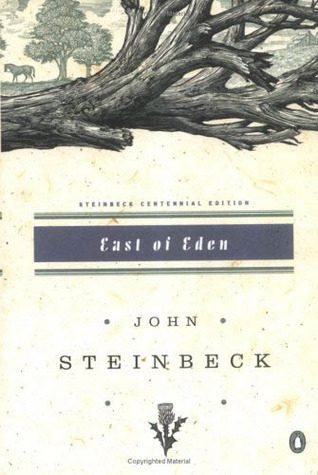 Steinbeck was not a man of strong Christian belief, I don’t think, but he wrote about faith all the time. The name of the book references a passage in Genesis–the the Land of Nod, where Cain settled after killing his brother Abel. Here, Steinbeck talks about the “miracle of creation,” and that is what almost all creation is: A miracle. Think about all the miracles we read about in the Bible: The light from darkness in Genesis, the life from death of the Gospels. Most of the miracles we see are explicit acts of creation. And as such, the fact that we humans have a desire to create (in our own limited way) is a miracle, too.
When we’re told that we’re made in God’s image, this is the area in which we reflect God the clearest: We both create. Honestly, I don’t believe we necessarily look like God. We can’t truly think as God would. But we do make things, a little like God did. We can feel the thrill of bringing something new to the world–not like a tree or a mountain, maybe, but a song or a painting or a house or even a blog post. When we create, we participate in a little miracle. Our children feel the joy of creation when they crack open their first can of Play-Doh and roll the putty into a snake. We feel a lightness in us when we build or paint or even dream–creating futures in our minds.
And even when we’re not creating, we can still feel the vicarious thrill of the act when we enjoy a well-made creation. A book by Steinbeck, for instance. We can feel the brilliance of it. We enjoy something made by a master, and in so doing, we brush the fringe of heaven. We see that, even the barest of building blocks–consonants and vowels and dots of punctuation–beauty can be built, a beauty that gives us just the barest hint of the inspiring awe beyond our understanding.
We cannot completely understand our God. If we could, He wouldn’t be God. But we can understand, in our own dim way, the satisfaction of creation. That’s a remarkable thing. And when we create, I think, we find ourselves in a thin place–a place a bit closer to God.
Previous Post

January 19, 2015
American Sniper: Holding Out for a Hero
Next Post

January 26, 2015 Big Hero 6: Binary Love
Browse Our Archives
Select a Category books celebrities Editor's Choice games movies music news sports superheroes television Uncategorized
Select a Month May 2026 April 2026 March 2026 December 2025 October 2025 July 2025 June 2025 May 2025 February 2025 January 2025 December 2024 July 2024 June 2024 May 2024 April 2024 March 2024 February 2024 January 2024 December 2023 September 2023 March 2023 February 2023 December 2022 November 2022 October 2022 September 2022 August 2022 July 2022 June 2022 May 2022 April 2022 March 2022 February 2022 December 2021 October 2021 August 2021 July 2021 June 2021 May 2021 April 2021 March 2021 October 2020 August 2020 July 2020 June 2020 May 2020 April 2020 March 2020 February 2020 January 2020 December 2019 November 2019 October 2019 September 2019 August 2019 July 2019 June 2019 May 2019 April 2019 March 2019 February 2019 January 2019 December 2018 November 2018 October 2018 September 2018 August 2018 July 2018 June 2018 May 2018 April 2018 March 2018 February 2018 January 2018 December 2017 November 2017 October 2017 September 2017 August 2017 July 2017 June 2017 May 2017 April 2017 March 2017 February 2017 January 2017 December 2016 November 2016 October 2016 September 2016 August 2016 July 2016 June 2016 May 2016 April 2016 March 2016 February 2016 January 2016 December 2015 November 2015 October 2015 September 2015 August 2015 July 2015 June 2015 May 2015 April 2015 March 2015 February 2015 January 2015 December 2014 November 2014 October 2014 September 2014
Follow Us!
TAKE THE
Religious Wisdom Quiz
What does the Sword of the Spirit represent?
Select your answer to see how you score.
The Word of God Faith The Holy Spirit The power of prayer
Books by This Author Books by Paul Asay
Related posts from Watching God

Finding Forgiveness in the Great Horror Film ‘Hokum’

Finding God's Grace in ‘Project Hail Mary’

Watching God’s Top 10 Movies of 2025

'Frankenstein' and the Monsters Among Us
TRENDING AT PATHEOS Religious Music & Entertainment

"Les Diabolique" and Transgression
Alongside something like Arrival, Vertigo, or Charade, Les Diaboliques is a...

"The Plague Dogs" and Mortality
So, flashback to the late 70s, early 80s. Walt Disney Studios is...

With the recent and highly successful release of Christopher Nolan’s epic film,...

"L'avventura" and Human Weakness
Today's piece is going to be a little different for a few...

I first want to apologize for not posting or writing anything. I'm...

I've engaged in the multi-year project of reading through the Church Fathers,...
view all Religious Music & Entertainment blogs
Ad-Free & Subscriber Log-In Subscription Support
- About Us
- 2026 Calendar
- Videos
- Podcasts
- Library of World Religions
- Faith In Media Tracker
- Advertise With Us
- Write for Us
- Privacy Policy
- Terms of Service
- Do Not Sell My Data
- Contact Us
- Radiant Digital
- Manage Newsletter Subscriptions
- Unsubscribe From Notifications
- Sitemap
Copyright 2008-2026, Patheos. All rights reserved.
Subscription Support Ad-Free & Subscriber Log-In
Follow Patheos