
BuddhistCatholicContemplativeEvangelicalGeneral ChristianHinduJewishLatter-day SaintMuslimNew VisionsProgressive Christian
Beliefs
- Buddhist
- Catholic
- Contemplative
- Evangelical
- General Christian
- Hindu
- Jewish
- Latter-day Saint
- More Voices
- Muslim
- New Visions
- Pagan
- Progressive Christian
Topics
- Religion News
- Food and Religion
- Sports and Religion
- Religious Art
- Religious Music and Entertainment
- Religious Events
- History and Religion
- Style and Religion
- Politics and Religion
- Women in Religion
- Recreation Outdoors and Religion
- Business Finance and Religion
- Careers Workplace and Religion
- Education and Religion
- Family Parenting and Religion
- Health Fitness and Religion
- Home and Religion
- Relationships and Religion
- Technology and Religion
- Travel and Religion
Columnists
- Buddhist Columnists
- Business Finance and Religion Columnists
- Careers Workplace and Religion Columnists
- Catholic Columnists
- Contemplative Columnists
- Education and Religion Columnists
- Evangelists Columnists
- Family Parenting and Religion Columnists
- General Christian Columnists
- Health Fitness and Religion Columnists
- Hindu Columnists
- History and Religion Columnists
- Home and Religion Columnists
- Jewish Columnists
- More Voices Columnists
- Latter Day Columnists
- Muslim Columnists
- New Visions Columnists
- Nonreligious Columnists
- Pagan Columnists
- Politics and Religion Columnists
- Progressive Columnists
- Recreation Outdoors and Religion Columnists
- Relationships and Religion Columnists
- Religion News Columnists
- Religious Art Columnists
- Religious Events Columnists
- Religious Music and Entertainment Columnists
- Sports and Religion Columnists
- Style and Religion Columnists
- Technology and Religion Columnists
- Travel and Religion Columnists
- Women in Religion Columnists
Resource Library
- 2026 Calendar
- Library of World Religions
- The 100 Most Holy Places on Earth
- Patheos Answers
- Podcasts
- Videos
- Faith Leaders Database
- Anglican Episcopalian
- Bahai
- Baptist
- Buddhism
- Christianity
- Confucianism
- Eastern Orthodoxy
- Hinduism
- Holiness and Pentecostal
- ISKCON
- Islam
- Judaism
- Lutheran
- Methodist
- The Church of Jesus Christ of Latter-day Saints
- New Age
- Paganism
- Presbytarian and Reformed
- Protestantism
- Religion Behind the Scenes
- Roman Catholic
- Scientology
- Shia Islam
- Sikhism
- Sufism
- Sunni Islam
- Taoism
- Zen
- See all religions
Research Tools
 Ad-Free & Subscriber Log-In Subscription Support
Ad-Free & Subscriber Log-In Subscription Support
Follow Patheos 

- Trending:
- Forgiveness
- |
- Marriage
- |
- Consciousness
- |
- Death Penalty
- |
- Election
- |
- Halloween

- Home
- Hindu
- Careers, Workplace and Religion
- Does your Belief System Suffer from “Low T”?
Does your Belief System Suffer from “Low T”?
Last updated on: July 17, 2025 at 2:26 pm by Gaurav Rastogi
Does your Belief System Suffer from “Low T”? 2025-07-17T14:26:08-07:00 Gaurav Rastogi
Patheos Explore the world's faith through different perspectives on religion and spirituality! Patheos has the views of the prevalent religions and spiritualities of the world.
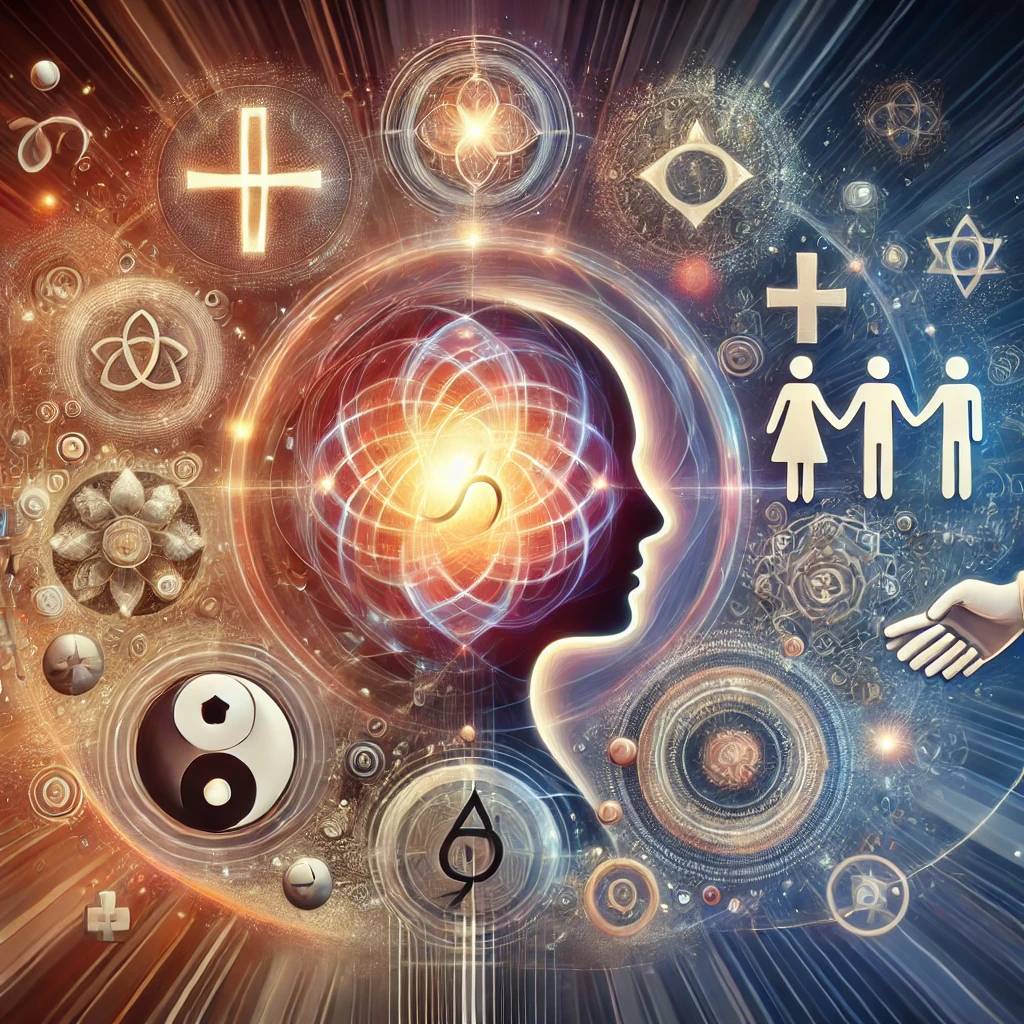
Being, Beliefs, Belonging, and Behavior, emphasizing the coexistence of multiple truths and identities in an illustrated image created in Dall*E for Patheos.
It’s 2024, and as voters, we face the complex landscape of our identities and beliefs. We must balance the influence of party loyalty and the weight of our policy preferences, all while straddling multiple truths. Something must give.
We belong to many truths and don’t always know how to choose among them. Our knee-jerk response is to look for a simplifying truth, a choice that supersedes every other choice and eliminates all paradoxes. But this reduces our identity to a tiny circle of possibilities.
Our identity works at many layers. Our Being is shaped by deeply personal convictions. Our beliefs encompass our secret names for God, our stance on scientific theories, the concept of the divine, and sometimes even the length of our pajamas. Our sense of Belonging is defined by our educational background, dietary restrictions, cultural affiliations, and even how we categorize societal structures. Our Behavior manifests in our accents, health choices, empathetic responses, and the symbols we display.
By embracing these overlapping aspects of our identities – Being, Beliefs, Belonging, and Behavior – we open ourselves to a richer, more nuanced understanding of the world. This capacity to hold seemingly contradictory truths makes us uniquely human, allowing us to grow, adapt, and connect in an ever-changing world, where even our choice of pronouns can be a profound statement of identity.
Contradictions and Paradoxes
These overlapping identities often lead us to embrace truths that, on the surface, might seem contradictory. A string theorist might find profound meaning in ancient religious texts. An advocate for social justice might struggle with inherited cultural practices. The parent who fiercely loves their child might also long for moments of solitude and independence. The beauty of human cognition lies in our ability to hold these multiple truths simultaneously. We can recognize that the pain we feel most acutely – tied to our nationality, race, or personal experiences – doesn’t negate the validity of others’ suffering. We can embrace scientific advancements like vaccines while respecting individual bodily autonomy.
Thou Shalt Have Low “t”?
However, this capacity for nuance and multiplicity often clashes with religious, political, and scientific systems that prefer a singular, unalterable truth. These “low truth” (or “low t”) systems seek to flatten the richness of human experience into a one-dimensional narrative. They demand unwavering allegiance to a limited set of beliefs, leaving no room for the natural contradictions and complexities that arise from our organically multifaceted identities. These systems fear the discomfort of holding multiple truths and paradoxes- seeing them as a threat rather than an opportunity for growth and understanding. But it is precisely this discomfort that allows us to craft our unique identities, form diverse groups, and take actions that reflect the full spectrum of our being.
By embracing the paradox of multiple truths, we open ourselves to a more nuanced understanding of the world. We become more adaptable, more compassionate, and more fully human. We recognize that the flag on someone’s social media profile doesn’t define their entire being, that the accent they speak with is just one thread in the tapestry of their identity.
In a world that often seeks to divide us into neat categories of “oppressor” and “oppressed,” embracing our multiple identities and truths allows us to see the humanity in others, even when their experiences differ from ours. It enables us to build bridges across seemingly insurmountable divides, recognizing that all contain multitudes.
Embrace the High T
Sanatana Dharma, often called Hinduism, offers a profound example of embracing multiple truths. This ancient tradition recognizes that Truth, with a capital ‘T’ and a small ‘t,’ can manifest in multiple forms. The Divine can be approached through countless paths, each valid in its own right. From the devotional bhakti yoga to the intellectual jnana yoga, from the action-oriented karma yoga to the meditative raja yoga, Sanatana Dharma offers a spectrum of approaches to spiritual realization.
It does not require adherents to reduce or limit the totality of truth. Instead, it encourages exploration and personal experience, recognizing that each individual’s journey to understanding is unique. This inclusive philosophy allows for the coexistence of seemingly contradictory ideas, celebrating the diversity of human spiritual experience while maintaining that all paths ultimately lead to the same universal truth.
As we navigate the complex landscape of our identities and beliefs, we will do well to remember the lessons of our political discourse. Just as voters in 2024 find themselves balancing party loyalty with policy preferences, we, too, must embrace the multiple truths that shape our lives. We should open ourselves to a richer, more nuanced understanding of the world and our place in it. Our capacity to hold seemingly contradictory truths makes us uniquely human, allowing us to grow, adapt, and connect in an ever-changing world.
Don’t let political and religious leaders reduce the Truths available to you.
Buddhism
Previous Post
December 1, 2023
Dharma: The Antidote to Effective Altruism's Cold Logic
Next Post

September 15, 2024 The One Truth, Many Names
Recent Comments
"Truth, like a celestial constellation, forms a unified whole from countless individual points of light. ..."
"Individuals frequently struggle to resolve and hold two or more personal contradictory truths simultaneously, finding ..."
Does your Belief System Suffer from ..."
"Excellent pitch for the karma theory. There is no free ride, you get what you ..."
Browse Our Archives
Select a Category Hindu religion spiritual Uncategorized
Select a Month October 2024 September 2024 December 2023 July 2023 June 2023 April 2023 March 2023 November 2016 October 2016 September 2016 February 2016 July 2015 May 2015 April 2015 January 2015
TAKE THE
Religious Wisdom Quiz
How many total plagues did God send on Egypt?
Select your answer to see how you score.
Ten Seven Twelve Five
Related posts from Watcher on the Hill
From Socrates to Silicon: The Evolution of our...
Dharma: The Antidote to Effective Altruism's Cold Logic
Written Religions face a Reckoning: A New God...
TRENDING AT PATHEOS Hindu

Indian Hindu pilot’s valor in line of duty...
There is a hoary maritime tradition that the captain of the...

Movie on Neem Karoli Baba’s life is a...
Neem Karoli Baba’s life (1900-1973) is associated with miracles he made in...

20 Questions to Ask Before an Interfaith Marriage,...
Four questions every interfaith couple should discuss before marriage: Conversion. Will either...

Avadhānam: The Art of Concentration and Intellectual Mastery
What is Avadhānam? In the summer of 2015, during a three-day Sanskrit...

Jesus in the Dharma: Where Christ Fits in...
Where Does Jesus Fit in Hinduism? That’s a question I get often...

Hormuz: A Shared Hindu and Zoroastrian Heritage
Every evening, somewhere in the world, a newsreader utters the words: "The...
view all Hindu blogs
What Are Your Thoughts?leave a comment
Ad-Free & Subscriber Log-In Subscription Support
- About Us
- 2026 Calendar
- Videos
- Podcasts
- Library of World Religions
- Faith In Media Tracker
- Advertise With Us
- Write for Us
- Privacy Policy
- Terms of Service
- Do Not Sell My Data
- Contact Us
- Radiant Digital
- Manage Newsletter Subscriptions
- Unsubscribe From Notifications
- Sitemap
Copyright 2008-2026, Patheos. All rights reserved.
Subscription Support Ad-Free & Subscriber Log-In
Follow Patheos