
BuddhistCatholicContemplativeEvangelicalGeneral ChristianHinduJewishLatter-day SaintMuslimNew VisionsProgressive Christian
Beliefs
- Buddhist
- Catholic
- Contemplative
- Evangelical
- General Christian
- Hindu
- Jewish
- Latter-day Saint
- More Voices
- Muslim
- New Visions
- Pagan
- Progressive Christian
Topics
- Religion News
- Food and Religion
- Sports and Religion
- Religious Art
- Religious Music and Entertainment
- Religious Events
- History and Religion
- Style and Religion
- Politics and Religion
- Women in Religion
- Recreation Outdoors and Religion
- Business Finance and Religion
- Careers Workplace and Religion
- Education and Religion
- Family Parenting and Religion
- Health Fitness and Religion
- Home and Religion
- Relationships and Religion
- Technology and Religion
- Travel and Religion
Columnists
- Buddhist Columnists
- Business Finance and Religion Columnists
- Careers Workplace and Religion Columnists
- Catholic Columnists
- Contemplative Columnists
- Education and Religion Columnists
- Evangelists Columnists
- Family Parenting and Religion Columnists
- General Christian Columnists
- Health Fitness and Religion Columnists
- Hindu Columnists
- History and Religion Columnists
- Home and Religion Columnists
- Jewish Columnists
- More Voices Columnists
- Latter Day Columnists
- Muslim Columnists
- New Visions Columnists
- Nonreligious Columnists
- Pagan Columnists
- Politics and Religion Columnists
- Progressive Columnists
- Recreation Outdoors and Religion Columnists
- Relationships and Religion Columnists
- Religion News Columnists
- Religious Art Columnists
- Religious Events Columnists
- Religious Music and Entertainment Columnists
- Sports and Religion Columnists
- Style and Religion Columnists
- Technology and Religion Columnists
- Travel and Religion Columnists
- Women in Religion Columnists
Resource Library
- 2026 Calendar
- Library of World Religions
- The 100 Most Holy Places on Earth
- Patheos Answers
- Podcasts
- Videos
- Faith Leaders Database
- Anglican Episcopalian
- Bahai
- Baptist
- Buddhism
- Christianity
- Confucianism
- Eastern Orthodoxy
- Hinduism
- Holiness and Pentecostal
- ISKCON
- Islam
- Judaism
- Lutheran
- Methodist
- The Church of Jesus Christ of Latter-day Saints
- New Age
- Paganism
- Presbytarian and Reformed
- Protestantism
- Religion Behind the Scenes
- Roman Catholic
- Scientology
- Shia Islam
- Sikhism
- Sufism
- Sunni Islam
- Taoism
- Zen
- See all religions
Research Tools
 Ad-Free & Subscriber Log-In Subscription Support
Ad-Free & Subscriber Log-In Subscription Support
Follow Patheos 

- Trending:
- Forgiveness
- |
- Marriage
- |
- Consciousness
- |
- Death Penalty
- |
- Election
- |
- Halloween

- Home
- Hindu
- Careers, Workplace and Religion
- The Full Supermoon (Poornamadaha Poornamidam)
The Full Supermoon (Poornamadaha Poornamidam)
Last updated on: February 27, 2023 at 1:13 pm by Gaurav Rastogi
The Full Supermoon (Poornamadaha Poornamidam) 2023-02-27T13:13:41-08:00 Gaurav Rastogi
Patheos Explore the world's faith through different perspectives on religion and spirituality! Patheos has the views of the prevalent religions and spiritualities of the world.
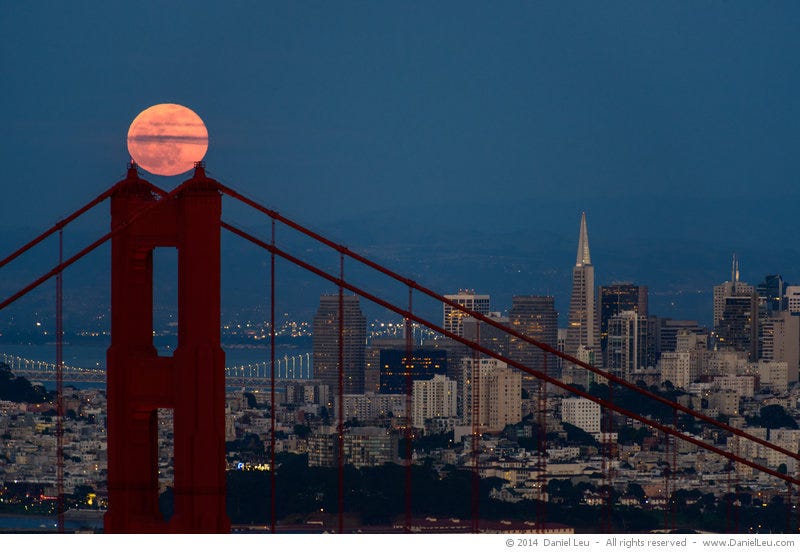
In 2016, November 14 is Gurpurab, the full-moon night celebrating the enlightenment of Guru Nanak Dev ji, the first Sikh Guru. It is also a Supermoon, the largest the moon will appear in a generation because it’s closest to the Earth today.
My private diaries are filled with doodles on the self, wholeness, and infinity, and today seems the appropriate to get some out; a whole-some part.
The Full Moon and Yoga. Of the heavenly bodies that light up our skies, the Sun is harsh to look at except at dusk and dawn, but the full Moon comes only once a month, and we can stare at it all night long. The moon’s attraction causes tides in the oceans, and in the affairs of men, to paraphrase Shakespeare. There against the dark sky, the bright beautiful moon calls out to poets, lovers and astronomers alike. In the Yoga system, the Sun and the Moon represent the two channels, the Pingala and the Ida nadis. Even gift-store-chakra charts have the two nadis snaking around the spinal column. The full moon has much deeper significance for the yogi than for the lover. Enlightenment is associated with the Full Moon in many traditions, and many Taoist and Buddhist teachings also use the full moon as a teaching aid. When the Buddha points his finger at the Moon, he is asking you to look at the Moon, and not his finger. The teaching is not the message, but the experience itself is the message. Don’t memorize his words, but follow his words to the experience of Enlightenment. The Moon means much.
Celebrating the Whole Whole-ness is celebrated in an early Upanishad in the yoga tradition. The first verse of the Isha-Upanishad is a concise definition of infinity, wholeness and the essence of our being.
ॐ पूर्णमदः पूर्णमिदं पूर्णात्पुर्णमुदच्यते
पूर्णस्य पूर्णमादाय पूर्णमेवावशिष्यते ॥
ॐ शान्तिः शान्तिः शान्तिः ॥
Om Puurnnam-Adah Puurnnam-Idam Puurnnaat-Purnnam-Udacyate
Puurnnasya Puurnnam-Aadaaya Puurnnam-Eva-Avashissyate ||
Om Shaantih Shaantih Shaantih ||
Om. That is full; this is full.This fullness has been projected from that fullness. When this fullness merges in that fullness, all that remains is fullness. Om. Peace! Peace! Peace!
There’s never half a hole. The 2016 Nobel prize for Physics was given to British scientists whose work was around unusual states of matter. According to Reuters, their research centers on topology, a branch of mathematics involving step-wise changes like making a series of holes in an object. The difficult-to-grasp concept was illustrated by Nobel Committee member Thors Hans Hansson at a news conference using a cinnamon bun, a bagel and a Swedish style of pretzel with two holes.
“If you are a topolgist, it’s only one thing that is really interesting with these things,” Hansson said. “The bagel has one hole, the pretzel has two holes … you cannot have half a hole, or 2–2/3 holes.”
When I saw the video of this news conference, I was struck by how similar this sentiment is to the verse from the Isha Upanishad.
You cannot have half-a-hole.
You can only have a whole-hole. You take a bagel with a single hole, and fold it into itself to get a pretzel, and you have two holes. The new hole is also whole. You can continue to fold and make as many holes as you want, but they will always be complete in themselves.
From one whole, there can be made another. This is whole, that is whole.
When we fold the bagel into a pretzel, the bagel-hole still remains whole. When we take a whole out of a whole, the whole still remains.
When the pretzel is unfolded, the two holes merge into one, and the new hole is still whole. When the wholes merge, the whole still remains.
When we weren’t yet born, we weren’t there. When we were but a fetus in our mother’s womb, we were just a part of our mother. We were just not there, and our mother felt complete in her own identity, her own self. And her mother, she felt complete too, and so on going all the way back to the first Mother. This sense of complete-ness is inherited from a long chain of being.
When we die, the universe stays around, not feeling any more complete than when we are alive. What came from the Universe (or God, which is what people called “the Absolute” before religion became a retrograde term for some) has gone back into the Universe, and nothing changes in the whole-ness of the Universe because of this coming of going away of an individual hole.
So what is it to live, and to feel like a full self? Our conscious mind creates our experience and we feel that we are complete. When I look out from my eyes, I don’t think “I somehow miss having X-ray vision”. When I feel things with my hand, I’m not thinking “I miss not having the ability to pass my hands through matter like a hot knife passes through butter”. We just don’t miss not being us. We feel our experience is complete, and we are a full self.
But still, deep inside, our sense of being a person is punctured by a sense of not being Whole. We know this feeling as a spiritual hunger, a yearning, or an unasked questioning that calls us. This sense of un-ease with our individual-ized identity drives us to madness, and we want to transcend this self and merge into the Universal Self.
This merging is the experience of Enlightenment, when we see the world outside and inside with the same eyes. When the distinction between “this” and “that” has disappeared, and when the distinction between “me” and “not me” has been dropped. That moment, we become Whole. That experience is what’s described in the Isha Upanishad, and by Guru Nanak Dev (in the Japji) and by every other seeker that has realized.
From many wholes, we return to the Whole. The Moon is Full again.
Om Shanti, Shanti, Shanti.
Previous Post

October 28, 2016
From Darkness to True Light
Next Post

March 8, 2023 The Land Remembers What People Have Forgotten
Browse Our Archives
Select a Category Hindu religion spiritual Uncategorized
Select a Month October 2024 September 2024 December 2023 July 2023 June 2023 April 2023 March 2023 November 2016 October 2016 September 2016 February 2016 July 2015 May 2015 April 2015 January 2015
TAKE THE
Religious Wisdom Quiz
Who opened the first seal to release the White Horse in Revelation?
Select your answer to see how you score.
John The Lamb (Jesus) An angel The 24 Elders
Related posts from Watcher on the Hill




The bluebird carries the sky on his back
TRENDING AT PATHEOS Hindu

Indian Hindu pilot’s valor in line of duty...
There is a hoary maritime tradition that the captain of the...

Movie on Neem Karoli Baba’s life is a...
Neem Karoli Baba’s life (1900-1973) is associated with miracles he made in...

20 Questions to Ask Before an Interfaith Marriage,...
Four questions every interfaith couple should discuss before marriage: Conversion. Will either...

Avadhānam: The Art of Concentration and Intellectual Mastery
What is Avadhānam? In the summer of 2015, during a three-day Sanskrit...

Jesus in the Dharma: Where Christ Fits in...
Where Does Jesus Fit in Hinduism? That’s a question I get often...

Hormuz: A Shared Hindu and Zoroastrian Heritage
Every evening, somewhere in the world, a newsreader utters the words: "The...
view all Hindu blogs
Ad-Free & Subscriber Log-In Subscription Support
- About Us
- 2026 Calendar
- Videos
- Podcasts
- Library of World Religions
- Faith In Media Tracker
- Advertise With Us
- Write for Us
- Privacy Policy
- Terms of Service
- Do Not Sell My Data
- Contact Us
- Radiant Digital
- Manage Newsletter Subscriptions
- Unsubscribe From Notifications
- Sitemap
Copyright 2008-2026, Patheos. All rights reserved.
Subscription Support Ad-Free & Subscriber Log-In
Follow Patheos