
BuddhistCatholicContemplativeEvangelicalGeneral ChristianHinduJewishLatter-day SaintMuslimNew VisionsProgressive Christian
Beliefs
- Buddhist
- Catholic
- Contemplative
- Evangelical
- General Christian
- Hindu
- Jewish
- Latter-day Saint
- More Voices
- Muslim
- New Visions
- Pagan
- Progressive Christian
Topics
- Religion News
- Food and Religion
- Sports and Religion
- Religious Art
- Religious Music and Entertainment
- Religious Events
- History and Religion
- Style and Religion
- Politics and Religion
- Women in Religion
- Recreation Outdoors and Religion
- Business Finance and Religion
- Careers Workplace and Religion
- Education and Religion
- Family Parenting and Religion
- Health Fitness and Religion
- Home and Religion
- Relationships and Religion
- Technology and Religion
- Travel and Religion
Columnists
- Buddhist Columnists
- Business Finance and Religion Columnists
- Careers Workplace and Religion Columnists
- Catholic Columnists
- Contemplative Columnists
- Education and Religion Columnists
- Evangelists Columnists
- Family Parenting and Religion Columnists
- General Christian Columnists
- Health Fitness and Religion Columnists
- Hindu Columnists
- History and Religion Columnists
- Home and Religion Columnists
- Jewish Columnists
- More Voices Columnists
- Latter Day Columnists
- Muslim Columnists
- New Visions Columnists
- Nonreligious Columnists
- Pagan Columnists
- Politics and Religion Columnists
- Progressive Columnists
- Recreation Outdoors and Religion Columnists
- Relationships and Religion Columnists
- Religion News Columnists
- Religious Art Columnists
- Religious Events Columnists
- Religious Music and Entertainment Columnists
- Sports and Religion Columnists
- Style and Religion Columnists
- Technology and Religion Columnists
- Travel and Religion Columnists
- Women in Religion Columnists
Resource Library
- 2026 Calendar
- Library of World Religions
- The 100 Most Holy Places on Earth
- Patheos Answers
- Podcasts
- Videos
- Faith Leaders Database
- Anglican Episcopalian
- Bahai
- Baptist
- Buddhism
- Christianity
- Confucianism
- Eastern Orthodoxy
- Hinduism
- Holiness and Pentecostal
- ISKCON
- Islam
- Judaism
- Lutheran
- Methodist
- The Church of Jesus Christ of Latter-day Saints
- New Age
- Paganism
- Presbytarian and Reformed
- Protestantism
- Religion Behind the Scenes
- Roman Catholic
- Scientology
- Shia Islam
- Sikhism
- Sufism
- Sunni Islam
- Taoism
- Zen
- See all religions
Research Tools
 Ad-Free & Subscriber Log-In Subscription Support
Ad-Free & Subscriber Log-In Subscription Support
Follow Patheos 

- Trending:
- Forgiveness
- |
- Marriage
- |
- Consciousness
- |
- Death Penalty
- |
- Election
- |
- Halloween

- Home
- Hindu
- Careers, Workplace and Religion
- Turning inwards
Turning inwards
Last updated on: February 27, 2023 at 1:15 pm by Gaurav Rastogi
Turning inwards 2023-02-27T13:15:25-08:00 Gaurav Rastogi
Patheos Explore the world's faith through different perspectives on religion and spirituality! Patheos has the views of the prevalent religions and spiritualities of the world.

Photo Credit: Flickr
Metanoia.
“Metanoia”…the word came to mind silently one morning in that period between sleep and wakefulness, and stayed around after one was awake. What does this word mean, and why was it ringing in the ear?
The dictionary says it means a change in one’s way of life resulting from penitence or a spiritual conversion. The word is Greek, and the English versions of the Christian Bible’s New Testament often translated this Greek word as “repentance”, and a whole culture has unfolded because of this translation, oriented towards guilt, sin and repentance. Clergy could offer the change to repent and therefore become more powerful intermediaries between the sinners and the absolver of this sin, said to be God.
There was one voice of dissent early on. This was a person called Tertullian, who is thought of as the father of western Theology. Tertullian was the first one to protest that the translation of Metanoia into “repentance” was not a confession of sins, but a change of mind. We are usually running into the outside world samsara, always looking for validation in things that we see in the outside world. A redirection of the energies inwards is exactly a change of mind. When we stop looking for completion outside, and begin to find the peace inwards in our own hearts. Dhyana or Meditation is metanoia, from this perspective. A change of mind, a change of heart, and a change of direction from centrifugal to centripetal.
Now imagine if the original Greek had been translated correctly and interpreted in the same way that yoga does! It would mean a redesign in the foundation of one of the largest organized religions. Instead of focusing on paying for sins through intermediaries, there would be a focus on an inner transformation, which does not, and can not, require brokers to intercede, interpret, and intermediate. There would be no cult, but the original message of Jesus could be transferred just the way it was said. As an inner transformation that cannot be had from the outside, and this inner work is something very personal, very private, very silent. This doesn’t require a social or cultural system, no set of beliefs, and definitely no power structure to enable this transformation.
Tertullian said another famous thing that rings a bell, but is also interpreted in the exact opposite way. Credo quia absurdum (I believe because it is absurd) is the usual way he is paraphrased. In this, Tertullian is explaining his reasons for believing in Jesus Christ, and that the reasons for belief are that there is no reason possible. That’s a strange and striking argument, isn’t it? It’s an almost child-like assertion of truth without facts, and the kind of argument that can be heard in a children’s playground. But what if you think about it differently. The capacity to reason is the responsibility of the mind. When all reason is consumed, something still remains. When the mind is no more, something still remains. That something must be absurd, irrational, unreasonable. The world is absurd because it is unknowable, and therefore there is a need to believe.
The mad greek was right, but he’s long gone, and his words are just the ramblings of another madman.
Previous Post

July 25, 2015
A Modern Vyasa
Next Post
September 23, 2016 Prayers just reminders
Browse Our Archives
Select a Category Hindu religion spiritual Uncategorized
Select a Month October 2024 September 2024 December 2023 July 2023 June 2023 April 2023 March 2023 November 2016 October 2016 September 2016 February 2016 July 2015 May 2015 April 2015 January 2015
TAKE THE
Religious Wisdom Quiz
Be still, and know that I am ____.
Select your answer to see how you score.
God Holy Faithful Sovereign
Related posts from Watcher on the Hill


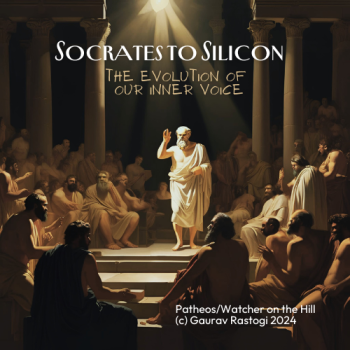
From Socrates to Silicon: The Evolution of our...
TRENDING AT PATHEOS Hindu

Indian Hindu pilot’s valor in line of duty...
There is a hoary maritime tradition that the captain of the...

Movie on Neem Karoli Baba’s life is a...
Neem Karoli Baba’s life (1900-1973) is associated with miracles he made in...

20 Questions to Ask Before an Interfaith Marriage,...
Four questions every interfaith couple should discuss before marriage: Conversion. Will either...

Avadhānam: The Art of Concentration and Intellectual Mastery
What is Avadhānam? In the summer of 2015, during a three-day Sanskrit...

Jesus in the Dharma: Where Christ Fits in...
Where Does Jesus Fit in Hinduism? That’s a question I get often...

Hormuz: A Shared Hindu and Zoroastrian Heritage
Every evening, somewhere in the world, a newsreader utters the words: "The...
view all Hindu blogs
Ad-Free & Subscriber Log-In Subscription Support
- About Us
- 2026 Calendar
- Videos
- Podcasts
- Library of World Religions
- Faith In Media Tracker
- Advertise With Us
- Write for Us
- Privacy Policy
- Terms of Service
- Do Not Sell My Data
- Contact Us
- Radiant Digital
- Manage Newsletter Subscriptions
- Unsubscribe From Notifications
- Sitemap
Copyright 2008-2026, Patheos. All rights reserved.
Subscription Support Ad-Free & Subscriber Log-In
Follow Patheos