
BuddhistCatholicContemplativeEvangelicalGeneral ChristianHinduJewishLatter-day SaintMuslimNew VisionsProgressive Christian
Beliefs
- Buddhist
- Catholic
- Contemplative
- Evangelical
- General Christian
- Hindu
- Jewish
- Latter-day Saint
- More Voices
- Muslim
- New Visions
- Pagan
- Progressive Christian
Topics
- Religion News
- Food and Religion
- Sports and Religion
- Religious Art
- Religious Music and Entertainment
- Religious Events
- History and Religion
- Style and Religion
- Politics and Religion
- Women in Religion
- Recreation Outdoors and Religion
- Business Finance and Religion
- Careers Workplace and Religion
- Education and Religion
- Family Parenting and Religion
- Health Fitness and Religion
- Home and Religion
- Relationships and Religion
- Technology and Religion
- Travel and Religion
Columnists
- Buddhist Columnists
- Business Finance and Religion Columnists
- Careers Workplace and Religion Columnists
- Catholic Columnists
- Contemplative Columnists
- Education and Religion Columnists
- Evangelists Columnists
- Family Parenting and Religion Columnists
- General Christian Columnists
- Health Fitness and Religion Columnists
- Hindu Columnists
- History and Religion Columnists
- Home and Religion Columnists
- Jewish Columnists
- More Voices Columnists
- Latter Day Columnists
- Muslim Columnists
- New Visions Columnists
- Nonreligious Columnists
- Pagan Columnists
- Politics and Religion Columnists
- Progressive Columnists
- Recreation Outdoors and Religion Columnists
- Relationships and Religion Columnists
- Religion News Columnists
- Religious Art Columnists
- Religious Events Columnists
- Religious Music and Entertainment Columnists
- Sports and Religion Columnists
- Style and Religion Columnists
- Technology and Religion Columnists
- Travel and Religion Columnists
- Women in Religion Columnists
Resource Library
- 2026 Calendar
- Library of World Religions
- The 100 Most Holy Places on Earth
- Patheos Answers
- Podcasts
- Videos
- Faith Leaders Database
- Anglican Episcopalian
- Bahai
- Baptist
- Buddhism
- Christianity
- Confucianism
- Eastern Orthodoxy
- Hinduism
- Holiness and Pentecostal
- ISKCON
- Islam
- Judaism
- Lutheran
- Methodist
- The Church of Jesus Christ of Latter-day Saints
- New Age
- Paganism
- Presbytarian and Reformed
- Protestantism
- Religion Behind the Scenes
- Roman Catholic
- Scientology
- Shia Islam
- Sikhism
- Sufism
- Sunni Islam
- Taoism
- Zen
- See all religions
Research Tools
 Ad-Free & Subscriber Log-In Subscription Support
Ad-Free & Subscriber Log-In Subscription Support
Follow Patheos 

- Trending:
- Forgiveness
- |
- Marriage
- |
- Consciousness
- |
- Death Penalty
- |
- Election
- |
- Halloween

- Home
- Hindu
- Careers, Workplace and Religion
- A question of Identity
A question of Identity
Last updated on: February 27, 2023 at 1:02 pm by Gaurav Rastogi
A question of Identity 2023-02-27T13:02:03-08:00 Gaurav Rastogi
Patheos Explore the world's faith through different perspectives on religion and spirituality! Patheos has the views of the prevalent religions and spiritualities of the world.

Anonymous. Photo Credit (link)
At a party the other day, while mingling with old and new faces, a friendly looking chap walks up and says, “So, who’re you?”. Very infrequently does one get an in-person friend request, in this age of social media, and so I habitually rattled off my name and enough biographical details for him to place me in terms of history, geography and economics. The sort you might find in my byline below. But this time it was different — I felt somehow that I hadn’t really answered his question.
This article first appeared in print on India Currents. (link)
Whenever I need to know more about something, I look it up on Google. Now that I needed to know more about myself, I turned to my friends at the Mountain View Googleplex…and it was a complete waste of a gorgeous three-day summer weekend! What would be that search, whose answer is “me”?
Where would I start, and where should I look? It’s not an easy question and, frankly, the answer is less interesting than the question itself.
Let’s eliminate the obvious right away — I’m not just my name. If that were true, and we were only our given name, we would be frozen in character when our parents named us. That reminds me of a story.
In the late-70s, before killer drones roamed the skies, global terror was created by the American satellite that was about to fall from the skies, a screaming ball of flaming metal traveling at a frightening velocity.
Far on the other side of the planet, we kids in India were warned to stay indoors that July week, for death was coming from above. The Skylab was falling and the entire world was waiting prayerfully. And so, but naturally, it was inevitable that a couple in Punjab would hit upon just the right name for their newborn son — Skylab Singh; what better name would strike fear in the heart of the enemy?! I often think — does he fly high, the boy who’s now a man, does he do experiments in space, and does he always re-enter in a fiery ball? I certainly hope not, or we would have heard about it too.
We’re not our names at all, dear Skylab Singh, so relax and don’t worry about falling from the skies anymore. If you Google “Skylab”, you will find things about your namesake, but not about your own character!
Maybe the answer is to situate oneself relative to other people. We are sons to our parents, carrying their genes and influenced by their nurture. We look like them, we talk like them and, much as we like to think otherwise, we somehow think like our parents too. We are also friends with famous or infamous people — some of their celebrity may have rubbed on us along the way. For example, I went to bschool with someone who has of late become an exceedingly popular writer of pulp fiction — does our time together mean that I too can spin a good yarn? Maybe not, but if that bloke can write (and if that tripe is called writing), then I also think myself a writer. We are also parents, and inherit traits in the other direction too, son to father. Being the father of William H Gates III, the Third, must have changed in some way the character of William H Gates II, the second, even though the latter came first. Counting out in this way, we are sons, fathers, friends, brothers, colleagues and mentors to other people. Our social network graph spirals out indefinitely in degrees, eventually touching all humanity, since history began, and goes back further to the first primate, continuing further back into the first mammal, then rewinding the story back to the fish that crawled, and going on (keep pace now, we’re almost there) to the multi-cellular goop and then to the simple creatures that bubbled around in the primordial soup.
Speaking of bubbly simple creatures, you’re probably “friends” with a few on Facebook. Everybody, their third cousin, and your fourth grade classmates are friends with you on Facebook. Does that tell you anything about yourself, other than that you like peeping through windows into other people’s homes and lives; that some of your friends like to over-share; that your friends play “Criminal Minds” and would like you to join in. Looking at others is a poor way to learn anything about your own self.
Relativity is great, but the variables are too many and the search likely futile.
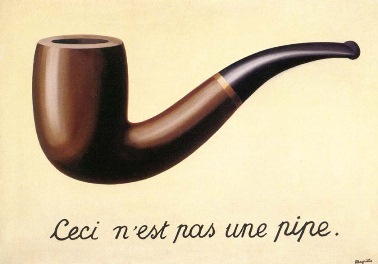
Sometimes we describe ourselves as a collection of social and cultural identities. An Indian, Hindu, American, Educated, Middle-Class, West Coast, Global Citizen, maybe? These are boxes in which we can put ourselves, but these cannot be a fulfilling way to describe ourselves. Cultural boxes may be meaningful in the society at a point in time, but will eventually lose their meaning, or even acquire the opposite meaning in time. These boxes are just labels, but they are not the thing itself. I am reminded of that painting “The Treason of Images” which shows a pipe, below which is written in French “this is not a pipe”. An image is not the thing itself. We are not the labels that we, or others, put on us. We are something entirely different from the words that can be used to describe us.

This is not a pipe. Photo Credit (wikipedia)
A little self-reflection is called for here. For many of us, self-reflection is limited to brushing and combing in front of the bathroom mirror. We know what we “look like”, but are we defined completely by our looks? If we were our looks, people across the world would not spend Billions to look like someone else. We’re not merely the face we see in the mirror.
Granted, we are not what we look like. But are we our body, since we identify so completely with it…we’re identical with it?
People who lose limbs don’t become someone else. People grow in size, change appearance, and still feel they are the same person all the way. Dead bodies still look like the people they used to be. We’re inside a body, but where exactly inside the body, and what is our relationship with this body? What separates a living person from a dead body? This isn’t just a hipster question to impress people with at parties. Sage Ramana Maharshi contemplated what it means to die, and attained enlightenment by just thinking only about this question, following it to the ultimate conclusion. So, ask yourself this: Who am I?
This is an absurd question, isn’t it? We know who we are. We have a name, and we’re situated in space and in time. We have experienced a series of experiences, we have our memories. We have parents, friends, relatives and colleagues. We belong to circles on Venn Diagrams. We carry out actions, and we think thoughts. When we see things, they are seen by us. When we hear things, they are heard by us.
When we touch things, they are touched by us. We are the focal point of all our senses. We are the generative point of all our actions. We are the lead protagonist of our story, a story that has a beginning, middle and an end. We are the center of our Universe, that’s who we are.
No really, not that borrowed answer. Ask again, Who Am I?
My name is a temporary label, my location in space and time is relative. My experiences are impermanent and my memory is fickle. My actions couple with the reaction of the Universe (Newton, I believe, figured this out). My thoughts use words, ideas and logical structures that are borrowed from others. My senses convey only a fraction of the reality to me, hiding the microwaves, the low pitches, and so on. Why, there appears nothing in me that stands on its own — everything about me is relative.
We run after hard, material things because we believe they will help us become someone, some-thing of substance and permanence. We want experiences that will define us, memories that shape our outline.
We want money, we want fame, we want the whole world — this hunger is so intense. We crave fulfillment in this world of passing experiences, and get frustrated when these experiences peak, and then pass away as well. Maybe the outside isn’t the right place to find fulfillment. “Wrong Way” signs on the freeway. Turn around and go inside.
Or maybe the answer isn’t meant to be found, and the question needs to be unasked — Who Am I?
Previous Post

May 11, 2015
Life, Interrupted
Next Post
May 11, 2015 Yoga by Ganga
Browse Our Archives
Select a Category Hindu religion spiritual Uncategorized
Select a Month October 2024 September 2024 December 2023 July 2023 June 2023 April 2023 March 2023 November 2016 October 2016 September 2016 February 2016 July 2015 May 2015 April 2015 January 2015
TAKE THE
Religious Wisdom Quiz
Who said, "Even though I walk through the valley of the shadow of death, I will fear no evil"?
Select your answer to see how you score.
Moses David Job Paul
Related posts from Watcher on the Hill



The bluebird carries the sky on his back

TRENDING AT PATHEOS Hindu

Indian Hindu pilot’s valor in line of duty...
There is a hoary maritime tradition that the captain of the...

Movie on Neem Karoli Baba’s life is a...
Neem Karoli Baba’s life (1900-1973) is associated with miracles he made in...

20 Questions to Ask Before an Interfaith Marriage,...
Four questions every interfaith couple should discuss before marriage: Conversion. Will either...

Avadhānam: The Art of Concentration and Intellectual Mastery
What is Avadhānam? In the summer of 2015, during a three-day Sanskrit...

Jesus in the Dharma: Where Christ Fits in...
Where Does Jesus Fit in Hinduism? That’s a question I get often...

Hormuz: A Shared Hindu and Zoroastrian Heritage
Every evening, somewhere in the world, a newsreader utters the words: "The...
view all Hindu blogs
Ad-Free & Subscriber Log-In Subscription Support
- About Us
- 2026 Calendar
- Videos
- Podcasts
- Library of World Religions
- Faith In Media Tracker
- Advertise With Us
- Write for Us
- Privacy Policy
- Terms of Service
- Do Not Sell My Data
- Contact Us
- Radiant Digital
- Manage Newsletter Subscriptions
- Unsubscribe From Notifications
- Sitemap
Copyright 2008-2026, Patheos. All rights reserved.
Subscription Support Ad-Free & Subscriber Log-In
Follow Patheos