
BuddhistCatholicContemplativeEvangelicalGeneral ChristianHinduJewishLatter-day SaintMuslimNew VisionsProgressive Christian
Beliefs
- Buddhist
- Catholic
- Contemplative
- Evangelical
- General Christian
- Hindu
- Jewish
- Latter-day Saint
- More Voices
- Muslim
- New Visions
- Pagan
- Progressive Christian
Topics
- Religion News
- Food and Religion
- Sports and Religion
- Religious Art
- Religious Music and Entertainment
- Religious Events
- History and Religion
- Style and Religion
- Politics and Religion
- Women in Religion
- Recreation Outdoors and Religion
- Business Finance and Religion
- Careers Workplace and Religion
- Education and Religion
- Family Parenting and Religion
- Health Fitness and Religion
- Home and Religion
- Relationships and Religion
- Technology and Religion
- Travel and Religion
Columnists
- Buddhist Columnists
- Business Finance and Religion Columnists
- Careers Workplace and Religion Columnists
- Catholic Columnists
- Contemplative Columnists
- Education and Religion Columnists
- Evangelists Columnists
- Family Parenting and Religion Columnists
- General Christian Columnists
- Health Fitness and Religion Columnists
- Hindu Columnists
- History and Religion Columnists
- Home and Religion Columnists
- Jewish Columnists
- More Voices Columnists
- Latter Day Columnists
- Muslim Columnists
- New Visions Columnists
- Nonreligious Columnists
- Pagan Columnists
- Politics and Religion Columnists
- Progressive Columnists
- Recreation Outdoors and Religion Columnists
- Relationships and Religion Columnists
- Religion News Columnists
- Religious Art Columnists
- Religious Events Columnists
- Religious Music and Entertainment Columnists
- Sports and Religion Columnists
- Style and Religion Columnists
- Technology and Religion Columnists
- Travel and Religion Columnists
- Women in Religion Columnists
Resource Library
- 2026 Calendar
- Library of World Religions
- The 100 Most Holy Places on Earth
- Patheos Answers
- Podcasts
- Videos
- Faith Leaders Database
- Anglican Episcopalian
- Bahai
- Baptist
- Buddhism
- Christianity
- Confucianism
- Eastern Orthodoxy
- Hinduism
- Holiness and Pentecostal
- ISKCON
- Islam
- Judaism
- Lutheran
- Methodist
- The Church of Jesus Christ of Latter-day Saints
- New Age
- Paganism
- Presbytarian and Reformed
- Protestantism
- Religion Behind the Scenes
- Roman Catholic
- Scientology
- Shia Islam
- Sikhism
- Sufism
- Sunni Islam
- Taoism
- Zen
- See all religions
Research Tools
 Ad-Free & Subscriber Log-In Subscription Support
Ad-Free & Subscriber Log-In Subscription Support
Follow Patheos 

- Trending:
- Forgiveness
- |
- Marriage
- |
- Consciousness
- |
- Death Penalty
- |
- Election
- |
- Halloween
 Walk the Land
- Home
- Catholic
- Politics and Religion
- A Spiritual Response to “How Rosaries Became the Extremist Symbol”
A Spiritual Response to “How Rosaries Became the Extremist Symbol”
Last updated on: October 21, 2022 at 6:21 pm by Melissa Presser
A Spiritual Response to “How Rosaries Became the Extremist Symbol” 2022-10-21T18:21:23-04:00 Melissa Presser
Patheos Explore the world's faith through different perspectives on religion and spirituality! Patheos has the views of the prevalent religions and spiritualities of the world.
I’m not going to write another opinion-based response to Daniel Panneton about how rosaries became the extremist symbol within the Catholic Church. And although I typically use this space to write about the creation of positive and inspiring Catholic content for social media, I find the Holy Spirit insistent that I address the response on both sides to this article.
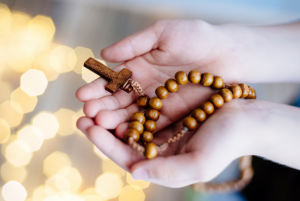
Image Courtesy of Canva Pro By djedzura
Let the least of us be Heard
I would have liked to have had more time to address this, but today’s news cycle has no patience for a thinker like me who still believes in civil discourse and fair and accurate responses. And while my opinion may be muted among the larger outlets that have money and louder voices, I still feel that the God I serve uses the small and weak of this world to shame the wise.
If you haven’t read the article, let’s just stop right there. Get yourself together. I will not engage in discourse if you have not sat down and read the article in its entirety.
Are words just Words?
God has been talking to me a lot lately about intentionality, in both word and deed. That it’s not just the words we say, but what is behind those words. This is very similar to how we look at the bible as Catholics. Yes, we read the words of scripture but we look at the intentionality of the words through the lens of Lectio Divina from a broader perspective. I know what these words mean, but what do they mean? What is the context behind those words? And after meditating on their meaning, how can I apply those in my own life?
And although the word of God is not comparable in context to a newspaper article or op-ed, the process we go through to engage in a deeper way of thinking certainly is.
We can take the tools we’ve learned in Lectio Divina, prayer, and reflection to come to secular writing with a Catholic lens. As Catholics, we are taught to search for the truth, and this also proves important as our ever-changing world picks a different truth by the minute to follow.
What’s in a Name
In prayerfully approaching this assignment, the Holy Spirit was quick to point out to me the change in title that presumably occurred as a result of backlash that The Atlantic received over this piece. The original title, “How the Rosary Became an Extremist Symbol,” was changed to “How Extremist Gun Culture Is Trying to Co-Opt the Rosary.” For background, the graphics included with the piece also changed as people were quick to point out that the image featured did not depict a proper rosary. Another graphic showing a rosary made out of bullets was also removed from the piece.
Since The Atlantic did not give a response as of the date of this article on why the title was changed, I will not comment any further on pure assumptions. But what I will comment on is the title of the original piece, and how both sides of this argument might agree that it wasn’t a good look.
As an attorney, when I come into mediation, I do not start by saying, “Hi everyone, I can’t wait to get you on the witness stand and destroy you in court.” Quite the contrary. I start out mediation by saying, “my intention is to resolve this case if possible.” There is meaning in those words, and it sets the tone for the next several hours on how those negotiations will go.
Choose Your Words Wisely
The intentionality of the choice of words used in that title, editor change or not, tells me that its purpose was to inflame and to create clickbait as a buy-in to reading that article. To publish an article that insinuates that the rosary is some sort of extremist symbol distorts any truth-telling that occurs in the rest of the piece. It is disingenuous at worst and irresponsible at best. And I think this is why you can stop even right here and pause to see why someone who is already enraged would not be able to read the piece from a place of fairness.
With that in mind, it is hard to move past the reason why Daniel Panneton wrote this piece in the first place. There was no retraction from him issued that the piece was mistitled or that he could have been more clear about what or who he was talking about. He also chose to cut off access to his Twitter page.
Do writers “owe” us anything?
As a Catholic, I understand the meaning of social and moral responsibility, and that words have the ability to build up or tear down. I read my bible not to bash it over someone’s head, but to use its wisdom in response to what this world tells me I should or should not do. And if the response from secularists is, “he doesn’t owe you anything,” they may be right. And this is the reason we have become such a damaged society.
Without the notion of truth, we believe things like this. We are not held accountable for our words or for our actions. We can put words into the universe that hurt and divide and owe no social responsibility to anyone. I dare to argue that anyone who calls themselves a humanist might agree with this notion.
A Catholic Response
I am a Catholic writer. When I put words out, I am held accountable by my Master. He has both praised me and lovingly corrected me. He has held my pen; he has also asked me to write pieces that are wholly and completely out of my comfort zone. And this is because I do have to give an account to someone. And not only to Him but to the people who will read my work. I daily must conduct an examination of my writer’s conscience to ask myself, are these words from Him, or are these words from me?
And so I ask you to consider this perspective; a deeper one, a meditative one that goes farther not just to consider the words on the page but the reason they were written. You may look at these words a little differently now.
Politics and Religion

About Melissa Presser
Melissa Presser is a Catholic writer, content creator, and online missionary for God You can read more about the author here.
Previous Post

August 10, 2022
How to find Connection on Catholic Twitter
Browse Our Archives
Select a Category Opinion Social Media Twitter
Select a Month August 2022 July 2022
Follow Us!
TAKE THE
Religious Wisdom Quiz
Which prophet's call included a vision of an almond branch and boiling pot?
Select your answer to see how you score.
Jeremiah Daniel Isaiah Ezekiel
Related posts from Walk the Land
How to Use Social Media for God

How to find Connection on Catholic Twitter

How to use Catholic Twitter for Good!

The 5 Ways to Effectively Use Social Media...
TRENDING AT PATHEOS Catholic

Creation, Preservation, and Teleology in Catholic Theology
As I write this, it is very early Monday morning. Like millions...

The Parable Of The Sower And The Word...
One of Christ’s most famous parables is that of the sower who...

Rejecting Doom: Christian Hope And Human Action
Christianity is a religion of hope. We are to have hope and...

Why I Choose the Eucharist Over the Sermon
Choose the Eucharist, Not the Sermon What are we supposed to get...

5 Design Elements Found in Spiritually Rooted Homes
Putting Spirituality Into Home Decor Our homes are more than our living...

Credo: A Story of God Told with the...
About 10 years ago, I began to imagine a personal "Credo" that...
view all Catholic blogs
Ad-Free & Subscriber Log-In Subscription Support
- About Us
- 2026 Calendar
- Videos
- Podcasts
- Library of World Religions
- Faith In Media Tracker
- Advertise With Us
- Write for Us
- Privacy Policy
- Terms of Service
- Do Not Sell My Data
- Contact Us
- Radiant Digital
- Manage Newsletter Subscriptions
- Unsubscribe From Notifications
- Sitemap
Copyright 2008-2026, Patheos. All rights reserved.
Subscription Support Ad-Free & Subscriber Log-In
Follow Patheos